
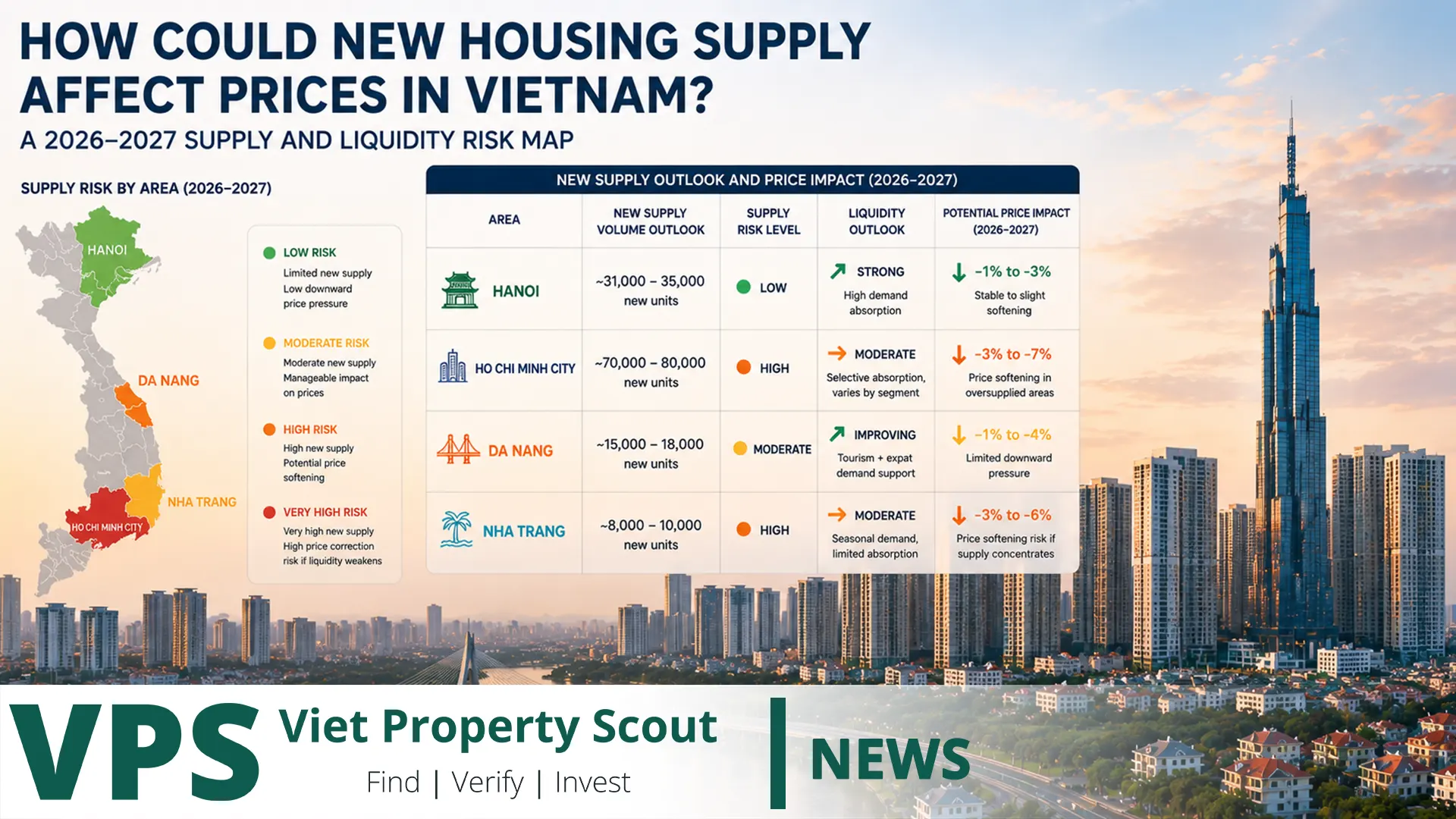
Vietnam's housing market is entering 2026–2027 with an important contradiction: new supply is improving rapidly while affordability and liquidity are becoming more fragile. In Q2 2026 alone, 113 new commercial housing projects containing 103,205 units received approvals, while 131 projects representing another 59,073 units became eligible to sell future housing. Yet successful real estate transactions fell to 100,005, only 71.5% of the Q1 level, while reported inventory increased slightly. More supply therefore does not automatically mean collapsing prices. It does mean that the market is becoming less capable of absorbing every product at every asking price.
The Real Question Is Not Whether Supply Is Rising, but Where and at What Price
Vietnam is not one residential market. Hanoi is experiencing a major apartment pipeline while prices remain extremely high. Core Ho Chi Minh City still has relatively restricted condominium launches, while low-rise and peripheral township supply is expanding. Da Nang has shifted rapidly from a low-supply market into a much more competitive apartment environment. In Nha Trang–Khánh Hòa, residential apartments must be separated from condotels and resort property. A national “supply is rising” statement is therefore not enough to predict prices.
What the National Q2 2026 Data Are Signalling
| Indicator | Q2 2026 Position | Market Signal |
|---|---|---|
| New commercial housing approvals | 113 projects / 103,205 units | Supply pipeline is accelerating materially |
| Projects eligible for future-home sales | 131 projects / 59,073 units | More inventory can reach buyers relatively soon |
| Successful transactions | 100,005 | Only 71.5% of Q1; liquidity weakened |
| Reported inventory | About 39,284 units/plots across 25 of 34 reporting localities | Unsold stock is beginning to build |
| Property lending rates | Typically 12–14%; some floating rates 15–16% | Financing is restricting purchasing power |
| Secondary prices | Generally modest corrections in several segments | Sellers have less unilateral pricing power |
Why More Supply Does Not Automatically Push Primary Prices Down
There are several reasons. Land, construction and financing costs remain high, which makes developers reluctant or unable to reduce headline prices aggressively. A large proportion of new commercial supply is still mid-high to premium rather than genuinely affordable. Developers can also preserve official pricing while offering longer payment schedules, interest subsidies, discounts, furnishing packages or other incentives.
A legally clean project in a genuinely supply-constrained micro-location can also maintain pricing while weaker projects nearby struggle. Most importantly, primary and secondary prices behave differently. In 2026–2027 it is entirely possible for developer list prices to appear stable while individual owners accept meaningful discounts in order to obtain liquidity.
Hanoi: The Highest Combined Supply, Price and Liquidity Sensitivity
Hanoi recorded nearly 36,000 condominium launches in 2025, and CBRE had forecast approximately another 33,000 units for 2026. At the same time, average primary pricing within Hanoi excluding Van Giang has remained above VND 100 million per square metre since Q3 2025.
More than 5,800 apartments were sold in Q2 2026, but this represented only around 68% of new supply launched during the quarter. During much of 2024–2025, absorption regularly exceeded 90%. More importantly, Q2 2026 brought the first downward secondary-price adjustment since late 2022.
This is not evidence of a Hanoi crash. It is evidence that high prices, higher financing costs and a strong new-supply pipeline are now interacting with one another.
VPS risk rating: relatively high supply risk and high liquidity sensitivity for expensive, finance-dependent projects; lower risk for completed communities supported by real end-user and rental demand.
Ho Chi Minh City: Affordability Risk Is Larger Than Core Apartment Oversupply Risk
The picture is different in HCMC. Only 850 new condominium units were launched in Q2 2026, 48% fewer than the previous quarter. The former central HCMC market therefore does not currently face a Hanoi-style wave of apartment supply. In contrast, low-rise launches rebounded to 1,934 units, while the merger with Bình Dương and Bà Rịa–Vũng Tàu has made the overall city market much larger and more diverse.
The principal risks are expensive acquisition prices, financing costs and the huge difference between markets such as Thu Thiem or Thảo Điền and lower-priced former Bình Dương locations. A single enlarged-HCMC average can conceal those differences.
VPS risk rating: low-to-medium apartment oversupply risk in the established core, but medium-to-high affordability and liquidity risk in premium projects. Peripheral townships must be assessed individually for delivery concentration and real end-user formation.
Da Nang: Moving from Scarcity into Competition
Before 2024, annual condominium launches in Da Nang were frequently below 1,000 units. More than 8,000 units were then launched during 2024–2025. By Q1 2026, cumulative apartment stock had reached approximately 16,000 units and the average primary price was around VND 83 million per square metre.
Cumulative absorption remained strong at around 89%, but Da Nang is a much smaller apartment market than Hanoi or HCMC. A handful of large projects can therefore alter local supply-demand conditions quickly. Investors need to monitor simultaneous delivery around the coast, Han River, Liên Chiểu and southern growth corridors.
VPS risk rating: medium-to-high for expensive new launches without proven end-user demand; lower for projects supported by established residential or rental markets.
Nha Trang–Khánh Hòa: Residential and Resort Supply Must Not Be Combined
Khánh Hòa's tourism growth is extremely strong, but tourism does not eliminate accommodation supply risk. A residential apartment in Nha Trang can draw demand from local residents, long-stay foreigners and tourism. A condotel in Bãi Dài is more dependent on operator performance, room occupancy, seasonality and the legal structure of the project.
If hotel rooms and tourism units expand faster than paid room nights, visitor numbers can continue rising while revenue per available unit weakens. This makes resort supply risk materially different from standard urban housing risk.
VPS risk rating: medium for good urban residential stock; high for operator-dependent tourism property relying on guaranteed-return narratives.
Industrial and Expansion Markets: Supply Can Work If Jobs Follow
In industrial and logistics markets such as Hải Phòng, Hưng Yên and former Bình Dương, significant housing supply can be absorbed when manufacturing jobs, internal migration and worker demand are growing in parallel. The number of homes alone is therefore not the correct measure of risk.
The problem begins when a large township is completed years before employment, schools, retail, healthcare and daily services. Such a market can become dominated by investors attempting to resell to other investors rather than by genuine occupiers.
2026–2027 Risk Map by Asset Class
| Asset Class | Supply Risk | Liquidity Risk | Primary Reason |
|---|---|---|---|
| High-priced primary condominiums | High in selected markets | High | Price + interest rates + competing launches |
| Completed apartments in functioning communities | Medium | Low to medium | Value can be tested through real rents and use |
| Land plots | Medium | High | Dependent on credit, speculation and the next buyer |
| Luxury villas / townhouses | Medium to high | High | Large ticket size and narrow buyer pool |
| Condotel / resort property | High in selected corridors | High | Seasonality, operator dependence and legal complexity |
| Social / affordable housing | Supply rising strongly | Strong end-user demand | Addresses a genuine affordability shortage |
Why Interest Rates Can Damage Liquidity More Than Supply Itself
When property lending costs reach 12–14% or more, a buyer qualifies for a smaller loan even if the developer keeps the same price. At the same time, investors whose principal-grace periods are ending may face sharply higher monthly payments and become motivated sellers. Liquidity pressure therefore often appears first in the secondary market.
A developer can maintain a headline price while an individual owner accepts a discount to free capital. For cash-rich investors this can create opportunities, but only where the underlying asset is strong. A cheap illiquid property remains illiquid.
Early-Warning Indicators Investors Should Track
- Sales-to-new-launch ratios decline for several consecutive quarters.
- Developers increase incentives without reducing official prices.
- Resale listings rise before project handover or loan grace-period expiry.
- The gap between primary and secondary pricing widens.
- Unsold stock increases at both project and district level.
- Large volumes of competing supply are scheduled within 24–36 months.
- Rental growth remains far below capital-price growth.
The Viet Property Scout Supply Test
| Test | Critical Question |
|---|---|
| Supply | How many competing units will complete in the next 24–36 months? |
| Demand | Who is the genuine end user? |
| Price | Am I paying more than a comparable completed asset? |
| Finance | What happens to the investment if rates remain high? |
| Rent | Does achieved net income justify the purchase price? |
| Exit | Who would buy this from me if I needed to sell within twelve months? |
Three Scenarios for 2027
Base case: Supply continues to improve while demand remains present but more selective. Primary prices move slowly, while secondary-market negotiations and project-specific discounts remain common.
Upside case: Financing conditions improve while employment and income growth remain strong. New supply is absorbed without a broad price correction, particularly in locations with infrastructure and genuine end-user depth.
Risk case: Financing remains expensive while large numbers of projects reach the market. Inventory rises and investors facing repayment pressure become motivated sellers, producing clearer corrections in weaker or overpriced projects.
Frequently Asked Questions
Will new supply cause a Vietnamese housing crash?
Current data do not support a simple nationwide crash thesis. A much more plausible outcome is divergence: strong assets remain resilient, developers offer incentives and weaker secondary markets correct.
Where is supply risk highest?
Where large pipelines combine with high purchase prices, finance-dependent buyers and weak genuine end-user demand.
Will falling secondary prices force developers to cut prices?
Not immediately. Developers can use incentives, payment schedules and interest support. However, a persistent large primary-secondary gap eventually increases repricing pressure.
Is 2027 a bad year to buy?
Not necessarily. More supply can improve buyer choice and negotiating power. The primary risk is not the calendar year; it is purchasing the wrong asset at the wrong price.
Conclusion: Liquidity Is the Real Risk, Not Supply Alone
Vietnam in 2026–2027 is not moving as one market. Hanoi faces the strongest test between large supply, expensive apartments and slowing absorption. HCMC is more exposed to affordability and market fragmentation than to an immediate core-apartment glut. Da Nang is moving from scarcity into competition. Nha Trang–Khánh Hòa requires a strict separation between residential and tourism assets.
For an investor, the most important question is therefore not “How much will this property appreciate?” but “Can I sell it when I need liquidity?” An asset supported by genuine occupiers, clean legal status, a defensible acquisition price, measurable rent and manageable competing supply has a much better chance of surviving the new supply cycle. That is how a national supply map becomes an investable liquidity-risk map.