
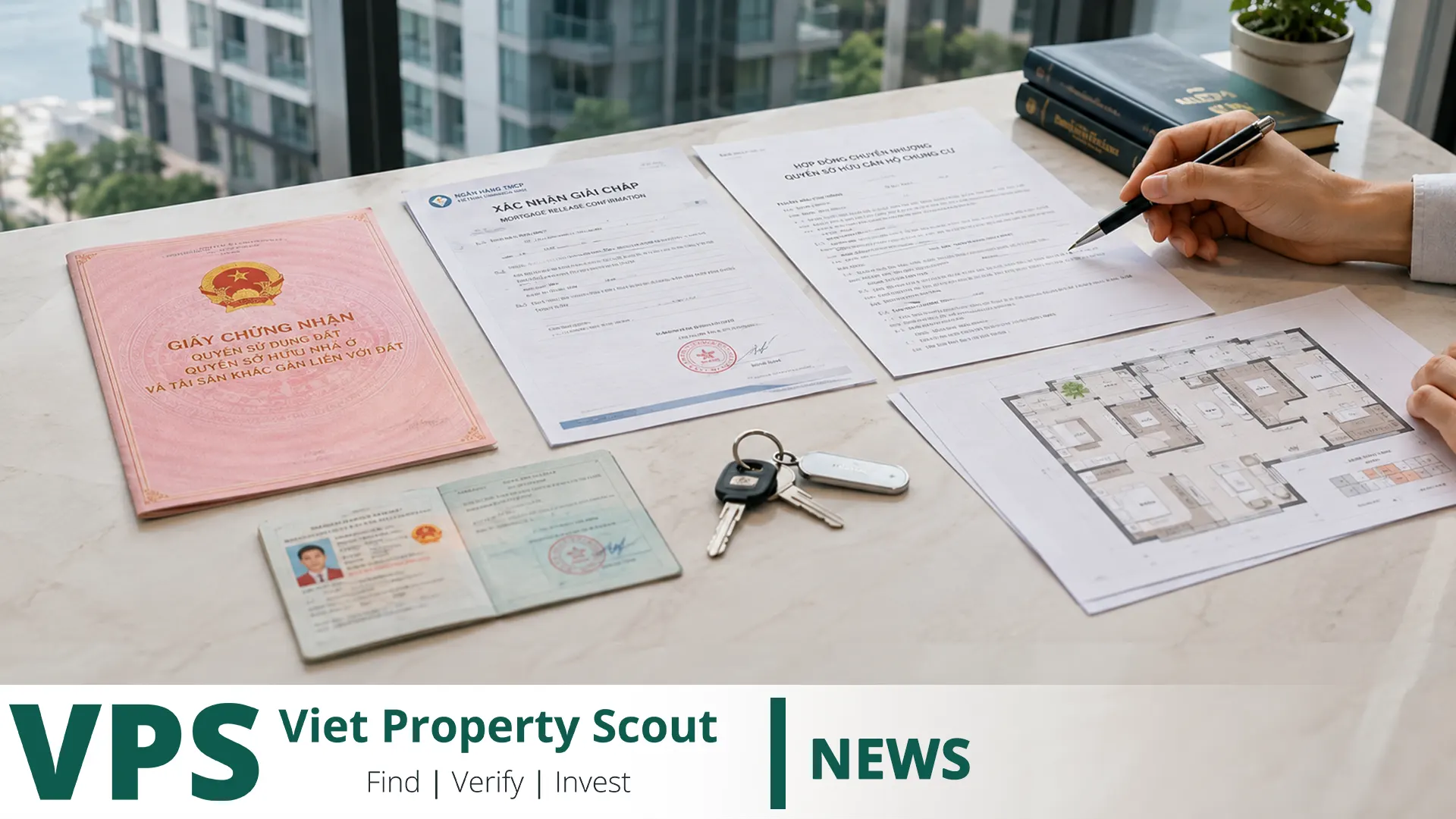
Buying a resale apartment in Vietnam requires a different due-diligence mindset from buying directly from a developer. In the secondary market, the critical issue is the ownership chain. The buyer must establish that the seller is genuinely entitled to sell, that the Certificate corresponds to the exact apartment, that the property is not affected by an ownership dispute, enforcement measure or other legal restriction, that any mortgage is released through a controlled process, and that the ownership change is formally registered after completion. A foreign buyer has an additional layer: eligibility to own, project eligibility, the foreign-ownership capacity of the building or block, and any ownership-period limitation.
First Check: Who Is the Seller?
The seller's legal identity should be matched against the owner named in the Certificate. Review the relevant identity card or passport and make sure the person signing is the person who has the disposal right. If someone else is signing, the power of attorney should be valid, appropriately scoped and suitable for the transaction.
If the property has multiple owners or another person has a legally relevant ownership interest, determine whose consent and signature are required. Where the seller is a legal entity, check the entity name and authority of the signatory. A broker's assurance that “this is definitely the owner” is not a substitute for documentary verification.
The Certificate Is the Core Resale Document
For an ordinary sale of a completed resale apartment, Vietnam's Housing Law generally requires the property to have a Certificate. A photograph sent through a messaging app should be treated only as preliminary evidence. The original or an appropriately verified document needs to be compared with the exact unit being acquired.
| Certificate Item | What to Match |
|---|---|
| Owner name | Seller identity and authority |
| Property address | Project, building, apartment and administrative address |
| Asset type/use | Residential apartment rather than a different-use product |
| Registered area | Contract, physical unit and represented sale area |
| Ownership period | Especially important where ownership is time-limited |
| Annotations/changes | Relevant registered changes or restrictions |
No Certificate? It May Not Be a Normal Resale Title Transfer
If a seller calls a unit “resale” but no Certificate has yet been issued, do not automatically treat the transaction as a conventional secondary-market ownership sale. The seller may still hold only the original developer purchase agreement or a transferred purchase agreement.
A future-house purchase contract may in certain circumstances be transferred before the Certificate application dossier has been submitted, subject to the Real Estate Business Law conditions. That is a contract-transfer transaction, not the same legal structure as acquiring a completed apartment already certified in the seller's name.
Check for Ownership Disputes, Complaints and Lawsuits
A home being sold must generally be free from disputes, complaints or lawsuits over ownership. This makes “Is there any problem with the apartment?” an insufficient due-diligence question.
Potential issues include inheritance disputes, disagreement between co-owners, challenges to earlier transfers or third-party ownership claims. If the seller needs a court or authority to resolve the title before registration can proceed, the apartment is not a clean conventional resale asset.
Check for Enforcement Measures and Recovery/Demolition Decisions
The apartment should not be distrained for enforcement of a legally effective judgment or administrative decision and should not be subject to relevant urgent or preventive measures imposed by a court or competent authority. It also should not be affected by an applicable land-recovery, clearance or demolition decision.
This distinction matters because the seller can possess a genuine Certificate while their right to dispose of the asset is currently restricted. Certificate authenticity and present transferability are separate questions.
Mortgage Due Diligence: Do Not Accept “I Will Repay the Bank After You Pay Me”
A resale apartment can be mortgaged to a bank or other permitted mortgagee. This does not necessarily make the sale impossible, but it changes the transaction sequence. The buyer needs to understand the outstanding debt, the mortgagee, the release requirements, where the original Certificate is held and how deregistration of the mortgage will be completed.
A weak structure requires the buyer to transfer a large sum to the seller and simply trust that the seller will repay the lender. A stronger structure coordinates the buyer, seller, mortgagee and transaction professionals so that money intended for debt release actually produces the release documents and permits the sale to proceed.
Mortgage Checklist
- Identity of the bank or mortgagee.
- Current settlement amount.
- Written information on the mortgage-release process.
- Location of the original Certificate.
- Procedure for deregistration of the security interest.
- Sequence of bank repayment, contract notarisation and purchase-price payment.
- Protection of buyer funds if they are used to discharge the seller's loan.
Check Building-Level Debts and Operational Obligations
Even when title is clean, the unit can carry unpaid management charges, parking charges, utility bills or practical obligations with the condominium management body. These are not necessarily equivalent to a registered mortgage, but they can create problems immediately after handover.
Where possible, obtain an appropriate statement or confirmation from building management. Check access cards, parking rights, management-account status and any recorded violation. If a tenant occupies the unit, review the lease because the buyer may need to deal with an existing occupancy relationship.
Match the Physical Apartment to the Registered Apartment
Owners may alter internal layouts after purchase. Compare the present layout, area, boundaries, doors, balcony and use with the Certificate and project documentation. A minor internal furniture change is very different from an alteration affecting structure, legal area or approved use.
Unexplained discrepancies often surface later when the new owner applies for finance or tries to resell. That makes them not just a technical issue but a liquidity issue.
The Sale Contract Must Be a Real Transfer Instrument
A housing sale contract should identify the parties, describe the apartment, state price and payment method, establish handover, rights and obligations, commitments, effective date and signatures. For a normal private-person house sale, the contract generally requires notarisation or certification, and its legal effectiveness generally begins at that point.
A preliminary deposit or reservation agreement should not merely say that the deposit is “non-refundable.” It should state what happens if title verification fails, an undisclosed mortgage appears, a required co-owner refuses to sign or the seller cannot legally transfer the apartment.
Link Payments to Legal Milestones
There is no single safe percentage that makes every resale transaction secure. The stronger principle is to tie payment to verifiable milestones.
| Milestone | Risk-Control Principle |
|---|---|
| Deposit/reservation | Limited amount with explicit due-diligence failure rules |
| Before formal contract | Seller, Certificate and mortgage position confirmed |
| Notarised/certified contract | Major payment follows controlled document flow |
| Registration/handover | Appropriate balance retained until agreed obligations are completed |
Notarisation Is Not the End of the Transfer
After the sale contract becomes effective, the ownership change must be registered. Land Law 2024 requires registration of changes when registered land-use rights and land-attached assets are transferred.
The buyer should retain evidence that the dossier has been submitted, track relevant financial obligations and then verify the updated or newly issued Certificate. “I have the keys and a signed contract” should not be treated as the final administrative state of ownership.
Foreign Buyer: Run an Additional Eligibility Check Before Paying a Deposit
A foreign individual should not assume that every resale apartment owned by a Vietnamese citizen is automatically available to a foreign purchaser. The apartment must be in a qualifying housing investment project, and the project must not be located in a prohibited national-defense or security area.
The foreign-ownership capacity of the relevant condominium or block must also be checked. Foreign organisations and individuals may generally own no more than 30% of the residential apartments in an eligible condominium building or qualifying block. The provincial housing authority's published information is therefore an important pre-contract check.
Can a Foreign Buyer Purchase a Resale Apartment From Another Foreigner?
Yes, the Housing Law permits eligible foreign organisations and individuals to acquire qualifying commercial housing from other foreign organisations or individuals that legally own such housing. However, the buyer still needs to verify their own eligibility, project eligibility, quota position and the ownership-period consequences of the transfer.
If the foreign seller's remaining ownership period is limited, do not assume without verification that a resale automatically gives the new foreign buyer a fresh, unrestricted period.
Buyer Document File
- Seller's ID/passport copy.
- Original Certificate for verification.
- Power of attorney or co-ownership documents where relevant.
- Mortgage balance and release documentation where applicable.
- Building management status where relevant.
- Notarised/certified sale contract.
- Evidence relating to agreed taxes and fees.
- Handover minutes, meters, keys and cards.
- Proof of submission for registration of changes.
- For a foreign buyer: buyer eligibility, project eligibility and foreign-quota verification.
Major Red Flags
- The seller refuses to produce the original Certificate.
- The seller's identity does not match title and no valid authority is shown.
- “The apartment has a mortgage but it is easy” with no bank documentation.
- A large payment is requested before mortgage and title checks are complete.
- Unit number, area or use differs materially from documents.
- An heir, spouse, co-owner or other relevant party disputes the sale.
- A broker guarantees foreign eligibility without checking project and quota status.
- The parties propose to finish at key handover without completing registration of changes.
The Viet Property Scout Method
- Find: Identify the real apartment, legal owner and ownership chain.
- Verify: Verify the Certificate, seller authority, disputes, enforcement status, mortgage, building obligations and foreign-ownership position.
- Invest: Release capital only when each payment milestone removes a specific legal or transfer risk.
Frequently Asked Questions
Is a photo of the Certificate enough?
It can support preliminary screening but should not be the basis for completion. The original status, seller identity and current encumbrance position need proper verification.
Can I buy an apartment that is currently mortgaged?
Potentially yes, if mortgage release and deregistration are properly structured. The critical issue is controlling the money and documents during that release.
Does notarising the sale contract mean the new Certificate is already in my name?
No. The effective sale contract is a major legal step, but registration of the ownership change must still be completed.
What if the seller has no Certificate yet?
The transaction may actually be a transfer of a developer purchase contract rather than a normal title resale. It should be analysed under the correct contract-transfer rules.
Can a foreigner buy any resale condo in Vietnam?
No. Buyer eligibility, project eligibility, national-defense/security restrictions, foreign quota and the seller/ownership structure all need to be checked.
Conclusion
The most serious risk in a resale apartment is not a scratched floor; it is a broken ownership chain. A discounted price cannot fix an unauthorised seller, mismatched Certificate, unresolved mortgage, title dispute or incomplete registration.
A robust transaction is one that can be explained document by document from beginning to end: who owns the apartment, why that person can sell it, whether the right is free to transfer, how a lender is removed if necessary, when the sale contract becomes effective and how the buyer becomes the registered owner. That documentary cleanliness protects today's capital and tomorrow's resale liquidity.