
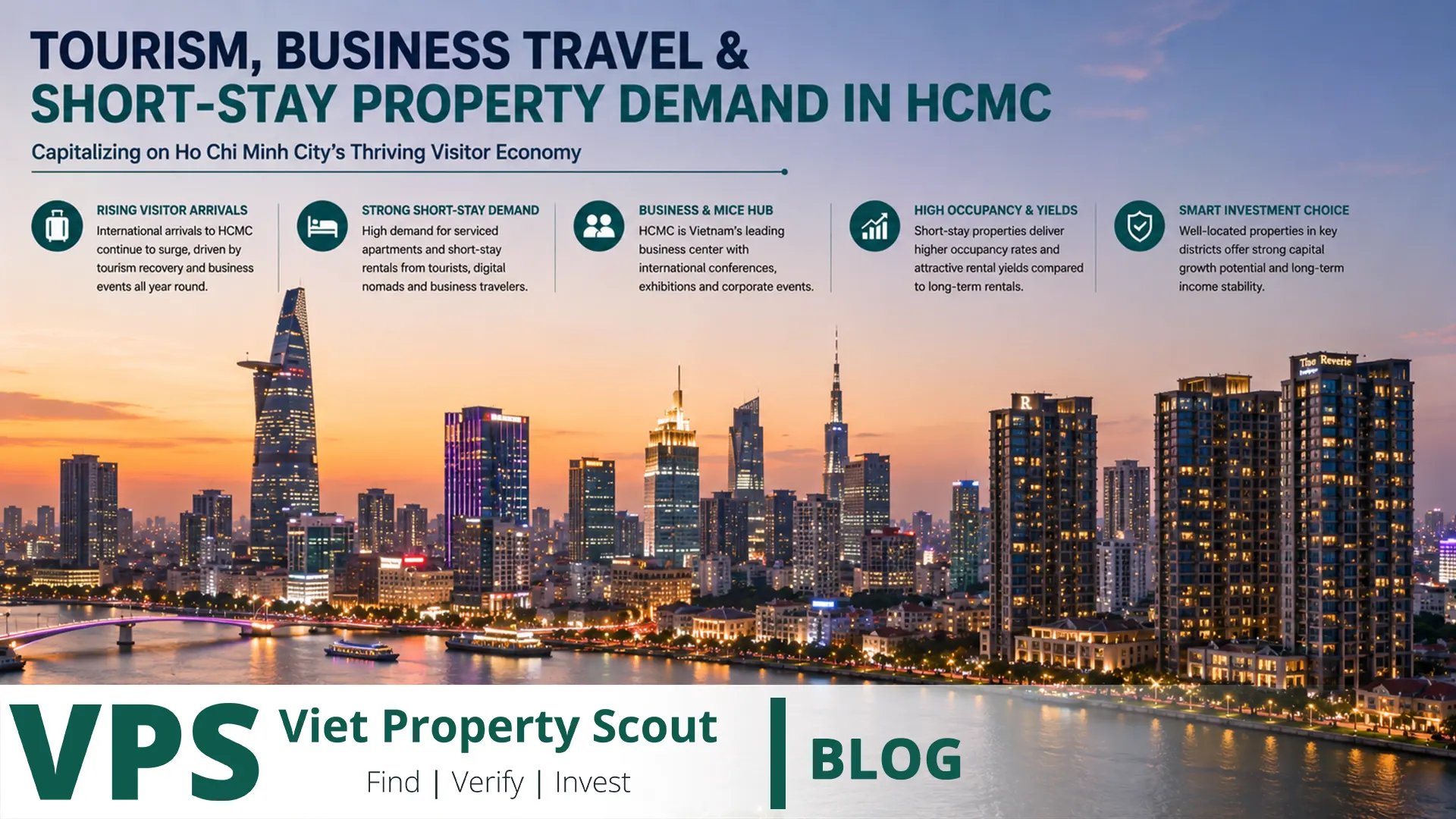
Investment takeaway: Short-term accommodation demand in Ho Chi Minh City is not driven by leisure tourism alone. International and domestic visitors, business travelers, MICE delegates, corporate transferees, entrepreneurs and professionals on temporary assignments create several overlapping demand pools. In 2025, HCMC recorded approximately 8.56 million international visitors, 45.6 million domestic visitors and tourism revenue of around VND279 trillion. Momentum remained strong in the first half of 2026, with international demand and accommodation-related spending continuing to expand. None of this means that any apartment can simply be converted into a profitable nightly rental. Since 25 April 2026, apartment use in HCMC has been governed by Decision 19/2026/QĐ-UBND, which replaced the previous 2025 rules and expressly addresses tourist-apartment leasing. The unit's approved function must be respected, tourist-accommodation activity must be registered where applicable, and tourism, tax, residence, security, e-commerce and fire-safety rules must be followed. The strongest investment therefore combines real demand, lawful operation, the right location, professional management and economics that remain attractive after all operating costs.
Why is HCMC different from a conventional leisure destination?
Ho Chi Minh City is not dependent on one beach season or a single visitor profile. People arrive for holidays, corporate meetings, exhibitions, conferences, factory visits, project assignments, medical services, shopping, family visits and regional business. That diversity creates both weekday and weekend accommodation demand.
The city's administrative expansion in 2025 also brought the former Bình Dương and Bà Rịa–Vũng Tàu areas into the expanded HCMC structure. Tourism geography now extends from the central business core to industrial areas, coastal leisure and resorts. Investors should not confuse these markets, however. A Monday-night corporate stay near the CBD is fundamentally different from a weekend seaside booking in Vũng Tàu even though both now sit within the larger city jurisdiction.
What do the latest tourism and hotel numbers show?
| Indicator | Latest reference | Investment meaning |
|---|---|---|
| International visitors in 2025 | Approximately 8.56 million | A substantial international guest base |
| Domestic visitors in 2025 | Approximately 45.6 million | Demand is not dependent solely on inbound tourism |
| Tourism revenue in 2025 | Approximately VND279 trillion | Visitor growth is translating into broad travel spending |
| Accommodation and food-service revenue, H1 2026 | Approximately VND119.3 trillion, up 14.3% y-o-y | Hospitality-related spending remained on a growth path |
| Hotel market, Q2 2026 | Occupancy above 70%; average room rate around VND2.4 million per night | International, business and MICE demand supported both occupancy and pricing |
Year-on-year tourism comparisons require some caution because HCMC's administrative geography changed after the 2025 merger. Hotel research providers also use different definitions of tracked supply. City-wide figures are therefore market context, not a substitute for property-level underwriting.
Who actually creates accommodation demand?
1. International leisure travelers
Short-stay international guests typically prioritize centrality, cleanliness, safety, reviews, easy check-in, service quality and access to restaurants and attractions. A compact unit with excellent access to Nguyễn Huệ, Bến Thành and the central riverfront may outperform a much larger apartment that requires long daily journeys.
2. Domestic travelers
Vietnam's large domestic tourism base creates another demand layer. Families and groups may be more price-sensitive and can value extra bedrooms, kitchens, washing machines, parking and convenient ride-hailing access. The best layout for this segment may therefore differ from the ideal international solo-traveler unit.
3. Business travelers
A business traveler is purchasing time and reliability as much as accommodation. Proximity to offices and meeting venues, dependable internet, a usable desk, easy check-in, invoices, quiet rooms and cleaning service can matter more than a resort-style swimming pool.
4. MICE demand
Meetings, Incentives, Conferences and Exhibitions create concentrated demand around specific dates. Group bookings, company travel policies and invoicing requirements often favor professionally managed hotels and serviced apartments over informally operated individual units.
5. Medium-stay professionals and executives
A guest staying two weeks, one month or three months has different needs from someone staying two nights. Kitchens, laundry facilities, workspaces, periodic housekeeping and clear residence-registration procedures become more valuable. Serviced apartments compete particularly well in this middle ground between hotels and conventional long-term rentals.
2026 hotel performance confirms genuine business demand
Published market data for Q2 2026 put average HCMC hotel occupancy above 70%, with average room rates increasing roughly 20% year on year to around VND2.4 million per night. International visitors, corporate demand and MICE were cited as major drivers even though flight volumes declined year on year.
For a real estate investor, this matters because it demonstrates that the market is not simply composed of tourists searching for the cheapest Airbnb. A meaningful segment is willing to pay for reliability, service, location and corporate-booking compatibility.
What is the legal position for short-term apartment rentals in 2026?
The 2025 HCMC apartment rules were widely interpreted as a blanket ban on Airbnb-style short stays in residential apartments. That is no longer an accurate description of the current position. Decision 26/2025/QĐ-UBND ceased to apply and was replaced from 25 April 2026 by Decision 19/2026/QĐ-UBND.
The current rules state that an apartment must be exploited in accordance with its apartment type, approved function and project design. Where a tourist apartment is leased within an apartment building, the tourism-accommodation activity must be registered and relevant tourism law must be followed. Operators must also comply with housing, tax, residence, security, e-commerce, environmental and fire-safety obligations, including temporary-residence or guest-stay reporting.
This is not a universal green light for every condominium unit to operate as Airbnb. The particular project's approved use, the specific unit, building-management framework, registration eligibility and local implementation requirements must be verified before any investment case relies on nightly rental revenue.
What do short-term rental platform data suggest?
As a third-party market indicator rather than an official registry, AirDNA tracked approximately 15,352 active short-term rental listings in its HCMC market in July 2026. It reported average occupancy of about 57%, an average daily rate near US$49 and RevPAR of roughly US$28. Active listing count was materially lower year on year while occupancy had improved.
These figures can help identify trends, but they are not evidence of what a particular apartment will earn. City averages combine different locations, unit sizes, building standards, operators and legal situations. Underwriting should use a narrow comparable set of legally operable properties in the same micro-market.
Which locations serve which demand?
| Submarket | Typical demand | Usually stronger product |
|---|---|---|
| Traditional central core associated with former District 1 | International leisure, business, city breaks, events | Hotels, serviced apartments, legally suitable tourist apartments |
| Ba Son–Ton Duc Thang riverfront | Premium international and corporate demand | High-quality professionally managed accommodation |
| Tân Sơn Nhất airport area | Transit, crews, early flights, business visits | Practical accommodation with easy 24-hour access |
| Thảo Điền–An Phú | Medium-stay expatriates, families and professionals | Larger furnished and serviced apartments |
| Thủ Thiêm | Growing business, premium and longer-stay demand | Modern professionally managed residential product |
| Vũng Tàu within expanded HCMC | Coastal leisure and weekend demand | Dedicated leisure accommodation rather than CBD-style product |
Hotel, serviced apartment or tourist apartment?
| Model | Strength | Weakness |
|---|---|---|
| Hotel | Professional operation, corporate sales and full services | High operating and capital intensity |
| Serviced apartment | Strong fit for business and medium-to-long stays | Requires specialized management and the right location |
| Registered tourist apartment | Flexible, home-like and potentially price competitive | Regulation, building rules and platform dependence matter greatly |
| Furnished monthly or long-term rental | Simpler operation and lower guest turnover | Potentially lower gross revenue per available day |
What really determines short-stay performance?
- Lawful operation: demand projections are irrelevant if the exact unit cannot be legally operated under the intended model.
- Location measured in minutes: actual travel time to the CBD, airport, office or attraction matters more than straight-line distance.
- Operator quality: dynamic pricing, response time, cleaning and review management directly affect revenue.
- Unit-market fit: studios, two-bedroom apartments and family units address different guest pools.
- Digital reputation: ratings can materially influence conversion and achievable ADR.
- Distribution: dependence on a single platform creates concentration risk.
- Noise, security and check-in: operational basics often determine guest satisfaction more than luxury finishes.
- Length-of-stay flexibility: the ability to serve weekly or monthly guests can help smooth seasonality when legally and operationally possible.
Gross booking revenue is not investment yield
An apartment should never be purchased simply because someone says it can rent for US$100 per night. The correct starting point is achieved ADR × occupied nights. Platform commissions, property management, cleaning, laundry, electricity, water, internet, building charges, repairs, furniture replacement, taxes, blocked nights and vacancy must then be deducted.
Net operating income must finally be compared with the full acquisition cost. A property can produce impressive monthly revenue and still deliver a weak return if the purchase price is excessive.
Eight major risks
- Regulatory risk: HCMC's apartment rules already changed materially between 2025 and 2026.
- Building-level risk: project function and management rules may restrict operation.
- Platform dependence: algorithm and fee changes can affect bookings.
- Competition: large volumes of similar listings put pressure on ADR.
- Operating costs: nightly rental is a hospitality business, not passive rent collection.
- Aviation risk: flight capacity and ticket prices influence inbound demand.
- Seasonality and events: annual averages can conceal weak months.
- Product mismatch: an excellent long-term apartment may be a poor short-stay product and vice versa.
Viet Property Scout short-stay investment framework
| Check | Question |
|---|---|
| Legal position | Can this exact unit legally operate under the intended accommodation model? |
| Building | Do approved function, design and management framework support that use? |
| Demand | Is the micro-market driven by leisure, business, MICE or medium stays? |
| Competition | How many genuinely comparable units compete for the same guest? |
| ADR | What rate is actually achieved rather than merely advertised? |
| Occupancy | What is realistic after accounting for seasonality? |
| Costs | What remains after full operating expenses and taxes? |
| Fallback | Can the apartment move profitably to monthly or long-term rental if conditions change? |
Frequently asked questions
Is tourism demand in HCMC strong in 2026?
Yes. Visitor and spending data continued to show strong momentum, while published Q2 hotel data showed average occupancy above 70%.
Does business travel materially affect accommodation demand?
Yes. Corporate travel and MICE are meaningful drivers, particularly for central hotels, premium accommodation and serviced apartments.
Is Airbnb banned in Ho Chi Minh City?
That blanket statement is not accurate as of August 2026. The 2025 decision was replaced. Decision 19/2026 expressly regulates tourist-apartment leasing and requires registration and legal compliance. That does not mean every apartment is automatically eligible.
Is nightly rental always better than monthly rental?
No. Nightly rental can generate higher gross revenue but usually involves higher operating costs, greater management intensity and more regulatory exposure. Both scenarios should be underwritten.
What is the best area?
There is no single answer. The central core is strongest for short leisure and business stays, Thảo Điền and An Phú for longer expatriate stays, the airport area for transit demand and Vũng Tàu for a separate coastal-leisure market.
What metric matters most?
Occupancy or ADR alone is insufficient. RevPAR, net operating income and return on total invested capital should be evaluated together.
Conclusion
Ho Chi Minh City should be understood first as a diversified hospitality market and only second as a short-term-rental market. Leisure tourism overlaps with corporate travel, MICE, temporary professional assignments and medium-length stays. That diversified demand base is attractive, but it does not excuse weak due diligence. The property must be legally operable, fit the target guest, be professionally managed and still produce a rational return after all costs. The strongest short-stay investment is often one that works under today's legal hospitality model while retaining a viable monthly or long-term rental fallback if regulation, aviation or traveler behavior changes.