
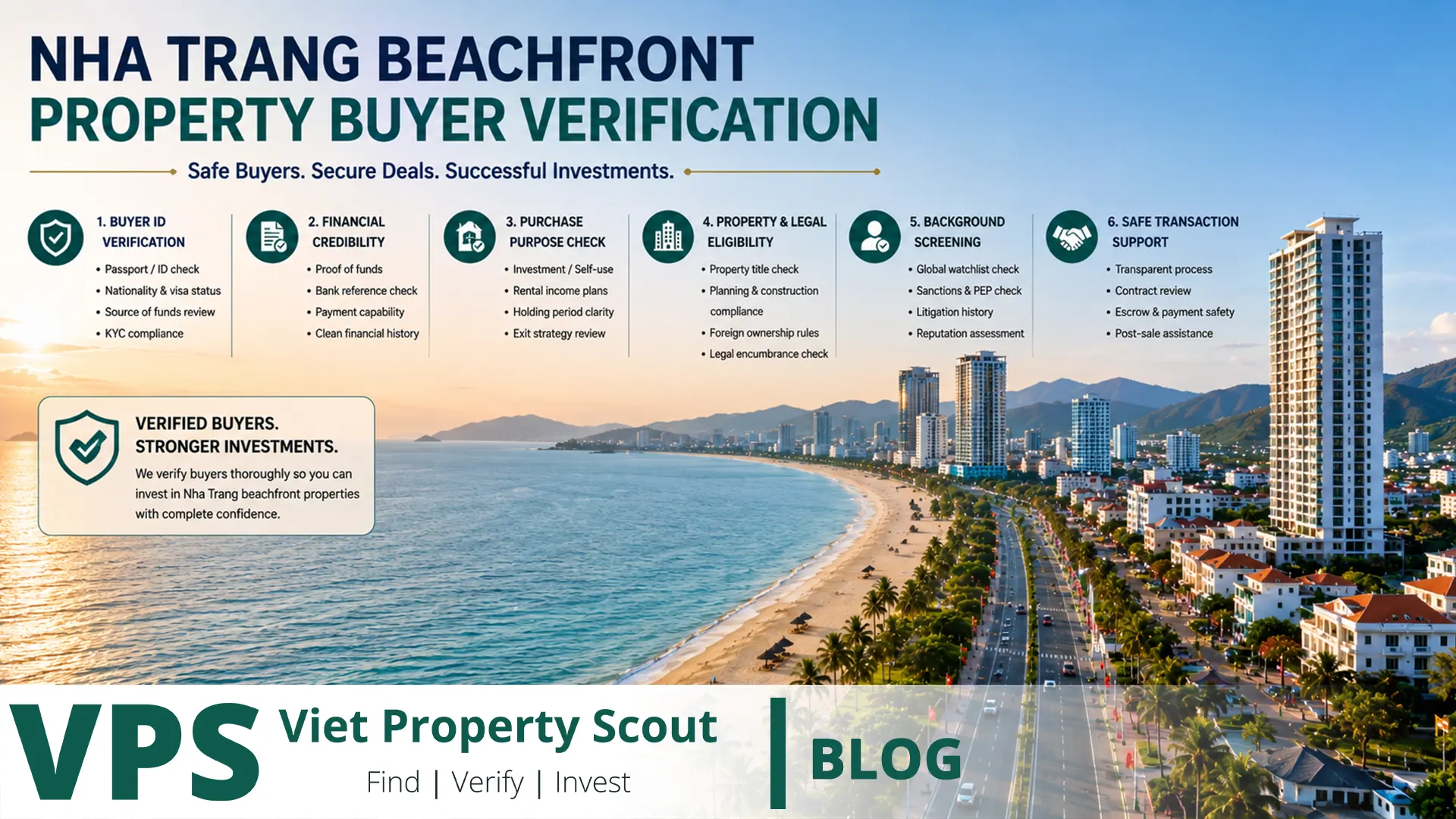
Investment takeaway: “Beachfront” is not a sufficient due-diligence category in Nha Trang. Before paying a reservation or deposit, a buyer should independently establish at least five things: the legal function of the unit and land, the exact rights being acquired, what may change or be built in front of the property, the technical risks created by the marine environment, and whether the rental and resale economics still work after all costs. A spectacular first-line unit can be a weaker investment than a second-line apartment if the acquisition premium is excessive, the project sits on time-limited commercial/service land, maintenance is poor, the view is not protected by planning or the rental model assumes a use the unit is not legally designed to perform. Nha Trang's waterfront itself is also changing. In 2026 a detailed 1/500 plan covering more than 80.6 hectares east of Trần Phú Street, from Trần Phú Bridge to the Nha Trang Port area, was approved with a stronger emphasis on parks, squares, public open space, tourism services and public access to the sea. Buyers should therefore purchase verified rights and economics, not the word “beachfront” in a brochure.
1. First define what “beachfront” actually means
The term can describe very different assets: a first-line building with no private building immediately in front, a tower that faces the sea across a public road and park, a project with organised beach access, or a development marketed as coastal even though other land or buildings sit between the property and the water.
| Marketing description | What to verify |
|---|---|
| Direct beachfront | The true project boundary and any public road, park or land between the building and the sea |
| Ocean view | Unit orientation, floor, height and development rights on parcels in front |
| Private beach | Whether this means a service, controlled access or a documented legal right; never infer beach ownership from wording alone |
| Walk to beach | The actual pedestrian route, road crossings, traffic and real walking time |
2. Identify the asset: residential condominium, tourist apartment or condotel
This is one of the most important legal distinctions in Nha Trang. Two units can look almost identical inside while having completely different land and project functions. A conventional residential apartment on residential land should not be analysed like a tourist apartment or condotel situated within a commercial-service project.
Vietnam's current Housing Law prohibits the use of a condominium apartment for a non-residential purpose. A buyer should therefore never construct a short-stay income model before confirming the approved project function, the function of the specific unit, the building rules and any applicable tourism-accommodation requirements.
3. Verify the land, project and certificate separately
Request documents showing the land-use purpose, investment/project approval, detailed planning, construction status, project term where relevant and the legal basis for issuing ownership certificates. For a completed resale unit, review the actual certificate if one has been issued. For future property, verify whether the relevant provincial authority has published that the units are eligible for sale or lease-purchase before committing significant funds.
Nha Trang has real historical examples of condotel owners facing long-running issues involving land-purpose adjustment and certificates. That does not make every condotel defective; it proves that developer reputation and project branding do not replace document-level verification.
4. Check remaining legal term, not only price per square metre
Where an asset sits on commercial/service land with a defined term, the important question is not simply the original project duration. The buyer needs to know how many years remain on the relevant right today.
A unit acquired after a meaningful portion of the term has elapsed should not automatically be valued against a conventional residential unit as though the rights were identical. Any assumption that the term will later be extended should be supported by the applicable law and procedure rather than salesperson reassurance.
5. Foreign buyers must verify the project and available quota before reservation
Under the current framework, qualifying foreigners may generally own up to 30% of the residential apartments in an eligible apartment building, subject to defence and security restrictions. This is not blanket permission to purchase every beachfront unit.
Before reservation, a foreign buyer should confirm that the development is eligible, the specific unit is residential and foreign ownership capacity remains available. For an eligible foreign individual, the initial ownership period recorded on the certificate can be up to 50 years; current implementing rules allow an application for one extension of up to another 50 years if the statutory conditions continue to be met.
6. Do not pay for a “protected ocean view” before checking planning
A sea view today is not automatically a permanent property right. Review every parcel between the building and coastline, permitted heights, approved developments, public facilities, parking structures and service buildings that may change the view.
The 2026 detailed plan for the area east of Trần Phú demonstrates why this matters. The coastline is being reorganised around public parks, squares, open spaces, tourism facilities and improved access. That may significantly improve the waterfront, but it also means an investor should examine the adopted planning rather than price the current photograph as permanent.
7. Separate private project rights from public coastal access
A building facing the sea does not mean the beach or land between the building and water belongs to apartment owners. Along Trần Phú, current planning strongly emphasises public open space, greenery, squares and access to the sea.
If sales material says “private beach,” ask for the exact legal explanation in writing: who owns or controls the land, who manages access, whether the arrangement is permanent or an operating service, and what rights remain public. Do not capitalise a hospitality phrase into the purchase price without documentation.
8. The marine environment creates real capital expenditure
Salt, humidity, wind and intense weather exposure are not cosmetic concerns. They can accelerate deterioration of balcony rails, metalwork, air-conditioning condensers, façade systems, window hardware, lift components and exposed electrical equipment.
- Inspect corrosion around balconies, windows and air-conditioning equipment.
- Ask how often the façade is coated, repaired and waterproofed.
- Review the building's history of leaks after heavy rain.
- Inspect window seals and high-floor glazing.
- Understand lift and mechanical maintenance expenditure.
- Review the maintenance fund and major works planned for the next several years.
9. Verify rainfall, flooding and drainage rather than focusing only on waves
Coastal risk is not limited to seawater reaching a building. Intense rainfall, road drainage, rivers, channels, basement ramps and access roads can affect both daily use and asset value.
Historic rainfall and flooding in November 2025 damaged infrastructure around Trần Phú Bridge, including erosion and deterioration near bridge and protective structures. Heavy local rainfall in May 2026 also flooded selected roads in the Nha Trang area. These events do not prove that every beachfront building is unsafe. They demonstrate why project-specific flood history and drainage capacity should be investigated.
10. On the Phạm Văn Đồng corridor, environmental drainage deserves special attention
Local authorities reported in 2026 that parts of Nha Trang's wastewater and stormwater collection system became overloaded during heavy rainfall, with discharges reaching the sea; several problematic outlets were identified along portions of Phạm Văn Đồng. For a coastal owner, environmental infrastructure affects more than appearance. Water quality, odour and beach usability can affect rental demand and quality of life.
11. Analyse the building as an operating system
A seafront building needs stronger-than-average management. Ask for the operating budget, management fee, maintenance fund, planned major repairs, building insurance, generators, pumps, fire-safety systems, lift-maintenance records and security procedures. Where legally relevant, understand how many units are being operated as tourism accommodation and how that affects resident experience.
A great view cannot compensate for failing building management.
12. Test access and noise at different times of day
Trần Phú is an intensely active tourism frontage. Pedestrian flows, coaches, events, nightlife and traffic can be positive for tourism-oriented rental but negative for a twelve-month resident. In 2026 authorities were examining additional pedestrian-crossing solutions because pressure on the road and beach interface had increased.
Visit on a weekday morning, evening rush hour, around sunset, on a weekend and after 22:00. Open the windows and measure the practical difference between marketing language and daily life.
13. Do not use Khánh Hòa tourism growth alone to justify any price
Strong regional tourism is supportive, but the beachfront premium should ultimately be justified by usable lifestyle value, sustainable rent or resale liquidity. If a first-line unit costs dramatically more than a comparable apartment several streets behind the coast while achieved rent is only moderately higher, the difference should be recognised as lifestyle consumption or a future-growth assumption rather than current income return.
14. Underwrite short stay and long stay separately
| Factor | Short stay | 6–12-month residential |
|---|---|---|
| Headline revenue | Potentially higher | More stable |
| Vacancy | Seasonally volatile | Lower with a good tenant |
| Cleaning | Frequent | Limited |
| Platform/operator cost | Material | Much lower |
| Utilities | Often owner-paid | Can be tenant-paid under the contract |
| Wear and tear | Higher | Usually lower |
| Legal-use diligence | Specially important | Clearer in genuine residential use |
One-, three-, six- and twelve-month contracts should also have separate monthly pricing. A single flat monthly rate does not reflect the economics of contract duration.
15. Stress-test the beachfront premium at resale
Ask who the natural buyer will be in five or ten years: a Vietnamese end user, foreign buyer, tourism investor or second-home purchaser. The narrower the future buyer pool, the greater the exit risk.
A legally clear residential unit with a practical layout and strong building management can have a deeper resale market than a highly specialised tourism unit even when the latter is physically closer to the water.
20-point buyer verification checklist
- Current legal address and ward.
- Exact legal project name.
- Land-use purpose.
- Residential versus tourist/condotel function.
- Remaining project or land term where relevant.
- Existing certificate or documented certificate pathway.
- Project 1/500 detailed planning.
- Developable parcels in front of the unit.
- Actual project boundary and beach-access arrangement.
- Foreign eligibility and available quota where applicable.
- Building-management rules.
- Management fee and maintenance fund.
- Corrosion and moisture inspection.
- Flood and drainage history.
- Basement access, pumps and generators.
- Building and unit insurance.
- Evidence of achieved rents rather than asking rents only.
- Full annual operating costs.
- Competing future supply.
- Natural resale buyer.
Red flags
- “It is beachfront, so the land must be residential.”
- “Every apartment here can operate on Airbnb.”
- “The ocean view is guaranteed forever.”
- “The private beach belongs to owners” without legal documentation.
- “The certificate will come later; there is no need to verify it now.”
- “We will solve the foreign quota after your reservation.”
- “The building is new, so salt exposure does not matter.”
- “Tourism is rising, therefore the property price is guaranteed to rise.”
Frequently asked questions
Is a first-line property always better than second line?
No. It can be superior for lifestyle and view, but a much larger purchase and maintenance premium may reduce investment yield.
Does being opposite Trần Phú beach mean the beach belongs to the project?
No assumption should be made. Project boundaries, public-space planning and documented access rights need to be verified separately.
Is every condotel a bad investment?
No. It is simply a different asset from a residential condominium and must be valued using the correct legal term, operating rights and buyer pool.
What are the most important technical checks?
Corrosion, waterproofing, leak history, façade, windows, air-conditioning, lifts, drainage and the maintenance reserve.
What is the strongest buyer-protection rule?
Do not make a material payment until major marketing claims have been matched to a legal document, adopted plan or independent technical evidence.
Conclusion
Beachfront property in Nha Trang can be an excellent asset, but it deserves more due diligence rather than less. Do not pay the coastal premium for a photograph alone. Verify the land and unit function, remaining legal term, certificate, foreign quota where applicable, adopted planning in front of the building, nature of beach access, corrosion and drainage exposure, building management, legally supportable rental model and net income. If the investment still works after removing assumptions of a permanently unobstructed view, perfect occupancy and continuous appreciation, the coastline is a genuine asset advantage rather than simply the most expensive word in the sales brochure.