
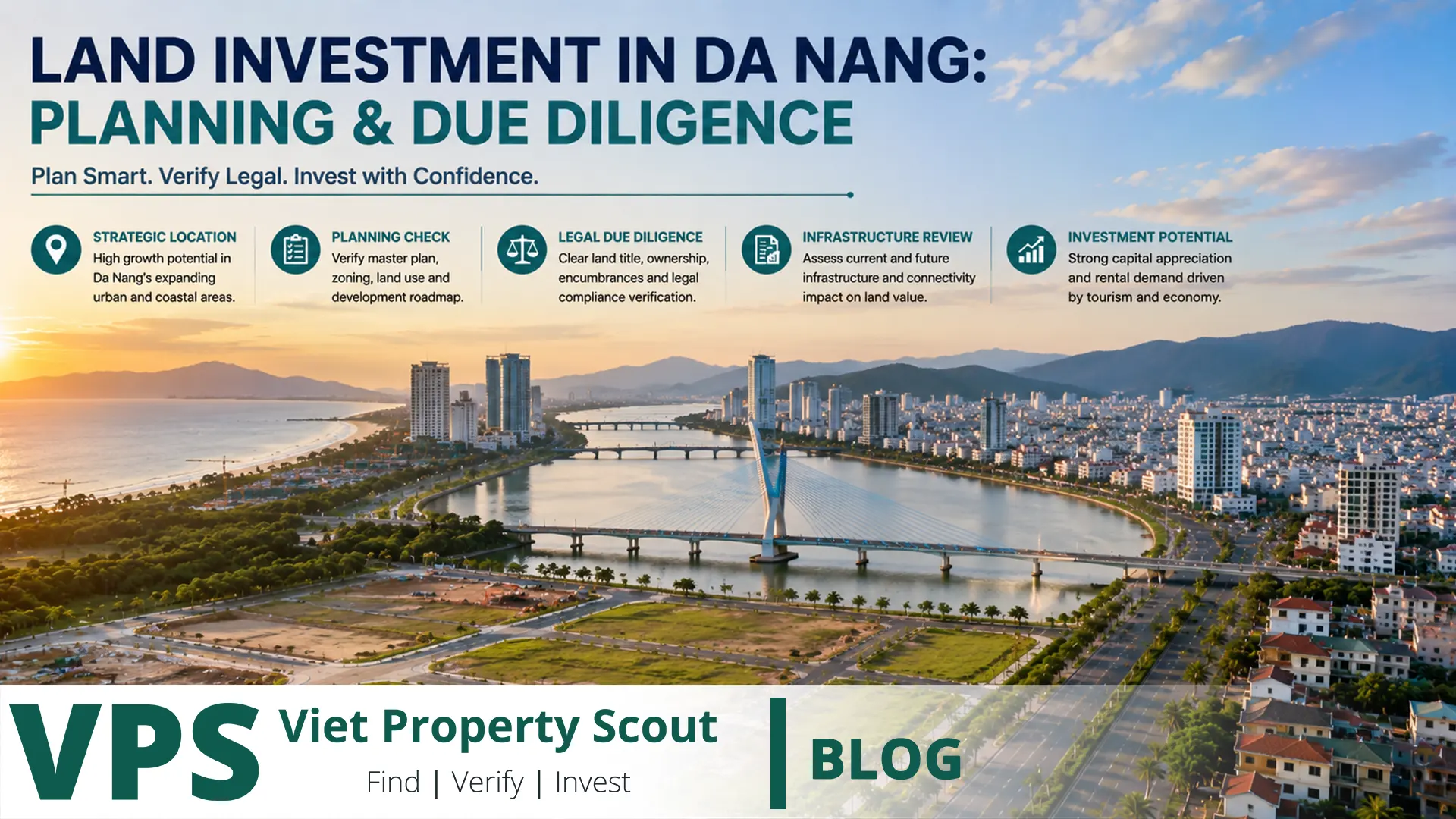
Investment takeaway: Land can generate substantial upside in Da Nang, but it is also one of the city's most planning-sensitive and legally demanding forms of property investment. In 2026, investors should not buy a parcel merely because it is described as “west of the city,” “near Liên Chiểu Port,” “near the Free Trade Zone” or “inside the future urban expansion area.” Following the 2025 merger of the former Da Nang and Quảng Nam, the enlarged city entered a major spatial-planning transition. In February 2026 the city council approved an adjustment to Da Nang's 2021–2030 planning framework with a vision to 2050, while further general and subdivision planning work and public consultation continued during 2026. The growth story is real, but a strategic development direction is not a building permit for every parcel inside it. A strong land investment starts with verifiable land-use rights, current legal land purpose, parcel boundaries, lawful road access, planning status, financial obligations and realistic development capacity before money is paid.
Why is Da Nang land attracting investors?
The post-merger Da Nang is far larger and more economically diverse than the coastal city investors knew before 2025. The enlarged city now combines the established urban core, tourism coast, Hội An, port and logistics corridors, industrial areas, high-tech development, rural communities, mountainous zones and new urban-expansion areas.
That creates more possible investment corridors, but it also means that “land in Da Nang” is not a useful asset category by itself. Two parcels within the same city may have entirely different legal functions and future value. One may be residential land suitable for a house, another agricultural land, another commercial-service land, another industrial land, and another may sit inside a future road or public-project boundary.
The major urban-expansion drivers in 2026
| Driver | Current status | Land-investment implication |
|---|---|---|
| Post-merger city planning | Adjustment to the 2021–2030 plan and 2050 vision approved locally in February 2026; additional planning work continues | Use the latest official parcel-level evidence rather than legacy maps |
| Liên Chiểu Port | Common infrastructure completed in March 2026 and major container-terminal investment launched | Potential catalyst for logistics, industry, services and employee housing in the northwest |
| Da Nang Free Trade Zone | Approximately 1,881 hectares across seven non-contiguous locations | Can create employment and logistics demand, but proximity does not automatically create residential development rights |
| Western and southwestern expansion | Urban, ecological and infrastructure plans under development | Long-duration opportunity with higher timing and conversion risk |
| Technology and industrial growth | High-tech, digital and industrial sectors remain strategic priorities | Can support land where employment connectivity and permitted use align |
Liên Chiểu: a genuine catalyst, but not a reason to buy any northwest parcel
Da Nang completed the common infrastructure component of Liên Chiểu Port in March 2026 and moved into the next stage of the large container-terminal project. The comprehensive terminal project has investment of more than VND45 trillion, covers approximately 172.6 hectares and is planned with eight container berths and significant future throughput capacity. The area also interacts with the city's Free Trade Zone and logistics strategy.
Those are real infrastructure commitments rather than purely promotional concepts. However, the investment question is parcel specific. Is the land within a residential or service corridor that can benefit from workers and businesses? Is it instead inside industrial zoning, port-related infrastructure, a future road, buffer zone or public project? “Three kilometres from the port” is not sufficient due diligence.
Western Da Nang and the former Hòa Vang area: a long-duration urbanisation story
Even before the administrative merger, former Hòa Vang was central to Da Nang's westward urban-development strategy. The 1/2000 Sườn Đồi ecological urban subdivision plan, for example, covers more than 2,832 hectares and was designed around tourism, commerce, services and residential development integrated with the natural landscape.
The direction is important: Da Nang's growth is not intended to remain confined to the old centre and beach corridor. But western land is much more sensitive than an established urban apartment to infrastructure timing, utility provision and the emergence of actual resident demand. A planning direction can be correct while the investment timing is wrong by five or ten years.
A general plan is not a building permit for your parcel
One of the most expensive mistakes in land speculation is seeing an area shown as a future urban-development zone and assuming every parcel inside it will become residential. Vietnam's planning system operates through different layers, including city and regional planning, general plans, subdivision plans, detailed plans, land-use planning and specific project decisions.
A broad growth corridor can contain future roads, schools, drainage infrastructure, parks, public works and non-residential land. Due diligence therefore needs the actual parcel number, map sheet, coordinates and current planning record rather than a coloured circle on a broker's presentation.
2026 is an unusually transitional planning year
The enlarged Da Nang must harmonise planning inherited from two former administrative territories. In June 2026, authorities were taking public comments on planning documents including a new general-plan direction toward 2050 with a vision to 2075 and adjustments to the 1/2000 Hàn River and East Bank subdivision planning. The city has also published a broader programme for preparing urban and rural planning over the coming years.
Investors should therefore identify the status of every claimed plan precisely: approved, under adjustment, under consultation or merely proposed. Those categories carry very different risk.
The most important document: the land-use rights certificate
Vietnam's land system is based on land-use rights rather than conventional freehold ownership of the underlying land. Under the Land Law 2024, exercising rights such as transfer, lease, mortgage or contribution of land-use rights generally requires the relevant legal conditions to be satisfied and, subject to statutory exceptions, a valid certificate.
The right holder's name, parcel number, map sheet, area, land-use purpose, use term and address should all be checked against the physical parcel and official records. A mismatch is a reason to stop and investigate, not to accept an explanation from the seller.
Land-use type matters more than price per square metre
| Land category | Typical investment logic | Main risk |
|---|---|---|
| Residential land | Generally the clearest category for lawful housing subject to planning and construction rules | Road setbacks, height rules, public projects or other planning constraints |
| Agricultural land | Often significantly cheaper | No automatic right to convert to residential land |
| Commercial/service land | May suit business or hospitality use | Use term and obligations may differ materially from residential land |
| Industrial land | Can benefit from manufacturing and logistics growth | Not a substitute for residential land |
| Land inside future infrastructure/project planning | May appear cheap or speculative | Acquisition, restriction or development uncertainty |
Do not buy agricultural land on a promise of future conversion
A common speculative pitch is that agricultural land is inexpensive today but will “become residential” once urbanisation reaches the area. Urban expansion does not automatically convert every private parcel. A change of land-use purpose requires a legal basis, procedures, approval where required and potentially material financial obligations.
An investor should first value agricultural land as agricultural land. Future conversion should be treated as an upside scenario only after the feasibility and likely financial burden have been verified.
Lawful road access can determine the value
A visually attractive parcel can be a poor investment if its only access is an informal path over another person's land. Investors should confirm whether the access road is legally recognised, its existing width, planned road boundary and whether the parcel has sufficient frontage for intended development.
Road access affects construction feasibility, emergency access, utilities, financing, resale liquidity and commercial usefulness.
Land acquisition for public infrastructure is not a guaranteed profit strategy
Land inside future roads or infrastructure corridors may eventually be recovered for public projects and compensation may apply under the relevant legal framework. That does not make “buy it because the government will acquire it later” a reliable investment strategy.
Compensation depends on land category, legal origin, documentation, project timing and other circumstances. A sound land investment should make sense without needing state acquisition to create the return.
The official land-price table is not the same as market value
Da Nang developed a new land-price framework after the merger, and in May 2026 the city adopted rules and land-price schedules for different categories. These values can be highly important for state administration, taxes, fees and specified legal calculations.
They should not be confused with guaranteed commercial selling prices. Investors should distinguish official schedule value, seller asking price and actual market transaction value.
How should real market value be checked?
- Compare parcels with the same legal land-use type.
- Match legal road access and road width.
- Compare frontage, depth, shape and total area.
- Separate clean certificates from incomplete or disputed documentation.
- Prioritise recent transaction evidence where available rather than portal asks alone.
- Separate the value of an existing building if it will be demolished.
- Deduct realistic filling, infrastructure, utility and conversion costs.
Parcel geometry, ground conditions and drainage
Two 200 m² parcels are not necessarily equivalent. A narrow, irregular or landlocked parcel may have substantially lower development efficiency. A site below road level may require expensive filling and drainage works.
In western, low-lying and river-related areas, investors should investigate flood history, drainage routes, ground elevation and soil conditions. Cheap land can become expensive after site preparation.
Infrastructure: separate announcement from operation
| Infrastructure stage | Confidence level | Investment treatment |
|---|---|---|
| Idea or proposal | Low | Pay little or no future premium |
| Approved plan | Medium | Check funding and implementation schedule |
| Investor/funding secured | Higher | Execution risk is reduced but not eliminated |
| Under construction | High | Monitor actual progress and accessibility |
| Operational | Highest | Demand impact can be observed rather than assumed |
Foreign buyers and direct land investment
A foreign individual's right to buy certain qualifying houses in Vietnam should not be confused with a general right to acquire a standalone land-use right. The Housing Law provides eligible foreign individuals with routes to own qualifying houses within housing investment projects subject to conditions. The Land Law does not provide an ordinary foreign individual with the same general direct acquisition route for a free-standing land parcel that a domestic Vietnamese individual may have.
Foreign-invested economic organisations, eligible overseas Vietnamese and approved investment structures can fall under different rules. Using an informal nominee, a Vietnamese friend or a private side agreement to hold land on behalf of a foreign buyer can create serious ownership and enforcement risks and should not be treated as equivalent to lawful title.
15-step land due-diligence checklist
- Inspect the original land-use rights certificate.
- Match the seller's identity to the registered right holder.
- Confirm parcel number, map sheet and area.
- Confirm current legal land-use purpose and use duration.
- Check current parcel-level planning information.
- Check planned roads, setbacks, public facilities and infrastructure corridors.
- Verify mortgages, seizures, disputes and transaction restrictions.
- Confirm lawful access to a public road.
- Survey boundaries where necessary.
- Check flood history, elevation and drainage.
- Estimate conversion charges if conversion is both necessary and legally feasible.
- Estimate filling, infrastructure and utility connection costs.
- Compare recent like-for-like market evidence.
- Identify the natural future resale buyer.
- Use properly documented, legally compliant contracts and traceable payment after verification.
Red flags in land sales
- “It will definitely become residential next year.”
- “A new road is guaranteed to run past this plot.”
- “It is near the FTZ, so it must double.”
- “There is no certificate yet, but the paperwork is guaranteed.”
- “The registered owner is abroad, but we do not need them.”
- “Sign a handwritten agreement now and transfer later.”
- “Just put it in a trusted Vietnamese person's name.”
- “The planning map is outdated, but that does not matter.”
Where do the different investment logics sit?
Liên Chiểu/Hải Vân: port, logistics, industrial and workforce demand can be powerful, but residential land must be separated carefully from industrial, infrastructure and buffer areas.
Western and southwestern Da Nang: longer-term urbanisation and ecological-city potential, but greater timing, infrastructure and conversion risk.
Established central areas: less cheap land and higher entry prices, but existing end-user demand and exit liquidity are easier to assess.
Southern corridors toward Hội An: potentially attractive overlap of residential, tourism and service demand, but post-merger planning, heritage and environmental constraints matter greatly.
Frequently asked questions
Does land near Liên Chiểu Port or the FTZ automatically appreciate?
No. Employment and infrastructure must actually improve the economics of the specific parcel, and the parcel's permitted land use must allow it to capture that demand.
Is agricultural land the cheaper opportunity?
It is often cheaper precisely because it carries different rights. It should not be valued as future residential land until lawful conversion is established.
Is an online planning map sufficient due diligence?
No. Parcel-level status should be confirmed through current official records, especially during Da Nang's ongoing planning transition.
What is the best type of land to buy?
Usually not simply the cheapest parcel. Strong land has clear rights, legal access, usable geometry, understandable planning and a real future user or buyer.
Can a foreign individual simply buy a standalone plot in their own name?
Foreign house-ownership rights in qualifying projects should not be treated as a general direct right to buy arbitrary land parcels. The legal structure needs to be verified before any payment.
What is the most useful question before paying a deposit?
Ask: if the zoning never changes, the new road is delayed and no conversion occurs, is this parcel still worth today's price? If the answer is no, you are primarily buying an expectation rather than a robust land asset.
Conclusion
The best Da Nang land investment starts with the parcel document, not the growth map. Liên Chiểu Port, the Free Trade Zone, technology expansion and westward urbanisation are real long-term catalysts that can reshape the enlarged city. But none of them eliminates planning, land-use, access, flood, title or timing risk. In 2026, while the post-merger planning framework is still being harmonised and adjusted, investors should be particularly sceptical of absolute promises. A parcel that is legally and economically sensible under its current status and can additionally benefit from future urban expansion is substantially stronger than land that only becomes a good investment if a long chain of future assumptions all comes true.