
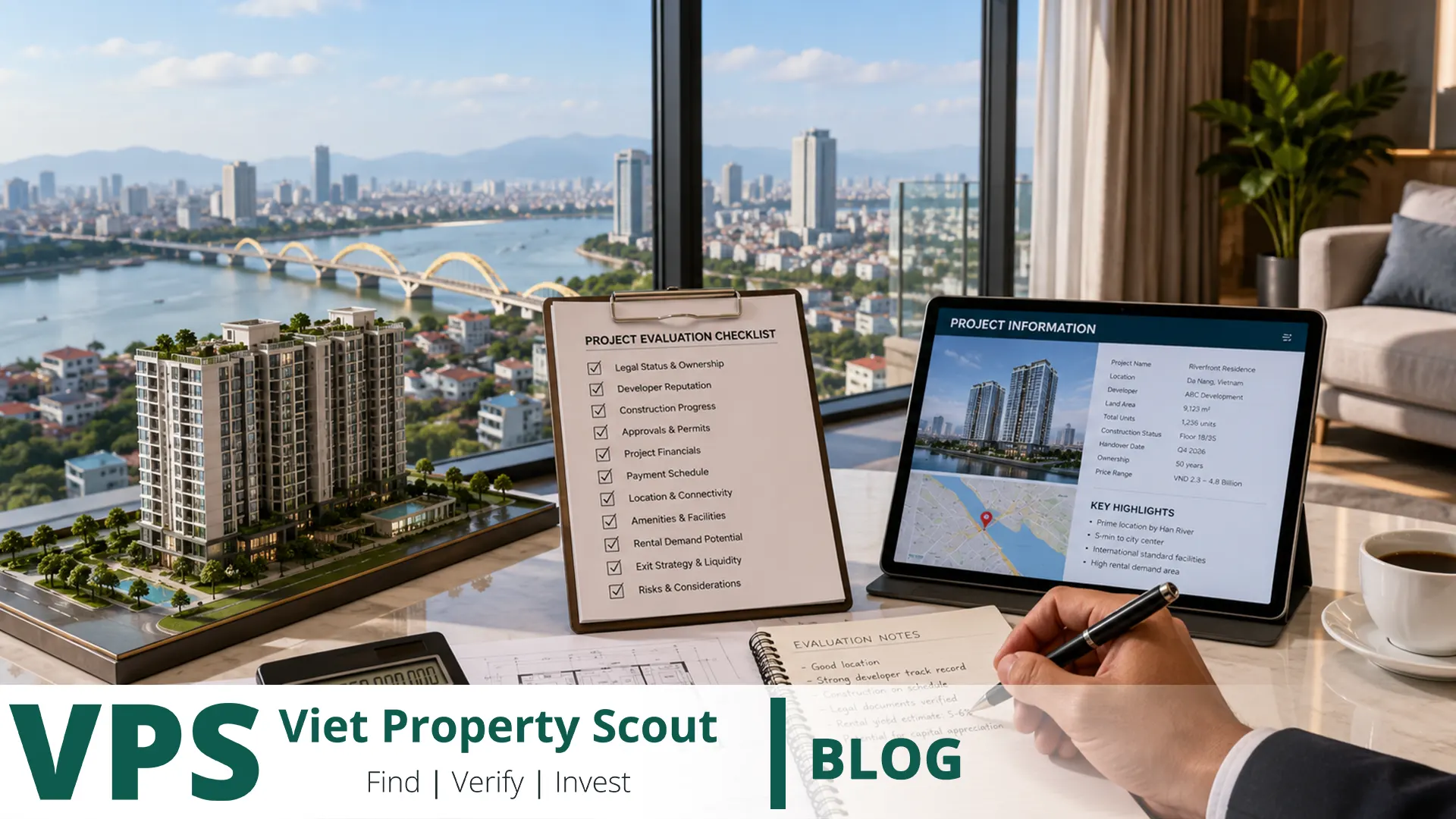
Short answer: in Vietnam, paying a deposit should not be the step that starts due diligence. It should be the final step after the project has passed legal, financial and operational verification. Before transferring money, a buyer should know exactly who the legal developer is, whether the specific unit is legally eligible for sale, what land rights support the project, whether the project or unit is mortgaged, whether construction progress supports the promised delivery date, whether a foreign buyer is legally eligible and foreign quota remains available, what the unit's legal use actually is, and what happens if delivery or certification is delayed. For future-formed property, the current Real Estate Business Law generally limits a developer's purchase or lease-purchase deposit to no more than 5% of the sale or lease-purchase price and only after the property has satisfied the conditions for being put into business. “Pay today and verify the documents later” is therefore the opposite of a disciplined acquisition process.
The core rule: do not pay money merely to obtain time to investigate later
New-project sales often create urgency: “last unit,” “price rises tomorrow,” “another buyer is waiting,” “fully refundable,” or “reserve first and we will send the legal documents later.” None of those statements changes the correct sequence. Documents first, independent verification second, deposit decision last.
A deposit may be small relative to the total purchase price but large in its effect on negotiating power. Before payment, a buyer can walk away easily. After payment, the psychological question often changes from “Should I buy?” to “How do I avoid losing the money I already paid?” A deposit should therefore be treated as the line between investigation and commitment.
A pre-payment Go / No-Go test
| Question | If yes | If no or unclear |
|---|---|---|
| Is the party receiving money the correct legal developer/seller? | Continue | Do not pay |
| Can the project be identified and verified through official approvals? | Move to unit-level review | Do not pay |
| Is the future property officially eligible for sale now? | Review the eligibility document and construction stage | Do not pay a purchase deposit |
| Are land and mortgage positions clear? | Assess remaining risks | Stop the transaction |
| Can this buyer legally own this specific unit? | Verify quota and ownership term | Do not rely on a sales promise |
| Have you received the deposit and sale-contract drafts? | Obtain independent review | Do not pay |
1. Verify the legal developer before evaluating the project brand
A parent company, project special-purpose company, sales agency, hotel operator and construction contractor may all appear under one development. The largest brand on the billboard is not necessarily the legal entity that owes obligations to the buyer.
- Obtain the developer's complete legal entity name.
- Verify corporate registration and legal representative.
- Match the entity against investment, land and project approvals.
- Identify who will sign the deposit agreement and sale contract.
- Identify the official receiving bank account.
- Do not send purchase money to a salesperson's or broker's personal account merely because they represent the project.
For future property there is an additional protection worth understanding: the developer may not delegate another organisation or individual to sign deposit, sale or lease-purchase contracts for future-formed housing, buildings or qualifying floor area on its behalf. A third-party sales agency collecting and contracting in its own name therefore deserves immediate scrutiny.
2. Prove that the project legally exists in the form being marketed
A 3D rendering does not prove development entitlement. The commercial description should be reconciled against documents defining the project legally. Relevant checks include the investment-policy or investment approval, land allocation or lease decisions, permitted land-use conversion where relevant, approved detailed planning, design approvals and required construction permits.
The current Real Estate Business Law requires material project and property information to be publicly disclosed before a project or property is put into business. That information framework gives buyers an important comparison point between what a sales presentation says and what the legal record supports.
3. For off-plan property, obtain proof that this sales phase is eligible now
A legally approved project is not automatically free to sell every unit at every stage. Future housing must satisfy specific conditions. These include appropriate land documents, construction having commenced, technical infrastructure completed consistently with approved project progress and, for apartment or mixed-use buildings containing housing, the required acceptance record showing completion of foundation construction.
Before signing sale or lease-purchase contracts for future housing, the developer submits a notification and supporting dossier to the competent provincial real-estate authority. The authority checks eligibility and issues a written response stating whether the housing is eligible for sale or lease-purchase, with the response to be published through the relevant housing and real-estate market information system. For a buyer, that document is considerably more important than a sales slide saying “official launch.”
4. Understand the 5% deposit limit correctly
For a deposit collected by a project developer to secure the purchase or lease-purchase of future housing or other covered future property, the current law generally caps the amount at 5% of the sale or lease-purchase price. The developer may collect it only after the property has satisfied the legal conditions to be put into business, and the deposit agreement must state the sale or lease-purchase price.
Be particularly careful when money is described as a “reservation fee,” “priority fee” or “expression-of-interest payment” while its commercial function is to secure the right to buy a specific unit. A label by itself does not resolve the legal substance. If money is requested before formal sale eligibility, an independent lawyer should determine what the document actually does, who holds the money and exactly when it is refundable.
5. Check the land before checking the kitchen finishes
The unit's value depends on the project's legal foundation on the land. Review the source and form of the land-use right, the land-use purpose, the duration where relevant, fulfilment of land-related financial obligations and whether the project boundary and approved plan align.
This is especially important with resort, tourism and mixed-use developments. A product marketed as an “apartment,” “residence” or “villa” can have a different legal function, land-use term and certification pathway from a conventional residential apartment.
6. Investigate mortgages; do not assume a financing bank makes the project safe
Large developments commonly use bank financing, so the project, part of the project or future property may have been mortgaged during financing. The right question is not merely “Is there a mortgage?” It is what exactly is encumbered, and has the unit being purchased been released or is there a legally reliable release mechanism?
Mortgage status is relevant to the eligibility process for future housing. Request documentary evidence. A bank financing the developer is not automatically guaranteeing the buyer's investment.
7. For a foreign buyer, verify project eligibility and quota before choosing the unit number
A foreign investor's first question should not be “Which floor is best?” but “Can I legally own this unit?” Eligible foreign organisations and individuals may own qualifying housing in permitted commercial housing projects, subject to defence, security and quantitative restrictions.
For residential apartment buildings, the general foreign-ownership ceiling is up to 30% of the residential-purpose apartments in the relevant building or block. Under the current implementation framework, local authorities publish relevant project information and foreign-ownership eligibility. The buyer should verify both project eligibility and actual remaining quota for the relevant building/unit. “Foreign quota available” is a sales statement until independently confirmed.
The buyer should also understand the ownership term that will be recorded for a foreign individual rather than assuming every product carries the same tenure as a conventional Vietnamese residential acquisition.
8. Determine the unit's exact legal function
| Marketing label | What must actually be verified |
|---|---|
| Apartment | Legally residential apartment or commercial/tourism unit? |
| Condotel | Land type, accommodation function, tenure, operator and certificate pathway |
| Serviced Residence | Residential ownership or managed hospitality product? |
| Villa | Residential house or tourism villa on commercial/service land? |
| Officetel | Approved use, tenure and residential-use limitations |
These distinctions affect ownership, leasing, financing, registration, taxation and resale. A sophisticated English marketing name is not a legal classification.
9. Underwrite the developer as a borrower and execution platform, not only as a brand
A legally compliant project can still be delayed if the developer is financially stretched or running too many projects simultaneously. Review delivery history, known delays, publicly identifiable disputes, actual construction progress, capital strength, debt burden and ability to finance the remaining work.
- How many projects is the group developing simultaneously?
- Has it delivered comparable projects on schedule?
- How are its older buildings managed after handover?
- Is the project company's financial strength comparable with the parent brand?
- Does progress appear excessively dependent on buyer advances?
- Is the named main contractor actually mobilised on site?
10. Visit the site rather than relying on the sales gallery
A site visit does not establish legal title, but it can expose operational inconsistencies. Compare physical progress with the promised delivery date. A project promising handover in twelve months while still at a very early construction stage requires a different risk premium from a nearly completed building.
Also inspect actual road access, noise, drainage, surrounding parcels, potential future view obstruction and real travel time to employment, schools, metro, airport or beach. “Five minutes away” in a brochure may be a map distance rather than peak-hour travel time.
11. Separate list price from effective economic price
Developers may offer interest subsidies, cashback, furniture packages, service-fee waivers, extended payment schedules or rental guarantees. Convert every incentive into cash value and calculate the effective price per square metre.
Then compare with completed competing projects and secondary-market units. If a new project is priced 20% or 30% above nearby completed stock, identify what measurable benefit justifies the premium: better location, newer specification, superior management, scarcity or merely an uncompleted future story.
12. Match the payment schedule to construction progress
Payments for future property are staged. Under a future-property sale contract, the first payment is generally capped at 30% of contract value including the deposit. Subsequent collections are subject to further statutory limits linked to construction, handover and certification.
Do not evaluate the payment plan only by asking how affordable this month's instalment looks. Compare each payment milestone with what should physically and legally have been completed by that point. The more money paid long before corresponding construction value is delivered, the greater the buyer's exposure to developer execution risk.
13. Understand the bank guarantee before waiving it
For future housing, the developer must generally obtain an eligible bank's commitment to guarantee its financial obligations if it fails to hand over the housing as agreed. Under the current system, the buyer can choose at the sale-contract stage whether to receive the individual guarantee or waive it in writing.
This should not be treated as a routine box to waive. If the guarantee is retained, understand the issuing bank, guaranteed amount, validity period, claim conditions and procedure. A statement that a bank “supports” or finances the project is not the same as an individual guarantee in favour of the buyer.
14. Read the deposit agreement as though a dispute will occur tomorrow
The agreement should identify the exact unit, price, deposit amount, deadline for signing the sale contract, refund conditions, circumstances in which the buyer loses the deposit and the consequences if the developer cannot proceed with the transaction.
For a foreign buyer, include a clear outcome if foreign quota is unavailable or the project/unit turns out not to qualify for foreign ownership. A seller-side eligibility problem should not be reclassified as a buyer withdrawal that causes forfeiture.
15. Read the sale contract before paying the deposit
Request the sale-contract draft before payment. Review the unit description, allowable area variation, price adjustment on final measurement, handover specification, common and private areas, parking, management charges, maintenance fund, handover date, grace period, delay compensation, certificate process, termination rights, assignment and resale.
If the sales team insists that the buyer must pay first before being allowed to see the contract that will govern a large purchase, that is itself a reason to slow down.
16. Do not confuse handover with the ownership certificate
Receiving keys is not the same as receiving the ownership certificate. The investor should understand expected handover, the certificate application process, each party's responsibility and the proportion of the purchase price that remains unpaid until certification under applicable law and contract.
If the exit strategy involves selling shortly after handover, also review contract-assignment and resale procedures before certification.
17. Test rentability and resale before believing a projected return
Identify the natural tenant after completion. Does the submarket genuinely need this unit, or will 1,000 identical one-bedroom apartments compete for the same renter? Use achieved rents in completed buildings instead of a sales forecast for three years into the future.
Then ask the liquidity question: if the unit had to be sold six months after handover, who is the natural buyer? If the only answer is “another investor who expects prices to rise,” the exit thesis is speculative rather than use-driven.
A 100-point pre-deposit scorecard
| Category | Points | What is assessed? |
|---|---|---|
| Project legal status | 25 | Investment, land, planning, permits and sale eligibility |
| Developer and finance | 15 | Track record, capital, debt, progress and execution |
| Unit and buyer rights | 15 | Classification, foreign quota, mortgage and certificate |
| Price and funding structure | 15 | Effective price, comparables and payment plan |
| Location and demand | 15 | Employment, schools, transport, rent and competition |
| Contract protection | 10 | Deposit, delay, refund, guarantee and termination |
| Liquidity and exit | 5 | Natural resale buyer and transferability |
A conservative internal rule could be: below 70/100, no deposit; 70-84, resolve open risks before proceeding; 85+ does not make the investment automatically attractive, but it indicates a more complete first-stage verification.
Major red flags before payment
- A deposit is requested before sale-eligibility evidence is produced.
- A broker asks for payment into a personal or agency account without a verified legal basis.
- The money-receiving entity does not match the legal developer.
- The sale-contract draft is withheld.
- “Foreign quota guaranteed” is not independently verified.
- The unit's residential versus tourism classification is unclear.
- Mortgage information is avoided.
- A high guaranteed return depends on a weak operator or counterparty.
- Construction progress does not support the promised delivery date.
- The price materially exceeds completed competition without measurable advantage.
- Independent legal review is discouraged.
- The buyer is told payment must be made “within the hour.”
The final 48-hour checklist before a deposit
- Obtain permanent copies of all relevant documents rather than salesperson phone screenshots.
- Match the developer entity across all documents.
- Verify investment, land and planning approvals.
- Verify the future-housing sale-eligibility response.
- Review mortgage and release position.
- If foreign, verify project eligibility and remaining quota.
- Confirm the unit's legal classification.
- Have the deposit and sale-contract drafts independently reviewed.
- Compare pricing with at least two or three completed alternatives.
- Calculate effective price after all incentives.
- Visit the site and surrounding area.
- Match construction, payment and handover schedules.
- Understand the bank guarantee before waiving it.
- Transfer funds only to the verified contractual party/account.
Frequently asked questions
What is the maximum developer deposit for future property?
For the developer deposit governed by the current Real Estate Business Law for purchase or lease-purchase of covered future property, the general ceiling is 5% of the sale or lease-purchase price after the property meets the conditions to be put into business.
Does an impressive sales gallery prove the project is legal?
No. A showroom, model and marketing campaign do not prove land status, planning, sale eligibility or foreign quota.
Can I rely on the broker to conduct legal due diligence?
A broker can collect documents and provide market information, but has an economic interest in closing the sale. Final legal review should be independent of the sales commission.
Is an individual bank guarantee mandatory for every buyer?
The developer must have the required guarantee framework for future housing; the current law allows the buyer at contract signing to choose the individual guarantee or decline it in writing. The consequences should be understood before waiver.
If a project is open to foreigners, is every unit available?
No. Remaining quota in the relevant building or block and the exact unit position still need verification.
Does buying from a major developer remove the need for due diligence?
No. A strong developer can reduce some execution risk but does not independently prove price, unit legality, mortgage status, foreign quota or contract fairness.
What is the strongest reason to walk away before paying?
An inability to independently verify a material document. A sound project should withstand transparency; urgency designed to prevent verification is itself risk information.
Conclusion: the deposit should be the result of due diligence, not the beginning
The most investable project in Vietnam is not the one with the best rendering or largest launch discount. It is the one where every material claim can be connected to evidence: who legally develops it, what land right supports it, whether it may be sold now, whether it is encumbered, whether the buyer may own it, what the contract protects and who will naturally rent or buy the unit after completion.
Find | Verify | Invest means: find the right project and unit, verify the law, documents, developer, price, contract, quota and exit, and only then invest. If money must be paid first so that verification can happen later, the process is backwards.