
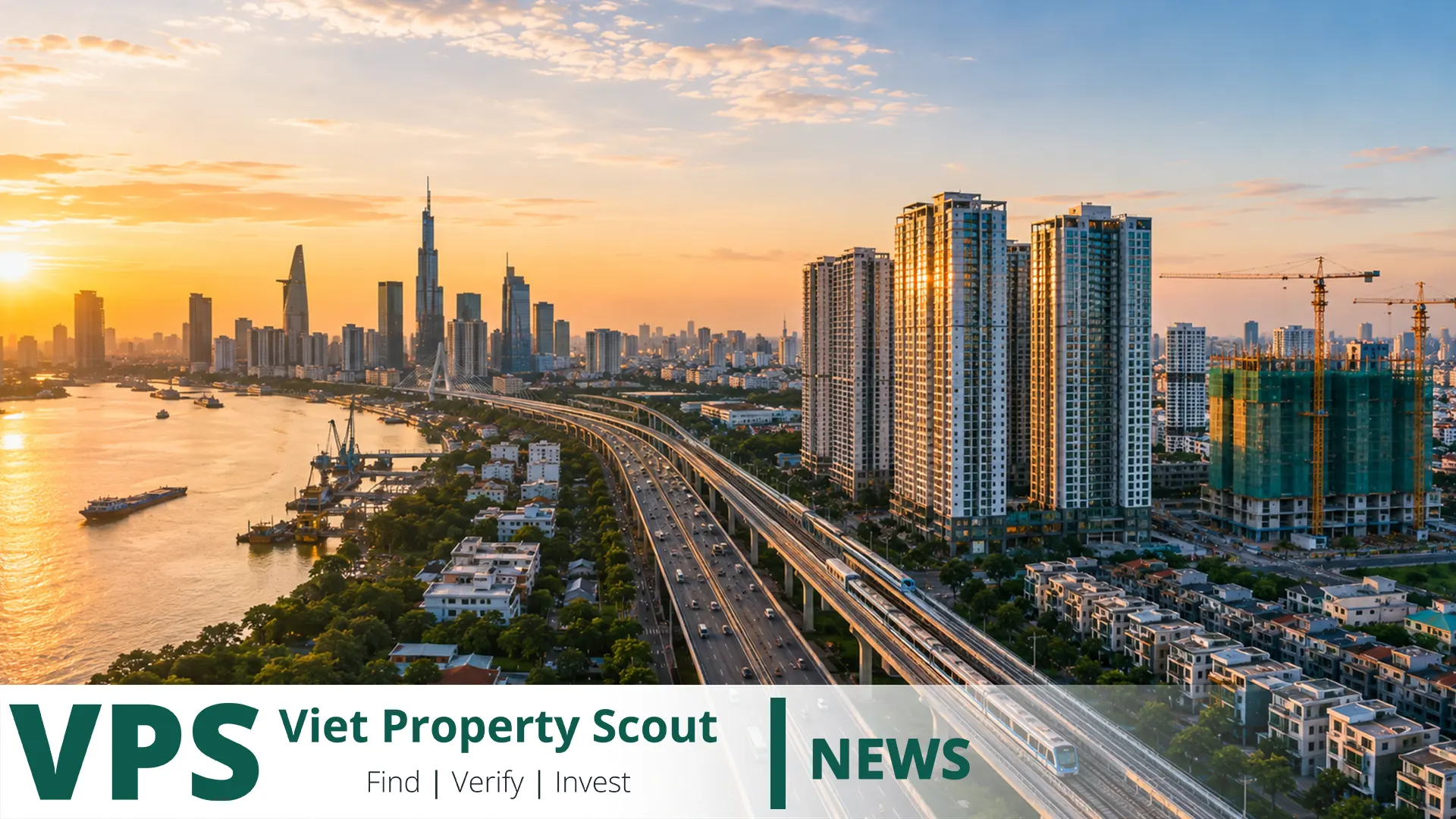
Ho Chi Minh City's property market entered a materially different phase in 2026. The old scarcity argument is no longer sufficient on its own. HCMC became a much larger administrative and economic entity after merging with Bình Dương and Bà Rịa–Vũng Tàu, while several infrastructure catalysts in the east have moved from planning narratives into operating or late-stage projects. Metro Line 1 is running, Ring Road 3 is moving toward completion, access to the Long Thành corridor is being expanded and Long Thành International Airport is approaching commercial operation. At the same time, residential supply is recovering and buyers are becoming more sensitive to financing costs, project quality and resale liquidity. The key question is therefore not whether “the east will rise,” but where infrastructure is genuinely converting into end-user demand.
First, the Definition of Ho Chi Minh City Has Changed
Since 1 July 2025, the new HCMC has incorporated the former Ho Chi Minh City, Bình Dương and Bà Rịa–Vũng Tàu. The enlarged municipality covers approximately 6,772.59 square kilometres and has a population above 14 million. This is critically important when reading 2026 property statistics because different research houses may still use different geographical definitions.
Some residential figures continue to describe the former HCMC market, while other datasets include the enlarged post-merger city. A lower average price across Greater HCMC therefore does not necessarily mean that prices in Thảo Điền, Thu Thiem or legacy Thủ Đức have fallen. The addition of lower-priced supply from former Bình Dương can alter the overall average without changing the underlying price of established eastern districts.
Key 2026 Market Indicators
| Indicator | 2026 Position | Investment Meaning |
|---|---|---|
| New HCMC scale | About 6,772.59 km² and more than 14 million residents | The market is now structurally polycentric |
| Q1 condominium launches | 1,642 units according to CBRE | Supply is recovering from extremely constrained levels |
| Eastern primary stock Q1 | About 85% according to Savills | The east remains the dominant apartment supply hub |
| Q1 average primary price | About VND 91 million/m² according to Savills | Affordability is becoming a major constraint |
| Q1 absorption | Approximately 40% | Buyers are becoming considerably more selective |
| Q2 condominium launches | 850 units, down 48% q-o-q | The supply recovery is uneven rather than a sudden glut |
| Ring Road 3 | Land clearance complete, full-route completion targeted in 2026 | Regional east-west connectivity is becoming more credible |
| Long Thành Airport | Commercial operation planned from 1 December 2026 | Strengthens the economic logic of the eastern gateway |
What Exactly Is the Eastern Corridor?
The eastern corridor should not be treated as one homogeneous investment market. For residential property, it includes several very different submarkets: Thu Thiem as the premium extension of the CBD, Thảo Điền and An Phú as established international residential districts, the deeper eastern parts of Thủ Đức toward Suối Tiên, and the wider regional link toward Dĩ An and former Bình Dương. Beyond HCMC's administrative boundary, Đồng Nai and Long Thành form another important economic extension.
Each area is driven by a different combination of employment, transport, education, lifestyle demand and price. “East HCMC” alone is therefore too broad to justify an acquisition.
1. Thu Thiem: Highest Location Quality, but Also a High Entry Basis
Thu Thiem sits directly opposite the traditional central business district and is being developed as an important financial, commercial and premium residential centre. Its buyer and tenant pool can include executives, affluent households, expatriates and corporations rather than purely price-sensitive local demand.
The difficulty is valuation. When entry prices are very high, even a high-quality property can produce a modest rental yield. An investor therefore has to determine whether the premium paid for location, river frontage or branding can realistically be recovered through income or resale. The newest tower is not automatically the strongest asset.
2. Thảo Điền and An Phú: Metro Line 1 Is Now an Operating Asset
Metro Line 1 between Bến Thành and Suối Tiên has changed the infrastructure argument in Thảo Điền and An Phú. Before opening, the metro was a future promise. By 2026, it is an operating public-transport system used by large numbers of passengers. That distinction matters because investors can now assess actual mobility behaviour rather than relying entirely on projections.
However, proximity to the metro has already been reflected in the pricing of many projects. Buyers should not pay an unlimited premium simply because a brochure shows a station nearby. Actual walking distance, station access, road noise, building management, achieved rent, vacancy and competing supply matter more than a marketing radius around a station.
3. Suối Tiên and Eastern Thủ Đức: Metro, Universities and Regional Connectivity
The area around Suối Tiên and Vietnam National University has a more diversified demand base, including students, employees, technology-related activity and services. It is also increasingly important as a future connection point between the existing HCMC metro and planned lines toward former Bình Dương areas.
This provides a credible long-term development thesis. Yet investors still need to distinguish between a project with functioning amenities and an established community and a project whose value depends almost entirely on future transport lines drawn on a map.
Ring Road 3 May Have a Broader Structural Effect Than One Metro Line
Metro Line 1 improves a largely radial connection between central HCMC and the east. Ring Road 3 can have a wider regional effect by allowing movements between industrial zones, logistics hubs, residential communities and major roads without routing every journey through the central city.
With land clearance completed and construction well advanced, Ring Road 3 in 2026 is increasingly an execution story rather than a purely political announcement. Nevertheless, a nearby interchange does not automatically create housing demand. Roads improve accessibility; they do not independently create schools, jobs, hospitals, retail or community life.
An Phú and Long Thành: A Corridor Investors Cannot Ignore
Expansion of the motorway connection from the An Phú interchange toward the HCMC–Long Thành–Dầu Giây Expressway is progressing alongside preparations for Long Thành International Airport. Long Thành Airport is located in Đồng Nai, not HCMC, but its economic impact extends directly toward the eastern gateway of the city.
Trial operations are planned for September through November 2026, with commercial operations currently scheduled from 1 December 2026. This can strengthen demand for transport services, logistics, hotels, offices and accommodation related to airport employment.
The mistake would be to assume that every property between HCMC and Long Thành receives the same benefit. Actual travel time, road access, employment, planning restrictions, project quality and acquisition price determine whether the airport creates usable value.
Housing Supply: The East Still Dominates, but Buyers Have More Choice
CBRE recorded 1,642 new condominium launches in Q1 2026, a substantial increase from the subdued level recorded a year earlier. Savills, using a somewhat broader market count, reported around 1,900 new units, primary stock of approximately 4,700 units and an eastern share of about 85%. At the same time, absorption fell to around 40% and the average primary price was approximately VND 91 million per square metre.
In Q2, CBRE recorded just 850 new condominium launches, a 48% quarterly decline. The market has therefore not suddenly moved into a massive apartment glut. But it has also moved away from the environment in which nearly any expensive launch could rely on rapid sales. Buyers are scrutinising payment terms, financing, legal status and comparative value more aggressively.
Through 2028, Approximately Half of the Pipeline Is Still Expected in the East
Savills has indicated that HCMC could add around 58,000 apartments from approximately 80 projects through 2028, with the eastern area accounting for roughly half. This is both a positive and a warning. It confirms the east as the city's leading residential development corridor, but it also means today's buyer may compete with thousands of new units for tenants and resale buyers over the next several years.
A proper investment analysis must therefore include the future supply pipeline. Asking how many competing projects will be completed within a five-kilometre radius in the next 24 to 36 months can be more useful than looking only at today's asking prices.
The Bình Dương Merger Changes the Supply Equation
Dĩ An, Thuận An and other former Bình Dương markets are now part of the enlarged HCMC. These areas bring substantial land reserves, generally lower residential prices than legacy eastern HCMC and a large employment base supported by industry, manufacturing and logistics.
They are not direct substitutes for Thu Thiem or Thảo Điền. A unit in Dĩ An typically targets a different tenant, buyer and price point. Investors who recognise this distinction can use the expanded city structure to their advantage; investors who treat the new administrative HCMC as one uniform market can misread both price averages and demand.
Social Housing Is Adding Another Layer of End-User Supply
The enlarged city has adopted an ambitious social-housing agenda for 2026–2030, including a plan for around 50,000 rental social-housing units within a much broader overall programme. By August 2026, tens of thousands of units were already under construction or scheduled for additional groundbreaking.
This supply does not compete directly with a luxury apartment in Thu Thiem. It is nevertheless relevant because the expanded metropolis has enormous housing demand from industrial workers, service employees and local families. In former Bình Dương areas especially, the balance between investor-oriented housing and genuine workforce accommodation will increasingly shape local pricing and rental markets.
How the Investment Decision Changes by Submarket
| Area | Demand Driver | Opportunity | Main Risk |
|---|---|---|---|
| Thu Thiem | Finance, business and CBD expansion | Premium long-term positioning | Very high entry price |
| Thảo Điền / An Phú | Metro, expatriates and services | Established rental market | Much of the metro premium may already be priced in |
| Eastern Thủ Đức / Suối Tiên | Metro, universities and technology | Long-term growth potential | Large differences in project quality |
| Dĩ An / former Bình Dương | Industry, employment and future metro connections | Lower entry basis and deep workforce demand | Not directly comparable with core eastern HCMC |
| Long Thành corridor | Airport and logistics | New regional economic catalyst | Timing and speculative pricing risk |
Foreign Investors Need Unit-Level Verification
A good project does not automatically mean that every unit can be purchased by a foreign buyer. Investors must verify project eligibility, remaining foreign ownership quota, the legal status of the exact unit, land rights, mortgages or encumbrances, contract structure and handover documentation. Foreign ownership of apartments is generally capped at no more than 30% of the residential units in an apartment building, while ownership by foreign individuals is normally subject to a statutory term.
A sales statement that “foreign quota is available” should therefore never replace documentary verification for the exact unit.
The Viet Property Scout Method
- Find: Identify the real demand engine: metro, employment, airport, university, technology, industry or an established residential community.
- Verify: Confirm actual infrastructure progress, project legality, developer position, foreign quota and the exact unit.
- Invest: Test acquisition price against net rent, competing supply and a conservative exit scenario.
Three Scenarios for 2026–2028
Base case: Ring Road 3 is completed, Long Thành begins operation and eastern connectivity improves gradually. Strong projects retain demand, while increased housing supply limits indiscriminate price escalation.
Upside case: Additional metro projects advance rapidly, while employment and economic activity around Long Thành and former Bình Dương accelerate. The east then develops into a genuine multi-centre employment and residential economy rather than a collection of commuter suburbs.
Risk case: Financing remains expensive while new supply grows faster than real demand and infrastructure premiums have already been fully capitalised into selling prices. Overpriced projects with weak legal or resale characteristics then face stronger discounting.
Frequently Asked Questions
Is eastern HCMC still the best area to invest?
It remains the city's dominant development corridor, but it is not automatically the best choice for every investor. Project quality and micro-location matter more than the direction on the map.
Does Metro Line 1 guarantee appreciation?
No. Operating infrastructure is a real positive, but much of its value may already be reflected in current prices. Purchase basis remains critical.
Does Long Thành Airport make every eastern project attractive?
No. The airport strengthens the wider economic corridor, but only properties with useful access, genuine employment exposure and defensible pricing benefit directly.
Will more supply cause apartment prices to fall?
Not necessarily. Greater supply can increase buyer choice, incentives and price discipline, while legally sound projects in locations with genuine demand can still perform better than the wider market.
Conclusion
The 2026 Ho Chi Minh City property story is no longer simply “the east is rising.” Metro Line 1 is operating, Ring Road 3 is approaching completion, Long Thành is moving into operation and the new HCMC now connects the former core city with Bình Dương and Bà Rịa–Vũng Tàu inside one much larger metropolitan economy. At the same time, residential supply is returning and buyers are becoming more price-sensitive.
The strongest investment is therefore not automatically the apartment closest to a metro station or the land parcel closest to an expressway. It is the asset where infrastructure can be connected to real users, real jobs, functioning services, verifiable legal status, a defensible acquisition price and realistic exit liquidity. That is where the eastern corridor stops being a speculative future story and becomes a property investment thesis that can actually be verified.