
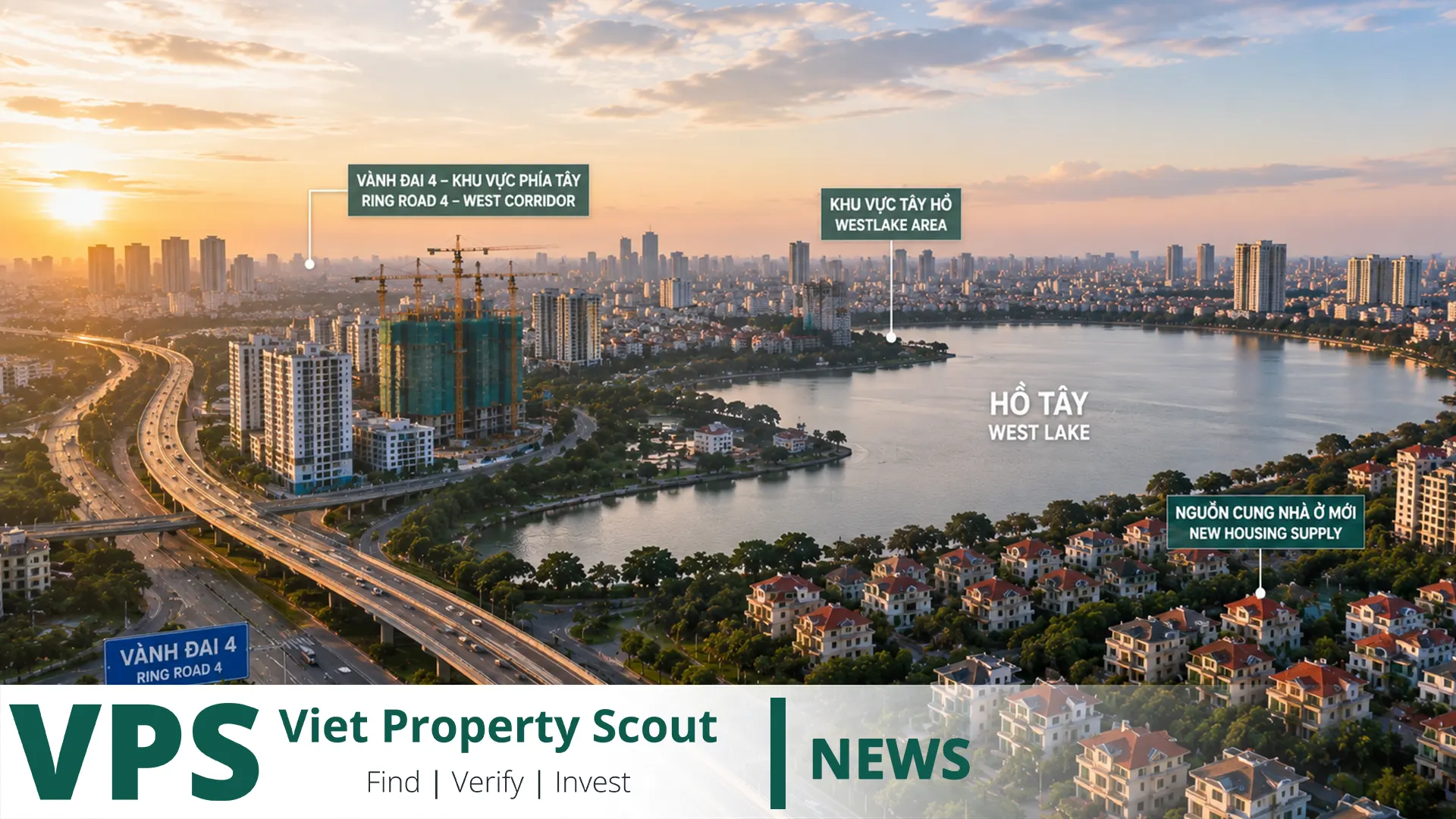
Hanoi’s real estate market entered a different phase in 2026 from the powerful 2024–2025 cycle. The capital continues to benefit from economic expansion, major transport investment and the gradual relocation of administrative and commercial activity into new centres. At the same time, residential supply is increasing, condominium prices are testing affordability limits and liquidity is becoming more sensitive to interest rates. The investment thesis can therefore no longer be reduced to “buy near new infrastructure and wait for appreciation.” The more important question is which districts are developing genuine demand capable of supporting prices, rents and resale as Hanoi expands outward.
Three Forces Are Redrawing Hanoi’s Investment Map
The 2026 agenda can be understood through three major forces. The first is Ring Road 4, which is restructuring connectivity between the urban core, outer districts and the wider Capital Region. The second is Tây Hồ Tây, or West Westlake, where administrative, diplomatic, office, technology and premium residential functions are increasingly concentrated. The third is the new housing supply wave, which is moving further into suburban and secondary locations because land in the traditional core is scarce and expensive.
| Indicator | 2026 Position | Investment Meaning |
|---|---|---|
| Ring Road 4 | Advanced construction, main system targeted for operation in 2027 | Improving regional access across western, northern and southern corridors |
| Q1 primary condo price | Above VND 100 million/m² excluding Van Giang | Affordability is becoming a central liquidity constraint |
| Q2 condo sales | More than 5,800 units, equal to about 68% of new supply | Demand remains meaningful but no longer absorbs launches automatically |
| Secondary market | First downward price adjustment since late 2022 | Capital appreciation can no longer be assumed across every project |
| Tây Hồ Tây | Office supply wave accompanied by softer rents and higher vacancy | Strong long-term story, but short-term absorption matters |
| Social housing | Minimum target of 120,000 units during 2026–2030 | Future housing supply will broaden beyond premium products |
Ring Road 4: The Value Is Not the Road Itself, but the Redistribution of Access
Ring Road 4 runs through Hanoi and neighbouring provinces as a major Capital Region transport project. Within Hanoi, the project corridor, using the administrative geography applied when the scheme was launched, passes through Sóc Sơn, Mê Linh, Đan Phượng, Hoài Đức, Hà Đông, Thanh Oai and Thường Tín. Land clearance has largely been completed, while parallel roads, bridges and expressway components continue progressing toward full operation.
For property, a nearby road does not automatically create value. The real benefit appears when infrastructure materially reduces travel time to employment, schools, commercial centres and other transport hubs. This is why not every Ring Road 4 location should be valued equally. An interchange surrounded by undeveloped land and few jobs may generate land speculation rather than genuine housing demand. An interchange connected to a strong radial road, employment cluster or functioning urban community can support a much more durable market.
Hoài Đức and Đan Phượng: The Strongest Western Residential Thesis
Western Hanoi already contains major townships, residential communities, schools, retail facilities and office clusters. Ring Road 4 therefore adds regional accessibility to an area where residential demand already exists. That is fundamentally stronger than buying an isolated plot solely because a future road passes nearby.
However, infrastructure expectations have already been capitalised into prices across parts of western Hanoi. Investors should compare the cost of a new or off-plan unit with completed alternatives that can already be occupied or rented. If an unfinished property is materially more expensive than a proven completed asset, the infrastructure story may already be overpriced.
Mê Linh and Sóc Sơn: A Longer-Term Airport and Logistics Thesis
The northern corridor benefits from proximity to Nội Bài International Airport and important industrial and logistics activity. Ring Road 4 strengthens that regional network. Yet residential depth is not as mature everywhere as it is in established western districts. Investors therefore need a longer time horizon and a more selective approach.
The strongest locations are likely to be those where transport access overlaps with actual employment, daily services and a credible urban plan. Agricultural land or thinly traded property should not be treated as a high-quality investment merely because it sits near a planned transport corridor.
Thanh Oai and Thường Tín: More Land, but Demand Must Be Proven
Southern and southwestern Hanoi offer larger land banks and capacity for major new urban developments. Ring Road 4 can improve their connection to the broader metropolitan economy. However, lower entry prices do not automatically mean better value. If jobs, schools, retail, healthcare and public transport are slow to arrive, end-user housing demand can remain shallow for years.
Tây Hồ Tây: From Premium Residential District to Institutional Hub
Tây Hồ Tây is one of Hanoi’s strongest quality-demand stories. Starlake, Samsung’s research and development presence, modern offices, premium residential development, new retail and hospitality facilities, proximity to West Lake and the airport, and plans to relocate a number of ministries and central agencies toward Tây Hồ Tây and Mễ Trì all give the district a deeper institutional base.
This matters because institutional, diplomatic, technology and professional employment can create housing demand from executives, specialists, expatriates, affluent families and companies seeking accommodation for staff. Such demand is more diversified than a market driven principally by speculative buyers.
The New Office Wave Is Also a Warning
By Q2 2026, the new office supply wave in Tây Hồ Tây was already contributing to softer rents and higher vacancy in Hanoi’s office market. That does not invalidate the district’s long-term story. It demonstrates the difference between long-term location quality and short-term absorption. When several large buildings arrive together, tenants take time to fill them.
For nearby residential property, the office pipeline can become a positive demand driver once those buildings are genuinely occupied. Investors should therefore monitor actual corporate moves and employment rather than assuming every newly completed office tower immediately creates thousands of tenants.
More Supply Is Changing Hanoi’s Condominium Market
Since Q3 2025, Hanoi’s average primary condominium price, excluding Van Giang projects in neighbouring Hưng Yên, has remained above the VND 100 million per square metre threshold. Including Van Giang, the broader market average reached approximately VND 84 million per square metre in Q1 2026. These figures demonstrate why affordability has become one of the market’s defining constraints.
More than 5,800 condominium units were sold in Q2 2026, yet that volume represented only around 68% of new supply launched during the quarter. This was materially below the 2024–2025 period, when absorption frequently exceeded 90%. For the first time since late 2022, the secondary market also recorded a downward price adjustment. Hanoi is not necessarily entering a crisis; it is entering a market in which buyers have more reason to discriminate between projects.
Where Is New Housing Supply Moving?
2026 market reports indicate that new launches are increasingly concentrated in suburban and secondary districts. At the same time, a large share of the pipeline remains positioned in high-end and luxury price segments, while genuinely affordable commercial housing remains scarce. Limited central land, high development costs and expanding infrastructure are therefore pushing Hanoi toward a more polycentric residential structure.
West: Hoài Đức, Nam Từ Liêm and Connected Corridors
The west remains one of the most mature residential markets outside Hanoi’s traditional core. Large developments, schools, retail, offices and established communities provide real end-user demand. It is also one of the markets that has already experienced substantial repricing. Investors should distinguish between projects supported by functioning communities and projects whose valuation rests mostly on future infrastructure narratives.
North: Tây Hồ Tây, Mê Linh and the Nội Bài Corridors
Tây Hồ Tây is the highest-value and most mature component of the northwestern story, while Mê Linh and airport-linked areas sit earlier in the development cycle. Investors seeking measurable rental demand today may prefer locations closer to established employment and services. Investors accepting a longer horizon may examine outer growth corridors, but planning, infrastructure delivery and liquidity require much stricter verification.
East and Van Giang: Do Not Confuse Administrative Hanoi with the Greater Residential Market
Van Giang lies in Hưng Yên rather than Hanoi, yet large township development there has become influential enough for market reports to present Hanoi apartment averages both including and excluding Van Giang. This distinction matters. Van Giang competes directly for buyers in the wider metropolitan market even though it is outside Hanoi’s administrative boundary. Investors should therefore compare it with eastern Hanoi alternatives while keeping the geography clear.
Social Housing Will Alter Another Part of the Supply Equation
Hanoi has established a target of at least 120,000 social housing units during 2026–2030. The broader planned pipeline covers 148 projects with potential capacity of approximately 135,602 apartments. As of May 2026, 41 projects totalling around 27,426 units were expected to begin during the year.
These homes will not directly compete with every premium apartment project, but they will change the broader housing market. Additional supply aimed at workers and lower- to middle-income households can gradually reduce some of the pressure that has forced buyers into expensive commercial housing. The scale of the programme also confirms that affordability is being treated as a structural issue rather than a temporary market inconvenience.
Areas Worth Watching in 2026–2028
| Area | Primary Driver | Opportunity | Main Risk |
|---|---|---|---|
| Tây Hồ Tây | Administration, offices, diplomacy, West Lake | High-quality long-term demand | High entry price and near-term office supply |
| Hoài Đức | Ring Road 4 and western townships | Existing residential depth plus improved access | Infrastructure already partly priced in |
| Đan Phượng | Ring Road 4 and westward expansion | New community formation | Large difference between micro-locations |
| Mê Linh | Ring Road 4, airport and logistics | Long-term growth potential | Less mature residential demand today |
| Thanh Oai / Thường Tín | Large land bank and regional connectivity | Scale for new urban development | Jobs and services must catch up |
| Van Giang | Large township market east of Hanoi | Strong alternative for capital-region buyers | Outside administrative Hanoi |
What Foreign Investors Must Verify
Selecting the right district is only the first step. Foreign ownership eligibility, remaining foreign quota, the legal status of the exact unit, land rights, mortgages or encumbrances, construction status, handover schedule, management fees, rental restrictions and resale conditions must all be checked. A developer’s primary asking price is not necessarily the price an investor will obtain when exiting through the secondary market.
The Viet Property Scout Method
- Find: Identify the real demand engine: road access, employment, school, office cluster, airport, transit or an established community.
- Verify: Confirm that infrastructure is funded and genuinely under construction and that the project and unit are legally eligible for the buyer.
- Invest: Test the price against rent, liquidity and competing assets and calculate a conservative exit scenario.
Three Scenarios for Hanoi
Base case: Ring Road 4 continues progressing, supply expands and buyers become increasingly selective. Areas supported by jobs and functioning services outperform speculative land locations.
Upside case: Ring Road 4 begins operating in 2027 as planned and the relocation of institutions and companies toward Tây Hồ Tây and other new centres accelerates. Residential demand then becomes more distributed beyond the traditional core.
Risk case: Interest rates remain elevated while expensive new supply grows faster than real demand. Highly priced or weakly liquid projects experience further secondary-market discounts.
Conclusion
In Hanoi in 2026, no single area automatically wins simply because Ring Road 4 is being built or because the city is expanding. Tây Hồ Tây stands out because of institutional, office and high-quality residential demand. Hoài Đức and Đan Phượng benefit from the maturity of western Hanoi and improved Ring Road 4 connectivity. Mê Linh and Sóc Sơn are longer-term airport and logistics stories, while Thanh Oai and Thường Tín require stronger evidence of end-user demand. At the same time, rising housing supply and slower absorption are forcing investors to become more disciplined.
The strongest investment is therefore not necessarily the plot closest to the new road. It is the asset whose value can be explained by improved accessibility, genuine employment, functioning services, verified legal status, measurable income and realistic exit liquidity. That is the point at which Hanoi’s infrastructure stops being a marketing story and becomes a defensible investment thesis.