
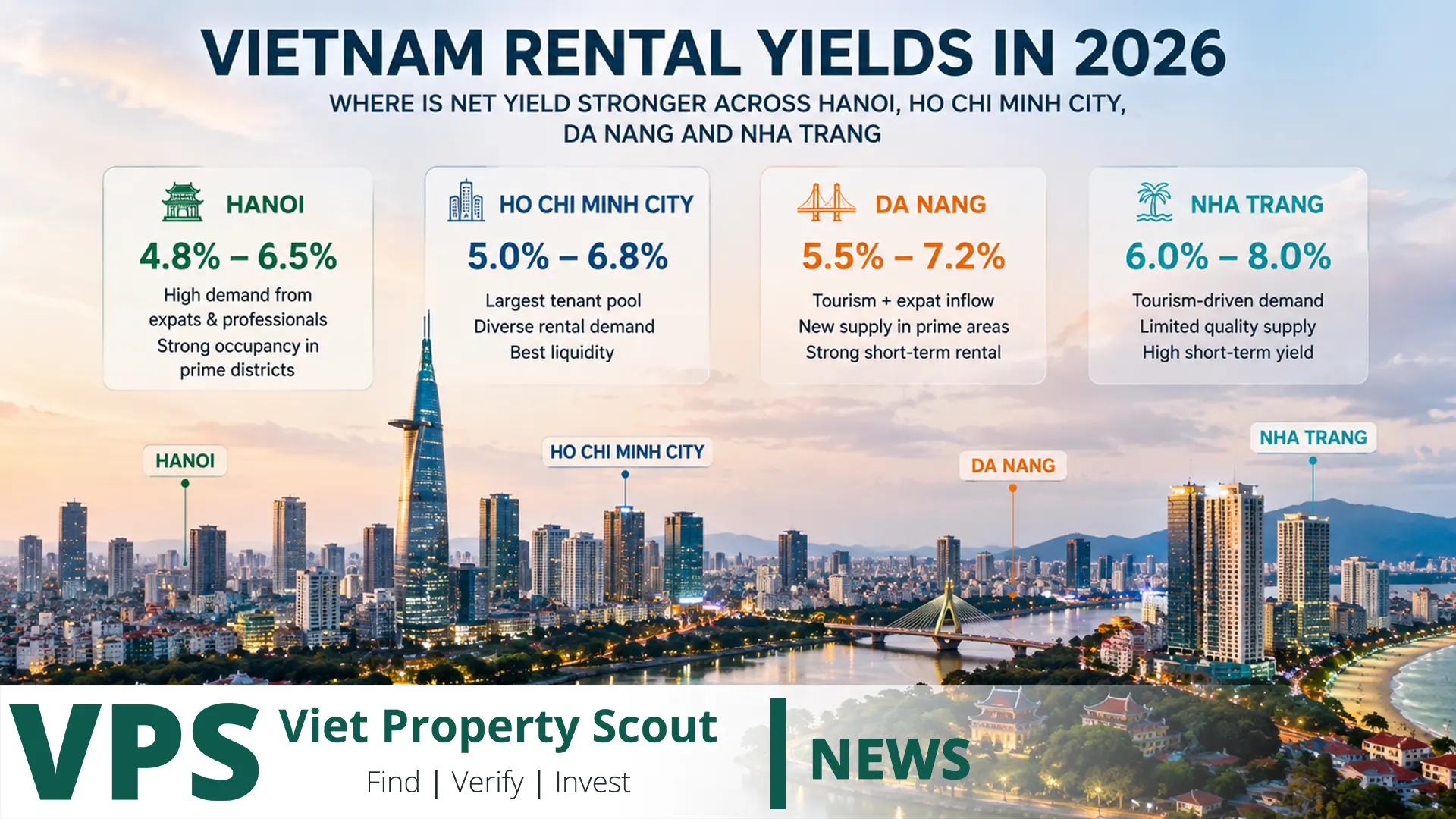
There is no defensible one-line answer to the question of which Vietnamese city offers the highest rental yield in 2026. A city can show a relatively low headline yield while delivering stable long-term occupancy and strong resale liquidity. A coastal market can show a substantially higher gross yield but lose much of that advantage through vacancy, management, maintenance and furnishing costs. Hanoi, Ho Chi Minh City, Da Nang and Nha Trang therefore need to be compared using net operating income, tenant depth, vacancy risk and exit liquidity rather than advertised rent alone.
What Does “Net Yield” Mean in This Analysis?
Gross rental yield is simply annual rent divided by acquisition price. It does not tell the investor what is actually retained. A practical operating net yield should account for vacancy, building and management charges, leasing costs where applicable, maintenance and the replacement of furniture and appliances. Financing should be analysed separately because leverage differs by investor. Tax should also be calculated under the current 2026 rules applicable to the particular landlord rather than using a blanket historical assumption.
This distinction matters. A unit advertised at a 6% gross yield can ultimately be economically weaker than a 4.5% gross unit that remains occupied almost all year and requires little management.
Four-City Rental Yield Snapshot
| City | Yield Profile | Main Strength | Main Constraint |
|---|---|---|---|
| Hanoi | Low to moderate | Deep local demand, offices and universities | Purchase prices have risen faster than rents |
| Ho Chi Minh City | Moderate with strong pockets | Deepest employment and tenant market | Premium locations compress yields sharply |
| Da Nang | Moderate to strong for smaller units | Lower entry basis and long-stay demand | New supply and seasonal exposure |
| Nha Trang | High gross potential in mid-ticket units | Relatively lower capital requirement and tourism | Net income highly sensitive to vacancy and management |
Hanoi: A Strong Economy but a Weakening Rent-to-Price Ratio
Current city-level datasets put Hanoi's average gross residential yield at around 3.5%. Smaller units can perform better, but the core problem is not weak rent. It is the purchase-price denominator. Apartment prices have risen significantly faster than rents in recent years, compressing the return available to new buyers.
Cầu Giấy: One of the Better Balances
Cầu Giấy combines offices, universities, employees and a broad residential tenant base. In 2026 datasets, selected one-bedroom units produce roughly 4.4% gross yield and around 2.9% estimated net yield. This is not a spectacular figure, but the income is supported by year-round employment and education demand rather than tourism.
Tây Hồ and Ba Đình: Excellent Tenant Quality, Weak Yield Efficiency
Expatriate, diplomatic and premium areas can achieve high monthly rents in absolute terms. The problem is that purchase prices are substantially higher. Some segments therefore show estimated net yields of only around 1–2%. Investors in these districts are typically purchasing location quality, tenant stability, lifestyle positioning and potential resale resilience rather than maximum annual cash income.
VPS view on Hanoi: It is not the natural first choice for an investor whose primary objective is maximum net cash yield. Smaller and mid-sized units near employment, universities and transport become more attractive when bought without paying an excessive location premium.
Ho Chi Minh City: The Widest Yield Range and Deepest Tenant Pool
HCMC's average gross residential rental yield is around 4.16%, above Hanoi. Yet the city average hides a very wide range. High-end areas can generate weak percentage returns because acquisition prices are extremely high, while functional employment-oriented districts can produce much stronger rent-to-price ratios.
Why Non-Prime Districts Can Outperform
In District 10, Tân Bình, parts of Bình Thạnh and selected Thủ Đức projects, entry prices can remain more rational relative to achieved rent. Detailed 2026 datasets show selected one- and two-bedroom units reaching estimated net yields in roughly the 3.5–4.2% range. More importantly, the underlying demand comes from professionals, students, offices, airport activity, services and employment that operate year-round.
Thảo Điền and An Phú: Better for Tenant Quality Than Maximum Yield
These areas benefit from an established expatriate community, international schools, restaurants, services and Metro Line 1. The trade-off is the high acquisition price. Estimated net yields in some unit categories can fall to around 1.7–2.1%. An investor therefore needs an additional reason to accept the lower yield, such as lower vacancy, stronger tenant quality, capital preservation or resale liquidity.
VPS view on HCMC: Of the four markets, it offers the strongest overall combination of rental cash flow, tenant depth and resale liquidity when the investor avoids paying an excessive prestige premium.
Da Nang: Net Yield Strengthens When Entry Price Remains Disciplined
Da Nang has a different rent-to-price structure. Apartment prices rose strongly during 2024–2026, compressing some yields, but entry costs in many segments remain below Hanoi and HCMC. Current 2026 apartment datasets place many long-term estimated net yields around 3.0–3.6%. Selected studio and compact condo segments in areas such as An Thượng, Mỹ An, Hòa Khánh, Hòa Minh and Thanh Khê can exceed 4% when acquired at sensible prices.
Why Smaller Units Are Efficient
Studios and one-bedroom apartments require less capital while attracting young local workers, long-stay foreigners and remote professionals. Rent per dong invested can therefore be materially more efficient than in large premium apartments.
Do Not Mix Long-Term Rental and Tourism Income
A unit rented to a twelve-month tenant is a different business from a tourism apartment. Short-stay use can generate stronger revenue in peak periods, but platform commissions, cleaning, management, furnishing wear and seasonal vacancy must be deducted. Gross revenue is not comparable to long-term net rent.
VPS view on Da Nang: One of the strongest markets for operating yield when the investor focuses on small or medium residential units in neighbourhoods that function throughout the year rather than buying purely because a building is close to the beach.
Nha Trang: Highest Visible Yield Potential, but the Greatest Need to Rebuild the Numbers
A July 2026 listing survey shows apartments priced around VND 2–3 billion generating roughly 5–6.7% gross yields, with the VND 3–5 billion segment at around 4.9–6.4%. Premium apartments above VND 5 billion fall sharply to approximately 2.7–3.3% gross. The pattern is important: paying more for beachfront positioning, luxury and scarcity often reduces income efficiency.
Those figures must not be treated as net yield. Coastal apartments can require better furnishing, greater maintenance and active leasing management. Tourism-oriented income introduces even more seasonality. A credible Nha Trang net yield should therefore be rebuilt from twelve months of actual revenue and costs rather than inferred from the gross headline.
Where Nha Trang Becomes More Interesting
The strongest cash-flow proposition may not be the most expensive apartment directly on Trần Phú. A legally residential unit in roughly the VND 2–4 billion range, close enough to the coast and services but priced for long-stay demand, can serve locals and monthly or annual foreign tenants without relying entirely on tourists.
VPS view on Nha Trang: It has the potential to lead the four cities in headline yield and may also produce strong net returns in selected units, but operational uncertainty is higher. It should not be ranked first until vacancy, management and maintenance are deducted.
Where Is Net Yield Actually Strongest?
| Investor Objective | Relatively Strongest Market | Reason |
|---|---|---|
| Best balance of yield and tenant stability | HCMC | Deep employment base with selected 3–4%+ net segments |
| Efficient small-unit cash flow | Da Nang | Lower capital requirement and long-stay demand |
| Highest headline yield potential | Nha Trang | Mid-ticket apartments can show strong gross ratios |
| Strong economic base but compressed yield | Hanoi | Purchase prices have outpaced rent |
Why a Cheaper Apartment Can Produce a Better Return
Tenants do not pay for luxury in the same proportion that investors pay to acquire it. A better view, higher floor, famous brand or prestigious address may increase the purchase price by 30–50% while increasing achievable rent by only 10–20%. The percentage return therefore falls even though the monthly rent is higher.
This is why the strongest rent-to-price ratios are often found in compact units and practical employment-oriented neighbourhoods rather than the most prestigious towers.
How Net Yield Should Be Calculated
| Component | What to Use |
|---|---|
| Rent | Achieved market rent, not the highest advertisement |
| Vacancy | Realistic unoccupied weeks or months |
| Management | Building and leasing-management expenses where applicable |
| Maintenance | Air-conditioning, appliances, painting, furniture and wear |
| Tax | Current 2026 rules based on landlord status and rental revenue |
| Financing | Analyse separately when calculating return on equity |
The Viet Property Scout Rental-Yield Test
- Find: Identify locations where tenants have a real reason to live: jobs, universities, schools, transport, services or a durable lifestyle market.
- Verify: Check real lease contracts, actual vacancy, recurring costs, legal status and the building's rental rules.
- Invest: Recalculate the return under a conservative scenario, then compare net income with resale liquidity and capital risk.
Frequently Asked Questions
Which city has the highest rental yield in 2026?
No city wins across every product. Nha Trang shows some of the strongest gross ratios, Da Nang is attractive for smaller units, while HCMC offers the strongest combination of yield and tenant depth.
Is a 4% net rental yield good in Vietnam?
For a legally sound residential apartment with stable demand and reasonable resale liquidity, an operating net yield around 4% is relatively strong in the 2026 environment.
Do luxury apartments generate better yields?
They often generate higher absolute rent but lower percentage yields because the purchase price rises faster than achievable rent.
Should investors use short-term rental to increase returns?
Not automatically. Legal eligibility, building rules, seasonality, management cost and furnishing wear must all be checked. Higher revenue does not necessarily mean higher net income.
Conclusion: Cash Flow Strength Is About Capital Efficiency
For an investor seeking net cash flow rather than a prestigious address, Vietnam's 2026 market rewards capital efficiency. Hanoi is relatively weak where purchase prices have moved too far ahead of rents. HCMC offers the deepest tenant pool and the broadest selection of balanced yield opportunities. Da Nang can outperform in compact units bought at disciplined prices. Nha Trang can show the highest headline returns in selected price bands but requires the most careful operational underwriting.
The best rental yield is therefore not the largest percentage quoted by an agent. It is the income that remains after vacancy, management, maintenance and applicable tax in an asset that can also be resold. Once net cash flow, legal verification and liquidity are analysed together, rental yield becomes an investable metric rather than a marketing number.