
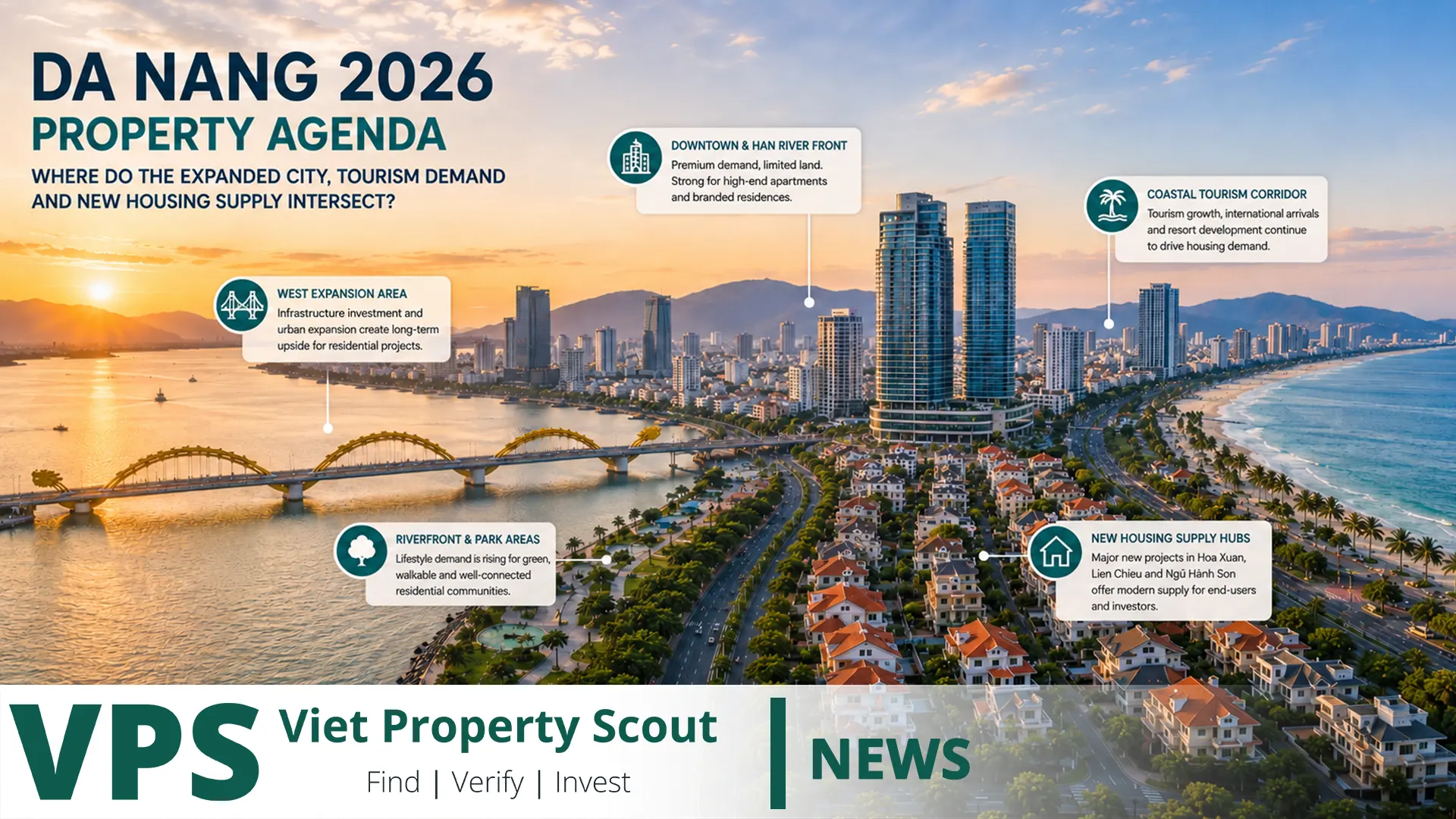
Da Nang's real estate market in 2026 can no longer be read simply as the property market of a beach city benefiting from tourism. Since the administrative restructuring that combined Da Nang with the former Quang Nam Province, the name “Da Nang” now covers a much larger economic and urban territory containing the established coastal core, new logistics and industrial corridors, tourism and heritage destinations, and substantial development land. The key question for investors is therefore not whether Da Nang is growing. It is where that growth is converting into real, sustainable property demand and where expectations may already be overcapitalised into prices.
2026 Changes the Way Da Nang Must Be Analysed
The new Da Nang officially began operating on 1 July 2025 following the merger with Quang Nam. The enlarged municipality covers approximately 11,859.59 square kilometres, has a population of more than 3.06 million and contains 94 commune-level administrative units. This is far more than a change of boundaries. It expands the labour market, infrastructure network, tourism base, development land bank and investment corridors that now sit under the Da Nang name.
It also creates an important analytical risk. Not every 2026 market report uses the same geographical definition. Some residential reports continue to focus primarily on the legacy urban Da Nang market, while government, tourism and economic datasets may cover the post-merger municipality. Before comparing price, visitor or supply figures, investors should therefore identify the geography behind each dataset. Two individually correct numbers can still produce a misleading conclusion if one represents old Da Nang and the other the enlarged city.
The Numbers Defining the 2026 Market
| Indicator | 2026 Position | Investment Meaning |
|---|---|---|
| Administrative scale | About 11,859.59 km² and more than 3.06 million residents | Da Nang has become a multi-centre market rather than one coastal urban core |
| H1 tourism | Nearly 9.8 million visitors served by accommodation establishments | Strong foundation for hospitality, retail and temporary accommodation demand |
| International visitors | Nearly 5.2 million, approximately 28.7% higher year on year | International connectivity is an increasingly important demand engine |
| Condominiums Q1 | Roughly 16,000 cumulative units; average primary price about VND 83 million/m² | The market has moved beyond the previous low-supply environment |
| Condo absorption | About 89% cumulatively according to CBRE | Demand remains substantial, but high prices increase asset-selection risk |
| Primary land plots Q2 | About 1,470 products; transactions equal to only around 4% of primary supply | Headline pricing should not be confused with exit liquidity |
| Social housing | 2026 completion target of 4,979 units | Housing expansion also targets workers and local households, not only premium investors |
Tourism Is Strong, but Tourism Does Not Make Every Property a Good Investment
During the first half of 2026, Da Nang accommodation establishments served nearly 9.8 million visitors, more than 22% above the same period of 2025. International visitors approached 5.2 million, while domestic visitors exceeded 4.6 million. More than 2.2 million visitors were served in July alone, taking the first seven months of the year above 12.1 million. Accommodation, food and tourism-related service revenue also recorded strong growth.
These figures create a powerful backdrop for real estate, particularly around hotels, serviced apartments, retail, short-stay accommodation and lifestyle property. They do not, however, guarantee that every apartment near the beach will produce an attractive return. Rental performance depends on exact location, building management, permitted use, management fees, furnishing costs, maintenance, seasonality, hotel and serviced-apartment competition, vacancy and the original acquisition price. A unit can have good occupancy and still deliver a weak net yield if the purchase price is excessive.
New Housing Supply Has Changed the Condominium Equation
More than 8,000 condominium units were launched during 2024–2025. Before 2024, annual new supply had remained below 1,000 units in many periods. By Q1 2026, cumulative condominium supply had reached approximately 16,000 units and the average primary price was around VND 83 million per square metre. CBRE reported a strong cumulative absorption rate of approximately 89%.
This does not indicate a weak apartment market. It does mean that an investor can no longer rely on a simple “Da Nang has very little new supply” thesis. When both supply and pricing rise sharply, legal quality, project positioning, true demand sources, competing pipeline and resale liquidity become more important than the city name or sea view alone.
Where Does the Enlarged City Meet Real Property Demand?
1. Coast and Han River: Strongest Tourism Exposure, Highest Entry Prices
The established coastal core and Han River corridor remain the clearest locations for investors targeting tourists, expatriates, premium residents and short- to medium-term tenants. Proximity to beaches, restaurants, international events, the airport and central services generally makes these areas easier to market and more liquid than many peripheral locations.
The problem is that their advantages are widely understood and can already be reflected in the purchase price. Investors should therefore calculate net yield rather than quote gross rent. Management fees, vacancy, furnishing, brokerage, maintenance and taxes matter. Paying a large premium for a view, branded project or luxury amenity package only makes economic sense if that premium can be recovered through income or resale value.
2. Liên Chiểu and the Northwest: An Employment and Logistics Thesis
Liên Chiểu represents a different investment story. Port development, supporting logistics infrastructure, strategic roads, the approximately 1,881-hectare Da Nang Free Trade Zone and technology and industrial activity have the potential to create housing demand from employees, managers, suppliers and service businesses. Here, the long-term thesis is linked more closely to employment formation and economic activity than to tourists staying for several nights.
The upside can be meaningful if infrastructure is completed and commercial operations genuinely scale. However, these areas carry execution and timing risk. A port, road or industrial zone appearing on a planning map does not mean full residential demand exists today. Investors should distinguish between infrastructure that is merely proposed, formally approved, financed, under construction, completed and actually generating economic activity.
3. Southern Corridor and Former Quang Nam Areas: Integration Opportunity with Higher Due-Diligence Requirements
The merger places development land, tourism areas and coastal corridors south of the former Da Nang boundary within the larger Da Nang story. Over time, this creates opportunities to connect tourism, residential communities, new urban developments, heritage destinations and employment centres within one broader metropolitan system.
But the expanded geography is not legally or commercially uniform. Land classification, permitted use, land-use term, planning status, infrastructure, developer quality and project approvals must be checked individually. Investors should never assume that an asset now marketed as being “in Da Nang” has the same liquidity, infrastructure or legal characteristics as a property in the legacy urban core.
4. Local and Social Housing: A Different but Important Demand Engine
Da Nang has set a target of completing 4,979 social housing units in 2026, with additional projects under implementation and preparation. These homes are not necessarily products available to foreign investors or speculative buyers, but the policy direction reveals an important underlying reality: a growing city needs housing for workers, families and public- and private-sector employees, not only luxury towers designed for tourism-driven investment.
As employment expands across tourism, logistics, technology, manufacturing and services, long-term rental and mid-market housing demand can become increasingly important. Some of the strongest demand stories for 2026–2028 may therefore look less glamorous than a beachfront tower while being more closely connected to measurable everyday housing needs.
Why Condominiums and Land Plots Must Be Analysed Separately
One of the most dangerous mistakes is treating “Da Nang real estate” as one market. While the condominium sector has shown strong cumulative absorption, the primary land-plot market was considerably less liquid in Q2 2026. Published DKRA figures indicated around 1,470 primary products with transactions equivalent to only about 4% of available primary supply.
This divergence matters. Positive expectations for Da Nang do not flow evenly into every asset class. Land can produce strong gains during an upcycle, but it is often more dependent on credit conditions, speculation, infrastructure timing and the ability of the next buyer to finance the purchase. A well-positioned apartment can additionally be tested against actual rent and occupancy. Exit liquidity should therefore be assessed before an investor becomes focused on projected capital appreciation.
Foreign Investors: Verify Legal Eligibility Before Choosing the View
Foreign buyers in Vietnam do not have the same unrestricted ability as Vietnamese citizens to acquire any property. Housing ownership is subject to project eligibility, restrictions relating to national defence and security areas and foreign ownership quotas. In an apartment building, foreign organisations and individuals are generally limited to a maximum of 30% of the residential units. For a foreign individual, the ownership period is generally up to 50 years from the issuance of the ownership certificate and, subject to legal conditions, may be extended once for up to a further 50 years.
Consequently, asking a seller “Can foreigners buy here?” is not sufficient. The answer must be verified for the specific project, the specific unit and the specific transaction date.
The Viet Property Scout Verification Method
- Find: Identify the property's real demand source: tourist, expatriate, local employee, industrial manager, family tenant or future resale buyer.
- Verify: Check the developer, land rights, permitted use, land-use term, construction approvals, eligibility for sale, mortgages or encumbrances, foreign quota and legal status of the exact unit.
- Invest: Calculate net return, acquisition basis and exit scenario rather than relying on promised appreciation.
| VPS Test | Critical Question |
|---|---|
| Legal | Can this exact unit legally be transferred to this exact buyer? |
| Demand | Who will rent or buy it later, and why? |
| Supply | How many competing projects will complete during the next 24–36 months? |
| Infrastructure | Is the catalyst merely announced, or financed, under construction or completed? |
| Income | What is the return after vacancy, fees, maintenance and taxes? |
| Exit | How long are comparable properties actually taking to resell? |
Three Scenarios for 2026–2028
Base case: Tourism remains strong and infrastructure continues to progress gradually. Quality assets in the established core and coastal areas remain resilient, while northwest employment and logistics corridors reprice in stages as real activity develops.
Upside case: Liên Chiểu Port, the Free Trade Zone, technology and financial-sector initiatives and stronger international connectivity accelerate employment and investment. Demand then broadens from tourism into professional housing, office demand and logistics-related accommodation.
Risk case: New residential supply grows faster than genuine demand, financing remains expensive and resale liquidity weakens. Overpriced projects or secondary locations can then underperform even while overall tourism statistics remain impressive.
Frequently Asked Questions
Is Da Nang already expensive at around VND 83 million per square metre in the primary condominium market?
Some projects are undoubtedly expensive, but the citywide average does not determine the value of an individual asset. Price must be tested against location, legal status, rental potential, competing supply and resale liquidity.
Which area is best for investment in 2026?
There is no universal answer. The coast and Han River are more directly exposed to tourism and expatriate demand; Liên Chiểu is more closely tied to logistics and job creation; and the southern corridor offers a longer-term urban and tourism integration thesis.
Does tourism growth guarantee rental yield?
No. Visitor growth supports the broader demand environment but does not guarantee occupancy or an acceptable net return for a specific apartment.
Should a foreign buyer purchase off-plan?
It can be appropriate in a strong project, but only after checking project legality, sales eligibility, foreign quota, payment schedule, developer track record, completion protections and contract terms.
Conclusion: The Intersection Is Not One Location
The strongest Da Nang real estate story in 2026 is not “tourism is rising, therefore all property will rise.” The real story is that a dramatically larger city is being formed at the same time that tourism is growing, condominium supply is increasing, social housing is expanding, Liên Chiểu infrastructure is advancing and a new Free Trade Zone is being developed. These forces intersect in different places and at different speeds.
In the established core and coastal area, tourism, expatriate demand and services overlap. In the northwest, ports, logistics and future employment are the major drivers. In the south, tourism, new urban space and long-term metropolitan integration become more important. The strongest investment is therefore not necessarily the property with the most attractive marketing story. It is the asset combining verifiable legal status, genuine demand, a defensible acquisition price, measurable income potential and a realistic exit market. That is the difference between simply following Da Nang's growth and investing in it on evidence.