
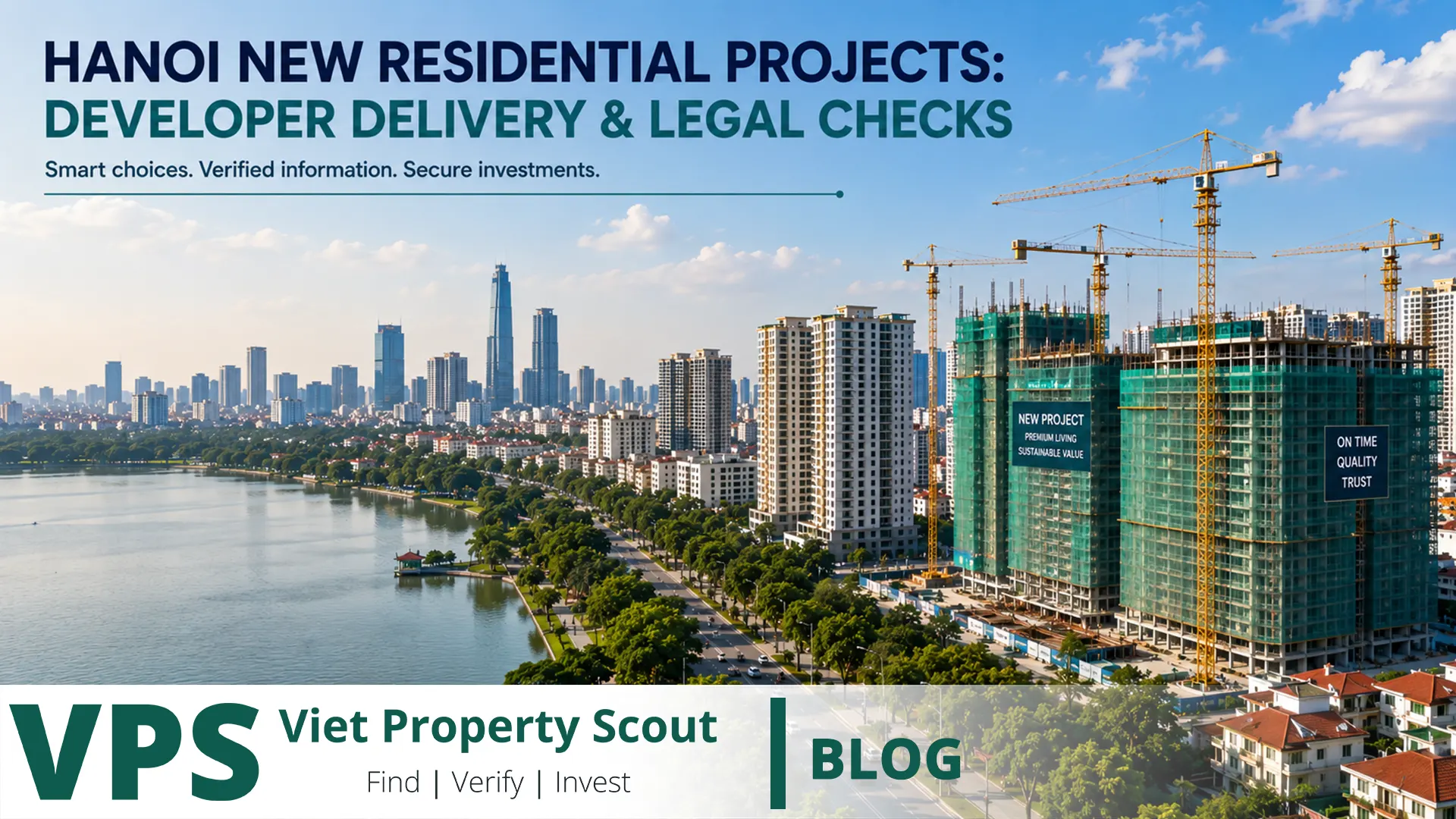
Short answer: A new residential project in Hanoi should be evaluated first through four questions, not through its pool, show unit or launch discount: Who is the actual legal project developer? Have the land, project approvals, construction and off-plan sale reached the required legal stage? Does the developer have the financial and execution capacity to finish and hand over the project? And does the purchase price still make sense after allowing for delay, construction quality, certificate risk and future competing supply? Since the Real Estate Business Law 2023 and Housing Law 2023 took effect on 1 August 2024, disclosure, deposit, payment and future-housing sale requirements have become more clearly structured. The core buyer rule is simple: a project being marketed does not prove it is legally ready for sale, a famous brand is not necessarily the legal project investor, and a handover date in a brochure is not a guarantee.
“New project” can describe very different legal and construction stages
| Stage | What a buyer may see | How to interpret it |
|---|---|---|
| Teaser / pre-marketing | Project name, renderings, registration of interest | Not evidence of legal sale eligibility |
| Early reservation | Preliminary unit selection or priority programme | Legal and payment structure requires close review |
| Construction commencement | Active site and foundation works | Positive progress, but not sufficient by itself |
| Eligible for off-plan sale | Official confirmation that future housing may be sold or lease-purchased | Critical legal checkpoint |
| Structure and fit-out | Visible physical progress | Execution risk declines but remains |
| Handover | Inspection, acceptance and keys | Quality and legal completion still need checking |
| Certificate issuance | Formal ownership/land-related rights documented | Separate milestone from receiving the keys |
A project in early marketing should not be underwritten like a tower whose foundation has been accepted and whose future apartments have received the required written confirmation for sale.
Who is the developer? The marketing brand may not be the legal project investor
A project can be marketed under a famous property group while the legally responsible investor is a separate project company or subsidiary. The relevant entity is the one shown in the investment decision, land documents, statutory disclosures and sale contract.
Ask who legally holds the project-development rights, who signs the sale contract, where buyer payments are sent, who owes the handover and certificate obligations, and whether the parent group provides any enforceable support or merely lends its brand.
Developer scorecard
| Factor | What to verify | Red flag |
|---|---|---|
| Delivery history | Projects actually completed and their original schedules | Many launches but few completed schemes |
| Post-handover quality | Waterproofing, lifts, finishes, common areas and management | Repeated resident complaints after delivery |
| Certificate history | Whether previous buyers received ownership certificates normally | Persistent unexplained certificate delays |
| Financial capacity | Debt, bonds, mortgages, cash flow and number of simultaneous projects | Heavy dependence on new presales to fund older developments |
| Contractor quality | Main contractor, consultants, supervision and track record | Repeated contractor changes or long stoppages |
| Transparency | Documents and construction progress can be independently checked | Sales team provides presentations but avoids legal files |
Legal documents: use a chain of verification, not one “legal pack”
A legally credible residential project is supported by a sequence of documents: investment policy/approval or investment decision, identification of the project investor, land allocation or lease decision or relevant land-use-right document, approved detailed planning, appraisal of the feasibility study/basic design, construction permit where required, commencement notice and then acceptance documents for project infrastructure according to progress.
For an apartment building or mixed-use building containing future housing, proof that foundation construction has been completed and accepted is an important part of the eligibility framework. Before future housing is sold or offered on lease-purchase, the developer must notify the provincial-level real-estate authority, which reviews the conditions and responds in writing on whether the housing is eligible to be brought to market.
The key off-plan document: written sale-eligibility confirmation
Do not accept “full legal” as a substitute for documentation. Ask for the official written confirmation covering the specific tower or phase containing your unit. Large developments can have several phases, and the legal status of one block should not automatically be assumed for another.
Current law also requires project and property information to be publicly disclosed through the housing and real-estate market information system and on the developer's website. Hanoi's own 2026 guidance directs market participants to the relevant Sở Xây dựng Hà Nội section covering brokerage activity and real-estate projects brought into business, providing an additional verification point beyond a PDF supplied by a salesperson.
Deposits and payment schedules: the cash flow must match the legal stage
Under the current framework, a developer may collect a deposit connected with the purchase or lease-purchase of future housing only once the property satisfies the conditions for being brought into business, and that deposit may not exceed 5% of the sale or lease-purchase price. The deposit agreement must state the price.
For an off-plan sale, the first payment may not exceed 30% of the contract value including the deposit. Subsequent payments must correspond with construction progress. Before handover, total payments generally may not exceed 70%; where the seller falls within the relevant category of foreign-invested economic organisation, the corresponding cap is 50%. Before the buyer's certificate of land-use rights/ownership of assets attached to land is issued, the seller may not collect more than 95% of the contract value; the remainder becomes payable after issuance.
These limits are risk controls, not bookkeeping trivia. A schedule demanding very high payment before physical progress or before sale eligibility deserves independent legal review.
Do not let the words Booking or Reservation hide the economic substance
Early-stage marketing uses many labels. The title of the form matters less than what it does. Is money being paid to secure a specific unit or priority to purchase? Is it fully refundable? Who receives it? What happens if the project never reaches sale eligibility? A buyer should analyse every early payment as a real financial commitment, not as harmless marketing administration.
Bank guarantee: understand what it actually protects
Before selling or lease-purchasing future housing, the developer must have a guarantee arrangement accepted by an eligible commercial bank for its financial obligations if it fails to hand over as agreed. Under the current system, however, each buyer can choose at contract signing whether to receive that protection for their own transaction or waive it in writing.
If the buyer chooses the guarantee, “the project is bank guaranteed” is not enough. Review the buyer-specific guarantee letter, beneficiary, covered amount, effective period, expiry and claim procedure. A general guarantee agreement between bank and developer is not the same thing as an individual guarantee letter protecting the buyer.
Project mortgages: financing is normal, opacity is not
Developers commonly finance projects using land, project rights or future assets as security. A mortgage is therefore not automatically evidence that a project is unsafe. The relevant issue is whether the land, project portion or future unit connected with the buyer remains encumbered and how the required release is handled.
Current disclosure rules include mortgages and restrictions on ownership or use. Where a housing project or future housing has been mortgaged, the buyer should verify the release treatment required under the Housing Law instead of relying on verbal reassurance from an agent.
How to evaluate handover-delay risk
Track physical progress over several months rather than comparing only today's date with a promised completion date. Observe workforce levels, structural floors, façade closure, MEP installation, lifts, common areas, internal roads and landscaping. A tower can appear advanced while the promised school, clubhouse, access road or wider infrastructure remains materially behind.
Compare the marketing completion date with the contractual handover date, any grace period, late-delivery compensation and buyer termination rights. “Expected Q4” in a presentation has little value if the signed contract gives the developer much wider flexibility.
Handover means more than receiving keys
At handover, inspect usable area, floors, walls, windows, doors, waterproofing, water pressure, drainage, electricity, air-conditioning systems, fire detection, sprinklers, communications, balconies, parking and common facilities. Where the contract specifies materials, brands or performance standards, compare the completed unit against them.
Current Housing Law sets minimum warranty periods for newly built housing: at least 60 months for apartment buildings and at least 24 months for individual houses, calculated from completion and acceptance for use. Statutory warranty coverage includes specified structural and major building-service defects, while installed equipment also follows manufacturer and contractual warranties.
Certificate risk: handover and completed ownership documentation are different milestones
A buyer may receive the unit and occupy it while certificate procedures remain outstanding. Review the developer's previous record: Were certificates issued to buyers in a reasonable period? Were land-related financial obligations completed? Did unauthorised design or use changes cause difficulties?
The rule preventing the seller from collecting more than 95% before certificate issuance provides structural leverage, but it does not eliminate time risk. Certificate delays matter particularly to investors planning rapid resale, refinancing or a clean future exit.
Foreign buyers: project and quota eligibility come before the view
Eligible foreign individuals may own housing in projects where foreign ownership is permitted, subject to security restrictions and statutory quantity limits. For residential apartments, the general cap is 30% of residential-purpose apartments in the relevant apartment building or, where applicable, each relevant block.
The 2026 framework makes local publication of projects eligible for foreign ownership an important verification step. A foreign buyer should separately confirm: Is the project permitted for foreign ownership? Is the specific unit legally residential housing? And does the relevant building still have available foreign quota? A brochure stating “foreigners can buy” is not enough.
Do not confuse a residential apartment with an officetel, serviced unit or condotel
Mixed-use developments can offer units that look similar in a brochure but have different legal functions. Legal use, tenure, residential registration, foreign ownership, financing, service charges and permitted operation can differ materially. The legal classification in the project documents is more important than the product's marketing name.
Is the launch price rational?
Compare three reference sets: competing new projects in the same corridor, recently completed projects whose actual quality can be inspected, and resale units in comparable buildings. If an off-plan unit is materially more expensive than completed stock, the premium should be supported by measurable advantages such as location, construction specification, management quality or genuine infrastructure superiority.
Do not prepay the entire future value of a promised mall, school, metro, park or view. An off-plan project normally carries more execution risk than a completed home; the buyer should be compensated for that risk rather than paying a premium merely because the project is a “new launch”.
Simple example: the economic cost of delay
Illustrative example only: assume an apartment costs VND 8 billion and is expected to hand over in two years, but delivery slips by 18 months. The cost is not just inconvenience. It includes tied-up capital, alternative accommodation, delayed rental income and lost investment opportunities. If the apartment was expected to produce VND 30 million per month of potential net rent, 18 months represents VND 540 million of deferred income before financing costs. The late-handover clause therefore deserves real financial attention.
Stress-test a new project
| Scenario | Assumption | Question |
|---|---|---|
| Base case | On-time handover and acceptable quality | Is the price still competitive with completed housing? |
| 18-month delay | Project completes late | Can you absorb tied capital and delayed income? |
| Specification downgrade | Common areas or materials disappoint | Does the contract give an enforceable standard? |
| Certificate delay | Unit handed over but certificate delayed | Does this damage resale or financing plans? |
| Supply shock | Several competing projects complete together | Are rent and resale assumptions still realistic? |
| Early exit | You need to sell before handover | Can the contract be transferred and at what cost? |
Practical due-diligence checklist before reservation or contract
- Identify the legal project investor, not only the brand.
- Review the investment approval/decision.
- Verify land allocation, land lease or land-use-right documents.
- Review approved detailed planning.
- Check design appraisal and construction permit where required.
- Confirm actual lawful construction commencement.
- For apartment projects, verify foundation completion acceptance.
- Obtain sale-eligibility confirmation for the exact tower or phase.
- Check project/unit mortgages and required releases.
- Review the bank guarantee and document your choice regarding it.
- Test deposit and instalment schedule against legal limits.
- Read the sale contract, not just the price sheet.
- Confirm handover date, grace period, compensation and termination rights.
- Record specification, parking and common/private ownership arrangements.
- Review the developer's certificate-issuance history.
- If foreign, verify project eligibility and remaining foreign quota.
- Compare price with completed and resale stock.
- Financially model a 12-18 month delay.
Red flags
- A famous group name but an unfamiliar contracting company with no clear parent support.
- Heavy sales activity but no sale-eligibility document for the relevant phase.
- Large early payments labelled reservation, cooperation or priority fees.
- Salesperson refuses to provide documents and asks the buyer to “trust the brand”.
- Payment schedule runs materially ahead of construction progress.
- Long construction stoppages while customer collection continues.
- Project mortgages cannot be clearly explained.
- Brochure gives a precise handover date while contract language is vague.
- Specifications allow broad substitutions without meaningful standards.
- Fast certificate issuance is promised despite poor historical performance.
- Foreign sale proceeds without formal project and quota verification.
- Large premium over completed housing without measurable advantage.
Investor decision matrix
| Investor profile | Product that often fits | Main priority |
|---|---|---|
| Conservative | Advanced construction or near-handover project | Reduce execution risk |
| Early-stage value buyer | Legally sale-eligible early phase from a strong developer | Price discount must compensate for time risk |
| Rental investor | Project in a proven tenant-demand location | Net rent rather than amenity marketing |
| Foreign buyer | Qualifying residential unit with clear foreign quota | Eligibility, certificate and resale |
| Short-horizon investor | Project with a workable contract-transfer market | Transfer rules, fees and secondary liquidity |
Frequently asked questions
Is a famous developer name enough?
No. Verify the legal project investor, project-specific documents, delivery record, finances and contractor.
Can a project take deposits before official sale?
Under the current framework, the deposit for purchasing future property is linked to the property already satisfying conditions for being brought into business and is generally capped at 5%. Early-reservation structures should be reviewed by substance.
What is the most important evidence that an off-plan apartment can be sold?
The official written confirmation from the competent authority that future housing in the relevant building or phase satisfies the conditions for sale or lease-purchase, supported by the underlying project documents.
Is bank-guarantee protection mandatory for the buyer?
The developer must have the guarantee arrangement, but under the current system the individual buyer may choose the guarantee or waive it in writing at contract signing. If chosen, the actual buyer-specific guarantee letter matters.
Does handover mean ownership is fully complete?
No. Physical handover and certificate issuance are separate milestones.
Can a foreigner buy any new apartment in Hanoi?
No. The project must permit foreign ownership, the unit must qualify as residential housing and the relevant foreign quota must remain available.
Conclusion: buy a project that can be verified, not merely a promise that can be marketed
New projects can provide modern design, payment flexibility and exposure to growing Hanoi districts. The trade-off is that the buyer pays today for an asset that will be completed in the future, so every promised future advantage carries execution, legal and timing risk.
For Hanoi new developments, Find | Verify | Invest means: find a project serving real demand, verify the legal investor, approvals, land, sale eligibility, mortgages, bank guarantee, construction progress, contract and foreign quota, then financially stress-test delay, quality and certificate risk. Invest only when the purchase still makes sense under a less-than-perfect handover scenario.