
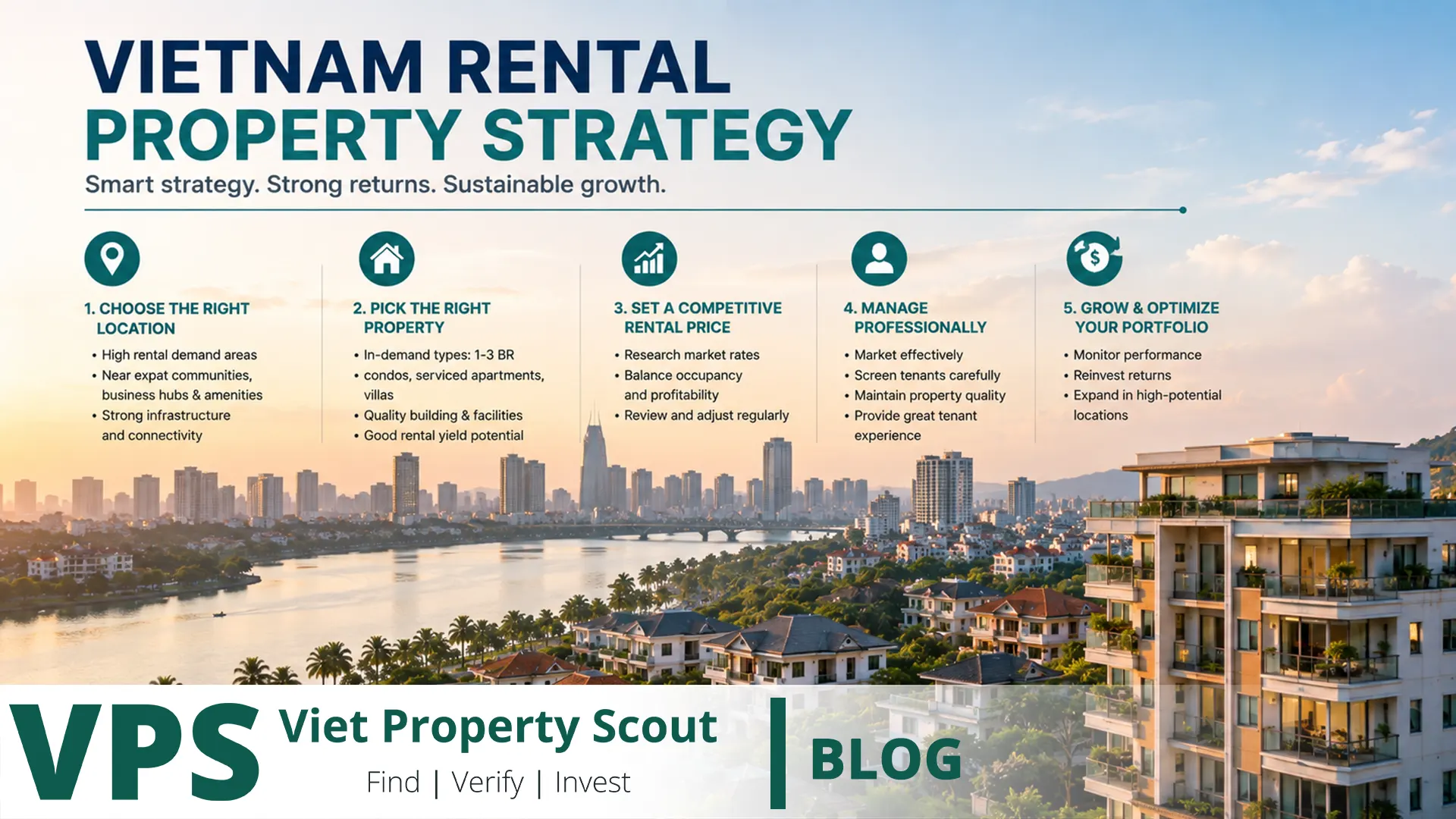
Short answer: for most individual property investors in Vietnam, long-term residential leasing is usually the simplest model legally and operationally and the easiest one in which to forecast cash flow. Short-term rental can generate higher gross revenue in tourism and business destinations, but only when the property type, project approvals, local rules and building management actually permit the intended accommodation use; an ordinary residential condominium should never automatically be underwritten as an Airbnb or hotel room. A serviced apartment is a third and genuinely different model: tenants pay a premium for furniture, cleaning, reception or support, maintenance and other services, making the product attractive to corporate and expatriate tenants, but operating costs, furnishing requirements and management standards are materially higher. The best strategy is therefore not determined by the highest nightly or monthly asking rent. It is determined by net operating income after all costs, legal durability, depth of tenant demand, management burden and resale liquidity.
Three rental strategies are three different businesses
| Model | Typical tenant | Typical stay | Management intensity | Primary risk |
|---|---|---|---|---|
| Long-term residential lease | Professional, family, student or resident expatriate | Usually 6-12 months or longer | Low to medium | Vacancy between contracts, tenant default and maintenance |
| Short-term accommodation | Tourist or business traveller | One night to several weeks | High | Legal use, seasonality, platforms, operations and hotel competition |
| Serviced apartment | Corporate executive, expatriate or relocating family | Weeks to 12 months or longer | High and professional | Service costs, operator quality and capital expenditure |
The first decision: are you buying a property or an operating business?
With long-term leasing, most of the investment value sits in the property itself: micro-location, acquisition price, layout, building quality, management, access to schools and employment. Once a suitable tenant is secured, day-to-day operating activity can be relatively limited.
Short-term rental changes the economics. The apartment partly becomes a hospitality business. Nightly pricing, booking management, guest registration, cleaning, check-in, reviews, utilities, urgent repairs, linen, consumables and repeated turnover become part of the operation. The investor therefore needs to underwrite real estate plus a hospitality operation, not simply a higher rent.
Serviced apartments sit between these models. A resident may stay for months, but expects a fully furnished product, regular cleaning, maintenance, reliable internet, support or reception and often common facilities. The premium paid by the tenant is compensation for a service package, and that service package costs money to provide.
What does Vietnam's professional serviced-apartment market show?
Savills' Q1 2025 data provide a useful benchmark for the institutional segment. Ho Chi Minh City had approximately 7,995 serviced-apartment units, with average occupancy of about 81% and average rents of roughly VND 529,000 per square metre per month. Hanoi had 6,246 units across 64 projects, with occupancy around 86% and rental growth continuing year-on-year.
In Hanoi, important Grade A tenant groups include Japanese and Korean expatriates working for FDI companies, multinational businesses, international banks and diplomatic organisations. This explains why genuine serviced residences can command a meaningful premium. It also demonstrates the standard an individual landlord competes against: international operators with organised housekeeping, maintenance, reception and corporate-leasing systems.
Strategy 1: long-term residential leasing
Long-term leasing is usually the most straightforward strategy for an investor who prioritises relatively stable cash flow and low operating complexity. In Hanoi, the natural tenant can be an office worker, technology professional, expatriate family, student or corporate employee. Ho Chi Minh City has an especially broad corporate, professional and entrepreneurial tenant base. In Da Nang and Nha Trang, long-stay foreigners, remote professionals, local workers and families can support selected submarkets.
Advantages of long-term leasing
- More predictable monthly cash flow.
- Fewer tenant turnovers.
- Lower cleaning and utility costs for the owner.
- Lower exposure to tourism seasonality.
- Simpler management.
- Easier net-yield calculation.
- Potentially lower furnishing wear.
Main long-term risks
- Extended vacancy if the apartment is overpriced.
- Non-payment or deposit disputes.
- Wear during a long tenancy.
- Limited ability to reprice during a fixed contract.
- Dependence on a single tenant.
- Weak yield if the acquisition price is too high.
Do not charge one monthly price for every contract duration
A one-month lease creates a different economic burden from a twelve-month lease. Short contracts mean more marketing, more handovers, more cleaning and greater vacancy risk. Monthly pricing should therefore vary by term rather than treating every tenant identically.
| Contract term | Monthly pricing logic | Operating risk |
|---|---|---|
| 1 month | Highest monthly premium | High |
| 3 months | Above 6- and 12-month rate | Medium to high |
| 6 months | Balance between price and stability | Medium |
| 12 months | Usually lower monthly rate in exchange for stability | Lower |
A property should also have a defined minimum rental duration. If the owner requires a minimum six-month term, one- and three-month pricing should not be presented as available contract options even if those rates exist in an internal pricing model.
Strategy 2: short-term rental
Short-term rental attracts investors because headline revenue can look impressive. A high nightly rate during summer, Tet, a conference or a major event can create the illusion of exceptional annual yield. But a VND 2 million nightly rate does not mean the unit earns VND 730 million a year. Occupancy, low season, platform commissions and operating costs materially reduce the result.
Costs commonly excluded from sales projections
- Booking-platform commission.
- Property-management fee.
- Cleaning and laundry.
- Electricity, water and internet.
- Guest consumables.
- Higher repair frequency.
- Furniture and linen replacement.
- Registration, administration and tax.
- Low-season vacancy.
- Unsellable nights between bookings.
Verify legal use before modelling Airbnb revenue
Vietnam's Housing Law 2023 prohibits using a residential apartment for a non-residential purpose. At the same time, Vietnam's tourism framework recognises separate accommodation categories, including tourist apartments and tourist villas. Investors should therefore not assume that buying a conventional residential condominium automatically gives them the right to operate it as daily tourist accommodation.
Ho Chi Minh City spent part of 2025 reviewing and developing possible pilot frameworks for regulated short-term apartment rentals under technical, safety, building and registration conditions. That debate is a useful reminder that local implementation can evolve. The correct investment rule is not “Airbnb is always prohibited” or “Airbnb is always permitted.” It is: verify the current rule for the exact city, project, legal unit classification and building at the date of operation.
When can short-term rental make sense?
- The unit is legally compatible with accommodation use.
- Demand exists across multiple seasons rather than one peak period.
- Achieved nightly rates and occupancy can be evidenced.
- A professional operator or genuine operating capability exists.
- The return still works after a 15-20% revenue downside.
- There is a legal fallback strategy if regulation or tourism changes.
Strategy 3: serviced apartment
A serviced apartment is not simply “a furnished apartment with a higher rent.” A genuine serviced product combines residential space with repeatable services: full furnishing, cleaning, maintenance, reception or resident support, security, internet and often a pool, gym, breakfast, shuttle or utility allowance.
For an individual investor, two very different structures are possible. One is exposure to a unit or investment within a professionally operated serviced-residence project. The second is buying an ordinary condominium and offering furniture plus extra services personally. The second product does not automatically become an institutional serviced apartment; it may simply be a premium furnished rental unless the service standard, operating structure and compliance are genuinely comparable.
Advantages
- Potential rental premium.
- Appeal to corporate and expatriate tenants.
- Medium- and long-stay demand.
- Strong relevance in Hanoi, HCMC and FDI centres.
- Product differentiation from standard condominium rentals.
Disadvantages
- Higher operating costs.
- Higher furniture and equipment Capex.
- Higher tenant service expectations.
- Competition from professional international operators.
- Exposure to corporate relocation and FDI cycles.
- More formal accounting, tax and operational administration.
How does the best strategy vary by city?
| Market | Long-term | Short-term | Serviced |
|---|---|---|---|
| Hanoi | Strong for families and professionals | Highly project- and rule-specific | Very strong for expatriate, diplomatic and FDI demand |
| Ho Chi Minh City | Very strong broad corporate demand | Strong demand, but regulatory verification is essential | Large established professional market |
| Da Nang | Good in functional urban and coastal submarkets | Strong tourism potential in legally suitable products | Smaller but relevant to international professionals |
| Nha Trang | Available but narrower | Strong tourism case in qualifying accommodation products | More tourism-oriented than major corporate-market driven |
Which model produces the highest yield?
There is no fixed answer. Short-term rental can produce the highest gross revenue and still produce a lower net yield. Serviced apartments can achieve a large rental premium, but part of that premium pays for the service platform. Long-term rental can look less exciting but sometimes generate the best risk-adjusted return.
Illustrative example only: assume a property costs VND 5 billion. As a long-term rental it earns VND 25 million per month and is occupied for 11.5 months, producing VND 287.5 million gross. If annual operating and turnover costs total VND 45 million, net operating income is VND 242.5 million, or about 4.85%. As a short-term unit, gross revenue could reach VND 420 million. But if platform fees, management, cleaning, utilities, vacancy and refurbishment consume VND 190 million, net income is VND 230 million, or 4.6%. Higher gross revenue produced a lower return.
Use one net-operating-income formula for all strategies
Compare all models on the same basis: actual gross revenue minus vacancy minus management minus building charges minus platform or marketing fees minus cleaning minus owner-paid utilities minus tax minus repairs minus furniture reserve = net operating income. Divide net operating income by total invested capital, not merely the advertised unit price.
Financing changes the investor return
If debt is used, separate the property's unlevered yield from the investor's cash-on-cash return. Rising interest rates can turn a positive-NOI property into negative monthly cash flow. Principal repayment is not an operating expense, but debt service must be included in investor-level cash-flow stress testing.
Risk profile by strategy
| Risk | Long-term | Short-term | Serviced |
|---|---|---|---|
| Seasonality | Low | High | Medium |
| Legal complexity | Low to medium | High | Medium to high |
| Management burden | Low | Very high | High |
| Furniture/equipment Capex | Low to medium | High | Very high |
| Income stability | Relatively high | Low | Medium to high |
| Tourism sensitivity | Low | High | Depends on tenant mix |
Stress-test the strategy before buying
| Scenario | Question |
|---|---|
| Rent falls 15% | Does net yield remain acceptable? |
| Two additional vacancy months | Can cash flow absorb the loss? |
| Tourism falls 20% | Can the unit legally move to a longer tenancy? |
| Management cost rises 20% | Does the serviced premium still create profit? |
| Short-term rules change | Is there a legal alternative strategy? |
| Furniture refurbishment after four to five years | Has sufficient Capex reserve been budgeted? |
| Sale required within six months | Would the next buyer want the property without the rental programme? |
Foreign investors: ownership and rental operation are separate questions
A property that can be rented is not automatically available for foreign ownership. Before acquisition, foreign buyers should verify project eligibility, unit classification, national-security restrictions and remaining foreign quota. For residential apartment buildings, the general foreign-ownership ceiling is up to 30% of residential-purpose apartments in the relevant building or block.
After ownership eligibility is confirmed, permitted rental use must be examined separately. Owning a residential apartment is not the same thing as holding permission to operate tourist accommodation. This distinction is particularly important in coastal, mixed-use and hospitality-marketed projects.
Due-diligence checklist before buying a rental property
- Choose the rental model before choosing the property.
- Define the natural tenant rather than an imaginary target customer.
- Verify the legal function of the unit and project.
- If foreign, confirm eligibility and remaining quota before paying a deposit.
- Collect achieved-rent evidence, not only asking rents.
- Use separate monthly pricing for 1-, 3-, 6- and 12-month contracts where relevant.
- Set a minimum permitted rental duration.
- Model realistic annual vacancy.
- Budget management, cleaning, utilities, tax and repairs.
- Create a furniture and appliance replacement reserve.
- Review building-management rules.
- Develop a fallback plan if short-term rental cannot continue.
- Map existing and future competing supply.
- Identify the natural resale buyer before purchase.
Red flags
- “Guaranteed Airbnb income” without legal and operating evidence.
- Peak-season nightly rate annualised for 365 days.
- A furnished condominium marketed as a professional serviced apartment.
- Only gross yield is presented.
- Platform, cleaning and utility costs are excluded.
- No clear lease, deposit or handover process for long-term tenants.
- The property only works if daily rental remains permitted forever.
- A weak operator promises a high guaranteed return.
- No reserve exists for furniture replacement.
- Hundreds of identical units in one project compete for the same renter.
Frequently asked questions
Which strategy is usually best for a first-time investor?
A legally straightforward residential unit with genuine long-term tenant demand is usually the easiest starting point because operating complexity is lower and income can be verified more clearly.
Does short-term rental always earn more?
It can earn more gross revenue. After platforms, cleaning, utilities, vacancy, management and faster refurbishment, net income may be lower.
Can every condominium be used for Airbnb?
No such assumption should be made. Housing law, project classification, local implementation and building rules should be checked at the time of operation.
What is the difference between a furnished apartment and a serviced apartment?
A furnished apartment provides furniture. A genuine serviced apartment adds a repeatable operating package such as cleaning, maintenance, support or reception and other resident services.
Can serviced apartments work for foreign investors?
Yes, if ownership eligibility, operator contract, fees and net return are clear. A marketing promise or guaranteed-yield brochure should never substitute for contract and counterparty analysis.
Is a twelve-month lease always better?
No. Shorter contracts may justify higher monthly rent, while longer contracts reduce vacancy and turnover. The right choice depends on the local tenant base and the property's operating costs.
Conclusion: the best strategy is the one that creates legally repeatable net cash flow
Vietnam offers three distinct rental opportunities: stability through long-term residential leasing, higher revenue potential through short-stay accommodation and a service premium through professionally managed serviced apartments. The highest headline rent is not necessarily the best investment.
Find | Verify | Invest means: find the real tenant and the appropriate rental model, verify legal use, contracts, achieved rent, costs and operator quality, and invest only when net income remains acceptable after vacancy, maintenance, tax and regulatory downside. In rental property, the strongest strategy is not the one with the highest nightly rate; it is the one that converts genuine demand into durable income with the fewest fragile assumptions.