
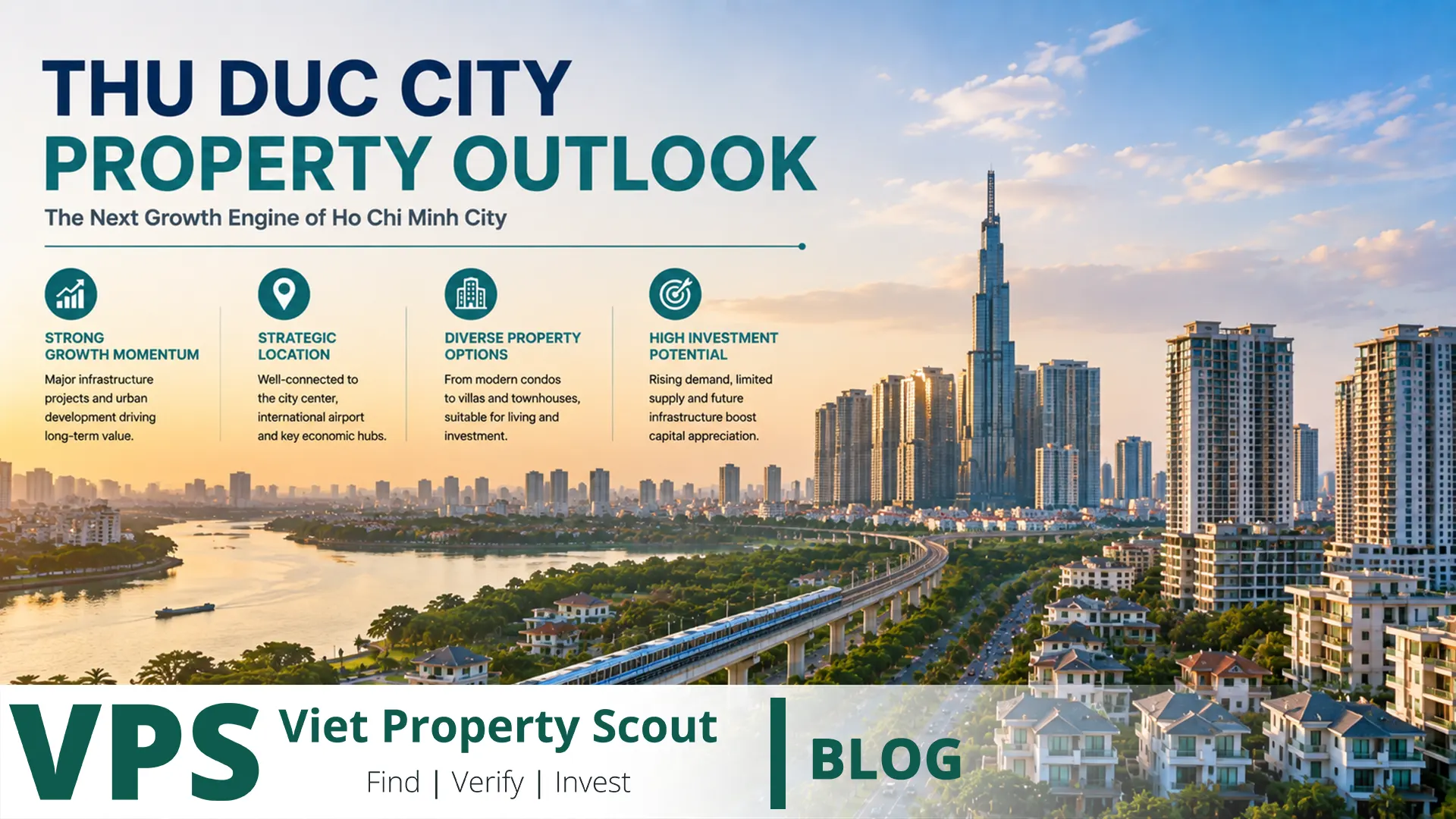
Investment takeaway: The eastern Ho Chi Minh City area still widely known in the property market as Thu Duc remains one of the metropolis's strongest structural residential growth corridors, but buying anything simply because it carries a “Thu Duc” address is not an investment strategy. Thu Thiem, An Phu and Thao Dien, Truong Tho, Long Binh, Long Truong, and the university and high-tech clusters each have different pricing, demand and liquidity characteristics. By 2026, some infrastructure catalysts that investors discussed for years have become operational reality, most notably Metro Line 1. Others, including Ring Road 3, Long Thanh International Airport and the An Phu Interchange, remain at different stages of construction. A disciplined investor should therefore avoid buying an infrastructure promise. The relevant questions are how much infrastructure already works, how much is genuinely under construction, how much future benefit has already been priced into the property, and whether the specific development has clear legal status plus genuine end-user or rental demand.
What does “Thu Duc” mean after the administrative restructuring?
One administrative change must be understood before analysing the market. Thu Duc City, previously formed from the former District 2, District 9 and Thu Duc District, no longer exists as the same city-level administrative unit following Vietnam's introduction of the two-tier local government structure on 1 July 2025. The area was reorganised into new wards. Nevertheless, “Thu Duc” remains deeply embedded in real estate language, location descriptions and long-term planning as a familiar geographic and economic identity for eastern Ho Chi Minh City.
That makes the name useful for market analysis, but sales contracts, leases and due diligence should use the property's current ward and official administrative address. Former labels such as District 2 and District 9 remain useful when discussing established submarkets, but investors should not confuse those legacy market names with the present legal address structure.
Infrastructure in 2026: what is operational and what is still being built?
| Catalyst | Status in 2026 | Property relevance | Mistake to avoid |
|---|---|---|---|
| Metro Line 1 Ben Thanh–Suoi Tien | Commercially operational since December 2024; approximately 19.7 km with 14 stations | Rail accessibility is now measurable rather than speculative | Assuming every eastern property benefits equally from the metro |
| Ring Road 3 | Overall construction exceeded 80% by August 2026, with additional sections targeted for operation during 2026 | Stronger regional connectivity and redistribution of road traffic | Pricing a property as if every section were already complete |
| An Phu Interchange | Approximately 75% complete in August 2026, with the implementation schedule extended into 2027 | Critical for the eastern gateway and HCMC–Long Thanh–Dau Giay Expressway access | Using outdated completion dates from sales presentations |
| Long Thanh International Airport | Still under construction, with commercial operations targeted for December 2026 | Long-term support for eastern connectivity, jobs and regional services | Treating the airport as already operational or as a guaranteed price-growth mechanism |
| Eastern urban development strategy | Focused on innovation, education, high technology, finance, healthcare and services | Can generate employment centres and durable housing demand | Confusing a long-term master plan with measurable demand today |
Why does Thu Duc have a credible residential growth case?
The area's fundamental strength is not one megaproject. It is the overlap of several demand engines: mass transit, regional roads, technology employment, universities, the financial centre planned around Thu Thiem and large residential communities. That combination matters because sustainable residential value rarely comes from infrastructure alone. It comes when people, jobs and services move with the infrastructure.
Metro Line 1 illustrates the change clearly. Before opening, buyers were purchasing an expectation. Today an investor can measure walking distance to a working station, actual journey times, feeder connectivity and the quality of the route between the building and the station. A marketing narrative can therefore be converted into observable evidence.
The eastern planning vision also centres on the knowledge economy, education, advanced technology, financial services and healthcare. To the extent that these plans translate into real workplaces, they create housing demand from employees, specialists and families. For a property investor, demand from people who genuinely need to live in an area is far more durable than price appreciation driven mainly by buyers expecting to sell to another investor.
Thu Duc is not one market: the key submarkets
Thu Thiem: strongest location quality, highest entry barrier
Thu Thiem sits directly across the Saigon River from the traditional city centre and has a strategic role in plans for an international financial centre as well as new commercial, cultural and public spaces. It is one of the east's strongest locations for premium developments, affluent owner-occupiers and executive rental demand.
The strength of the story creates its main investment risk: paying today for growth that everybody already expects. Entry price must be compared with the secondary market, competing projects, delivery timing, unit position, floor, view and developer quality. An excellent property purchased at an excessive valuation can still produce a weak investment return.
Thao Dien and An Phu: a relatively mature residential and rental ecosystem
Thao Dien and An Phu already have international schools, restaurants, services and a substantial international residential community. For rental investors, existing tenants can be more valuable than a distant promise of future population.
However, analysis must be building-specific and street-specific. Metro accessibility, road congestion, construction activity, drainage conditions in individual locations, building management and competing rental inventory can produce materially different results between projects only a short distance apart.
Truong Tho: urban transformation and TOD potential
Truong Tho features in development planning as a new urban centre associated with public transport and redevelopment. The long-term potential is meaningful, but the investment case requires more patience. A site already supported by connectivity and established economic activity is fundamentally different from one that depends on several future planning, land-assembly and construction stages.
Long Binh, Long Truong and the former District 9 growth corridor
These locations have a different value proposition from Thu Thiem. Larger land areas and master-planned residential communities can attract families, employees and buyers seeking relatively lower entry prices. Ring Road 3 and the wider Long Thanh connectivity story are particularly relevant here.
Investors must nevertheless monitor future supply. A district capable of accommodating tens of thousands of new homes does not guarantee equal appreciation for every apartment. If thousands of similar units complete together, owners may compete for the same tenant and the same resale buyer.
University and High-Tech Park areas
Universities, research facilities and technology employment can create genuine housing demand, but the product must match the user. A very large luxury apartment may be poorly aligned with a young engineer or postgraduate renter. Sound investment analysis identifies the probable occupier or end buyer first and selects the property second.
Housing supply growth is both an opportunity and a warning
Ho Chi Minh City's condominium market recorded a meaningful supply rebound in 2026. CBRE reported 1,642 newly launched condominium units in the former HCMC market during Q1 2026, an increase of 369% year on year. In Savills' Q1 2025 outlook, the then-defined Thu Duc City was expected to contribute approximately 55% of almost 40,000 apartment units anticipated through 2027.
Those figures require interpretation. Additional supply can create better choice, greater market depth and stronger communities. It can also create competition between projects. “More housing is coming” is therefore not automatically bullish. The more useful question is: is solvent end-user demand growing at a comparable rate, and does the specific unit have a defensible advantage over competing stock?
Infrastructure does not automatically create capital gains
One of the weakest investment arguments in a growth market is: “A road or metro is coming, therefore prices must rise.” Infrastructure value can be reflected at several stages: announcement, approval and funding, physical construction, and finally operation. Property prices can move significantly during the first two stages, leaving later buyers to pay in advance for benefits that have not yet arrived.
Investors should therefore analyse the gap between expected infrastructure value and today's price. A home 600 metres on foot from an operating metro station, with a practical pedestrian route and an existing community, is fundamentally different from a development marketed as “near a future metro” because a proposed line appears on a long-term planning map.
The Viet Property Scout framework for analysing a Thu Duc investment
| Factor | The question that matters |
|---|---|
| Legal status | Can the land status, project approvals, construction permits, sales eligibility, contracts and ownership documentation be independently verified? |
| Current connectivity | How long does it take today to reach employment, schools, metro stations and major roads? |
| Future infrastructure | Is the catalyst merely proposed, approved and funded, physically under construction, or approaching operation? |
| End-user demand | Who will genuinely live here: a family, technology worker, foreign executive, student, or simply another speculative investor? |
| Rental depth | How many competing units are available, how long do they remain vacant and what rents are actually being contracted? |
| Entry valuation | Does today's purchase price leave room for return, or has the infrastructure story already been fully capitalised? |
| Exit liquidity | If you sell in three or five years, who is the natural buyer for this exact unit? |
Which strategy fits which investor?
| Investor objective | Stronger logic | What to avoid |
|---|---|---|
| Capital preservation in a premium asset | Legally strong, high-quality projects in established premium locations such as Thu Thiem | Paying any price purely for a prestigious project name |
| Rental income | Areas with tenants today, such as Thao Dien, An Phu and established employment clusters | Depending entirely on tenants expected to arrive years later |
| Medium- to long-term capital growth | Locations benefiting from infrastructure that is genuinely being delivered while entry valuation remains rational | Buying after the entire infrastructure premium has already been priced in |
| Lower budget | Selective projects in outer corridors supported by genuine residential demand | Buying a huge project only because its price per square metre looks cheaper |
| Foreign investor | Eligible project, available foreign ownership capacity, clear documentation and a practical exit strategy | Paying a reservation before confirming ownership eligibility |
Rental yield: asking rent is not evidence
Two units in the same development can deliver very different investment returns because purchase price, furniture, floor, view and acquisition timing differ. Yield should therefore be calculated using realistically achievable rent after vacancy and operating expenses, not the highest advertised rental listing found online.
Management charges, repairs, furnishing depreciation, leasing commissions, vacancy periods and relevant taxes or obligations should be deducted to understand net performance. An investor can buy an excellent apartment at an excessive price and end up with a poor yield.
Seven major risks in a Thu Duc investment
- Infrastructure already priced in: the market may have capitalised much of the expected metro, road or airport benefit.
- Delivery delay: An Phu demonstrates that complex infrastructure can move beyond earlier schedules.
- Legal risk: location quality cannot compensate for weak documentation or unclear sales and ownership eligibility.
- Supply risk: large master plans can release thousands of similar units into the market.
- Liquidity risk: ultra-premium products may have a limited resale buyer pool.
- Micro-location risk: traffic, noise, construction and drainage can vary dramatically within a small radius.
- Financing and currency risk: borrowing costs, interest rates and exchange-rate movements matter, particularly to international investors.
Foreign investors: verify before reserving
A foreign buyer should verify project eligibility for foreign ownership, available foreign ownership capacity, applicable ownership structure and duration, developer documentation, fund-transfer procedures and tax implications before paying a reservation. A famous project or established sales agency does not remove the need for unit-specific verification.
Pre-investment verification checklist
- Use the current ward address and treat former District 2, District 9 and Thu Duc City labels only as market references.
- Verify land status, approvals and project legal documentation.
- Separate operational infrastructure from construction projects and long-term proposals.
- Actually travel from the project to the metro, employment centres and main roads.
- Compare developer pricing with the secondary market and genuine competing projects.
- Check achieved rental transactions rather than relying only on asking rents.
- Calculate net yield after vacancy and operating costs.
- Review how much competing future supply is planned around the project.
- Define the probable renter or resale buyer before purchasing.
- Build conservative three-, five- and seven-year exit scenarios.
Frequently asked questions
Is Thu Duc still an independent city-level administrative unit?
Not in the form that existed before July 2025. Vietnam's two-tier local government reform removed the intermediate administrative level and the former Thu Duc City area was reorganised into wards. The name nevertheless remains widely used as a geographic, planning and real estate market reference for eastern HCMC.
Is Metro Line 1 still a future project?
No. The Ben Thanh–Suoi Tien line has been commercially operational since December 2024. Properties should therefore now be evaluated on actual station access and real travel times rather than a future promise.
Is Ring Road 3 complete?
Not fully as of August 2026. Overall progress is above 80%, with different sections moving toward operation during 2026. Investors should verify the particular section relevant to their property.
Is Long Thanh International Airport already operational?
No as of August 2026. The official target is commercial operation in December 2026. Its property impact should therefore still be treated as a catalyst under delivery rather than a completed operating reality.
Is every apartment near the metro a good investment?
No. Practical walking distance, pedestrian access, legal status, building quality, purchase valuation and real housing demand all matter. Metro proximity cannot rescue an overpriced or legally weak property.
Where is the greatest growth potential?
There is no single answer for every investor. Thu Thiem offers premium location quality, Thao Dien and An Phu have deeper existing rental demand, while Truong Tho, Long Binh and Long Truong offer different transformation and infrastructure-led opportunities. The strongest investment is the one where price, catalyst, user demand and exit liquidity remain in balance.
Conclusion
The investment case for Thu Duc is credible, but not simply because “eastern Ho Chi Minh City is growing.” The area combines an operating metro, a ring-road system approaching further completion, an international airport targeted to begin operations, technology and education clusters, financial-sector development and a substantial residential pipeline. The market, however, already knows all of these stories, which means part of the future may already be embedded in today's prices. A disciplined investor asks more than “what will be built here?” The harder questions are what works today, what is genuinely likely to be completed, how much you are paying for the future, who will actually use the property, and whether it can still be rented or sold if prices rise more slowly than expected. In Thu Duc, the right project purchased at the right price can be a powerful long-term investment. The wrong project or the wrong entry valuation will not be rescued by even the best infrastructure in the city.