
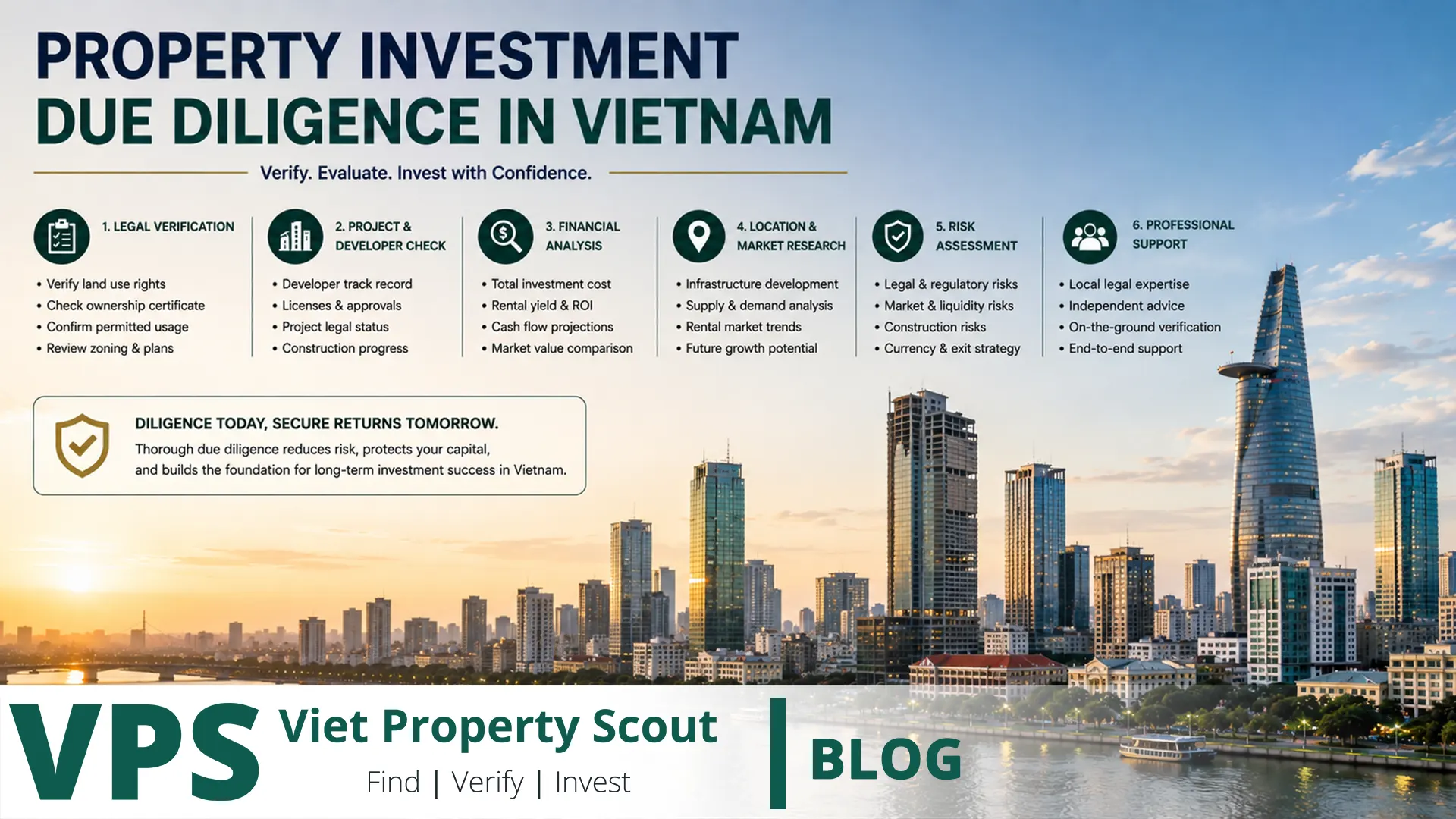
Short answer: real estate due diligence in Vietnam is not merely checking whether a certificate exists or asking a broker whether a project is “legal.” It should answer a stricter question: can this specific buyer acquire this specific asset from this specific seller under this contract and at this price, legally hold and operate it, and later exit with an enforceable and economically viable position? A transaction should pass at least nine verification gates: buyer eligibility, seller/developer authority, project status, land and certificate, mortgages and disputes, physical condition, price and income, contract and payment mechanics, and finally liquidity and exit. Every gate should end with one of three outcomes: Go when evidence is sufficiently clear, Fix where a risk can be cured by a document or contractual condition, and No-Go where a fundamental right is missing or cannot be independently verified.
Due diligence is not document collection; it is a system for rejecting bad deals
A common mistake is to treat due diligence as a process for finding reasons to proceed. Its real function is to identify the reason not to pay before the investor becomes financially or psychologically committed. A development can have a famous brand, a strong developer and an attractive unit while still being unsuitable because foreign quota is full, a mortgage is unresolved, legal use is unclear, pricing is excessive, the contract is weak or the resale buyer pool is narrow.
Every material claim should therefore connect to independent evidence: an official document, certificate, register record, contract, bank document, technical inspection, achieved rental evidence or defensible market comparison. “The sales team told me” is not due-diligence evidence.
The nine-gate verification framework
| Gate | Core question | Go | Typical No-Go |
|---|---|---|---|
| 1. Buyer | Can this buyer legally hold this asset? | Eligibility evidenced | Asset is not legally available to buyer |
| 2. Counterparty | Is the seller/developer legally entitled to transact? | Identity and authority match | A different person/entity demands funds |
| 3. Project | Is the project approved in the function being marketed? | Approvals are consistent | Marketing conflicts with official project use |
| 4. Land/certificate | What legal right actually supports the asset? | Type, term and certificate are clear | Legal position cannot be explained |
| 5. Mortgage/dispute | Is the asset encumbered or contested? | Clear or documented release mechanism | Unresolved mortgage or dispute |
| 6. Physical reality | Does the asset match what is being sold? | Condition, size and access align | Material technical or functional defect |
| 7. Price/income | Is value supported by market and realistic income? | Comparables and NOI are credible | Value depends mainly on future promises |
| 8. Contract/payment | Are buyer protections enforceable? | Balanced terms and payment path | Non-refundable money before verification |
| 9. Exit | Who will rent or buy later? | Natural demand pool exists | Exit relies only on another speculator |
1. Start with buyer eligibility before selecting the unit
A Vietnamese citizen, overseas Vietnamese person, foreign individual, foreign organisation and foreign-invested enterprise do not automatically have the same acquisition rights. The first step is therefore to identify the buyer's legal category and then test the asset against that category.
For a foreign individual, the review normally includes lawful entry eligibility, whether the housing project is open to foreign ownership, remaining foreign quota in the relevant building or block, the unit's legal residential classification and expected ownership term. In a residential apartment building, the general ceiling for foreign ownership is up to 30% of the residential-purpose apartments in the relevant building or block. Foreign-individual housing ownership is generally limited to up to 50 years from certificate issuance, with one extension potentially available if the statutory conditions continue to be met.
A foreign individual should not treat qualifying housing ownership as equivalent to an unrestricted standalone land-use right available to an eligible local holder. Nominee ownership through a friend, partner or employee adds control, enforcement, inheritance and creditor risk rather than solving the underlying legal issue.
2. Verify the party that is going to receive the money
A new development may involve a parent company, project company, sales agency, contractor, operator and marketing team. Due diligence must identify who legally controls the project, who has authority to sign, who is entitled to receive funds and whether the receiving bank account belongs to the correct contractual counterparty.
- Obtain the full legal entity name and registration details.
- Verify the legal representative or authorised signatory.
- Match the entity against investment, land and project approvals.
- Do not send purchase funds to a salesperson's or broker's personal account.
- For resale, match seller identity against the certificate and review relevant marital, inheritance or power-of-attorney issues.
For future property, the current Real Estate Business Law also places important restrictions around delegation of deposit and sale-contract signing by project developers for covered products. If the entity taking money does not match the legal developer or seller, stop until the legal basis is established.
3. The asset type determines the due-diligence route
| Asset | Core document | Additional verification |
|---|---|---|
| Resale apartment | Certificate + seller identity | Mortgage, dispute, management, fees, transferability |
| New development / Off-plan | Project file + current sale eligibility | Progress, guarantee, deposit, payment and handover schedule |
| Land | Land-use-right certificate | Purpose, tenure, planning, boundaries, access and acquisition risk |
| Villa/Townhouse | Certificate or project legal structure | Land, common areas, building rights and foreign eligibility |
| Condotel/tourism product | Project function + land classification | Tenure, operation, certificate, management agreement and liquidity |
A residential apartment and a condotel can look almost identical in a brochure while creating completely different legal, operating and resale rights. One generic checklist is therefore not enough.
4. Verify the project before the individual unit
For a new development, confirm that the project exists legally in the form being marketed. Typical review areas include the investment decision or approval, land basis, approved detailed planning, authorised project function, required construction documentation and actual construction progress.
Infrastructure and planning should always be divided into four categories: completed and operational, under construction, formally approved but not started, and conceptual or merely proposed. A conceptual metro line should never receive the same valuation weight as an operating station. Likewise, a general city master plan does not equal parcel-level entitlement.
5. Land and certificate: do not finish the review with a WhatsApp image
For completed assets, obtain a verifiable copy of the certificate covering land-use rights and ownership of assets attached to land. Review the named rights holder, land or asset use, area, term, origin of rights and registered restrictions where applicable. Decree 101/2024 forms part of the current framework governing land registration, certificate issuance and the land information system.
For land, legal boundaries also need physical verification. A certificate does not prove that the current fence, access lane or area occupied on the ground matches the legal parcel. Survey boundaries, lawful access, encroachments, easements and potential road or public-project reservations should be reviewed.
6. For off-plan property, verify sale eligibility before the deposit
An approved development does not mean every construction phase can immediately be sold. Future property must satisfy the statutory conditions for being put into business, including relevant land and construction-progress documentation.
The current Real Estate Business Law generally caps a developer deposit for covered future-property purchases or lease-purchases at 5% of the sale or lease-purchase price, after the property satisfies the legal conditions for being put into business. The deposit agreement must also state the relevant price. If money is requested earlier under a label such as “reservation fee,” the legal substance of the payment should be analysed rather than relying on its marketing name.
7. Investigate mortgages, enforcement and disputes
Bank financing is normal for major developments. The question is whether the project land, part of the project or the unit is encumbered and, if so, how the specific unit will be released before or at completion.
For resale, examine registered mortgages, disputes, enforcement proceedings, unresolved inheritance, marital claims and whether the seller has full authority to transfer. Possession of an original certificate does not automatically prove the absence of every legal dispute.
8. Planning due diligence asks what may happen to the asset, not only what exists today
An excellent property today can face a future road reservation, a tower that blocks its view, a change in traffic patterns or public infrastructure affecting access. Conversely, peripheral land can benefit from genuinely approved and implemented infrastructure. The investor should not, however, pay the entire future upside in today's purchase price.
Classify every infrastructure catalyst as operational, under construction, approved or conceptual and apply a progressively larger discount as implementation certainty falls.
9. Physical inspection should occur at more than one time of day
Do not inspect only at midday. Visit in the morning, rush hour, evening and, if possible, during heavy rain. Check noise, smells, drainage, water pressure, lifts, backup power, parking, security, management quality, taxi and delivery access and the actual condition of common areas.
For an apartment, also inspect leaks, cracks, sound insulation, sun exposure, ventilation, air conditioning, appliances, furniture and unpaid management charges. For villas and land, check boundaries, fill level, drainage, lawful access and flood exposure.
10. Price verification should use transactions, not optimistic advertisements
An asking price is the seller's opinion. Investment value should be supported as far as possible by recent transactions, comparable units in the same project, secondary-market evidence, signed rents and actual operating costs.
Adjust comparables for size, floor, view, fit-out, parking, certificate status, building age and payment terms. Developer incentives such as cashback, furniture packages or interest support should be converted into cash value before comparing effective prices.
11. Return analysis should begin with NOI, not gross yield
Illustrative example only: assume an apartment costs VND 8 billion and a realistic achieved rent is VND 35 million per month with eleven occupied months. Annual gross rent is VND 385 million. If brokerage, vacancy, maintenance, replacement and landlord-paid fees total VND 75 million, NOI is about VND 310 million, or roughly 3.9% of purchase price before financing and tax. A simple gross yield of 5.25% would have presented a much more optimistic picture.
Then stress test the deal: reduce rent by 10%, assume two vacant months and add a major repair. If the transaction only works in the best case, it is not robust. Tourism property should similarly be modelled using occupancy, ADR, platform charges and operating expenses rather than 365 perfect nights.
12. Verify that the intended rental strategy is legal
Owning a residential apartment does not automatically permit daily tourist accommodation. Review the approved function of the project and building, condominium rules, business requirements, taxation, fire-safety obligations and guest or temporary-residence reporting.
If the investment only works with short-term rental, legal permission for that use becomes a core due-diligence document. If it is uncertain, also model a six- or twelve-month rental strategy.
13. The contract is where sales promises become enforceable rights or disappear
Review the sale-contract draft before the final deposit, not afterwards. It should cover the exact asset, price, payment schedule, taxes and fees, handover specification, area-adjustment mechanism, delivery date, grace period, delay compensation, certificate process, mortgage, termination, refunds, assignment and dispute resolution.
Oral statements such as “the view is guaranteed,” “foreign quota is available,” “Airbnb is allowed,” “the return is guaranteed” or “the certificate will come quickly” have little value unless they are both legally possible and documented in an enforceable form.
14. Building management and operating expenses are part of asset quality
A legally clean asset can perform poorly because of weak management: broken lifts, poor security, inadequate maintenance, high service charges or disputes between residents and management. Review the service-charge budget, building rules, maintenance record, parking arrangements and separately billed services.
For serviced or hospitality assets, also examine the operator, management-agreement term, management and marketing fees, reserve fund, operator-replacement rights and how distributable revenue is calculated.
15. Exit analysis is part of entry due diligence
Before purchase, ask who the natural buyer will be in five years. Is it a Vietnamese owner-occupier, another foreigner, a family or only another investor? How many identical units compete in the same tower? Does tenure or legal function narrow the buyer pool? Can the contract be assigned before certification if liquidity is needed?
If the only exit thesis is “sell to another investor at a higher price,” the strategy depends on continued speculation. More defensive assets have a natural user or tenant even when investor sentiment slows.
A 100-point due-diligence score
| Category | Points | Assessment |
|---|---|---|
| Buyer and ownership | 10 | Eligibility, foreign quota and tenure |
| Seller/developer | 10 | Identity, authority, track record and execution |
| Project and land | 20 | Approvals, use, certificate and boundaries |
| Mortgage/dispute | 10 | Release, disputes, enforcement and inheritance |
| Physical/management | 10 | Condition, access, fees and building operation |
| Price/return | 15 | Comparables, rent, NOI and stress testing |
| Contract/payment | 15 | Deposit, delivery, compensation, termination and certificate |
| Liquidity/exit | 10 | Buyer pool, transferability and resale |
A conservative internal rule can be useful: below 70 = No-Go; 70–84 = Fix unresolved risks before payment; 85+ = proceed to the final investment decision. Even a score above 90 does not prove that the price is attractive; it only means the risk structure is better understood.
A practical pre-payment deal room
- Buyer identity and eligibility evidence.
- Seller/developer identity and signing authority.
- Certificate or project and land documentation.
- Investment, planning and approved-use records.
- Current sale eligibility for off-plan property.
- Mortgage evidence and release mechanics.
- Dispute, enforcement and inheritance review where relevant.
- Plans, areas and survey evidence where needed.
- Defensible sale and rental comparables.
- Management, service and maintenance budgets.
- Deposit agreement and sale-contract draft.
- Payment, handover and certificate schedule.
- Evidence that the intended rental use is lawful.
- Resale analysis and identification of the natural future buyer.
Red flags that justify an immediate stop
- Pressure to pay before documents are provided.
- “The certificate will come later” without a verifiable legal pathway.
- Mortgage status is not disclosed.
- The payment recipient does not match the contractual party.
- Foreign quota is evidenced only by a broker message.
- The product is alternately described as apartment, residence and condotel without explanation.
- Conceptual infrastructure is priced as though already completed.
- Guaranteed return without verifiable credit support.
- A major premium over market with no measurable justification.
- Short-stay income assumed without confirmed legal use.
- A nominee proposed instead of a lawful ownership right.
- The buyer is discouraged from using independent advisers.
Frequently asked questions
Is a clean certificate enough to complete due diligence?
No. A certificate is important but does not by itself resolve planning, unregistered disputes, physical condition, management quality, market price, rental legality or contract risk.
What is the most important off-plan document?
No single document is sufficient. Land status, project approvals, construction progress, sale eligibility, mortgage position, contract and certification pathway must work together.
Can I pay a small amount to reserve the unit and verify later?
Doing so reduces buyer leverage. Core documentation and initial verification should ideally be complete before any non-refundable payment, and future-property deposits must also comply with the current legal framework.
Does a major developer require less due diligence?
A strong developer may reduce some execution risk but does not replace review of the specific unit, price, mortgage, foreign quota, planning or contract.
Are online listings enough for price comparison?
No. Asking prices are not completed transactions. Achieved sales and signed rents are more valuable whenever available.
What is the strongest protection against a bad investment decision?
Define No-Go criteria before becoming emotionally attached to the asset. If the criteria are created after the investor already wants the property, due diligence often becomes an exercise in justification.
Can due diligence be completed without independent advisers?
An investor can perform substantial initial screening independently, but major, foreign, off-plan, land and tourism-product transactions warrant independent legal and, where relevant, technical review before commitment.
Conclusion: a good investment begins with a provable right, not a desire to complete the deal
A practical Vietnam due-diligence framework turns every sales claim into a verifiable question: who owns it, who is selling it, what can legally be sold, what land right exists, is there an encumbrance, can this buyer own it, is the intended use lawful, is the price supported by real market and income evidence, and who is the natural exit buyer?
Find | Verify | Invest means: find the asset, verify the right, documents, physical reality, price, contract and exit, and invest only when the transaction does not need unproven assumptions to look attractive. Good due diligence does not make a deal more complicated; it makes the final yes or no more defensible.