
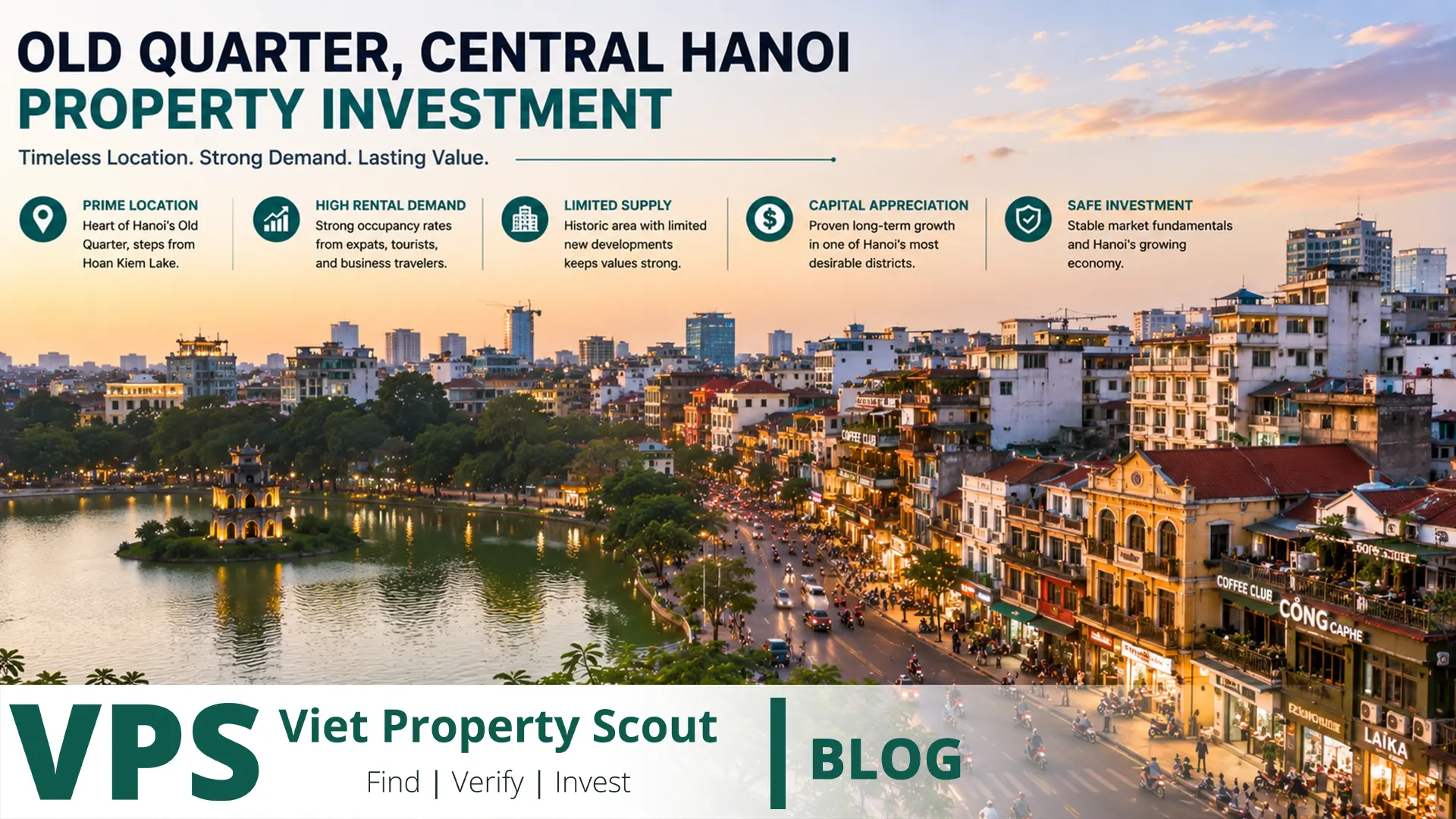
Short answer: Old Quarter and central Hanoi real estate offers something that new districts cannot easily reproduce: scarcity, historic location, proximity to government, commerce, tourism, culture and deeply established urban services. That does not make every central property a good investment. The Old Quarter, Hoàn Kiếm, Ba Đình and the French Quarter contain ageing buildings, narrow streets, limited parking, potentially complex shared ownership, heritage constraints, redevelopment uncertainty and high acquisition prices that can compress rental yields. The right question is therefore not “Is the historic centre more valuable?” but “Does the historical-location premium remain justified after real income, building condition, legal use, maintenance, liquidity and operational practicality are measured?” For an investor prioritising capital preservation, scarcity and irreplaceable location, central Hanoi can be exceptionally strong. For someone prioritising straightforward management, parking, modern facilities and easier-to-model residential income, a newer condominium outside the historic core may be more practical.
What do “Old Quarter” and “central Hanoi” mean after the 2025 administrative reorganisation?
Since 1 July 2025, Hanoi's former district structure no longer operates as the same administrative layer. The new Hoàn Kiếm ward was formed from all or parts of historically familiar wards including Hàng Bạc, Hàng Bồ, Hàng Buồm, Hàng Đào, Hàng Gai, Hàng Mã, Lý Thái Tổ and several adjoining areas. The new Ba Đình ward was likewise assembled from Quán Thánh, Trúc Bạch and portions of Điện Biên, Đội Cấn, Kim Mã, Ngọc Hà and other former wards. Contracts, certificates and planning searches should therefore use the property's current official address even though Old Quarter, French Quarter, Hoàn Kiếm and Ba Đình remain widely used real-estate and geographic labels.
For investment purposes, central Hanoi should be separated into several different markets: the commercially intense Old Quarter; the Hoàn Kiếm Lake core; the more spacious and architecturally different French Quarter; the political, diplomatic and administrative Ba Đình area; and Trúc Bạch and adjoining central residential areas that combine centrality with a more residential environment.
Central Hanoi submarket comparison
| Submarket | Core strength | Investment use that can fit | Main risk |
|---|---|---|---|
| Old Quarter | Historic scarcity, tourism, commerce and walkability | Selected mixed-use, commercial or highly distinctive residential assets | Access, fire safety, ownership complexity, heritage controls and noise |
| Hoàn Kiếm Lake core | Iconic address and extreme central scarcity | Capital preservation and rare assets | Very high entry price and potentially compressed residential yield |
| French Quarter | Wider streets, distinctive architecture, institutions, hotels and offices | Premium residential or selected institutional use | Maintenance, heritage restrictions and high acquisition cost |
| Ba Đình | Government, embassies, business and health care | Long-term professional and diplomatic rental | Ageing and highly uneven building stock |
| Trúc Bạch / adjoining residential centre | Central access with stronger everyday residential practicality | Long-term professionals and foreign tenants | Limited supply and building-quality variation |
Why does the Old Quarter remain scarce?
The Old Quarter is not a suburban growth zone that a developer can recreate elsewhere. Its value comes from a historic urban street network, traditional trading streets, narrow shophouses and direct proximity to Hoàn Kiếm Lake, markets, restaurants and cultural attractions.
Hanoi's current long-term spatial strategy explicitly prioritises restructuring the historic inner city while preserving areas of unique historical, cultural and architectural value including the Old Quarter, French Quarter, Hoàn Kiếm Lake, Ba Đình's political-administrative centre and other central heritage spaces. The strategy also envisages reducing construction density and high-rise development in selected central locations while creating more public and green space.
This creates an important investment paradox. Preservation can strengthen scarcity because every historic block cannot simply be replaced with a tower. But the same preservation framework can restrict demolition, additions, façade modification or land-use changes. An investor should never value an old central house on the assumption that a much larger building will later be permitted unless that development right has been specifically verified.
Old Quarter: exceptional address, potentially difficult asset
Traditional Old Quarter properties often have narrow street frontage and considerable depth. Buildings may have been extended over multiple periods and can combine residential, retail and storage functions. Some properties may involve shared entrances, stairs, roofs, courtyards or overlapping occupation rights.
Due diligence must therefore go beyond reading one ownership certificate. The investor should compare documented area with physical area, identify common and private sections, verify access, check whether extensions are documented and establish exactly which parts can legally be controlled and used. A famous address with uncertain rights can be a worse investment than a much less glamorous modern apartment with clean documentation.
Vehicle access and parking are investment variables
The Old Quarter's walkability and pedestrian intensity are commercially valuable but can work against some residential uses. Narrow roads and limited car parking may be acceptable to tourists and pedestrian-led retail but less attractive to families or executives who use cars daily. Night-time visitor activity can strengthen ground-floor commerce while reducing residential quietness.
Inspect a central asset in the morning, rush hour, evening and weekend. Test where a taxi can stop, how furniture would be delivered, where motorcycles are parked and whether emergency access is practically usable. These are underwriting questions, not lifestyle details.
Fire safety and ageing buildings
Older properties require stricter review of wiring, staircases, escape routes, alarms, fire suppression, ventilation and structural condition. In January 2026, Hanoi launched a large programme to inspect the condition of old apartment buildings across 48 wards and communes. Hoàn Kiếm, Ba Đình and Cửa Nam are among the central areas included.
The inspections are intended to identify dangerous buildings and determine whether repair, strengthening, demolition or reconstruction is required. “Old building” should therefore never be translated automatically into “redevelopment upside.” It can also mean capital expenditure, safety risk, collective-owner decisions and uncertain regulatory timelines.
Old-apartment reconstruction: opportunity and constraint at the same time
In April 2026, Hanoi issued a separate plan to study the planning of old-apartment renovation and reconstruction citywide. The studies are to consider land use, population, technical and social infrastructure, public amenities, greenery and parking, together with building-condition assessments.
An investor should not pay today's price as if a particular reconstruction outcome were guaranteed. Compensation, resettlement, replacement area, development density and timing depend on the specific scheme and formal decisions. “They will demolish it and I will receive a larger new apartment” is not a reliable investment assumption without building-specific official evidence.
Hoàn Kiếm Lake: exceptional scarcity, but yield can be compressed
The streets surrounding Hoàn Kiếm Lake carry symbolic and commercial value that is almost impossible to reproduce. Tourism, hospitality, retail, offices, events and pedestrian activity create strong recognition and potential resale interest.
Yet acquisition prices for good assets can be so high that a normal long-term residential rent produces a modest percentage yield. This market often suits investors who deliberately prioritise location quality, scarcity and capital preservation over maximum annual cash yield.
The French Quarter: historic centrality with more usable urban form
Areas around Tràng Tiền, Ngô Quyền, Lý Thường Kiệt, Trần Hưng Đạo and adjacent streets contain French-influenced villas and buildings, major institutions, international hotels, offices and generally wider streets than the Old Quarter. This environment can support premium residential and institutional demand.
A heritage villa, however, should not be underwritten as an ordinary parcel of central land. The investor needs to verify architectural-protection status, permitted alterations, roof and structural condition, damp, utilities and the cost of preserving historic fabric. Maintaining a distinctive building can cost materially more than maintaining a modern condominium.
Ba Đình: often more practical for diplomatic and professional demand
Ba Đình combines Hanoi's political-administrative centre with embassies, offices, hospitals, cultural sites and premium residential streets. A long-term foreign or Vietnamese professional who wants to live centrally without the intense tourist environment of the Old Quarter may find Ba Đình more practical.
The stock is heterogeneous: modern residences, serviced apartments, old apartment blocks and low-rise houses can sit close together. The building should therefore be valued before the postcode. An ageing walk-up or poorly maintained block should not be priced like a professionally managed modern residence nearby.
Does tourism automatically make the Old Quarter the better investment?
No. Tourism supports hospitality, food, retail and cultural uses, but province- or city-level visitor demand does not prove one property's income. In May 2026, Hanoi approved a new night-economy development plan for 2026-2030 with a vision to 2045. Hoàn Kiếm and the Old Quarter are among the areas where cultural tourism, heritage experiences, food, events and night activities are expected to be developed, while environmental standards and urban order are also to be tightly managed.
For investors, this creates both opportunity and conflict. Higher footfall can increase the value of a commercial frontage while increasing noise and reducing convenient residential access. Night-economy development also does not mean that any historic house can legally be operated as an Airbnb, hotel or serviced-accommodation business.
Long-term housing, short stays and commercial property are different investments
| Operating model | Potential advantage | Main risk |
|---|---|---|
| 12-month residential lease | Stable occupancy and simpler operation | Central purchase price may compress yield |
| Professional / expatriate rental | Strong demand in Ba Đình, Trúc Bạch and suitable central buildings | Higher expectations for building quality, furniture and management |
| Short-stay accommodation | Potentially higher gross revenue in tourist locations | Licensing, operation, tax, fire safety and building-rule requirements |
| Commercial / mixed use | Street frontage and pedestrian value | Different legal use, lease structure and operating costs from housing |
Yield: do not confuse address scarcity with asset profitability
Illustrative example only: assume a central property costs VND 20 billion and produces VND 70 million per month for eleven occupied months, creating VND 770 million of gross annual income. If vacancy, repairs, brokerage, tax, maintenance and other operating costs total VND 170 million, approximate net operating income is VND 600 million, or about 3% of the acquisition price before financing. The same income stream attached to a VND 12 billion property would generate a materially higher percentage return. A more famous address can therefore be less efficient as an income investment.
Stress-test central historic property
| Scenario | Assumption | Question |
|---|---|---|
| Base residential | Long lease and eleven months occupied | Does net yield justify today's price? |
| Tourism weakness | Visitor activity softens for two years | Is there a local or professional tenant fallback? |
| Old-building cost | Roof, electrical or structural repair is required | Is sufficient capital reserve available? |
| Heritage restriction | Planned alteration cannot be approved | Does the asset work without redevelopment? |
| Fast exit | Sale required within six months | Is there a real buyer pool without a major discount? |
Foreign buyers: the historic core is not always the easiest product to acquire
Vietnam's current housing framework allows eligible foreign individuals to own qualifying housing in permitted residential projects within foreign-ownership limits, including the general 30% cap on residential apartments in a relevant apartment building or block. Many historic Old Quarter houses, individual villas and land-linked assets do not fit the same straightforward structure as a qualifying apartment in a modern residential project.
A foreign buyer should therefore never assume that a “house for sale in Hoàn Kiếm” can automatically be purchased in their own name. The asset type, land-use-right origin, project status if any, foreign eligibility, ownership certificate, planning/security restrictions and shared rights need independent legal verification.
When is central Hanoi genuinely a strong investment?
- When ownership and use rights are clean and enforceable.
- When the property is genuinely scarce rather than merely old.
- When it works economically today without depending on future redevelopment.
- When access and parking match the intended tenant or user.
- When income justifies the price, or the investor consciously accepts lower yield for capital preservation.
- When structural and maintenance costs are understood and budgeted.
- When there is a natural resale buyer pool.
Red flags
- “Old Quarter can never fall because it is historic.”
- Buying an old building based on an unapproved redevelopment assumption.
- Physical floor area does not match legal documents.
- Shared entrance, stair, roof or occupancy rights are unclear.
- Fire-safety concerns are ignored because the façade is attractive.
- Tourism demand is used to justify residential rent.
- A historic French villa is valued like freely developable land.
- A foreign buyer pays a deposit before verifying eligibility.
- Maintenance costs are ignored because the location is “premium.”
Which strategy fits which investor?
| Investor objective | Often better fit | Logic |
|---|---|---|
| Capital preservation and scarcity | Hoàn Kiếm core / French Quarter | Irreplaceable central location |
| Professional long-term rental | Ba Đình / Trúc Bạch | Central but more residentially practical |
| Tourism / commercial exposure | Carefully selected Old Quarter property | Footfall and commercial identity |
| Simple management and measurable yield | Modern residential project close to the centre | Parking, management, facilities and clearer building systems |
| Conservative foreign buyer | Qualifying apartment in a permitted project | More verifiable ownership structure |
Frequently asked questions
Is the Old Quarter better than a modern condominium?
Not automatically. The Old Quarter offers scarcity and historic location; modern condominiums offer easier management, parking, building systems and generally more predictable residential operation.
Is central Hanoi better for rental income?
It can have strong tenant demand, but high acquisition prices can suppress percentage yields. Ba Đình and central residential areas can be more practical for long leases than the tourism-heavy Old Quarter core.
Is an old building automatically a redevelopment opportunity?
No. Heritage protection, planning, collective ownership and formal old-apartment reconstruction programmes can all restrict the outcome.
Does tourism guarantee Airbnb income?
No. Tourism does not replace legal-use, licensing, tax, fire-safety and building-management requirements.
Can a foreigner buy a house in the Old Quarter?
This should never be assumed. Foreign-acquisition rights depend on the legal type and structure of the specific property, so each asset requires independent verification.
Who is central Hanoi best suited to?
Investors who value scarcity, historic position and long-term capital preservation and are willing to accept greater operational complexity or potentially lower cash yield in exchange.
Conclusion: history creates scarcity, but practicality determines investment quality
The Old Quarter, Hoàn Kiếm, French Quarter and Ba Đình are among the most difficult addresses to reproduce in Hanoi. The city's long-term planning direction explicitly protects their historic value rather than simply replacing the inner city with towers. That supports scarcity but makes legal restrictions, physical building condition and operating costs more important.
In central Hanoi, Find | Verify | Invest means: find genuine scarcity rather than mere building age, verify ownership, legal use, planning, safety, access, maintenance and net income, and invest only when the asset makes economic sense without relying on an unapproved redevelopment story or an ideal tourism scenario.