
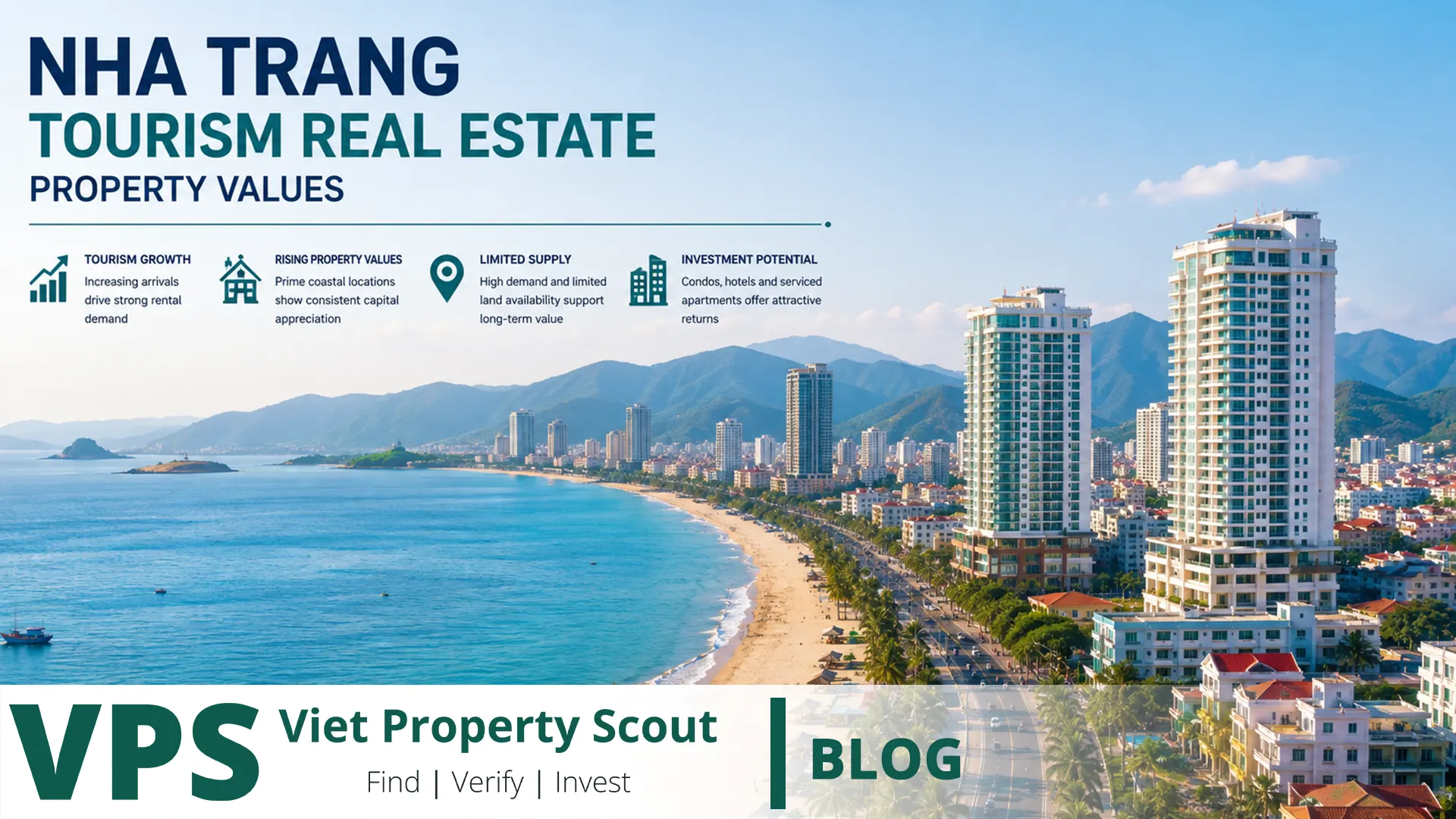
Short answer: Tourism influences property values in Nha Trang through accommodation demand, premiums for well-located coastal and central properties, stronger surrounding commercial activity and, in some cases, improved resale liquidity. However, rising visitor numbers do not automatically produce rising property prices or strong rental returns. Investors must separate tourism demand from long-term residential demand, hotel performance from private apartment performance, and residential apartments from tourism-oriented products such as condotels. Legal status, rental permissions, operating costs and project-level supply must all be verified before buying.
Why is Nha Trang real estate so closely connected to tourism?
Nha Trang is more than a conventional coastal residential market. It sits within the broader Khanh Hoa tourism economy, supported by beaches, resorts, international aviation, domestic tourism, restaurants, entertainment and hospitality services. Because accommodation is a core part of the visitor economy, changes in tourism flows can pass quickly into demand for certain types of real estate.
In the first half of 2026, Khanh Hoa recorded approximately 11.9 million tourist arrivals, including more than 4.6 million international visitors. Average accommodation occupancy was about 60%, while tourism revenue exceeded VND 42.5 trillion. These are province-wide tourism figures, not private-apartment occupancy statistics for Nha Trang. They should therefore not be used directly to forecast the income of a specific unit. What they do show is the scale of tourism within the regional economy.
| Indicator | Recent context | Investment relevance |
|---|---|---|
| Khanh Hoa tourist arrivals | About 11.9 million in H1 2026 | Large visitor base, but demand is not evenly distributed across the province |
| International visitors | More than 4.6 million in H1 2026 | Supports locations and products relevant to international guests |
| Average accommodation occupancy | About 60% | Shows destination demand but does not guarantee private-unit occupancy |
| Cam Ranh International Airport | About 7.3 million passengers in 2025, including roughly 4.7 million international passengers | Air connectivity is a major component of sustainable tourism demand |
How does visitor demand translate into property value?
1. Accommodation demand creates location premiums
Visitors do not choose property in the same way permanent residents choose a home. Proximity to the beach, walkability to restaurants and cafes, easy access to attractions, sea views, transport convenience and professional building management may matter more than absolute floor area. A smaller unit in a highly functional visitor location can therefore generate stronger tourism demand than a larger apartment in an area designed mainly for local residential use.
2. Tourism rewards location, but not every coastal location equally
The Tran Phu beachfront corridor and central areas immediately behind it are directly exposed to visitor flows. The northern coastline around Pham Van Dong can attract buyers and tenants seeking sea views and a somewhat less concentrated setting. Inland areas tend to depend more heavily on local and long-term residential demand. Bai Dai and Cam Ranh should also be treated as distinct submarkets rather than extensions of central Nha Trang because their product mix, distance profile, resort orientation and supply dynamics are different.
3. Tourism strengthens the economy surrounding a property
More visitors support restaurants, cafes, retail, entertainment and professional services. Improved amenities can subsequently make an area more attractive to residents, workers, expatriates and long-term tenants. Tourism can therefore influence residential value indirectly by improving the broader service environment.
4. Tourism can support resale liquidity
A property in a recognised location with competent management, clear documentation and a verifiable rental history may be easier to market than an asset whose investment story depends only on broad claims about city growth. Liquidity is never guaranteed, however. Large pipelines of new apartments, hotels or tourism units can give future buyers more alternatives.
5. Successful tourism attracts new supply
This is one of the most important counterforces in a tourism-led property market. Strong tourism does not only bring more guests; it also attracts developers. New hotels, apartments, resorts and tourism-oriented units may compete for the same customer. Investors should therefore ask not only, “Are visitor numbers growing?” but also, “Is competing accommodation supply growing faster than demand?”
Which visitor segments matter to Nha Trang?
Nha Trang benefits from both Vietnamese domestic tourism and international arrivals. Domestic demand may be particularly visible during weekends, public holidays and summer travel periods. International segments are more dependent on direct air routes, package-tour networks, visa conditions, currency movements and different average lengths of stay. South Korea, Russia, China and Central Asian markets have all played material roles in Khanh Hoa tourism in recent years.
Diversification is positive because it reduces dependence on one source market, but it does not remove risk. Airline capacity, ticket prices, exchange rates, economic conditions in origin countries, visa policy or changes to tour programmes can quickly alter demand from individual visitor groups.
Functional submarkets investors should analyse separately
| Area | Main demand driver | Potential advantage | Main risk |
|---|---|---|---|
| Tran Phu and central beachfront | Tourism, beach access and services | Strong demand for walkable visitor locations | High acquisition prices and intense competition |
| Central city behind the beachfront | Mixed tourism and residential demand | Potential balance between visitor use and long-term tenancy | Large differences between streets and individual buildings |
| Northern coast / Pham Van Dong | Sea views, tourism and residential demand | Coastal alternatives that can be less concentrated than the core | Access and amenity depth should be tested seasonally |
| Western and inland residential areas | Local residents and long-term tenants | Less dependent on daily tourism volumes | Lower suitability for some short-stay strategies |
| Bai Dai / Cam Ranh | Resorts, aviation and leisure tourism | Distinct tourism product with relative airport proximity | Should not be valued using central Nha Trang assumptions |
Why can tourism grow while some property values remain weak?
One of the most common mistakes in coastal property investing is assuming that more tourists must mean more expensive real estate. The relationship is more complicated. Visitor numbers can increase while individual properties underperform because new supply grows faster, building management is weak, short-term letting is restricted, legal status is unclear, operating charges are high or the property is poorly positioned for the way tourists actually use the city.
- Visitor growth does not guarantee higher occupancy in every building.
- Higher occupancy does not automatically mean a higher net return.
- A strong nightly rate can still produce weak profit when operating costs are excessive.
- A sea view does not compensate for uncertain legal status.
- A marketed “guaranteed return” is not a substitute for auditable operating data.
Gross yield versus net yield
Gross rental yield can be calculated by dividing annual gross rental income by the acquisition price. It is useful as a first filter but does not represent actual profitability. Investors should deduct management fees, booking commissions, cleaning, owner-paid utilities, repairs, vacancy, furniture replacement, taxes and relevant legal or administrative costs.
Illustrative example only: suppose a property costs VND 4 billion and generates VND 320 million of annual gross rent. The gross yield is 8%. If annual operating expenses total VND 120 million, net operating income falls to VND 200 million, or approximately 5% of the purchase price. These figures are educational examples, not estimates of current Nha Trang market performance.
Stress-test seasonality before buying
An investment model should never be based on the strongest month of the year. At minimum, investors should model an upside case, a realistic base case and a downside or stress case. The stress case should include lower occupancy, weaker nightly rates, increased maintenance costs and longer vacant periods.
| Scenario | Assumption | Purpose |
|---|---|---|
| Upside | Strong demand and high nightly rates | Measures potential, not the sole basis for purchase |
| Base | Realistic combination of strong and quiet periods | Main underwriting scenario |
| Stress | Lower occupancy, weaker rates and higher costs | Tests whether the investment can survive adverse conditions |
A residential apartment and a condotel are not the same asset
In a tourism market such as Nha Trang, investors must distinguish carefully between a residential apartment and a unit developed for tourism accommodation or marketed as a condotel. Land-use purpose, land-use duration, certificate type, owner rights, management model and accommodation rules may differ materially. The word “apartment” in a sales advertisement should never be assumed to mean conventional residential ownership.
Before paying a deposit, investors should inspect the property certificate or project documentation, land-use purpose and term, legal classification of the unit, owner's rental rights, building rules and any mandatory management or rental-pool agreement.
What should a foreign buyer verify?
Vietnam's housing framework allows eligible foreign organisations and individuals to own certain residential housing within permitted projects and statutory ownership limits. One important rule limits foreign ownership to no more than 30% of residential-purpose apartments in an apartment building, while separate rules apply to individual houses. A general legal entitlement, however, does not mean that every project or every unit remains available to a foreign buyer.
- Is the project eligible for foreign ownership?
- Is foreign ownership quota still available in the relevant building?
- Is the unit legally residential or tourism/commercial?
- What is the land-use purpose and duration?
- Has the ownership certificate actually been issued?
- Are there mortgages, disputes or other encumbrances?
- Does a management or rental agreement restrict the owner's use?
Short-term rental must be verified, not assumed
An apartment can be located in an excellent tourism area without automatically being suitable for daily or short-term rental. Building regulations, project classification, local operating requirements, registration and taxation can affect how a unit may be rented. Investors should obtain written confirmation where possible and verify the applicable rules before including short-stay income in an investment model.
A verification process for tourism-dependent property
- Identify the legal asset type before analysing return.
- Request actual rental evidence from the building rather than relying only on city averages.
- Compare competing units available during the same dates.
- Do not treat hotel occupancy as private-apartment occupancy.
- Calculate net income after all operating costs.
- Analyse weak-season performance, not only peak periods.
- Review future projects and incoming competing supply.
- Test whether the property can switch to long-term rental if tourism weakens.
- Assess resale liquidity and the likely future buyer pool.
- Independently verify legal documents before making a deposit or transfer.
Investor red flags
- High or “guaranteed” returns without verifiable operating records.
- Province-wide tourism statistics presented as proof of occupancy for one building.
- No clear distinction between residential and tourism-oriented property.
- Verbal claims that an ownership certificate will be issued “soon” without documentary basis.
- Yield calculations that ignore management, maintenance and vacancy.
- Claims that proximity to the sea alone guarantees appreciation.
- No fallback long-term rental strategy.
Which strategy fits which investor?
| Objective | More suitable profile | Primary verification focus |
|---|---|---|
| Tourism income | Strong location with demonstrated visitor demand | Occupancy, management, rental legality and costs |
| Long-term rent | Areas used by residents, workers and expatriates | Daily amenities, unit layout and monthly rent |
| Personal use plus income | Property allowing both owner use and rental | Management flexibility and owner rights |
| Capital appreciation | Relatively scarce, legally clear and liquid property | Entry price, future supply and resale market |
Frequently asked questions
Do rising tourist numbers guarantee higher apartment prices in Nha Trang?
No. Tourism is important, but prices also depend on supply, acquisition cost, legal status, building quality, credit conditions, residential demand and resale liquidity.
Is the property closest to the beach always the best investment?
No. Beachfront locations may increase both income potential and acquisition cost. Investors must test whether the additional income justifies the location premium and operating expenses.
Can hotel occupancy data be used to forecast private-apartment income?
Not directly. Hotels use different distribution channels, services, pricing and management systems. Data from the same building or genuinely comparable private units is more useful.
Can a foreign investor buy any apartment in Nha Trang?
No. Project eligibility, remaining foreign ownership quota, legal asset classification and applicable statutory or security restrictions must be checked at the time of the transaction.
Is a condotel equivalent to a normal residential apartment?
No. Legal use, land purpose, term, certificate and operating model must be reviewed separately.
What is the most important number to request before buying a tourism investment property?
No single number is sufficient. The useful dataset combines actual revenue, occupancy, nightly rates, expenses, vacant periods and ideally at least twelve months of history for the unit or genuinely comparable units.
Conclusion: tourism is a powerful driver, not a substitute for verification
Tourism gives Nha Trang a demand base that many purely residential markets do not possess. International access through Cam Ranh, diversified visitor segments, a recognised coastline and a broad service economy can support appropriately positioned real estate. Successful investing, however, does not start with visitor numbers. It starts with the correct asset, the correct acquisition price, verified legal rights and an income model that still works after expenses and under weaker conditions.
In this context, Find | Verify | Invest means: find locations where tourism demand overlaps with genuine residential utility, verify legal documents, rental evidence and competing supply, and invest only when the economics remain convincing after a realistic stress test.