
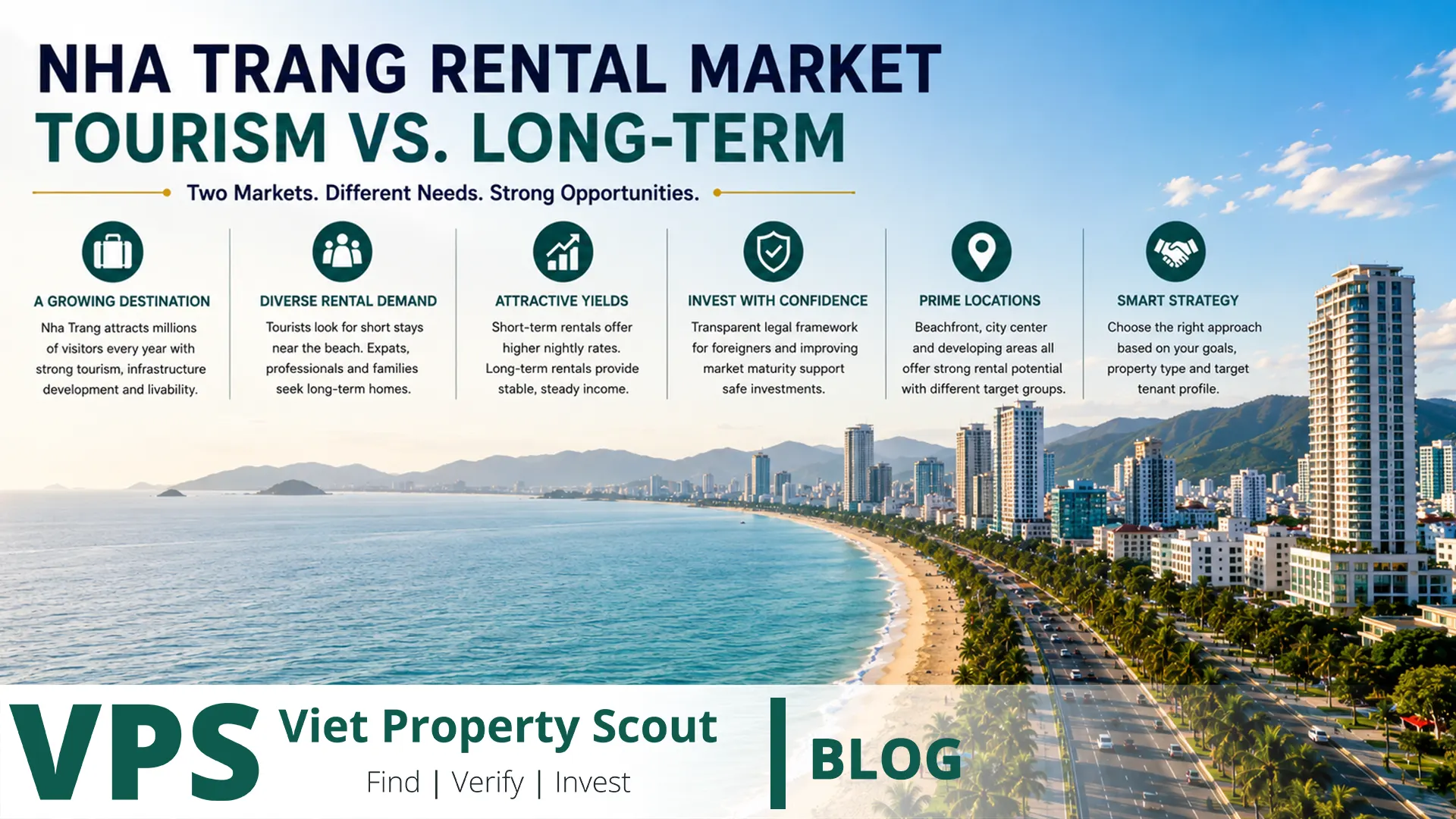
Investment takeaway: tourist rentals and long-term residential leasing in Nha Trang are two fundamentally different businesses. Nha Trang sits inside an exceptionally strong tourism economy: enlarged Khánh Hòa recorded approximately 15.1 million visitor arrivals during the first seven months of 2026, including around 5.5 million international visitors, while average room occupancy across the province was approximately 63.4%. That makes Trần Phú, Hòn Chồng and other coastal locations highly attractive for tourism-oriented demand. It does not prove that an individual residential apartment will achieve the same occupancy, nor does apartment ownership automatically establish the right to operate the unit like a hotel. Long-term demand is driven by different priorities: a usable kitchen, washing machine, quiet bedroom, reliable internet, parking, competent management, proximity to work and a sensible monthly cost. Short-stay accommodation can generate the higher gross revenue under favourable conditions, while a six- or twelve-month residential lease can generate superior net cash flow once vacancy, cleaning, platform commissions, utilities and management are included. The correct comparison is therefore legal use first, natural customer second and net income third.
One city, two very different rental economies
A tourism guest is purchasing a short experience. The priorities are beach access, view, recognisable location, convenience, cleaning, check-in and proximity to attractions. A residential tenant is purchasing everyday life. They need to cook, wash clothes, work, sleep, store belongings, park and live without paying a tourism premium every day.
| Factor | Tourist rental | Long-term residential |
|---|---|---|
| Typical stay | Nights to weeks | 3–12+ months |
| Primary location driver | Beach, downtown and walkability | Daily life, work and services |
| Pricing | Dynamic nightly rate | Monthly contract |
| Operating intensity | High | Much lower |
| Seasonality | High | Usually lower |
| Customer acquisition | Repeated continuously | Lower with stable tenancy |
| Furniture wear | Higher | Generally lower |
| Legal-use diligence | Critical | Usually clearer for genuine residential use |
Why tourist rental looks so attractive in Nha Trang
Nha Trang combines an internationally recognised bay, Trần Phú, Hòn Chồng, islands, restaurants, nightlife, resorts and international air access through Cam Ranh. South Korea, Russia, China, Kazakhstan and other markets create a large external demand pool.
A well-located unit can therefore achieve strong nightly pricing during holidays, festivals, summer periods and periods of robust international connectivity. The mistake is treating the best nightly rate as the annual average.
Khánh Hòa's 63.4% room occupancy is not your apartment occupancy
The current tourism statistic covers the entire enlarged province and multiple forms of accommodation. It includes destinations beyond central Nha Trang. It is therefore inappropriate to insert the provincial hotel-room occupancy rate directly into a private-apartment underwriting model.
Individual-unit occupancy depends on legal use, building quality, view, reviews, price, operator, platform ranking, season, competing supply and customer segment.
The most dangerous calculation: nightly rate × 365
Suppose an apartment can achieve VND1.5 million on an attractive night. Multiplying VND1.5 million by 365 produces VND547.5 million, but this is not a defensible annual revenue estimate. Occupied nights need to be modelled by season, and rates need to fall during weaker periods.
Then deduct platform or distribution commissions, operator fees, cleaning, laundry, electricity, water, internet, consumables, repairs, furnishing replacement and tax. What matters is the owner's net cash flow rather than what the guest paid.
Short-term rental is a small hospitality business
- Listings and pricing require continuous management.
- Guest communication and check-in need a process.
- Every departure creates cleaning and turnover work.
- Ratings affect future demand quickly.
- Furniture and linen experience heavier wear.
- Pricing should change with season and events.
- Foreign-guest temporary-residence compliance must be handled correctly.
Legal use comes before revenue: a residential apartment is not automatically Airbnb inventory
Vietnam's current housing framework prohibits the use of condominium apartments for non-residential purposes. That rule should not be simplified into a blanket assumption that every form of short stay is automatically permitted or automatically prohibited. The investor should verify the approved function of the development and unit, building regulations, relevant local implementation and any tourism-accommodation requirements.
This distinction is particularly important in Nha Trang because conventional residential condominiums, tourist apartments and condotels can look physically similar while carrying different legal and operating structures.
What creates genuine long-term residential demand?
Long-term tenants are not simply tourists who stay longer. The market includes local households, professionals, business owners, foreign residents, project staff, internationally connected couples and remote workers who choose Nha Trang as a place to live.
These customers value everyday functionality. A full kitchen, washing machine, storage, quiet bedroom, workstation, reliable internet, parking and responsive management can matter more than an infinity pool or hotel-style lobby.
Where is tourist demand naturally strongest?
Trần Phú and central Nha Trang
This is the city's most recognisable tourism corridor, with strong walkability and immediate beach access. Acquisition premiums and competition are also among the highest.
Hòn Chồng–Vĩnh Phước
The area combines meaningful coastal appeal with a more residential atmosphere, allowing tourism and medium-stay demand to overlap.
Selected parts of Bắc Nha Trang
Northern areas can benefit from coastline and future urban growth, but not every northern location has equal tourist depth.
Where does long-term residential leasing make more sense?
Hòn Chồng–Vĩnh Phước
One of the strongest hybrid submarkets because the beach is part of daily life rather than the only reason to stay.
Vĩnh Hải–Vĩnh Hòa
A calmer residential environment suited to professionals, foreign residents and smaller households.
Phước Long–VCN and Nam Nha Trang
Family housing, organised neighbourhoods and six- to twelve-month residential demand matter more than tourism peaks.
Tây Nha Trang
Local incomes, employment, schools and daily access matter more than tourism visibility, so pricing should be anchored to genuine local affordability.
A one-month lease and a twelve-month lease should not carry the same monthly rent
Flexible tenants normally pay more per month. A three-month commitment justifies some discount, six months a larger discount and twelve months typically the most favourable monthly rate. The owner receives lower monthly pricing in exchange for lower vacancy and customer-acquisition risk.
| Term | Monthly pricing logic | Turnover cost | Income stability |
|---|---|---|---|
| 1 month | Highest | High | Low |
| 3 months | Moderate discount | Medium | Medium |
| 6 months | Greater discount | Low | Good |
| 12 months | Usually lowest monthly rate | Very low | Highest |
The property's minimum rental term should also be configured separately. If the owner requires a minimum six-month contract, one- and three-month pricing should not be presented as available inventory.
What does the strongest 6–12-month apartment look like?
- An efficient one- or two-bedroom layout.
- A genuinely usable kitchen.
- In-unit washing machine.
- Useful storage.
- A proper workstation and reliable internet.
- Good sound insulation.
- Stable building management.
- Transparent monthly operating charges.
- Practical motorcycle or car parking.
- Convenient beach and service access without paying the maximum tourism premium.
Foreign tenants and temporary-residence compliance
Circular 87/2026/TT-BCA has been in force since 24 July 2026 and provides the current framework for how foreign temporary-residence information is declared and received. A landlord or accommodation operator targeting foreign guests or tenants needs a reliable process for compliance.
Strong foreign demand does not remove the owner's administrative responsibilities.
Which model produces the higher return?
There is no citywide winner. A legally suitable tourism unit in a strong Trần Phú or Hòn Chồng building with professional management can outperform long-term leasing. A conventional residential apartment with lower operating cost and stable twelve-month occupancy can outperform short stay after expenses.
| Situation | Model more likely to fit |
|---|---|
| Prime tourism location + legitimate accommodation use + professional operator | Short stay |
| Residential building without clear tourism operation | Long-term residential |
| Owner wants passive income | 6–12 months |
| Large kitchen and practical living space | Medium/long stay |
| Compact hotel-style unit with strong tourism function | Short stay if legally suitable |
| Family-oriented Phước Long location | Long-term |
Short-stay risks
- Seasonality: peak summer is not the entire year.
- Air connectivity: changes in international flights can affect demand quickly.
- Competition: hotels, serviced accommodation and condotels compete aggressively.
- Legal and building rules: operating assumptions can fail if the use is unsuitable.
- Platform dependence: rankings, reviews and commission structures matter.
- Cleaning and turnover: costs recur constantly.
- Furniture depreciation: guest turnover accelerates wear.
- Cash-flow volatility: month-to-month revenue can change sharply.
Long-term rental risks
- Overpricing: monthly tenants are highly price-sensitive.
- Tenant selection: a poor tenant can create payment or damage issues.
- Large-unit vacancy: expensive three-bedroom or premium units can take longer to place.
- Narrow expat targeting: relying only on foreigners can reduce the tenant pool.
- Contract rigidity: the owner cannot immediately reprice during a long fixed agreement.
How to stress-test both strategies
For tourism rental, model several occupancy cases such as 40%, 50% and 60%, reduce ADR during weak months and include all turnover costs. For long-term rent, include at least a potential one-month vacancy between contracts, annual repairs and brokerage where relevant.
If the investment becomes unattractive after a small decline in occupancy or one vacant month, the safety margin is insufficient.
Do not confuse gross yield with net yield
A short-stay apartment can report an impressive gross return while producing ordinary net cash flow. Conversely, a twelve-month lease can look less exciting because its monthly headline rent is lower but can preserve more of the revenue.
Use net annual income divided by the full acquisition cost, including furnishing and transaction expenditure, when comparing the strategies.
Viet Property Scout decision framework
| Owner objective | More suitable strategy |
|---|---|
| Highest possible gross revenue | Legally suitable short stay in a prime tourism location |
| Predictable cash flow | 6–12-month residential lease |
| Minimum operating work | 12-month lease |
| Personal use plus rental flexibility | 3–6-month residential strategy |
| Lower dependence on tourism | Long-term residential |
| Direct exposure to international tourism | Legitimate tourism-accommodation product |
A practical acquisition checklist
- Confirm whether the unit is residential, tourist accommodation or another legal function.
- Read the building's management rules before modelling short stay.
- Identify the natural customer for the exact micro-location.
- Collect evidence of achieved rents rather than asking prices alone.
- Separate one-, three-, six- and twelve-month pricing.
- Set the minimum rental period explicitly.
- Estimate vacancy separately for each strategy.
- Calculate platform, operator and cleaning costs for short stay.
- Calculate brokerage and turnover costs for long-term rental.
- Include electricity, water, internet and building fees according to who pays them.
- Budget annual repair and furnishing replacement.
- Check temporary-residence procedures for foreign occupants.
- Evaluate competing hotels, condotels and residential units nearby.
- Stress-test weaker tourism seasons.
- Compare annual net cash flow, not marketing yield.
Red flags
- “This apartment rents for VND2 million tonight, so multiply that by 365.”
- “Khánh Hòa is 63% occupied, therefore this unit will be too.”
- “Every beachfront apartment can operate on Airbnb.”
- “Utilities and cleaning are insignificant.”
- “Foreign tenants always pay more.”
- “A one-month and twelve-month lease should use the same monthly rate.”
- “Tourism growth alone guarantees capital appreciation and rent.”
Frequently asked questions
Is tourist rental always more profitable in Nha Trang?
No. It can produce more gross revenue, but platform fees, vacancy, cleaning, utilities, management and furniture wear can materially reduce the net return.
Can every apartment on Trần Phú be rented nightly?
That should never be assumed. The project function, unit function, building rules and applicable local requirements need verification first.
What is the strongest contract term for predictable income?
Six- and twelve-month contracts generally offer greater predictability, although the monthly rate should be lower than a flexible one-month rental.
Are foreign tenants more valuable than Vietnamese tenants?
Not automatically. Credit quality, deposit, contract duration, household fit and tenant behaviour matter more than nationality.
What is the most defensive rental strategy?
A legally clear residential apartment that can serve several three- to twelve-month tenant groups and does not require perfect tourism conditions to cover its costs.
Conclusion
Tourist rental in Nha Trang offers the greater upside when location, legal function, professional operation and seasonality align; long-term residential demand usually offers a simpler, more predictable and less operationally intensive cash-flow model. Trần Phú leans naturally toward tourism, Hòn Chồng–Vĩnh Phước is one of the strongest hybrid markets, while Vĩnh Hải, Phước Long and other residential districts fit six- to twelve-month demand more naturally. Do not choose between the models using the highest nightly rate or provincial visitor numbers. Start with what the unit is legally allowed to do, identify the natural tenant, and then compare short-stay net income with one-, three-, six- and twelve-month rental scenarios after all costs. The strategy that still works under conservative assumptions is the stronger investment.