
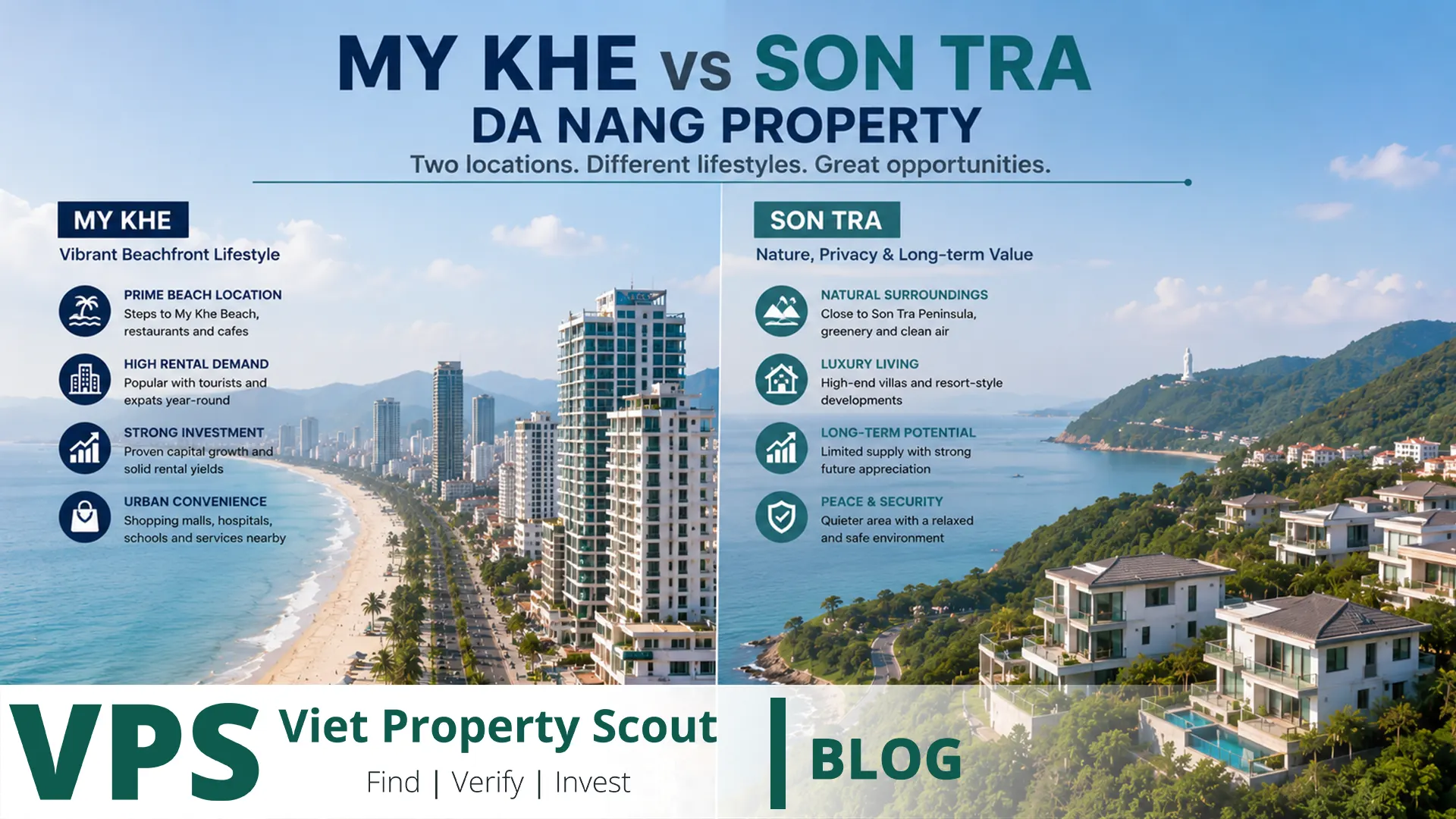
Investment takeaway: Mỹ Khê and Sơn Trà are frequently grouped together in Da Nang property marketing, but they are not the same type of location and should not be underwritten as one market. Mỹ Khê is primarily a beach and real-estate market label rather than a current standalone administrative ward. Following the local-government restructuring effective 1 July 2025, much of the traditional Mỹ Khê market associated with former Phước Mỹ is now within the new An Hải ward, which covers approximately 7.37 km² and has a population of about 82,635. The current Sơn Trà ward was formed from the former Thọ Quang, Nại Hiên Đông and Mân Thái wards and covers approximately 56.03 km² with about 86,890 residents. “Sơn Trà” is also the name of the peninsula and is still used informally for the former district. Investors therefore need the exact current address rather than relying on a listing headline. Broadly, Mỹ Khê offers stronger tourist visibility, walkability and short-to-medium-stay demand, while Sơn Trà is more heterogeneous and combines local residential demand, coastline, maritime activity and access toward the protected peninsula. Neither is automatically the better investment.
First, separate the market name from the legal address
One of the most common sources of confusion in Da Nang property research is the phrase “Mỹ Khê, Sơn Trà.” Historically, Mỹ Khê and former Phước Mỹ were closely associated with the old Sơn Trà District, so many brokers, older portals and property owners continue to use the legacy district name.
That is no longer sufficient for due diligence. An Hải now combines the former Phước Mỹ, An Hải Bắc and An Hải Nam wards. The current Sơn Trà ward combines Thọ Quang, Nại Hiên Đông and Mân Thái. A listing described as “Sơn Trà apartment” may therefore refer to the former district, the current ward or simply proximity to Sơn Trà Peninsula. The contract, project documentation and current official ward should determine the investment analysis.
The wider 2026 Da Nang market context
| Indicator | 2026 reference | Why it matters for Mỹ Khê and Sơn Trà |
|---|---|---|
| Cumulative condominium supply, Q1 2026 | Approximately 16,000 units | Da Nang remains relatively compact, so new coastal supply can alter competition quickly |
| Average primary condominium price | Approximately VND83 million/m² | Coastal Da Nang can no longer be treated as a low-cost market by default |
| Cumulative absorption | Approximately 89% | Underlying demand is strong, but project-level pricing still matters |
| New launches during 2024–2025 | More than 8,000 units | Competition is materially higher than in the low-supply years before 2024 |
| Visitors served by accommodation establishments, H1 2026 | Approximately 9.78 million | Coastal areas benefit from a very large tourism base |
| International visitors, H1 2026 | Approximately 5.16 million, +28.7% y-o-y | International-facing coastal locations have a growing guest pool |
What does Mỹ Khê mean as a property market?
In practical real-estate language, Mỹ Khê generally refers to the urban beachfront east of the Hàn River, particularly the highly recognizable coastal environment around the former Phước Mỹ area and adjoining beach corridors. Its strength is not simply the beach itself. It is the combination of beach access, hotels, restaurants, cafés, convenience retail, international services and relatively quick access to central Da Nang and the airport.
This creates a natural market for studios, one-bedroom and two-bedroom apartments, furnished rentals, serviced accommodation and medium-stay housing. It also gives Mỹ Khê a marketing advantage: an international buyer or tenant may recognize the name before understanding Da Nang’s administrative geography.
What does Sơn Trà mean as a property market?
Sơn Trà is substantially more complex. The current ward includes urban residential areas, coastal neighbourhoods and communities associated with maritime and port-related activity. The Sơn Trà Peninsula itself is a large natural and ecological area where visitor access is managed and environmental protection is a core planning priority.
That means property performance varies sharply by micro-location. Areas closer to Mân Thái or Thọ Quang may have strong local residential characteristics, while selected locations toward the peninsula and coastline can offer greater nature, view and lifestyle value. A generic “Sơn Trà” label does not tell an investor enough.
Side-by-side comparison
| Factor | Mỹ Khê | Sơn Trà |
|---|---|---|
| Market identity | Urban beach, hospitality and lifestyle market | Broader local residential, coastal and nature-oriented market |
| Walkability | Typically strong in the central beach grid | Highly location dependent |
| Tourism demand | Very visible and direct | Strong in selected coastal and peninsula-adjacent locations |
| Long-term rental | Strong for expatriates and professionals in suitable buildings | Can have deeper local and family demand in certain neighbourhoods |
| Competitive supply | High hotel, apartment and new-development competition | Less uniform and more micro-market specific |
| Nature and quiet | More urban and active | Stronger advantage toward the peninsula |
| Resale recognition | Usually stronger because Mỹ Khê is internationally recognizable | More dependent on the exact asset and street |
| Emotional overpayment risk | “Sea view” and “walk to beach” premiums | “Nature”, “peninsula” and “rare view” premiums |
Which is stronger for tourism-oriented rentals?
On average, Mỹ Khê has the clearer tourism proposition. A guest can understand the product immediately: beach access, food, nightlife, cafés, East Sea Park and a recognizable leisure environment. Da Nang’s 2026 Beach Tourism Season was staged across East Sea Park, Mỹ Khê and other beaches as well as Sơn Trà Peninsula, showing how central this entire eastern coastal corridor remains to the city’s tourism product.
However, tourist demand should never be confused with legal permission to operate a nightly-rental business. The approved use of the project and unit, building rules and applicable accommodation registration requirements must be verified. A residential apartment can still be an excellent monthly-rental asset without being the correct product for nightly hospitality.
Which is stronger for long-term rental?
Mỹ Khê can perform extremely well for expatriates, entrepreneurs, remote professionals and employees who value beach access but still need practical city living. The most defensive apartments are often not the most tourism-oriented units; they have real kitchens, washing machines, usable desks, good sound insulation and access to supermarkets and daily services.
Sơn Trà can offer a broader local tenant profile in some areas. Families, local professionals, service workers and people linked to the maritime economy can create rental demand that is less dependent on international visitor cycles. This can be a strength, provided the unit is correctly priced for the local market.
Which offers the better lifestyle?
For a buyer who wants to leave the building and walk to the beach, breakfast, coffee and restaurants, central Mỹ Khê is generally easier. It offers a more internationally oriented urban-beach lifestyle.
Selected Sơn Trà locations can offer more quiet, greater access to nature and a more local environment. But quiet can also mean fewer shops, weaker late-night services or longer daily journeys. Lifestyle should be tested on the ground rather than inferred from marketing photography.
Sơn Trà Peninsula requires a different investment logic
The peninsula should not be viewed as an ordinary future development zone. Visitor access is managed through designated routes and operating periods, and environmental and forest protection are explicit priorities. For real estate, this creates an important distinction: proximity to protected nature can create scarcity and view value, but it does not imply greater future buildability.
An investor should therefore treat peninsula proximity as a lifestyle, environmental and scarcity factor while separately verifying planning and land-use constraints.
Do not compare only price per square metre
A cheaper Sơn Trà unit can be the superior investment if it has strong local demand, rational service charges and a sensible acquisition price. A more expensive Mỹ Khê apartment can still outperform if it generates stronger occupancy, better monthly rents and easier resale.
The proper comparison is total acquisition cost, achievable net operating income, legal certainty and exit liquidity, not simply advertised VND per square metre.
What type of unit is most defensive?
- An efficient one- or two-bedroom layout rather than an oversized tourism-only design.
- A real kitchen, washing machine and workspace suitable for monthly tenants.
- Clear project and unit legal documentation.
- Genuine walking access to beach and daily services.
- A layout that can serve short, medium and long stays under the appropriate legal model.
- An acquisition price that does not require perpetual tourism and price growth to justify the investment.
Main risks in Mỹ Khê
- Overpaying for sea view: the purchase premium may exceed the rent premium.
- Competition: hotels, serviced apartments and condominiums compete for similar guests.
- Noise: a great tourism street may be a weaker residential street.
- Short-stay concentration: investors need a viable monthly-rental fallback.
- View obstruction: future construction can change the economics of a “sea-view” purchase.
Main risks in Sơn Trà
- Geographic ambiguity: the label alone does not identify the real micro-market.
- Uneven demand: nearby streets can serve completely different tenants.
- Environmental and planning constraints: peninsula proximity does not create extra development rights.
- Resale variation: some assets have less international name recognition.
- Buying the story: nature and rarity do not compensate for weak access, rent or legal status.
Which market fits which investor?
| Investor objective | Likely stronger fit | Reason |
|---|---|---|
| Recognizable location and easier marketing | Mỹ Khê | Strong international beach identity |
| Tourism and medium-stay demand | Usually Mỹ Khê | Walkability, services and visitor recognition |
| Local demand plus nature | Sơn Trà | More varied residential environments |
| Quieter owner-occupation | Selected Sơn Trà pockets | Potentially lower tourism intensity |
| Defensive income investment | Choose the unit, not the label | Multiple rental demand sources matter more than the district name |
Due-diligence checklist
- Request the current ward and complete official address.
- Clarify whether “Sơn Trà” refers to the current ward, peninsula or former district.
- Verify approved project and unit use.
- Compare with genuine secondary-market transactions in the same micro-location.
- Visit morning, evening and weekend.
- Actually walk from the building to the beach and daily services.
- Check whether a claimed view can be obstructed by future development.
- Model short-, medium- and long-term rental separately.
- Deduct management fees, vacancy, maintenance, furnishing and taxes.
- Define the likely future resale buyer before acquisition.
Frequently asked questions
Is Mỹ Khê always more expensive than Sơn Trà?
No. Pricing varies by legal status, building quality, age, view and micro-location. Central Mỹ Khê does, however, often command a stronger beach and tourism premium.
Which is better for a foreign buyer?
The location alone does not determine eligibility. The exact project, unit status and applicable ownership conditions must be verified before paying a reservation.
Is Sơn Trà quieter?
Some parts are, but the area is too large and heterogeneous for a general answer.
Does Mỹ Khê automatically produce a higher yield?
No. Higher achievable rent can be offset by a higher acquisition price, management cost and competition.
What is the biggest difference between them?
Mỹ Khê is a clearer, more internationally marketable urban-beach product. Sơn Trà is broader and requires much more precise micro-location selection.
Conclusion
If the objective is a recognizable, walkable coastal location that is easy for international tenants and buyers to understand, Mỹ Khê generally has the advantage. If the priority is a more varied combination of local residential demand, coastline, nature and selected lower-tourism pockets, parts of Sơn Trà may offer better value. The correct 2026 comparison is not between two names on a map. It is between two specific properties after verifying their current address, legal use, acquisition price, realistic rent, competing supply and resale liquidity. A famous beach name can improve marketing, but it cannot rescue an overpriced or legally weak asset.