
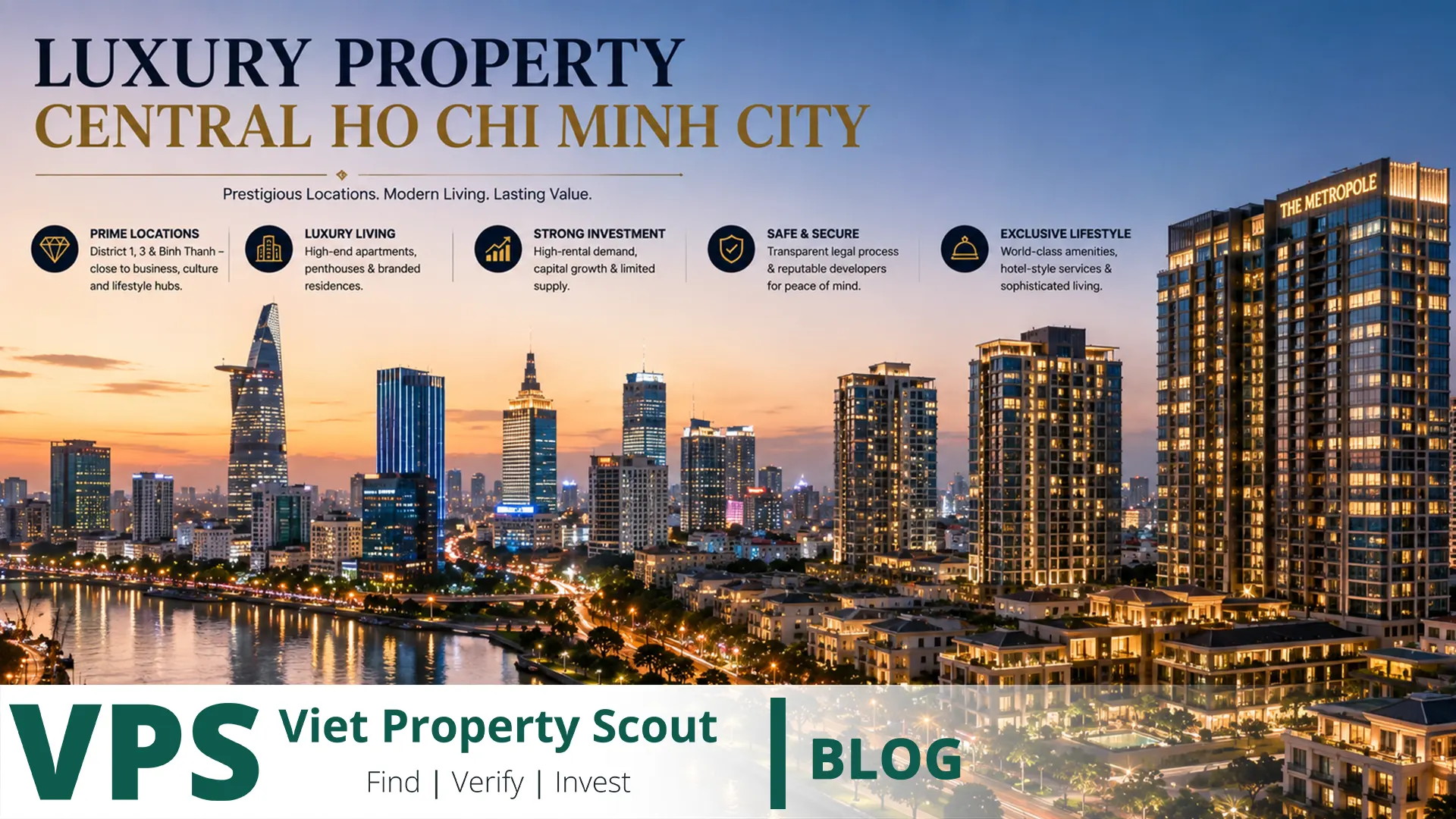
Short answer: Central Ho Chi Minh City's luxury residential market is not supported by a single type of buyer or tenant. Affluent Vietnamese households form a crucial ownership base, joined by overseas Vietnamese, eligible foreign buyers and investors seeking capital preservation in scarce core-city assets. The rental market is more heavily influenced by expatriate executives, corporate transferees, entrepreneurs and other high-income residents who value proximity to the business core without necessarily wanting to commit substantial capital to a purchase. The strongest demand is not created by a “luxury” label alone. It comes from the combination of scarce central land, legal certainty, developer quality, building management, protected views, connectivity to offices and Metro Line 1, foreign-ownership availability and genuine depth in the rental and resale markets.
What counts as “central” luxury real estate in HCMC?
Vietnam's administrative restructuring from July 2025 changed the formal local-government map. Legacy names such as District 1 and District 3 no longer describe administrative units in exactly the same way they once did, although they remain deeply embedded in real estate language and everyday location references. In market terms, central luxury HCMC normally refers to the historic and commercial core associated with the former District 1, the Ba Son and Ton Duc Thang riverfront corridor and selected premium locations in the former District 3.
Thu Thiem, across the Saigon River, is not the same traditional central market, but it has become its most important competitive luxury cluster. Investors should therefore distinguish market geography from the current legal address. Contracts and due diligence should use the property's current ward and official administrative address even when a development is still commercially described as being in “District 1” or “District 3”.
How large is the genuine luxury segment?
True luxury remains a relatively small part of the overall condominium market. Under Knight Frank's segmentation, Luxury apartments are priced above roughly US$4,000 per square metre and Ultra-Luxury above US$10,000 per square metre. Its research through Q1 2025 indicated that luxury and ultra-luxury represented only around 2% of total apartment supply yet had achieved a cumulative sold rate above 93%. Average primary pricing for luxury and higher-tier apartments in HCMC was around US$8,000 per square metre in that research.
Those figures should not be interpreted as evidence that every expensive apartment is a strong luxury asset. Central land scarcity, development costs and aggressive positioning can produce a high price even where unit design, long-term management, legal readiness or resale liquidity are not strong enough to justify the premium.
Who buys luxury homes in central HCMC?
1. Affluent Vietnamese buyers
Domestic high-net-worth buyers are a fundamental part of the market. Some purchase a primary home, some want a central asset for long-term wealth preservation and others allocate part of a broader portfolio to prime property. For these buyers, address, privacy, prestige, developer credibility, view and long-term scarcity can matter more than maximizing annual rental yield.
2. Overseas Vietnamese buyers
Viet Kieu demand can combine family, lifestyle and investment motivations. Some want a permanent or repeat-use base in HCMC, while others see Vietnamese real estate as an asset linked to the country's long-term economic growth. Eligibility and ownership treatment depend on individual legal status, so documentation should be checked rather than assuming every overseas Vietnamese buyer is treated identically.
3. Eligible foreign buyers
Vietnam's upper-end residential market also attracts international capital. Research has historically identified buyers from South Korea, Japan, Greater China and other Asian markets alongside investors of other nationalities. Motivations include portfolio diversification, commercial links to Vietnam, economic-growth exposure, rental income and anticipated long-term capital appreciation.
However, an international buyer cannot simply purchase any unit offered for sale. Project eligibility, security restrictions, the remaining foreign-ownership allocation and the specific unit's transaction status are part of the investment decision.
4. Buyers seeking branded residences
Branded residences attract buyers who value standardized service, professional management, concierge functions, high-quality fit-out and global brand recognition. A strong brand can widen a project's buyer pool and differentiate it from conventional luxury housing. It does not, however, eliminate valuation risk. If a buyer pays an excessive brand premium at entry, the resale market must later accept that same premium for the investment to perform as expected.
Who rents luxury apartments in the central market?
The natural tenant profile is different from the buyer profile. The main rental groups include:
- Expatriate executives: particularly senior personnel in multinational companies, financial services, consulting, technology and international trade.
- Corporate transferees: employees whose employers fund all or part of their housing allowance and who prioritize access, management and predictable quality.
- Entrepreneurs and business owners: residents who need a central base but prefer flexibility while establishing operations in Vietnam.
- High-income families: where central employment, schools and lifestyle justify the location, although some families prefer larger homes in areas such as Thao Dien.
- Affluent local renters: residents who want to experience a project, preserve capital flexibility or avoid a major purchase commitment.
Buyers and tenants do not pay for exactly the same things
| Factor | Importance to buyer | Importance to tenant |
|---|---|---|
| Legal status | Critical | Important, mainly for a valid lease and trouble-free occupancy |
| Location scarcity | Major long-term value factor | Valuable when it reduces commuting time |
| View and floor | Can materially affect resale value | Important, but tenants are usually more price-sensitive |
| Brand | May support prestige and liquidity | Useful when it delivers better service |
| Management | Protects long-term asset quality | One of the biggest drivers of daily living experience |
| Rental yield | Important to investors, less so to owner-occupiers | Not directly relevant |
| Lease flexibility | Limited importance | Often very important |
What actually drives luxury demand?
Scarcity of central land
Creating a new luxury residential project in the established core is much harder than delivering thousands of units in a growth corridor. Scarcity can support long-term pricing power, but scarcity alone does not justify an unlimited premium. The asset itself still needs to deserve the price.
Legal certainty and ownership readiness
In luxury real estate, legal certainty is part of the product. A project with verifiable land status, approvals, sales eligibility and a clear route to ownership documentation can be more valuable than a visually impressive project carrying unresolved legal uncertainty.
Access to employment and Metro Line 1
Metro Line 1 has been operating commercially since December 2024, turning rail access in the central-eastern corridor from a future promise into something that can be measured. Actual walking time to a working station and proximity to major employment centres can strengthen both owner-occupier and rental demand.
Protected views rather than temporary views
Saigon River or skyline views can command substantial premiums, but investors should ask what can legally be built on the land in front of the unit. A spectacular view today is not necessarily a protected view for the next twenty years.
Management after handover
Luxury is not simply marble in a sales gallery. Lift performance, security, maintenance, privacy, visitor management, common-area quality and long-term upkeep determine whether a building still feels premium five or ten years after completion.
Unit size and layout
Bigger is not automatically better. A well-designed two- or three-bedroom luxury apartment can have a much larger tenant and resale pool than an oversized four-bedroom unit with a very high total ticket price.
Developer execution
Delivery history, construction quality, documentation and post-handover service directly influence buyer confidence. In a premium market, confidence itself becomes a liquidity factor.
Foreign-ownership availability
In projects with strong international appeal, the availability of foreign ownership can influence liquidity. Foreign demand is economically useful only when the specific transaction can legally be completed.
Where is central luxury demand concentrated?
The traditional former District 1 core
Corporate offices, hotels, restaurants, luxury retail, culture and established city services make the old CBD difficult to replicate. For buyers who genuinely want a central-city address, this density is a structural advantage. Comparable new residential supply, however, remains limited.
Ba Son and Ton Duc Thang riverfront
The combination of river frontage, CBD access, Metro Line 1 and high-profile residential development has made this corridor a key benchmark for urban luxury. Tower position, orientation, floor, traffic exposure and the quality of pedestrian access can materially alter the value of individual units.
Selected former District 3 locations
Some locations offer established streets, relative calm and fast CBD access. New luxury inventory is limited and highly project-specific, making blanket neighbourhood averages less useful.
Thu Thiem as the direct competitor
Thu Thiem is not the traditional central core, but it competes for the same affluent buyer. Newer towers, riverfront planning and larger development sites can attract buyers seeking contemporary urban design, while the old CBD retains the advantage of existing commercial density and established services.
Are branded residences worth the premium?
Vietnam has become an increasingly important global branded-residence market, and urban schemes now represent a growing share of future development. A brand premium can be rational when the brand delivers measurable value: operating standards, long-term professional management, concierge and hospitality services, stronger design control and access to an international buyer network.
The premium becomes harder to defend when the brand functions mainly as a marketing badge. A buyer who pays heavily for a name without durable operational differentiation may discover that the secondary market does not value the branding as highly.
What about rental yield?
Prime central property is not necessarily a yield-maximizing strategy. Investment research has used reference apartment yields of roughly 3% to 3.5% for mature core markets such as HCMC and Hanoi, but that should never be treated as a guaranteed yield for an individual luxury property. An ultra-expensive apartment can produce a lower percentage return even when its monthly rent appears high.
The correct calculation uses achievable annual rent minus vacancy, leasing commissions, management costs, repairs, furniture replacement, relevant taxes and other recurring costs. That net income should then be compared with the full acquisition cost. The highest asking rent visible online is not evidence of achievable yield.
What can a foreign buyer legally own?
Under Vietnam's current housing framework, eligible foreign individuals permitted to enter Vietnam and not falling under relevant diplomatic or consular exemptions may own housing in eligible commercial residential projects, subject to security restrictions and ownership limits. For condominium buildings, foreign ownership is generally capped at 30% of the residential units in the relevant building, with detailed rules applying to buildings with multiple blocks or sections.
For an eligible foreign individual, the ownership term recorded on the certificate may be up to 50 years from issuance. One extension of up to a further 50 years may be requested if the applicable conditions continue to be satisfied. None of this means that every advertised apartment is automatically available to a foreign purchaser. Project eligibility, the specific unit, remaining quota and transaction documentation should be verified before a reservation payment is made.
Investment logic by objective
| Objective | What to prioritize | Main risk |
|---|---|---|
| Capital preservation | Scarcity, legal certainty, quality and resale liquidity | Overpaying for prestige |
| Rental income | Tenant depth, efficient unit size and rational entry price | Buying an oversized unit with a narrow tenant pool |
| Capital growth | Reasonable valuation plus genuine improvement in location or project | Paying today for all expected future upside |
| Owner occupation | Lifestyle, privacy, management and location | Over-optimizing for theoretical yield |
| Foreign purchase | Eligibility, quota, documents and exit route | Assuming purchase and resale eligibility are automatic |
Verification checklist before buying central luxury property
- Confirm the current official ward and address rather than relying only on a legacy district label.
- Verify the project's legal status, the specific unit and the seller's authority.
- For a foreign buyer, confirm project eligibility and remaining foreign quota before reserving.
- Compare the developer's or seller's price with genuine secondary-market evidence.
- Inspect the view and identify any site that could obstruct it later.
- Visit at different times to test traffic, noise and building operation.
- Review actual management quality after handover where possible.
- Identify management fees, parking costs and other recurring charges.
- Use actual rental contracts or realistic achieved rents in yield analysis.
- Define the likely future tenant and resale buyer before purchasing.
Red flags that should not be ignored
- “Luxury” is used as a substitute for explaining legal status.
- High-yield promises are made without evidence from real leases.
- The asking price is far above comparable resale stock without a measurable advantage.
- The investment case depends entirely on an unprotected view or future infrastructure.
- Long-term management costs and operating structure are unclear.
- A foreign buyer is told that ownership quota issues will be solved after money is transferred.
Frequently asked questions
Who buys most central luxury property in HCMC?
Affluent Vietnamese buyers are a fundamental demand base, while overseas Vietnamese and eligible international buyers add meaningful demand, particularly in projects with internationally recognizable standards.
Who rents central luxury apartments?
Expatriate executives, corporate transferees, entrepreneurs and other high-income residents who prioritize CBD access, service and privacy are important tenant groups.
Is the most expensive project automatically the best investment?
No. A high price may reflect genuine scarcity and quality, but it can also contain an excessive marketing or brand premium. Investment performance depends on value relative to entry price.
Are branded residences always better?
No. They are strongest when the brand translates into superior long-term operations, service, management and international liquidity rather than simply a name.
Are central luxury apartments good rental-yield investments?
They can provide strong tenant quality, defensive demand and capital-preservation characteristics, but lower-priced locations can sometimes offer higher percentage yields. Net yield must be calculated property by property.
What is the single most important feature of a luxury property?
There is no single feature. The strongest central assets usually combine difficult-to-replicate location, legal certainty, strong management, genuinely differentiated product and a credible exit market.
Conclusion
Demand for luxury property in central Ho Chi Minh City is not simply a function of wealth; it is a function of scarcity meeting the needs of the right buyer and tenant. A wealthy local buyer may prioritize capital preservation and prestige, an international investor may seek diversification and long-term growth, while an executive tenant values access, privacy and service. Projects that satisfy these different needs while offering clear legal status, professional management and a location that is genuinely difficult to reproduce have the strongest demand foundation. A project supported mainly by the word “luxury”, a famous logo, a marketing view or an assumption of automatic price appreciation can be expensive without being a strong investment. In central HCMC, scarcity creates value only when it is attached to an asset that can be verified, occupied, rented and eventually resold.