
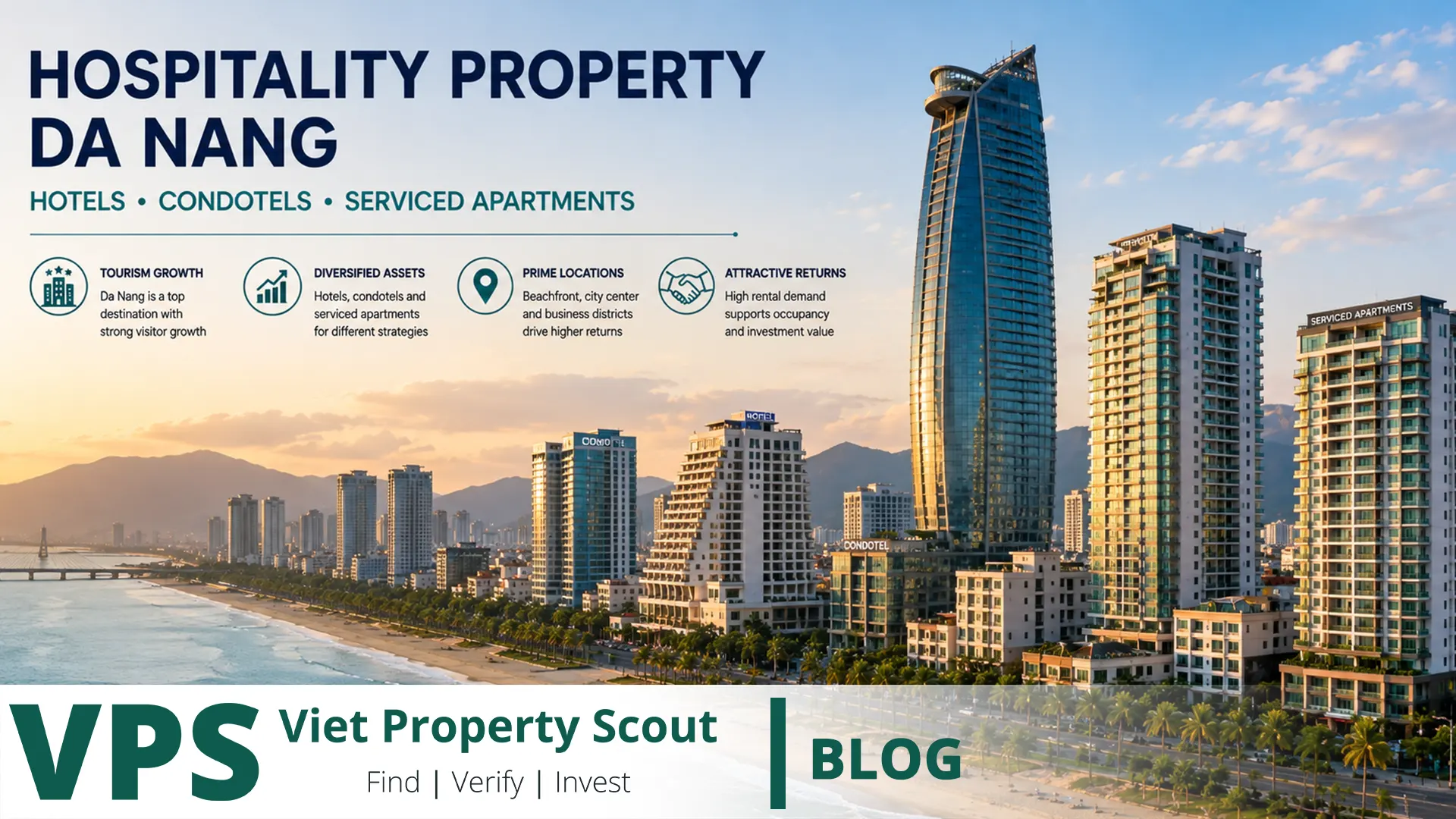
Investment takeaway: Da Nang's hospitality-property market has a powerful demand base in 2026, but hotels, condotels and serviced apartments should not be underwritten with the same investment logic. During the first seven months of 2026, accommodation establishments across the enlarged city served approximately 12.1 million visitor arrivals, including just over 6 million international visitors. Overnight visitor arrivals reached about 11 million, while average stay was approximately 1.79 days per visit. Accommodation-service revenue alone reached roughly VND12.297 trillion during the period. Those figures confirm substantial demand, but they do not make every hotel room, condotel unit or serviced apartment a good investment. A hotel is fundamentally an operating business embedded in real estate. A condotel is a tourism-related property interest whose land purpose, remaining term, certificate, operator agreement and income-sharing structure require close scrutiny. A serviced apartment is a hybrid housing-hospitality product whose economics generally depend more heavily on medium- and longer-stay guests. The professional investment question is therefore not simply “How many tourists visit Da Nang?” but “Who will use this exact asset, what sustainable net cash flow can it generate, and what legal right am I actually buying?”
Why Da Nang supports multiple hospitality formats
Da Nang combines beach tourism, the Hàn River urban core, major events, MICE, business travel, growing international air connectivity and convenient access to Hội An and Central Vietnam's wider heritage circuit. As a result, the city's guest base is unusually diverse. A Korean family on a four-night holiday, an Indian wedding group, a corporate project team, an international consultant, a conference participant and an expatriate staying for six months do not need the same accommodation product.
That diversity allows city hotels, beach resorts, tourist apartments and serviced apartments to coexist. It also means that product-market fit matters more than the generic label “tourism property”.
What the 2026 demand numbers really tell investors
| Indicator | January–July 2026 | Investment implication |
|---|---|---|
| Visitor arrivals served by accommodation establishments | Approximately 12.108 million | Large and growing demand pool |
| International visitor arrivals | Approximately 6.009 million | International air connectivity is economically important |
| Overnight visitor arrivals | Approximately 11.019 million | Most recorded visitors use overnight accommodation |
| Average stay | Approximately 1.79 days per visit | High visitor volume does not necessarily mean long stays |
| Accommodation-service revenue | Approximately VND12.297 trillion | Strong sector growth, but property-level profitability still needs verification |
The relatively short average stay is particularly important. It supports conventional hotels and resorts, but it also reveals a strategic opportunity for products able to extend guest length of stay: larger suites, serviced apartments, wellness residences, corporate accommodation and work-from-Da-Nang products.
Hotels: an operating business, not merely a building
Buying a hotel is fundamentally different from buying a conventional apartment. Hotel value is driven by the ability to convert available rooms, food and beverage, events and services into sustainable operating profit. Investors therefore need to analyse occupancy, ADR, RevPAR, F&B revenue, banqueting, spa and other departments alongside payroll, utilities, laundry, OTA commissions, marketing, management, insurance, maintenance, taxes, furniture replacement and capital expenditure.
A hotel with 85% occupancy is not necessarily a better investment than one with 70% occupancy. If the first property discounts heavily or carries high distribution and operating costs, the second may produce materially stronger profit.
The core hotel metrics
| Metric | What it measures | Why it matters |
|---|---|---|
| Occupancy | Rooms sold as a percentage of available rooms | Measures utilisation |
| ADR | Average daily rate for rooms actually sold | Measures pricing power |
| RevPAR | Room revenue per available room | Combines occupancy and rate |
| GOP | Gross operating profit | Shows operational profitability |
| FF&E reserve | Reserve for furniture, fixtures and equipment | Prevents renovation needs from being ignored |
Event occupancy is not annual occupancy
During the DIFF 2026 grand-finale period, average citywide room occupancy reached approximately 85%. In central and heavily demanded areas including Hải Châu, Hòa Cường, An Hải, Sơn Trà and Ngũ Hành Sơn, occupancy reached roughly 95–98%.
That is strong evidence of Da Nang's ability to compress accommodation supply during major events. It is not a valid assumption for a 12-month acquisition model. Investors should underwrite at least a complete trailing year and preferably several years, separating summer, Tet, DIFF, weekends, weekdays, wet season and major source-market holiday periods.
Premium-hotel competition is already deep
According to tourism-management data updated in April 2026, the enlarged Da Nang had 49 officially classified five-star accommodation establishments, plus 13 properties listed in a separate equivalent-five-star management category. A further 61 establishments held official four-star classification.
Not all of these properties pursue exactly the same guest, but the data make one point clear: high-end accommodation is not an undersupplied blank market. A new luxury hotel requires a differentiated location, brand, international distribution, loyalty network, MICE strategy, F&B, wellness proposition or operating advantage.
Different hotel locations serve different demand
Hải Châu and the Hàn River
This area can balance corporate, government, banking, meetings, events and leisure demand. Properties with good conference and business infrastructure can reduce pure beach-season dependence.
An Hải and Sơn Trà
The east-bank urban-beach market combines access to Mỹ Khê with reasonable connection to the city centre. It suits conventional urban beach hotels, lifestyle brands and shorter leisure stays.
Ngũ Hành Sơn and Non Nước
The southern beachfront corridor is more naturally associated with resorts, wellness, golf, family leisure, luxury villas and guests combining Da Nang with Hội An.
Hội An and the southern part of the enlarged city
Heritage, slow travel, boutique hotels and resort products can follow a different seasonal and pricing pattern from central Da Nang.
What exactly is a condotel?
A condotel is generally an apartment-format unit within a tourism or hospitality project that is sold to an investor and commonly placed into a central rental or management programme. The primary due-diligence error is assuming that because the unit looks like an apartment, it carries the same legal status as an ordinary residential condominium.
Vietnam's Tourism Law recognises a “tourist apartment” as a type of tourist accommodation establishment, and the current real-estate framework recognises constructed floor areas whose function is tourism and accommodation. A tourism-accommodation function, however, is not the same legal function as residential housing.
A certificate does not automatically turn a condotel into residential housing
Vietnam's legal reforms created a pathway for qualifying non-housing construction used for tourism accommodation on commercial-service land to receive certification where land, construction and real-estate requirements are met. The critical point is that certification records the legally existing asset and land-related rights. It does not automatically convert commercial-service land into residential land or transform a time-limited project into perpetual residential ownership.
Investors should therefore review the land allocation or lease decision, approved land purpose, remaining land term, investment approval, construction permit, completion acceptance, eligibility for sale, sale contract and the actual or expected certificate wording.
Ten questions before buying a condotel
- What is the officially approved land-use purpose?
- How much land or project term remains?
- Is the specific unit legally tourism accommodation or residential housing?
- Has the development completed the required legal and construction process?
- Does the unit already have a certificate, or is certification only promised?
- Is participation in the operator's rental programme mandatory?
- Who controls room pricing?
- How are gross revenue, costs and owner distributions calculated?
- Who pays for FF&E replacement and major renovation?
- Who is the natural resale buyer when the owner wants to exit?
Guaranteed returns need to be treated as credit risk
If a condotel promises a fixed or guaranteed return, investors should identify who is legally responsible for that payment and what balance sheet supports the promise. A contractual guarantee does not create guests, occupancy or hotel profit.
Review the guarantor's financial strength, duration of the promise, exclusions, management deductions and the economics after the guarantee expires. A useful stress test is to value the unit with the guarantee removed entirely. If the asset no longer makes investment sense, the buyer is underwriting the promisor rather than the property.
Serviced apartments: the housing-hospitality hybrid
A genuine serviced apartment combines residential functionality with professional accommodation service. A kitchen, washing facilities, living space, workspace and storage allow longer occupancy, while cleaning, reception, maintenance, security and guest support reduce the friction of relocating.
The target customer is often a corporate employee, project engineer, consultant, expatriate, relocating family or business traveller staying for weeks or months rather than a typical two-night hotel guest.
Da Nang already demonstrates hybrid demand
The market includes real examples of hotel and serviced-apartment integration. Novotel Danang Premier Han River combines 323 hotel rooms with 90 serviced apartments. Wink Hotel Danang Riverside incorporates larger suite products for short- and long-term stays, while Altara's apartment-style accommodation provides kitchens, washing machines, dining space and working areas near Mỹ Khê.
These examples demonstrate that medium-stay accommodation is not merely a theoretical niche. It is already part of Da Nang's hospitality ecosystem.
But “serviced apartment” is not a legal conclusion
The term is widely used commercially and can describe different structures. A serviced apartment may be a tourist-accommodation unit, a residential apartment leased with services, or a component of a mixed-use project. The permitted legal use therefore needs to be established independently of the marketing name.
The first question should be: what is this exact unit legally permitted to do?
Hotel vs condotel vs serviced apartment
| Factor | Hotel | Condotel | Serviced apartment |
|---|---|---|---|
| Main revenue | Rooms, F&B, events and services | Rental programme or revenue share | Weekly/monthly accommodation plus services |
| Operations | Full hospitality business | Usually central operator | Usually lighter than hotel operations |
| Typical stay | Short | Often short/tourist | More medium and long stay |
| Capital requirement | Very high for whole-hotel ownership | Individual-unit entry possible | Unit or whole-building strategies possible |
| Primary risk | Operations, costs and seasonality | Legal status, operator and land term | Monthly occupancy, competition and legal function |
| Owner control | High for owner-operator | Often relatively low | Medium to high depending on structure |
What makes a strong serviced apartment?
- A kitchen that genuinely supports months of living.
- A private washing machine or reliable laundry system.
- Fast, stable internet.
- A usable workstation.
- Flexible cleaning rather than unnecessary daily service.
- Transparent electricity and water charges.
- A location matched to the customer: office, beach, school or technology hub.
- English or multilingual guest support where relevant.
- Correct foreign temporary-residence procedures.
- Separate 1-, 3-, 6- and 12-month pricing if the product targets medium and long stays.
Foreign guests and operating compliance
Vietnam introduced a unified accommodation-notification and foreign temporary-residence declaration system in May 2026, with Circular 87/2026/TT-BCA taking effect in July 2026. Hotels and other responsible accommodation providers need procedures capable of handling the required declarations correctly.
For a property targeting international demand, guest identity, residence declaration, invoicing, safety and data handling are part of the operating infrastructure, not optional back-office details.
How should a hotel investment be modelled?
Do not calculate rooms × advertised room rate × 365. Start with available room nights and realistic seasonal occupancy and ADR. Add achievable F&B, meeting and ancillary revenue. Then deduct distribution and OTA fees, payroll, utilities, laundry, maintenance, management, marketing, insurance, tax, FF&E reserves and recurring capital expenditure.
A hotel whose EBITDA appears high only because renovations have been deferred can be substantially less valuable than its accounts initially suggest.
How should a condotel investment be modelled?
Begin with sustainable unit room revenue and deduct operator share, hotel charges, distribution, marketing, maintenance, FF&E, renovation reserves, closure periods and taxes. If distributions are based on revenue sharing, establish exactly which expenses are deducted before the owner's percentage is calculated.
The remaining land or project term also belongs in the valuation. A time-limited tourism asset earning the same current yield as a long-duration residential asset does not necessarily have the same economic value.
How should a serviced apartment be modelled?
Test realistic one-, three-, six- and twelve-month monthly rates, renewal rates, vacancy between occupants, cleaning, utilities, management, furnishing replacement and customer-acquisition cost. The strongest asset is not necessarily the one producing the highest flexible one-month rate; longer retention can reduce vacancy and acquisition expense materially.
Ten risks hospitality investors should not ignore
- Seasonality: DIFF and peak summer occupancy do not represent the full year.
- New competition: Da Nang already has deep premium-hotel and apartment supply.
- Source-market concentration: airline or economic changes in major visitor markets can move demand quickly.
- Short average stay: 1.79 days limits some guest-spend models.
- Operating-cost inflation: payroll, power, maintenance and platforms can absorb revenue growth.
- Legal classification: especially dangerous when a condotel is treated as residential housing.
- Operator risk: an international brand does not automatically mean a favourable management contract.
- Renovation cycle: hospitality assets continuously consume FF&E and capital expenditure.
- Coastal environment: salt and humidity accelerate maintenance.
- Exit liquidity: a hotel or condotel may take longer to sell than a conventional residential apartment.
Viet Property Scout hospitality due-diligence framework
| Check | What should be proven |
|---|---|
| Legal | Land use, project function, unit status, term and certificate |
| Demand | Actual guest source rather than generic tourism growth |
| Operations | Occupancy, ADR, RevPAR, operating expenses and net profit |
| Operator | Contract, fees, track record, performance tests and replacement rights |
| CAPEX | FF&E, renovation, equipment and façade requirements |
| Seasonality | Full-year performance rather than event weeks |
| Exit | Who will buy the asset later and why? |
Frequently asked questions
Is a hotel automatically the best hospitality investment in Da Nang?
No. Hotels offer greater operational control and multiple revenue streams, but require far more capital, expertise and ongoing management.
Does a condotel certificate mean permanent residential ownership?
No. The project's land purpose, remaining term, legal function and actual certificate wording must be read together.
Are serviced apartments more stable than hotels?
They can be less seasonal when supported by corporate, expatriate and monthly demand, but only if the location and unit design fit those users.
Can 95% DIFF occupancy be used in an annual model?
No. It is evidence of peak-event demand, not stabilised annual occupancy.
What is the most defensive hospitality asset?
One with clear legal status, several demand sources, measurable operating performance, properly funded renovation requirements and a realistic resale market.
Conclusion
Da Nang is a strong hospitality market in 2026, but buying generic “tourism exposure” is not an investment strategy. A hotel is an operating company inside a property. A condotel combines tourism use, operator dependency, land duration and property rights. A serviced apartment attempts to capture the space between hotel stays and conventional residential leasing. Da Nang's visitor growth, accommodation revenue and event compression prove that demand is real; its extensive four- and five-star supply proves that competition is equally real. The stronger investment is therefore not the asset with the most attractive brochure or guaranteed-return headline, but the one whose legal rights, full-year operating economics, renovation cycle and exit value still make sense after every marketing promise is removed.