
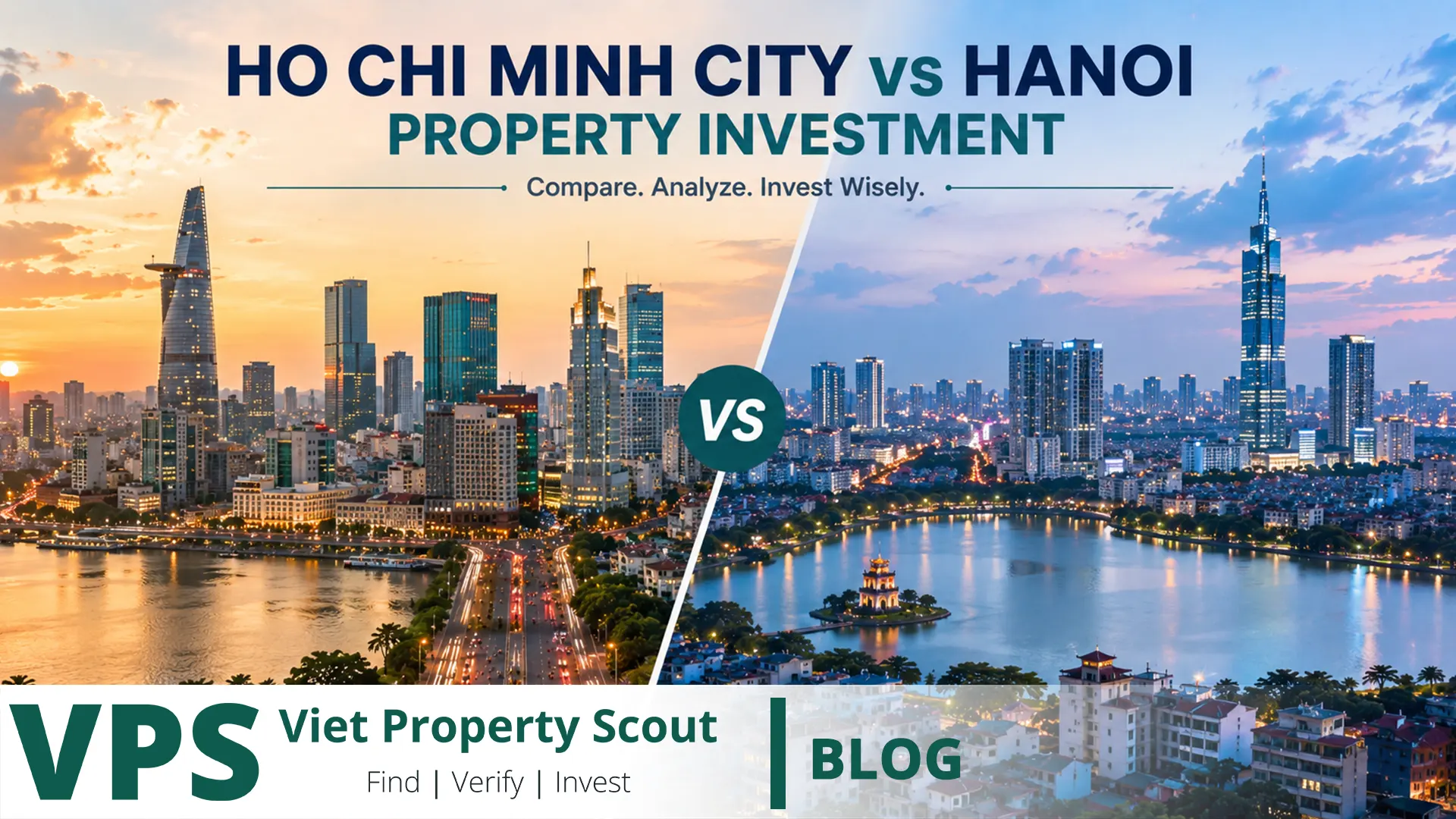
Short answer: there is no defensible rule that Ho Chi Minh City is automatically a better property market than Hanoi, or vice versa. They are driven by different economic engines and suit different investor profiles. Ho Chi Minh City is more exposed to private enterprise, multinational companies, finance, technology, trade, consumer services, logistics and professional mobility. That can make it attractive to investors seeking dynamic corporate rental demand, expatriate tenants, liquidity in well-positioned apartments and long-term opportunities tied to the eastern corridor, Thủ Thiêm, Metro Line 1 and southern transport infrastructure. Hanoi is supported by its role as the national capital, central government, diplomacy, universities, research, technology, offices and the manufacturing ecosystem of northern Vietnam. It can therefore suit investors who prefer longer-duration family, diplomatic and institutional demand or multi-year growth themes around Tây Hồ, Ba Đình, Cầu Giấy, Ring Road 4, Hòa Lạc and the capital's eastern and northern expansion. The comparison became more complicated after 1 July 2025, because the new Ho Chi Minh City merged the former city with Bình Dương and Bà Rịa - Vũng Tàu and now has a population of more than 14 million. A citywide HCMC average can therefore combine central apartments, industrial-corridor housing and coastal property. The correct decision is to compare submarket with submarket and product with product rather than city name with city name.
The fundamental difference: political capital versus commercial capital
Hanoi is Vietnam's national political centre. Central government, diplomacy, universities, research institutions, hospitals and public administration create a substantial permanent demand base. At the same time, Hanoi is closely linked to the technology, electronics and advanced-manufacturing economy of northern Vietnam, adding corporate and professional demand to the city's institutional foundation.
Ho Chi Minh City plays a different role. It is Vietnam's largest centre for private enterprise, finance, commerce, international business, consumer services, start-ups and technology. Following the 2025 merger with Bình Dương and Bà Rịa - Vũng Tàu, the new municipality also directly integrates major industrial districts, logistics systems, ports and a coastal economy.
In simplified investment terms, Hanoi has a more institutional and administrative demand floor, while Ho Chi Minh City is more commercially driven and potentially more cyclical. That does not tell us which has the higher return. It tells us which economic risk the investor is buying.
Hanoi and Ho Chi Minh City at a glance
| Factor | Hanoi | Ho Chi Minh City |
|---|---|---|
| Core economic engine | Government, diplomacy, education, technology, northern manufacturing | Finance, private business, FDI, trade, technology, logistics and services |
| Residential demand character | Families, long-term professionals, diplomats and institutional employment | Corporate tenants, executives, entrepreneurs, expatriates and higher job mobility |
| Premium apartment nodes | Tây Hồ, Ba Đình, Cầu Giấy, Tây Hồ Tây | Former central CBD, Thủ Thiêm, Thảo Điền-An Phú, Phú Mỹ Hưng and selected projects |
| Infrastructure thesis | Ring Road 4, metro expansion, western Hanoi and Hòa Lạc | Metro Line 1, Ring Road 3, Thủ Thiêm and industrial/logistics connectivity |
| Peripheral land | Multi-polar capital expansion | Very broad residential, industrial, logistics and coastal spectrum after merger |
| Market cycle | Somewhat stronger structural institutional floor | More sensitive to business, credit and investment cycles |
| Foreign ownership | Qualifying housing in permitted projects and quotas | Same national framework |
Critical 2026 context: “Ho Chi Minh City” is now a much larger market than it was before 2025
From 1 July 2025, the former Ho Chi Minh City, Bình Dương and Bà Rịa - Vũng Tàu were merged into a new centrally governed Ho Chi Minh City. The new municipality covers approximately 6,772.6 square kilometres and has a population above 14 million. It operates with 168 commune-level administrative units, including 113 wards, 54 communes and one special zone.
This creates a major analytical problem if investors rely on broad averages. A luxury apartment near the former central business district, an apartment serving an industrial employment cluster in former Bình Dương and a coastal property in the former Vũng Tàu area can now all sit inside the administrative boundary of Ho Chi Minh City. They are not economically interchangeable assets.
The issue is visible in Q2 2026 residential data. CBRE recorded only about 850 newly launched condominium units in HCMC during the quarter, down 48% quarter-on-quarter. In contrast, the landed market recorded 1,934 newly launched units, largely from a major suburban township project. The overall average primary selling price therefore declined 3% quarter-on-quarter and 29% year-on-year. That figure should not be read as evidence that every central apartment fell 29%; product mix materially changed the headline average.
Hanoi in Q2 2026: substantial supply but more selective absorption
Hanoi recorded more than 5,800 condominium sales in Q2 2026, equal to about 68% of the new units launched during the quarter. This was materially below the 2024-2025 period, when absorption frequently exceeded 90%. The secondary market also recorded its first downward price adjustment since late 2022.
The implication is not that Hanoi has become weak. It is that after several years of strong price growth, investors need greater price discipline. Location quality, genuine owner-occupier demand, rental economics, competing supply and resale liquidity matter more than a simple expectation that every new launch will appreciate.
Which city is stronger for professional and expatriate rental demand?
Both are strong, but the tenant composition differs. Ho Chi Minh City has a very broad private-sector corporate base, regional business activity, finance, technology and services. This supports executives, multinational staff, entrepreneurs and internationally mobile professionals. Former central areas, Thủ Thiêm, Thảo Điền-An Phú and selected southern communities each serve different expatriate segments.
Hanoi combines foreign corporate demand with diplomacy, international organisations, universities, northern manufacturing and technology. Tây Hồ and Ba Đình serve many diplomats and international families, while Cầu Giấy, Tây Hồ Tây and Nam Từ Liêm are increasingly connected to office, technology and Asian professional demand.
An investor comfortable with corporate leasing, professional mobility and more frequent tenant turnover may prefer HCMC. An investor targeting longer family tenancies, diplomatic demand or institution-related occupants may prefer selected Hanoi submarkets.
Ho Chi Minh City: major residential investment themes
Former central CBD
Central assets benefit from employment density, prestige, services and scarcity. Entry prices are correspondingly high, which can compress percentage rental yields. These properties often suit capital preservation, executive demand and resale liquidity better than investors seeking maximum income yield.
Thủ Thiêm / An Khánh
Thủ Thiêm remains one of the most important long-term extensions of HCMC's commercial core. In April 2026, the city approved investment policy for a major central square and administrative centre in An Khánh within the Thủ Thiêm core. This should be classified correctly: it is an approved investment project, not an already operational civic centre. Investors here are paying for future centrality and therefore accept execution, supply and timing risk.
Thảo Điền - An Phú and the eastern corridor
This market has long attracted expatriates through international schools, restaurants, services and residential communities. Metro Line 1 between Bến Thành and Suối Tiên has been in commercial operation since December 2024, giving the eastern corridor an infrastructure asset that can be measured rather than merely promised.
That does not mean every property near the metro performs equally. Actual walking distance, road access, flooding, noise, building quality and management determine whether the infrastructure translates into rent or resale value.
Phú Mỹ Hưng and southern residential communities
Planned communities, schools, retail and established services support family and Asian professional demand. These areas can provide operating certainty, although the purchase price may already reflect much of that lifestyle premium.
Former Bình Dương industrial areas within the new HCMC
These areas represent a different investment thesis: employment-driven housing linked to factories, technology parks and logistics. Practical apartments close to real employment clusters may make more sense than expensive luxury units without a natural tenant base.
Hanoi: major residential investment themes
Tây Hồ / West Lake
One of the deepest international family and lifestyle rental markets. International schools, services and established communities support demand. The main investment risk is paying too much for a lake-view, brand or amenity premium that is not matched by rent.
Ba Đình
Government, embassies, international institutions, hospitals and central offices create durable professional and diplomatic demand. This can fit conservative investors seeking longer leases rather than fast speculative turnover.
Cầu Giấy / Tây Hồ Tây / Nam Từ Liêm
These areas benefit from Hanoi's westward office shift. JLL reported a new 60,000-square-metre Grade A completion in West Westlake in Q2 2026, while positive net office absorption in H1 2026 was driven by non-CBD areas. That is genuine evidence of changing business geography, although new office and apartment supply also increases competition.
Long Biên / Gia Lâm and eastern Hanoi
Bridges, road connectivity and large urban developments support a medium- to long-term growth thesis. The best properties should work under today's transport conditions and become better if future infrastructure improves; they should not depend entirely on an uncompleted bridge or road.
Hòa Lạc and outer western growth
Hòa Lạc is primarily a science, technology, education and infrastructure investment story. It is not the same product as a mature Tây Hồ rental apartment. The horizon is longer, liquidity can be lower and success depends on real employment and urban formation.
Infrastructure: where is progress measurable today?
Ho Chi Minh City has a clear operational milestone in Metro Line 1, which has been running commercially since December 2024. Ring Road 3 had exceeded 80% of contractual construction volume by August 2026 according to official city updates, with completion and operation targeted during 2026. These are projects with observable physical progress.
Hanoi currently has two operating urban railway services: Cát Linh - Hà Đông and the elevated Nhổn - Cầu Giấy section of Metro Line 3. By the end of April 2026, the two lines had carried more than 62.2 million passenger trips cumulatively. The underground section of the Nhổn-Hanoi Station line had reached approximately 79.3% progress. Ring Road 4 has also advanced materially; the Hanoi section is 59.2 kilometres long and all 13 resettlement areas had been completed by April 2026.
The investment lesson is not to count planned infrastructure projects. It is to ask whether a specific property benefits from infrastructure that is operational or physically advancing and whether the property remains useful if future phases are delayed.
Which city is better for apartment investment?
| Objective | Market that may fit better | Reason |
|---|---|---|
| Dynamic executive / expatriate leasing | Ho Chi Minh City | Broad private-sector and FDI employment base |
| Diplomatic / long-term family leasing | Hanoi | Capital-city, embassy and education demand |
| Capital preservation in scarce premium locations | Both | Different but scarce central submarkets |
| New business-centre growth | Thủ Thiêm or Tây Hồ Tây | Employment geography is shifting |
| Mid-market professional rental | Project-specific | Micro-location matters more than city name |
Which city is better for land and peripheral growth?
Hanoi offers a relatively coherent multi-polar capital-expansion story through Ring Road 4, Hòa Lạc, eastern development and northern corridors. The thesis is that transport, universities, technology and jobs gradually redistribute growth away from the traditional core.
The new Ho Chi Minh City offers a much broader range after the merger: residential suburbs, industrial hubs, logistics, port connectivity and coastal zones. The opportunity set is larger, but so is the chance of analytical error. “Land in HCMC” is now far too broad to be an investment category.
A parcel beside an industrial employment zone, residential land near an operating metro and coastal tourism property require three different underwriting models.
Which city is better for a foreign buyer?
The core foreign-ownership rules are national rather than city-specific. Eligible foreign organisations and individuals can own qualifying housing in permitted commercial housing projects, subject to national-security restrictions and quantity limits. For residential apartment buildings, the general foreign-ownership cap is 30% of residential-purpose apartments in the relevant building or block.
There is therefore no automatic legal advantage to Hanoi or HCMC. The better purchase is the project with clear foreign eligibility, remaining quota, correct residential classification, strong legal documentation, reliable developer and a natural resale market.
Rental yield: avoid citywide headline comparisons
Statements such as “HCMC yields X% and Hanoi yields Y%” are usually too crude to support a purchase. Yield depends on acquisition price, unit size, tenant profile, furniture, building management, tax, vacancy, repairs and leasing commissions.
A functional two-bedroom apartment in Cầu Giấy may produce a better percentage return than an expensive West Lake luxury apartment. Likewise, a sensibly priced apartment in HCMC's eastern employment corridor can outperform a prestige CBD unit on income yield.
Calculate net yield after service charges, management, tax, vacancy, brokerage, maintenance and furniture replacement. If the deal only becomes attractive after assuming strong capital appreciation, it is an appreciation strategy rather than an income strategy.
A common stress test for both cities
| Scenario | Question to ask |
|---|---|
| Rent falls 15% | Does net yield remain acceptable? |
| Two additional vacancy months | Can cash flow absorb tenant turnover? |
| Secondary prices stay flat for three years | Does the investment work without capital gain? |
| Infrastructure is delayed three to five years | Is the location useful today? |
| Competing projects deliver nearby | Can the building retain tenant preference? |
| Sale required within six months | Who is the natural buyer and what discount might be required? |
Which investor fits which market?
| Investor profile | Initial preference | Logic |
|---|---|---|
| Conservative / institution-focused | Hanoi | Capital-city, diplomacy and education demand |
| Dynamic / private-sector focused | Ho Chi Minh City | Business, FDI, finance, trade and services |
| Expat rental investor | Both | HCMC more corporate; parts of Hanoi more family/diplomatic |
| Infrastructure-growth investor | Both | Metro/Ring Road 3 versus Ring Road 4/metro expansion |
| Long-horizon land investor | Hanoi is easier to frame; HCMC offers more diverse themes | Different spatial complexity after merger |
| Portfolio diversifier | Both | Different economic demand engines |
Due-diligence checklist before choosing Hanoi or HCMC
- Define whether the objective is yield, capital appreciation, capital preservation or personal use.
- Define the natural tenant.
- Compare project against project, not city average against city average.
- Verify the current legal administrative address after the 2025 reforms.
- In HCMC, distinguish the former core city from former Bình Dương and Bà Rịa - Vũng Tàu areas.
- Compare the purchase price with completed properties of similar quality.
- Calculate net rather than gross rent.
- Map competing supply expected over the next three to five years.
- Separate operating infrastructure from construction and long-term plans.
- Verify project law, certificate status, mortgages and developer.
- If foreign, verify project eligibility, unit classification and remaining quota.
- Identify the natural resale buyer before purchase.
Red flags
- “HCMC always appreciates faster” or “Hanoi is always safer” without product-level evidence.
- Using new-HCMC citywide averages to value a central apartment.
- Mixing condominium and landed-property price movements.
- Using legacy district labels as current legal addresses after the 2025 restructuring.
- Treating a planned metro as an operating line.
- Comparing gross rental yields without costs.
- Paying a luxury premium without proven tenant demand.
- Buying land based only on a general master plan.
- A foreign buyer proceeding without quota verification.
Frequently asked questions
Is Ho Chi Minh City better for property investment than Hanoi?
Not automatically. HCMC often fits investors seeking private-sector, FDI, executive and commercially driven demand. Hanoi can better fit investors seeking institutional, diplomatic, education-linked and long-term family demand.
Which city has higher rental yields?
There is no reliable citywide answer. Comparable units must be analysed after all operating costs.
Which city is better for foreign buyers?
The core law is national. Project eligibility, remaining foreign quota, documentation and resale liquidity matter more than city choice.
Which has the stronger infrastructure story?
Both have material infrastructure investment. HCMC has an operating Metro Line 1 and advanced Ring Road 3 construction. Hanoi has two operating metro services, Ring Road 4 and a broad rail expansion programme. The relevant issue is the impact on the exact property.
Where is land investment more attractive?
Hanoi offers a more coherent multi-polar capital-expansion thesis. The new HCMC offers broader industrial, logistics, residential and coastal opportunities but requires much more precise submarket analysis.
Does it make sense to own property in both cities?
Yes, if the assets are driven by different tenant and economic bases. Diversification is less useful if both purchases are simply expensive low-yield units relying on capital appreciation.
Conclusion: do not choose the city first; choose the right demand engine
Hanoi and Ho Chi Minh City are Vietnam's two most important urban property stories, but they do not behave in the same way. The enlarged HCMC now combines finance, private enterprise, technology, industry, logistics, ports and coast within a much larger metropolitan structure. Hanoi combines national-capital functions, diplomacy, education, research and technology with a planned multi-centre expansion.
Find | Verify | Invest means: first find the demand engine that matches your strategy, verify the exact project, micro-location, net economics, infrastructure stage and legal position, and invest only if the transaction still works without assuming automatic price appreciation. The best market is not the city name; it is the asset with a real tenant, a natural future buyer and a clear economic reason to exist.