
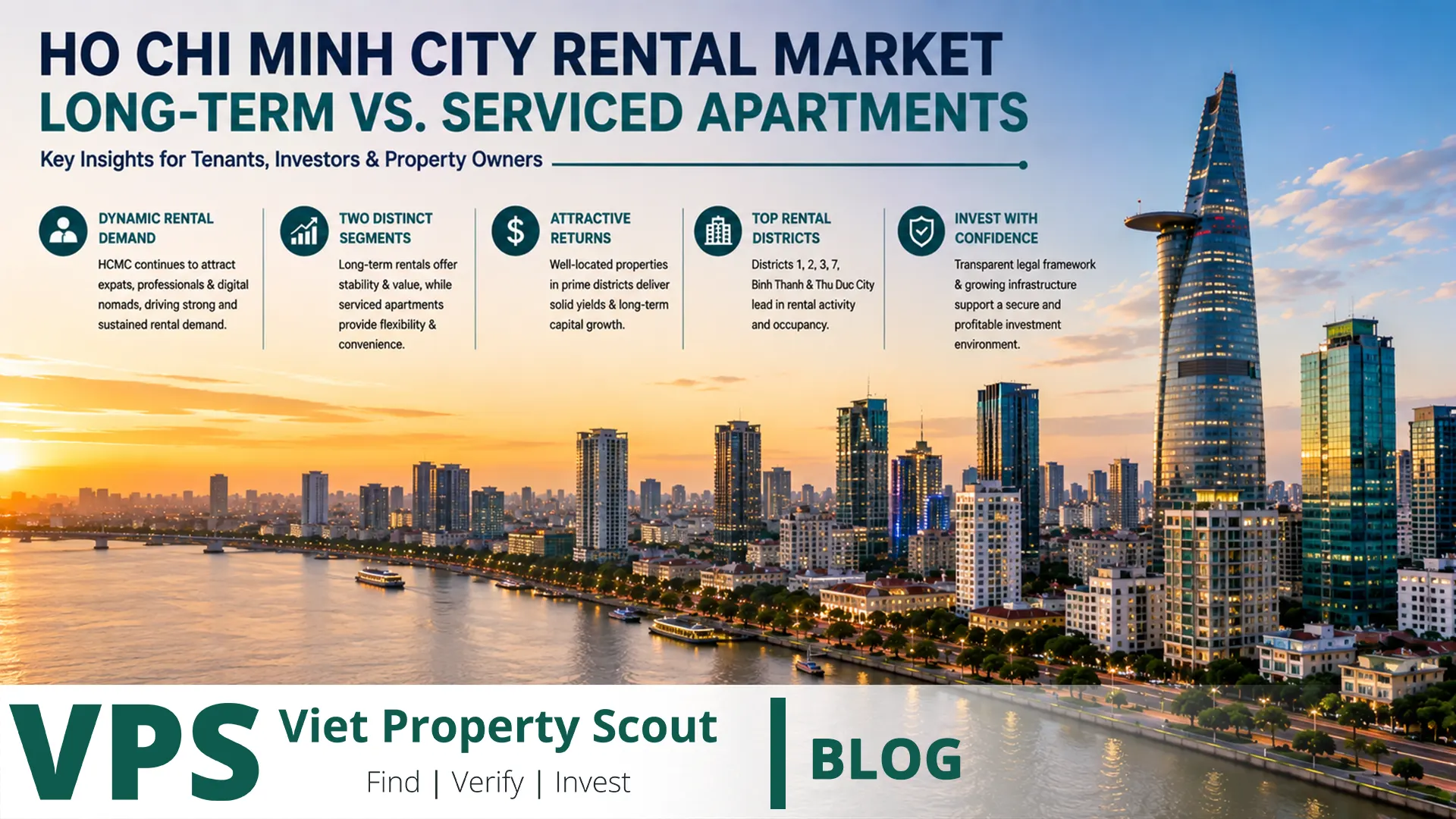
Short answer: If you expect to live in Ho Chi Minh City for six to twelve months or longer, a conventional long-term apartment lease will usually offer better value, particularly if you are comfortable managing utilities, cleaning and day-to-day household arrangements yourself. If your stay is uncertain, likely to last one to three months, or you want a move-in-ready home with professional management and bundled services, a serviced apartment can be the smarter option despite its higher monthly price. The correct comparison is not advertised rent versus advertised rent. It is total housing cost, contract length, deposit exposure, included services, exit flexibility, location, building management and legal compliance.
Long-term rental vs serviced apartment at a glance
| Factor | Long-term rental | Serviced apartment |
|---|---|---|
| Best-fit stay | Usually 6–12 months or longer | One month to several months, although longer stays are also possible |
| Monthly price | Usually lower for comparable location and quality | Usually higher because service and flexibility are built in |
| Deposit | Often higher and tied to a longer commitment | Can be more flexible depending on the operator |
| Furniture | Ranges from unfurnished to fully furnished | Normally fully furnished and move-in ready |
| Cleaning and linen | Usually arranged by the tenant | Often included or provided on a schedule |
| Electricity, water and internet | Usually billed separately | May be fully or partly included, sometimes subject to usage caps |
| Early departure | Less flexible and may put part of the deposit at risk | Generally more flexible, especially on monthly contracts |
| Maintenance | Depends on the landlord, agent and building management | Usually supported by an organized operating team |
| Best for newcomers | Good once the preferred location is known | Excellent as an initial landing option |
Understanding the Ho Chi Minh City rental market
Ho Chi Minh City should not be treated as one uniform rental market. Established central locations, Thao Dien, An Phu, Thu Thiem, Binh Thanh, Phu My Hung and other residential clusters serve different tenant profiles and can vary sharply in price, apartment size, building age, international services and commuting patterns. Vietnam's administrative restructuring from 2025 also means that former district names remain widely used as market labels even where the current administrative structure has changed. A lease should therefore be checked against the property's current official address rather than relying only on an old district label used in an advertisement.
Serviced apartments represent a professional accommodation segment rather than simply a furnished version of an ordinary rental apartment. Savills reported approximately 7,995 serviced apartment units in HCMC in Q1 2025, with average occupancy of 81%. Average rent was approximately VND 529,000 per square metre per month, up 4% year on year. Demand is supported by expatriate employees, managers, corporate relocations, long-stay business travellers and residents who want flexibility before committing to a permanent home.
When does a long-term lease make more sense?
A conventional lease becomes increasingly attractive when you already know how long you will stay, where you will work and which part of the city fits your daily routine. A tenant who can commit for twelve months gives the owner predictable cash flow and lower turnover risk, which can create more room to negotiate rent, furniture, minor upgrades or other terms.
- Stays of 12 months or longer: monthly savings compound over time and usually outweigh the value of short-term flexibility.
- Families: the traditional rental market offers a broader supply of larger layouts, multiple bedrooms, full kitchens and residential facilities.
- Employees with a stable work assignment: they can optimize for office or school access rather than paying for flexibility they do not need.
- Residents who want a home rather than temporary accommodation: long-term rentals generally provide more choice in size, layout and furnishing.
However, lower base rent is not the same as lower total cost. Building management fees, electricity, water, internet, cleaning, parking and certain maintenance items may be separate. The financial consequences of breaking a lease early also need to be included in the calculation.
When is a serviced apartment the better option?
A serviced apartment does more than provide space. It buys convenience, time and flexibility. Someone arriving in HCMC for the first time may not yet know whether Thao Dien, Thu Thiem, the central business area, Binh Thanh or Phu My Hung best matches their work and lifestyle. Signing a twelve-month lease in the first few days can therefore create avoidable location risk. One to three months in a serviced apartment allows you to test real commuting time, traffic, noise, surrounding services and building management before committing.
Serviced apartments can also be efficient for companies relocating staff because accommodation, furniture, maintenance, housekeeping and sometimes utilities can be managed under a single operating relationship. For executives and employees arriving at short notice, that simplicity can be more valuable than achieving the lowest possible monthly rent.
The convenience comes at a premium. A Savills survey in Q4 2024 found that serviced apartment rents in selected comparisons were up to 45–112% higher than upscale conventional rental apartments. That does not mean every serviced apartment carries such a premium, but it demonstrates why tenants must compare like-for-like total costs rather than assuming the two products are interchangeable.
Compare total housing cost, not headline rent
For a long-term apartment, calculate: base rent + building management fee + electricity + water + internet + housekeeping + parking + any recurring extras. For a serviced apartment, begin with the package rate and then identify electricity caps, additional cleaning fees, parking charges, guest fees or any services excluded from the package.
Next, calculate the cost over your realistic stay rather than over a single month. A cheap twelve-month lease may become expensive if you leave after five months and lose a significant deposit. Conversely, a tenant who is almost certain to remain for twelve or eighteen months may pay a substantial unnecessary premium by remaining in a serviced property for the entire period.
What works best for 1, 3, 6 and 12 months?
| Expected stay | Usually the stronger option | Reason |
|---|---|---|
| 1 month | Serviced apartment | Flexibility and immediate move-in matter more than a long-term discount |
| 3 months | Serviced apartment or a carefully documented short lease | Compare flexibility premium with deposit exposure |
| 6 months | Decision zone | A conventional lease can become competitive if pricing and exit terms are good |
| 12 months | Usually long-term rental | Monthly savings become materially more important |
| More than 12 months | Usually long-term rental | Stability and negotiating leverage normally dominate unless an employer pays for service |
Which HCMC areas suit each rental strategy?
Established central business areas
Central locations suit tenants who prioritize proximity to offices, restaurants, hotels and international services. Professional serviced-apartment supply is relatively strong, but tenants pay more for space and should inspect street-level noise and construction conditions carefully.
Thao Dien and An Phu
These are established international residential areas with schools, restaurants, services and a large stock of conventional apartments. They are particularly popular with families and longer-term foreign residents. Real rush-hour commuting time should be tested rather than judging a property by kilometres on a map.
Thu Thiem
Thu Thiem offers a newer high-rise environment, modern developments and convenient access to the traditional central business area. Building quality, occupancy, surrounding retail and construction activity can vary significantly between projects, so building-level verification matters more than neighbourhood reputation alone.
Binh Thanh
Binh Thanh can provide a useful balance of central access, modern residential towers, riverfront developments and varied pricing. It often works well for professionals, couples and smaller families.
Phu My Hung and southern residential areas
Planned streets, larger layouts, family-oriented services and access to international schools make the south attractive to many households. Tenants who work in the traditional central business area should test peak-hour travel time before signing.
Foreign tenants: the contract and temporary-residence process matter
Foreign tenants should verify more than the apartment's photos and price. HCMC rules governing condominium use require residential apartments rented as homes to be used for residential purposes and to have a rental agreement between the owner and tenant. Tourist accommodation in condominium developments is treated separately and must satisfy the relevant property-use and operating requirements. An apartment offered online for a short stay should therefore not automatically be assumed to operate under the same framework as a professionally managed serviced apartment.
Foreign residents must also have their temporary-residence information declared under Vietnam's immigration rules. The updated 2026 framework places the declaration responsibility on the accommodation establishment, owner, legal representative or authorized declarant as applicable. Before paying a deposit, ask who will complete the registration, whether the building routinely handles foreign tenants and whether evidence of the declaration can be provided if required.
Verification checklist before paying a deposit
- Verify the landlord's identity or the signatory's authority to act for the owner.
- Match the apartment number and current official address to the lease.
- Confirm in writing whether building management fees are included.
- For a serviced apartment, obtain a written list of included services and utility limits.
- Check the deposit amount, refund deadline and permitted deductions.
- Read the early-termination clause rather than assuming a replacement tenant automatically releases you.
- Photograph furniture, appliances, walls and floors at handover.
- Check pet, smoking, guest and parking policies.
- Confirm the foreign temporary-residence declaration process before moving in.
- Visit at different times of day to evaluate traffic, noise and nearby construction.
Which tenant profile should choose which option?
| Tenant profile | Likely best strategy |
|---|---|
| New arrival who does not yet know the city | Start with a serviced apartment, then move to a long-term lease |
| Expat employee on a one-year assignment | Usually a conventional long-term rental |
| Executive with company-paid housing | Serviced apartment may be operationally more efficient |
| Family with children | Usually a long-term home near school and workplace |
| Resident staying 1–3 months | Usually a serviced apartment |
| Entrepreneur unsure how long they will remain | Stay flexible initially and avoid committing too early |
The investor and landlord perspective
The distinction matters to owners as well. Long-term leasing can deliver steadier income, lower tenant turnover and less day-to-day operating work. A well-run serviced-apartment model can command higher gross revenue per occupied month, but it also carries higher operating requirements: housekeeping, maintenance, staff, marketing, vacancy management and regulatory compliance. Higher gross rent does not automatically produce a higher net yield.
An investor should therefore model net operating income after all expenses and verify the permitted use of the property and building rules before assuming that short stays or hospitality-style operations are available. A financial model built on an operating strategy the property cannot legally or practically support is not an investment thesis.
Common mistakes to avoid
- Comparing only the advertised monthly price.
- Paying a deposit before verifying ownership and contract authority.
- Treating every furnished short-stay apartment as a legitimate serviced apartment.
- Ignoring management charges, utilities and parking.
- Signing a twelve-month lease immediately after arriving without understanding the city.
- Choosing an area based on reputation rather than real commuting time.
- Failing to document the property's condition at move-in and move-out.
Frequently asked questions
Is a serviced apartment always more expensive?
Its monthly rate is usually higher, but the true difference can be smaller once cleaning, internet, maintenance and other included services are accounted for. Compare total monthly cost on the same basis.
Can foreigners rent long-term apartments in HCMC?
Yes. Long-term residential leasing to foreign residents is common, but the lease, accommodation declaration process and the legitimacy of the specific rental arrangement should still be verified.
Should I sign a twelve-month lease as soon as I arrive?
Not necessarily. If you do not yet understand the city's neighbourhoods and commuting patterns, a flexible first month or two can significantly reduce the risk of choosing the wrong location.
What are the most important lease clauses?
Deposit return, early termination, included charges, repair responsibility, payment schedule and handover conditions are among the most important.
Is the city centre always the best area?
No. The best location is the one that minimizes the combined cost of housing, commuting and daily life. Being near an office, school or metro station can matter more than having a central address.
How can I tell whether the asking rent is fair?
Compare actual units in the same project or closely comparable buildings, adjusting for size, age, furnishing, floor, view, lease duration and included services. Broad district averages are useful for orientation, not for final valuation.
Conclusion
There is no universal winner in the Ho Chi Minh City rental market. Long-term rental usually wins on cost efficiency and residential stability; serviced apartments win on flexibility, convenience and operational simplicity. For many newcomers, the strongest strategy is a two-stage approach: use a serviced apartment as a temporary base, learn the city's neighbourhoods and commuting realities, and move into a long-term lease only when the right location and expected stay are clear. Whichever option you choose, verify total cost, contract terms, deposit conditions, building management, temporary-residence procedures and the property's permitted use before transferring money.