
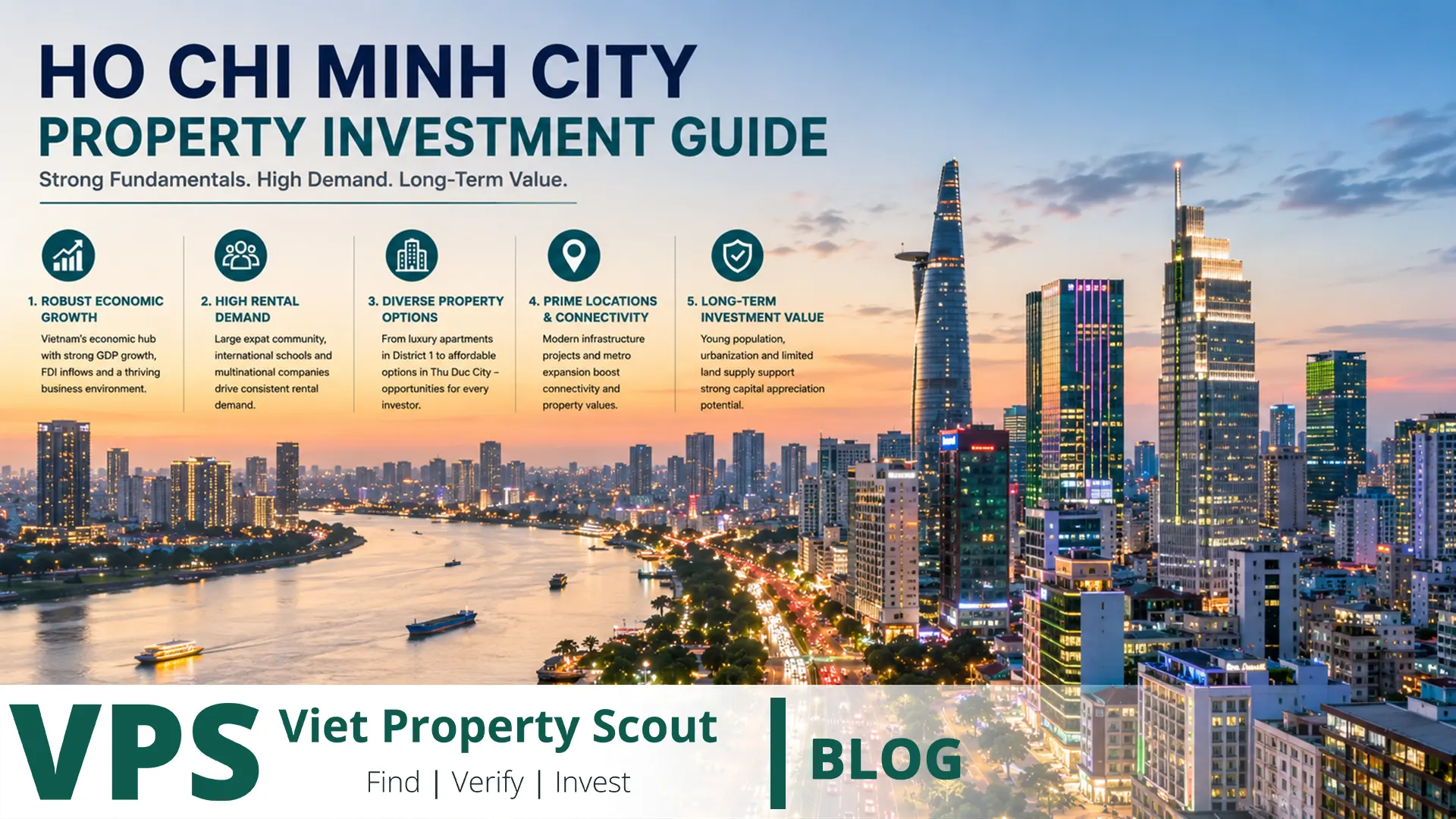
Quick answer: Ho Chi Minh City remains one of Vietnam’s deepest and most diversified property markets because demand is supported by business activity, population growth, infrastructure, education, tourism, domestic migration and a broad rental base. The strongest investment opportunities are usually not defined by a single “best district” but by the relationship between location, real tenant demand, project quality, legal clarity, transport access, entry price and exit liquidity.
For investors, the key question is not simply whether Ho Chi Minh City is a good place to buy property. The more useful question is which part of the city fits the investment strategy, which property type matches the target tenant or buyer, and what must be verified before capital is committed. Ho Chi Minh City contains central luxury markets, established family neighborhoods, metro-linked eastern growth corridors, large master-planned communities, rental-focused apartment clusters and peripheral development zones. Each behaves differently.
This guide explains how to evaluate the city as an investor, where different types of demand are concentrated, what drives long-term value, how rental strategies differ and which risks should be checked before making a decision. Investors who want to compare currently available opportunities can browse Viet Property Scout property listings, review real estate projects and contact local property advisors for market-specific verification.
Ho Chi Minh City Property Investment at a Glance
| Investment Theme | What Supports Demand | Main Opportunity | Main Risk to Verify |
|---|---|---|---|
| Central apartments | Business activity, executive tenants, tourism and limited prime locations | Prestige, rental depth and resale visibility | High entry price and compressed yield |
| Eastern growth corridors | Metro access, infrastructure, employment nodes and new urban development | Long-term capital appreciation and modern residential demand | Paying too much for future expectations |
| Established southern communities | Schools, retail, healthcare, family demand and organized neighborhoods | Stable long-term rental and owner-occupier demand | Project-to-project differences and competing supply |
| Serviced and flexible-stay units | Corporate travel, tourism, international visitors and mobile professionals | Higher gross revenue in the right micro-location | Operating intensity, vacancy and building rules |
| Landed property | Household wealth, lifestyle demand and business-use flexibility | Scarcity and long-term land-linked value | Higher ticket size and slower resale |
| Peripheral land and development property | Roads, urban expansion, regional connectivity and population movement | Potential capital growth | Planning, legal status, infrastructure timing and liquidity |
Why Is Ho Chi Minh City Attractive to Property Investors?
Ho Chi Minh City attracts property investors because several independent demand engines operate at the same time. It is Vietnam’s leading commercial center, one of the country’s largest employment markets, a destination for domestic migration, a hub for international companies, an important tourism gateway and a city with continuous residential expansion. That combination creates multiple buyer and tenant profiles rather than dependence on one narrow segment.
Demand comes from local professionals, entrepreneurs, families, students, international employees, corporate tenants, tourists, business travelers and buyers seeking long-term exposure to Vietnam’s largest urban economy. Each of these groups uses property differently. That is why a one-bedroom apartment near a business corridor, a family apartment near schools, a serviced residence in a central location and a land parcel on the metropolitan fringe should never be evaluated using the same investment criteria.
Citywide economic strength does not automatically make every property a strong investment. A poorly positioned apartment can underperform inside a growing city. A peripheral property can remain illiquid even when nearby infrastructure is improving. A luxury unit can have excellent design but weak rental economics if the purchase price is too high. Investors therefore need to separate the story of the city from the economics of the specific asset.
Where Is Property Demand Moving in Ho Chi Minh City?
Property demand in Ho Chi Minh City is moving in several directions at once. Central locations continue to attract buyers who value scarcity, convenience and international visibility. Eastern areas benefit from transport and infrastructure-led urban expansion. Established southern residential communities remain attractive for families and long-term tenants. Peripheral locations can benefit from wider metropolitan growth, but they require much stricter legal, planning and liquidity checks.
- Prime central areas remain relevant for buyers focused on prestige, convenience, executive rentals and long-term scarcity.
- Eastern corridors are increasingly associated with metro connectivity, large-scale projects, education, technology, transport and new residential communities.
- Southern residential zones appeal to families and professionals who prioritize schools, daily services, organized communities and long-term livability.
- Outer growth areas can offer lower entry points and larger potential upside, but the investment thesis often depends more heavily on future infrastructure and planning.
The most important lesson is that investors should not follow district names alone. Capital tends to follow functioning connectivity, employment, services, community formation and realistic pricing. A location becomes investable when people genuinely want to live, work, study, shop or operate businesses there, not simply because developers have created a strong marketing narrative.
Central Ho Chi Minh City: Is Prime Property Still Worth the Premium?
Central Ho Chi Minh City remains the reference point for prime property because it concentrates offices, hotels, restaurants, retail, tourism, international services and established urban amenities. High-quality central apartments can attract executives, entrepreneurs, internationally mobile professionals and buyers who prefer an address with strong recognition.
The investment case is usually based on scarcity, location defensibility and liquidity rather than low purchase price. Investors may accept a lower rental yield in exchange for a location that is difficult to replicate. Yet central property can still be a poor investment if the entry price is disconnected from achievable rent or resale demand.
Before buying a central apartment, investors should compare:
- actual achievable rent rather than advertised rent;
- price per square meter versus competing buildings;
- building age, management quality and maintenance standards;
- parking, traffic access and practical walkability;
- unit layout efficiency, orientation and natural light;
- management fees and recurring ownership costs;
- the number of competing rental units in the same building;
- resale activity at comparable price levels;
- the likely buyer profile when the investor eventually exits.
A prestigious address supports demand, but prestige cannot compensate for overpaying. The strongest central investments normally combine a defensible location, efficient unit design, professional management, realistic rental demand and an entry price that remains understandable to the future resale market.
Why the Eastern Corridor Matters
Eastern Ho Chi Minh City has become one of the most discussed investment themes because infrastructure and urban development are changing how residents move between established centers and newer residential districts. Metro connectivity, major roads, education clusters, new commercial areas and large master-planned communities can all improve the practical attractiveness of a location.
For investors, the useful question is not “Is this project near the metro?” but rather “Does transport connectivity materially improve the daily life of the target tenant or future buyer?” A project that is technically close to transport but difficult to access on foot may not receive the same benefit as a project integrated with transport, retail, employment and daily services.
A stronger eastern-corridor investment typically combines:
- operational or clearly progressing transport infrastructure;
- real residential occupancy rather than only investor purchases;
- nearby employment, education or commercial demand;
- daily services such as supermarkets, healthcare and schools;
- credible developer execution;
- pricing that still leaves room for future growth;
- a resale market that is broader than the project’s original investor pool.
Infrastructure can strengthen an investment thesis, but it should never be the only reason to buy. Investors should distinguish between infrastructure that already improves access, infrastructure that is genuinely under construction and infrastructure that exists only in promotional materials or long-term planning documents.
Thu Duc and Long-Term Growth Logic
Thu Duc is often viewed as a long-term growth area because it combines newer residential development with universities, technology-related activity, major road connections and large urban projects. That creates more than one investment strategy.
An investor may choose an established apartment with existing rental demand, a newer project positioned around future transport and commercial growth, or a longer-horizon asset where the main thesis is capital appreciation. These strategies should not be evaluated with the same return expectations.
The more an investment depends on future assumptions, the more important the purchase price becomes. If the buyer pays today for every benefit expected to arrive several years later, much of the future upside may already be priced in. A disciplined investor therefore separates existing value from expected future value.
Existing value can be measured through current accessibility, occupancy, tenant demand, surrounding services and comparable properties. Future value depends on infrastructure, planning, population growth, employment creation and successful project delivery. The two should not be confused.
Southern Ho Chi Minh City: Why Established Communities Can Outperform Hype
Southern residential areas can provide a different type of investment profile. Mature communities with schools, shopping, healthcare, parks, restaurants and organized residential environments often attract families and long-term tenants. This can create a more stable rental base than speculative areas that depend heavily on future development.
For rental investors, this matters because tenants do not rent a floor plan in isolation. They rent a daily lifestyle. A family may pay more for a location that reduces school travel, offers safe pedestrian areas and provides convenient access to groceries and healthcare. A professional may prioritize reliable commuting and nearby services over a larger but more isolated unit.
When comparing southern projects, investors should evaluate the complete neighborhood ecosystem, not just the apartment itself. Community maturity, school access, retail quality, healthcare, green space, building management and transport can all directly affect occupancy and tenant retention.
Is Land Around Ho Chi Minh City a Good Investment?
Land can offer attractive long-term appreciation, but it usually carries a higher verification burden than apartments. Value depends heavily on planning, legal status, permitted use, access, surrounding development, infrastructure timing and the depth of the resale market.
Land investment becomes especially risky when the purchase decision is based primarily on rumors about roads, rezoning, airports, industrial projects or future urban expansion. A credible opportunity should be supported by documents and observable development rather than sales language.
Before considering land or development property, verify:
- the legal identity of the seller and their authority to transact;
- the exact parcel and boundaries;
- current land-use classification;
- planning and zoning status;
- legal road access;
- existing utilities and infrastructure;
- whether proposed infrastructure is approved, funded, under construction or merely discussed;
- transaction restrictions or encumbrances;
- realistic resale demand from end users, not only other speculators;
- whether the proposed use of the property is legally and commercially realistic.
Land can generate significant gains, but it is not automatically safer simply because it is a physical asset. Investors should be especially cautious when projected returns rely almost entirely on a future planning change or a future buyer paying a substantially higher price.
Apartments, Houses or Land: Which Is Better for Investors?
| Property Type | Best Suited For | Income Potential | Liquidity | Verification Burden |
|---|---|---|---|---|
| Apartment | Rental income, easier comparison and professional management | Regular rental income | Usually stronger in active projects | Medium |
| Townhouse or villa | Long-term holding, lifestyle and business-use flexibility | Variable | Depends heavily on location and ticket size | Medium to high |
| Land | Capital appreciation and development strategies | Usually no immediate rental income | Can be weak in speculative areas | High |
| Serviced apartment | Investors targeting flexible rental demand | Potentially higher gross revenue | Depends on location and operating model | Medium to high |
There is no universally superior property type. The correct choice depends on whether the investor prioritizes income, capital appreciation, liquidity, personal use or long-term strategic exposure.
How Should Investors Evaluate the Ho Chi Minh City Rental Market?
Rental property should be evaluated using net operating logic, not advertised monthly rent. A high gross rent can still produce a weak investment return after vacancy, management, maintenance, furnishing, leasing commissions and other costs are considered.
A practical rental calculation begins with annual gross rent and then deducts realistic operating costs. Investors should also model periods without a tenant. Rental performance depends heavily on matching the property to a specific demand group.
- Local professionals often value commuting efficiency, modern buildings and practical unit sizes.
- Families may prioritize schools, larger layouts, storage, parks and long-term neighborhood stability.
- Expatriate tenants may value English-speaking management, international services, furnished units and convenient access to business centers.
- Corporate tenants often prioritize professional management, invoicing, security and predictable service standards.
- Short-stay and business travelers value centrality, transport, housekeeping, flexible check-in and hospitality-style services.
The best rental asset is not necessarily the one with the highest advertised rent. It is the one with the strongest combination of occupancy, manageable costs, tenant depth and resale liquidity.
How Should Rental Yield Be Calculated?
Rental yield should be calculated using realistic annual net income rather than headline monthly rent. Investors should estimate the rent that can actually be achieved, subtract vacancy and operating costs, and compare the remaining annual income with the total acquisition cost.
| Rental Calculation | What to Include |
|---|---|
| Gross rental income | Realistic monthly rent multiplied by occupied months |
| Vacancy allowance | Periods between tenants or seasonal weakness |
| Management | Property management or leasing service costs |
| Maintenance | Repairs, appliance replacement and wear |
| Furnishing | Initial furnishing and future replacement costs |
| Building charges | Relevant management and operating expenses |
| Net rental income | Gross income after realistic recurring costs |
This prevents investors from comparing properties using an unrealistic yield percentage that ignores the actual cost of operating the asset.
Long-Term Rental or Serviced Apartment?
Long-term rentals generally offer more predictable occupancy and lower operating intensity. Serviced apartments can generate higher gross revenue in the right location, but the owner may face more frequent tenant turnover, furnishing costs, cleaning, management expenses and seasonal demand.
| Factor | Long-Term Rental | Serviced / Flexible Stay |
|---|---|---|
| Tenant turnover | Lower | Higher |
| Management effort | Lower | Higher |
| Gross revenue potential | Moderate | Potentially higher |
| Income stability | Usually stronger | More variable |
| Furnishing and service expectations | Moderate | High |
| Best locations | Employment and residential demand zones | Business, tourism and high-mobility zones |
Investors should also verify whether the building, management rules and current regulations permit the intended rental model. A rental strategy that cannot legally or practically be operated is not a valid investment strategy.
How Does Tourism Affect Ho Chi Minh City Property?
Tourism can support accommodation demand, particularly in central and highly accessible locations, but investors should not assume that every property near a tourist area is automatically suitable for short-stay use. Tourism demand affects hotels, serviced residences, flexible accommodation and some professionally managed apartments differently.
The strongest tourism-linked locations generally combine attractions with transport, restaurants, shopping and convenient access to business activity. Ho Chi Minh City is not only a leisure destination; it also receives corporate travelers, trade visitors, entrepreneurs and people combining business with tourism. That creates a broader visitor economy than purely seasonal resort markets.
For investors, the practical questions are occupancy stability, permitted rental model, operating costs, management quality and whether the property can also attract longer-term tenants when visitor demand weakens.
What Should Foreign Buyers Verify Before Paying a Deposit?
Foreign buyers should never assume that every apartment or project is equally available to them. Eligibility can depend on the buyer, project, unit, ownership structure and current legal status. A marketing statement that a development is “foreign-buyer friendly” is not enough.
Before paying a reservation fee or deposit, a foreign buyer should verify:
- whether the project and specific unit are eligible for the proposed ownership structure;
- whether current foreign ownership availability exists for that development;
- the identity and authority of the seller or developer;
- the exact contract being signed and which payment is refundable;
- construction and handover status;
- relevant project approvals and documents;
- payment schedule and verified payment instructions;
- maintenance, management and recurring charges;
- resale, leasing and transfer conditions;
- which documents the buyer is expected to receive after completion.
The safest sequence is to verify eligibility and documents before emotional or financial commitment. Investors can compare Viet Property Scout projects and use local property advisors to investigate project-specific conditions.
How to Evaluate a New Development Before Buying
New developments can offer modern amenities, staged payment plans and stronger future positioning, but they also require careful evaluation. Investors should not judge a project only by renderings, showrooms or launch promotions.
A project review should cover:
- Developer: track record, completed projects, delivery history and reputation.
- Legal status: project approvals, sales eligibility and transaction documentation.
- Construction: actual site progress versus promised milestones.
- Location: existing access and services, not only future plans.
- Supply: number of units in the project and nearby competing developments.
- Unit economics: price, size efficiency, view, floor, orientation and likely tenant profile.
- Operating costs: management fee, parking, furnishing and maintenance.
- Exit strategy: who is likely to buy the unit later and at what price range.
Investors can browse current real estate projects and compare them with individual property listings instead of evaluating a development in isolation.
What Makes a Property Liquid in Ho Chi Minh City?
Liquidity means the ability to sell an asset within a reasonable period without accepting an excessive discount. In practice, liquidity is created by a large pool of potential buyers, transparent pricing, strong location demand, understandable property characteristics and clean transaction documentation.
Properties with very unusual layouts, extreme pricing, weak legal clarity or narrow buyer eligibility may be harder to resell even if they appear attractive at purchase. Investors should ask a simple question before buying: Who is the likely next buyer?
If the only realistic answer is “another investor hoping prices rise,” the asset may be more speculative than it first appears. A strong exit strategy identifies the future buyer before the current investor signs the purchase contract.
What Are the Biggest Investment Mistakes in Ho Chi Minh City?
- Buying the marketing story instead of the asset. Infrastructure, views and future development should be verified independently.
- Using asking prices as proof of market value. Asking prices do not necessarily reflect completed transactions or realistic buyer demand.
- Ignoring total ownership costs. Rental yield calculations should include vacancy, management, maintenance and furnishing.
- Assuming all projects have the same legal or ownership conditions. Verification must be project- and unit-specific.
- Choosing a property before defining the target tenant. The rental strategy should influence location and unit selection from the beginning.
- Overpaying for future infrastructure. Future growth only creates value if it has not already been fully priced into the purchase.
- Ignoring exit liquidity. A property can rise on paper but still be difficult to sell.
- Depending on guaranteed-return marketing. Investors should understand where rental income actually comes from and who carries the operating risk.
- Failing to inspect the real property or site. Digital brochures should never replace physical and documentary verification.
A Practical Ho Chi Minh City Property Due Diligence Checklist
| Verification Area | Questions to Answer |
|---|---|
| Seller / Developer | Who is receiving the money and do they have authority to sell? |
| Property / Project | Does the physical property match the documents, plans and marketing? |
| Ownership Eligibility | Can this buyer acquire this specific asset under the proposed structure? |
| Planning | What is the current approved use and are future infrastructure claims documented? |
| Price | How does the price compare with realistic competing properties? |
| Rental | Who will rent it, at what realistic net return and with what vacancy assumption? |
| Management | What are the recurring fees, rules and building management standards? |
| Contract | What are the payment, cancellation, delay, handover and transfer conditions? |
| Exit | Who is the future buyer and how deep is the resale market? |
Which Ho Chi Minh City Strategy Fits Which Investor?
| Investor Profile | Potential Strategy | Priority |
|---|---|---|
| Income-focused investor | Apartment in an established rental location | Occupancy, net yield and tenant depth |
| Capital-growth investor | Infrastructure-linked growth corridor | Entry price, project quality and future demand |
| Conservative long-term buyer | Mature central or established residential market | Liquidity and location defensibility |
| Higher-risk investor | Peripheral land or early-stage development area | Planning, legal verification and timing |
| Lifestyle investor | Property suitable for both personal use and rental | Livability, management and resale flexibility |
How Should an Investor Start a Ho Chi Minh City Property Search?
The first step should be defining the investment objective before selecting individual properties. Investors should decide their approximate budget, preferred holding period, target tenant or future buyer, acceptable level of risk, preferred property type and whether rental income or capital appreciation is the primary objective.
Once those parameters are clear, investors can use property listings to compare actual inventory, review development projects to understand new supply and speak with Viet Property Scout advisors about specific locations and verification requirements.
This approach prevents a common mistake: falling in love with a particular property first and inventing an investment strategy afterward.
Frequently Asked Questions About Ho Chi Minh City Property Investment
Is Ho Chi Minh City good for property investment?
Ho Chi Minh City can be attractive for property investment because it combines a large economy, diverse rental demand, multiple residential submarkets and continuing infrastructure development. Investment quality still depends on the specific property, legal status, purchase price, location, tenant demand and exit liquidity.
Which area of Ho Chi Minh City is best for investment?
There is no single best area for every investor. Central locations may suit buyers focused on scarcity and prestige, eastern growth corridors may suit long-term capital-growth strategies, and mature residential communities may suit investors seeking stable rental demand.
Are apartments better than land in Ho Chi Minh City?
Apartments are generally easier to compare and can generate rental income, while land may offer stronger long-term appreciation in the right location but requires more planning and legal verification. The better choice depends on the investor’s risk tolerance, holding period and income objective.
Is Ho Chi Minh City suitable for rental property investment?
Yes, but rental demand varies significantly by micro-location, property type and tenant profile. Investors should evaluate net income, vacancy, management costs, competing supply and realistic tenant demand rather than relying on advertised rent alone.
What is the biggest risk when buying property in Ho Chi Minh City?
The biggest risk is making a financial commitment before verifying the legal, commercial and physical facts behind the property. Price, project status, ownership eligibility, planning, rental assumptions and contract terms should all be checked before a deposit is paid.
Can foreign buyers invest in Ho Chi Minh City property?
Foreign buyers can participate in qualifying parts of Vietnam’s housing market, but eligibility is not identical for every project or unit. The current legal structure and project-specific foreign ownership availability should be verified before any payment.
What should investors check before buying a rental apartment?
Investors should check realistic rent, vacancy, management fees, furnishing costs, tenant profile, competing units, building rules, project quality, legal status and resale demand. Net return is more important than advertised gross rent.
Does being near a metro station guarantee property appreciation?
No. Metro access can improve the attractiveness of a property, but appreciation also depends on entry price, walkability, project quality, surrounding services, employment demand, competing supply and resale liquidity. Transport is one part of the investment case, not a guarantee.
What is more important: rental yield or capital appreciation?
Neither is universally more important. Income-focused investors may prioritize stable net rental yield, while long-term investors may accept lower income for stronger capital-growth potential. The correct balance depends on the investor’s objectives, cash-flow needs, holding period and risk tolerance.
The Viet Property Scout Approach: Find, Verify, Invest
Viet Property Scout approaches property investment as a sequence rather than a sales event. First, identify assets that match the investor’s objective. Second, verify the evidence behind the opportunity. Only then should the investor decide whether the expected return justifies the risk.
- Find: compare locations, properties, projects, prices and investment strategies.
- Verify: examine ownership eligibility, seller or developer identity, project status, planning, contracts, physical condition, rental assumptions and comparable market evidence.
- Invest: commit capital only after the commercial and legal assumptions behind the transaction have been tested.
This order matters. Buyers often become emotionally committed to a property before investigating the details. Professional property investment requires the opposite: verification should come before commitment.
Final Investment Perspective
Ho Chi Minh City is best understood as a collection of different property markets rather than one uniform market. Central scarcity, eastern infrastructure, established residential communities, flexible rental demand and peripheral urban expansion can all create opportunity, but each requires a different investment logic.
The strongest decisions begin with a clear objective. Decide whether the priority is rental income, capital growth, liquidity, personal use or long-term exposure. Then identify the location and property type that match that objective. Finally, verify every assumption before committing money.
Viet Property Scout is built around that sequence: Find. Verify. Invest. Start by comparing available properties, reviewing real estate projects and connecting with local property advisors. The purpose is not to make a property look attractive. It is to determine whether the evidence supports the investment.