
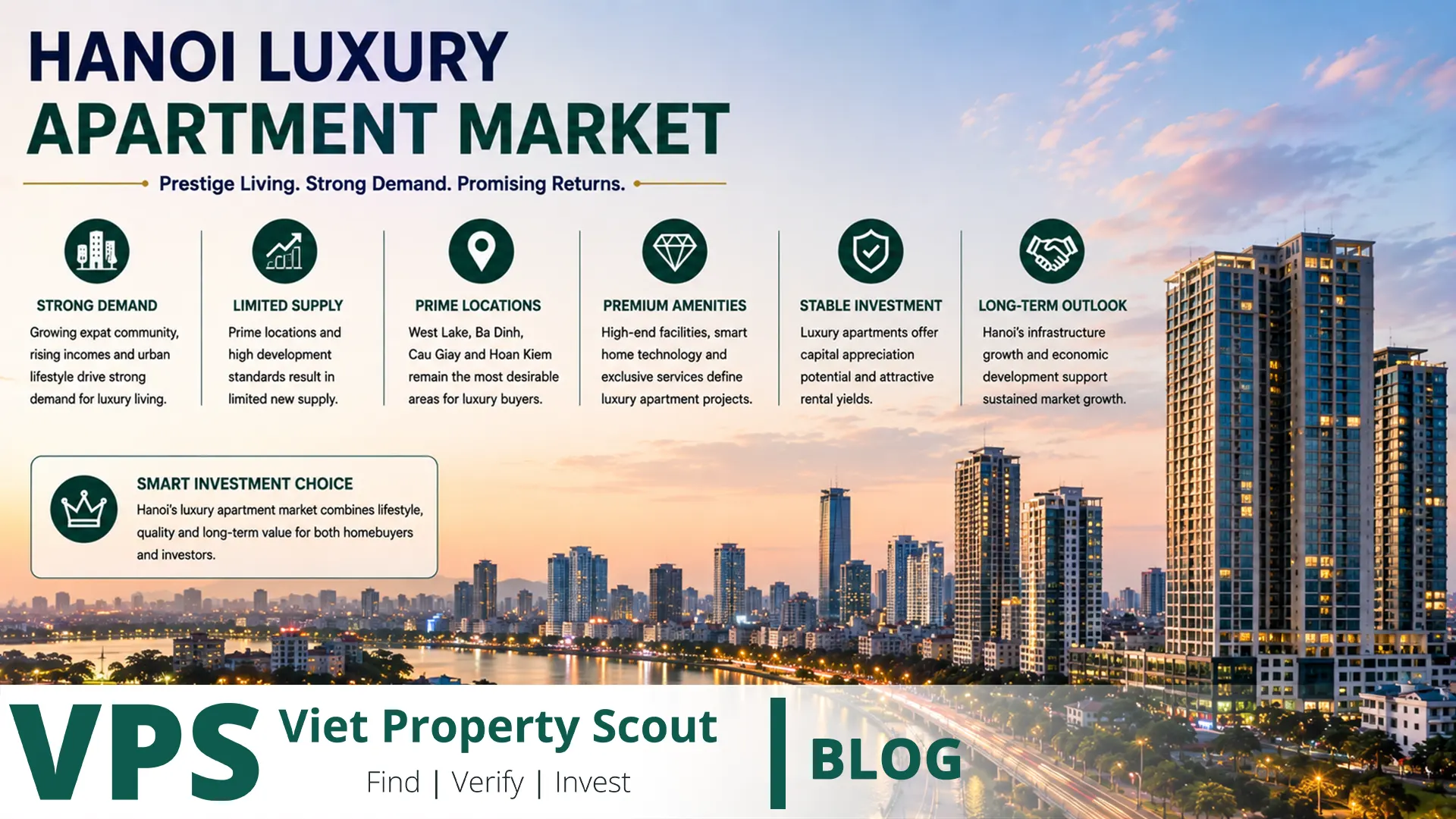
Short answer: Hanoi's luxury apartment market is not driven by one buyer or tenant group. On the rental side, important demand comes from foreign executives, FDI companies, embassy and international-organisation staff, Asian and Western expatriate families, and affluent Vietnamese tenants who want professional management and modern buildings. On the purchase side, wealthy Vietnamese households, business owners, senior managers, owner-occupiers upgrading from older housing and domestic investors form a major base; eligible foreign buyers add a smaller but important layer within projects and quotas open to foreign ownership. Geographically, there is no single luxury centre. Tây Hồ / West Lake remains one of the deepest markets for international family and lifestyle demand; Ba Đình is strong for diplomats and central professionals; Cầu Giấy and Nam Từ Liêm benefit from technology, corporate and Asian tenant demand; and West Westlake / Tây Hồ Tây is emerging as a new premium node combining Grade A offices and high-quality housing. Hoàn Kiếm offers exceptional central scarcity and prestige but a smaller scalable stock of modern condominiums. For an investor, the best luxury apartment is therefore not necessarily the most expensive one. It is the unit that best connects the target tenant's workplace, school, lifestyle and airport needs while delivering defensible management, parking, building quality and legal clarity.
What actually qualifies as a luxury apartment in Hanoi?
Luxury is not a single legal property classification. Research firms may separate high-end, luxury and ultra-luxury housing using price thresholds, while developers often use the word to describe design, amenities or branding. Investors should therefore build a functional definition rather than trust the label.
A defensible luxury apartment should combine several characteristics: strong micro-location, professional building management, reliable lifts, adequate parking, robust fire and security systems, good acoustic performance, efficient air-conditioning and ventilation, durable finishes, common areas that can age well, and proximity to offices, international schools or diplomatic infrastructure.
A marble lobby and rooftop pool can support positioning, but they do not compensate for a 60-minute daily commute, weak management, poor parking or a building that deteriorates quickly after handover.
Hanoi in 2026: high prices, but buyers are becoming more selective
By Q1 2026, CBRE reported that Hanoi's average primary condominium price, excluding Van Giang townships, had remained above VND 100 million per square metre since Q3 2025. The second quarter nevertheless showed a more selective market. More than 5,800 new condominium units were sold in Q2, equivalent to about 68% of new supply launched during the period. That was materially below the frequently 90%+ absorption seen during 2024-2025. For the first time since late 2022, the secondary market also recorded a downward price adjustment.
This matters for luxury housing. A high launch price and a prestigious brand are no longer sufficient to create automatic investment demand. JLL's Q2 2026 residential assessment also points to demand shifting toward actual occupancy rather than short-term investment and describes new high-end supply as competing on increasingly elevated quality standards.
Who rents Hanoi luxury apartments?
| Tenant segment | Typical priorities | Submarkets that often fit |
|---|---|---|
| Diplomats and embassy staff | Security, privacy, reliable management and institutional access | Ba Đình, Tây Hồ, Trúc Bạch and selected central locations |
| FDI-company executives | International standards, parking, service, office and airport connectivity | Tây Hồ, West Westlake, Cầu Giấy, Nam Từ Liêm |
| Expatriate families | 2-3 bedrooms, international schools, green space, pool and security | Tây Hồ, Ciputra and integrated western/northwestern communities |
| Korean and Asian professionals | Proximity to western office clusters and community services | Cầu Giấy, Nam Từ Liêm, Mỹ Đình |
| Japanese professionals | Predictable management, service quality and business access | Ba Đình, Cầu Giấy, Đống Đa and selected western projects |
| Affluent Vietnamese tenants | Prestige, schools, parking, modern amenities and building quality | West Lake, Tây Hồ Tây, Cầu Giấy, Nam Từ Liêm and selected central projects |
What does the serviced-apartment market tell us about foreign demand?
Serviced apartments are useful as a proxy for international housing demand because their tenant base is heavily influenced by expatriates, corporate relocations and foreign employers. Savills recorded 6,246 serviced-apartment units across 64 Hanoi projects in Q1 2025. Average occupancy reached 86%, up four percentage points year-on-year, while average rents rose 5% year-on-year to roughly VND 610,000 per square metre per month including service charges and excluding VAT.
Cầu Giấy, Đống Đa, Nam Từ Liêm, Tây Hồ and Ba Đình were identified among the most favoured areas for foreign tenants. These figures should not be applied directly to a privately owned luxury condominium. Serviced apartments typically bundle management, housekeeping or corporate-level services and can have a different cost base. What they do demonstrate is that international demand is distributed across West Lake, the diplomatic centre and Hanoi's western business corridor.
Tây Hồ and West Lake: the international lifestyle benchmark
Tây Hồ remains one of Hanoi's strongest luxury rental names. West Lake, international restaurants, cafés, clubs, international schools, larger residential formats and relatively convenient access toward Nội Bài make the area attractive to Western families, diplomats and multinational executives.
However, “near West Lake” is not a uniform product. A professionally managed modern building with proper parking, good waterproofing, efficient lifts and strong security should not be underwritten like an ageing block with the same neighbourhood label.
Two- and three-bedroom apartments can be particularly relevant to family demand. Very large four-bedroom units and penthouses may command high headline rents, but the pool of tenants able and willing to pay those rents is smaller.
West Westlake / Tây Hồ Tây: an emerging intersection of luxury housing and Grade A offices
Hanoi's business geography is shifting westward. JLL reported Grade A office stock of approximately 652,000 square metres NLA by the end of Q2 2026 after a major new completion in the West Westlake cluster. The firm's outlook expects substantial future non-CBD supply to remain concentrated in West Westlake. Cushman & Wakefield likewise identifies the West as the dominant contributor to Hanoi's high-quality office pipeline through 2026-2028.
This matters to residential investors because high-income housing demand often follows employment. An executive working in a new international-standard office in Tây Hồ Tây may have a structural reason to live in West Lake, Starlake or nearby premium western projects rather than commute every day from Hoàn Kiếm.
The office pipeline must still be treated carefully. New Grade A supply does not automatically create occupied offices. Investors should track actual tenant take-up rather than treating planned office square metres as guaranteed residential demand.
Ba Đình: durable diplomatic and professional demand
Ba Đình offers a different premium proposition from Tây Hồ. Government institutions, embassies, international organisations, hospitals, offices and direct central access support a tenant base that often values security, convenience and operational reliability more than a lakeside lifestyle.
High-quality apartments and serviced residences can work well for diplomats, senior professionals and long-term corporate leases. The building stock is highly uneven, however. A modern professionally managed residence should not be valued solely by district name against an older building with poor parking or outdated systems.
Cầu Giấy: luxury demand increasingly follows technology and offices
Cầu Giấy has become one of western Hanoi's most important business clusters. Technology, finance, education and international corporate activity support residential demand, while expanding Grade A and high-quality office stock makes the area increasingly practical for employees who prioritise commute time over historic-centre prestige.
For an investor, a well-designed two-bedroom apartment in a professionally managed building near major office clusters can have a broader tenant pool than a much more expensive penthouse. In Cầu Giấy, functional luxury such as parking, lifts, convenience retail, gym, strong management and road connectivity can be more valuable than decorative extravagance.
Nam Từ Liêm and Mỹ Đình: Asian corporate and family demand
Nam Từ Liêm and Mỹ Đình have developed strong Korean and broader Asian communities alongside modern offices, retail, restaurants, schools and residential projects. For professionals working in western Hanoi or travelling frequently toward northern industrial provinces, these locations can be more practical than the historic centre.
The trade-off is larger competing supply. Tenants can compare several similar projects, so dated furniture, weak management or ageing facilities can quickly erode a property's premium. New completions continuously reset tenant expectations.
Hoàn Kiếm and the traditional centre: maximum scarcity, but not the largest modern luxury apartment market
Hoàn Kiếm has exceptional symbolic and central-location value, but limited land and historic urban constraints restrict the ability to add large volumes of modern luxury condominiums. Some central assets therefore have a stronger scarcity and capital-preservation case than a pure rental-yield case.
The area can suit executives, diplomats and buyers who prioritise CBD access, culture and walkability. It is less naturally suited to some family tenants who want large compounds, extensive children's facilities, international schools and abundant parking.
Who buys luxury apartments in Hanoi?
Affluent Vietnamese buyers are a core market. Business owners, senior managers and families may buy for occupation, upgrading, children, long-term wealth storage or a mixture of personal and investment reasons.
Domestic investors also buy for rental and resale. But after very strong price growth, the slower Q2 2026 absorption and secondary-market correction make a simple “buy any luxury launch and resell higher” strategy less defensible.
Foreign buyers are an important but legally channelled group. They tend to concentrate in projects where foreign ownership eligibility, remaining quota, certificates and resale procedures are relatively clear.
The 30% foreign-ownership cap is not the same as 30% availability
Eligible foreign organisations and individuals may own qualifying housing in permitted commercial housing projects, subject to national-security restrictions. For residential apartments, the general cap is 30% of the residential-purpose apartments in the relevant apartment building, with additional rules for multi-block structures.
That statutory maximum does not mean 30% remains available when a buyer arrives. Previously purchased, lease-purchased and certified foreign-owned units matter. The buyer must also confirm that the specific unit is legally residential housing rather than an officetel or other commercial product.
What does a genuine luxury tenant actually pay for?
- Predictable commute to office and school.
- 24/7 security and responsive building management.
- A usable car-parking arrangement.
- Enough fast, reliable lifts.
- Strong acoustic insulation, ventilation and cooling.
- Stable internet and transparent utility billing.
- High-quality but maintainable furniture and appliances.
- Family-friendly storage and bedroom layouts.
- Pool, gym and children's facilities where family demand is targeted.
- Professional lease paperwork and temporary-residence registration support for foreign tenants.
A lake view is not an investment thesis by itself
Lake-view apartments can command substantial premiums. Investors should check whether the view is actually protected or whether developable land exists between the building and the lake.
Even a permanent view does not guarantee a strong income return. If an investor pays 30% more for the view but receives only 10% more rent, much of the premium depends on future resale willingness rather than current cash flow.
Yield example: expensive rent can still produce a modest return
Illustrative example only: assume a luxury apartment costs VND 15 billion and rents for VND 55 million per month for eleven occupied months. Gross annual rent is VND 605 million. If management, vacancy, brokerage, tax, maintenance and furniture reserves total VND 105 million, approximate net operating income is VND 500 million before financing, or roughly 3.3% of the purchase price. A VND 10 billion apartment producing VND 450 million net income would generate a higher percentage return despite having a lower headline rent.
The investor therefore needs to decide whether the goal is rental yield, capital preservation, personal use or a combination. The luxury label does not answer that question.
Which unit types are most rentable?
| Unit type | Potential demand strength | Main limitation |
|---|---|---|
| Premium 1BR | Single executives and couples | Competition from serviced apartments |
| 2BR | Broadest pool across couples, executives and small families | Layout quality matters heavily |
| 3BR | Expat families and corporate leases | Higher absolute rent narrows tenant pool |
| 4BR / Penthouse | Executive and diplomatic niche | Lower rental and resale liquidity |
| Serviced apartment | Turnkey corporate and expatriate demand | Higher operating and management cost |
Is a corporate lease always better than an individual tenant?
Not necessarily. Corporate leases can offer more structured payment and longer occupancy but may require proper invoicing, tax compliance, clearly documented maintenance, inventory lists and strict termination clauses. Corporate budgets can also be capped, so companies will not necessarily pay a premium merely because a project is famous.
An owner targeting corporate tenants should prepare the unit accordingly: bilingual agreement, temporary-residence registration, organised invoicing and taxes, inventory documentation, a clear maintenance contact and fast response times.
A major 2026 risk: new premium competition
CBRE recorded nearly 36,000 new condominium launches in Hanoi during 2025, while the 2026 pipeline remained substantial. By Q2 2026, absorption had already slowed relative to the previous two years. In the luxury segment, this means tenants and buyers have increasing choice.
A building that looks premium at handover can appear average five years later if management, furniture, lobby quality, technical systems and common areas fail to keep pace with newer competitors. Long-term asset management matters as much as initial design.
Key luxury-investment risks
- Paying a large brand premium without a corresponding rental premium.
- Buying an oversized apartment with too small a tenant pool.
- Relying on an “expat area” label without real proximity to schools or offices.
- Paying for an unprotected view.
- Insufficient parking in a building targeting executives.
- High service charges reducing net yield.
- Furniture and finishes ageing quickly.
- New competing projects resetting quality expectations.
- Foreign purchase without project and quota verification.
- Using serviced-apartment rent directly to value a private condominium.
- Treating asking rents as achieved contract rents.
- Assuming automatic capital appreciation despite a more selective secondary market.
Luxury-apartment stress test
| Scenario | Assumption | Question |
|---|---|---|
| Base case | Eleven occupied months and stable rent | Does net yield justify the price? |
| Rent falls 15% | New projects increase competition | Is the asset still attractive? |
| Two extra vacancy months | Tenant replacement takes longer | Can cash flow absorb it? |
| Refurbishment after five years | Furniture and appliances need replacing | Has capital reserve been budgeted? |
| Six-month resale | Quick liquidity required | How large is the genuine buyer pool? |
| Flat secondary prices | No capital appreciation | Does the rental case work by itself? |
Where is demand strongest by strategy?
| Strategy | Often logical submarket | Why? |
|---|---|---|
| Western/international family | Tây Hồ / West Lake / Ciputra | Schools, space, international community and lifestyle |
| Diplomat / international organisation | Ba Đình / Trúc Bạch / Tây Hồ | Embassies, government access and security |
| Technology / corporate | Cầu Giấy / Tây Hồ Tây | Modern offices and expanding Grade A supply |
| Korean / Asian professional | Nam Từ Liêm / Mỹ Đình / Cầu Giấy | Community services and western business corridor |
| Central scarcity | Hoàn Kiếm / selected central assets | Irreplaceable address rather than large supply |
| Emerging premium node | West Westlake / Tây Hồ Tây | New office clusters combined with premium urban development |
Due-diligence checklist before buying
- Define the natural tenant rather than an imaginary “wealthy expat”.
- Measure rush-hour travel time to offices and schools.
- Compare achieved rents where possible, not only listings.
- Verify building management, service charges and parking rights.
- Inspect acoustics, moisture, cooling, lifts and security.
- Map competing projects due in the next three to five years.
- Budget furniture and appliance replacement.
- Verify legal status, certificate and any mortgage issues.
- If foreign, confirm project, unit and remaining foreign quota eligibility.
- Compare net return with lower-priced alternatives before paying a luxury premium.
- Identify the natural resale buyer before purchase.
Frequently asked questions
Where is Hanoi's strongest luxury rental demand?
Tây Hồ/West Lake remains one of the deepest international family markets. Ba Đình is particularly relevant to diplomatic and central professional demand, while Cầu Giấy, Nam Từ Liêm and Tây Hồ Tây are gaining from western corporate and office growth.
Are foreigners the main buyers of luxury apartments?
No. Affluent Vietnamese owner-occupiers and domestic investors are a major part of purchase demand. Foreign buyers are important but operate within legally eligible projects and ownership quotas.
Is a lake-view apartment always the better investment?
No. Compare the view premium with the actual rent and resale premium, and check whether future development could block the view.
Is a 3BR better than a 2BR?
Three-bedroom apartments can be strong for expatriate families and corporate leases, while two-bedroom units usually have a broader tenant pool and lower entry price. Building and location determine which is better.
Can serviced-apartment rents be used as the benchmark?
Only with adjustment. Serviced apartments usually include management and services that private condominiums do not.
Will Hanoi luxury prices automatically continue rising?
No. Q2 2026 data show slower absorption and a secondary-market price adjustment. Product quality, pricing and liquidity now require closer scrutiny.
Conclusion: the strongest luxury demand is where work, lifestyle and quality intersect
Hanoi's luxury map is increasingly multi-centred. Tây Hồ remains the reference point for international lifestyle housing; Ba Đình serves diplomatic and institutional demand; Cầu Giấy and Nam Từ Liêm capture western corporate and Asian tenant demand; and West Westlake / Tây Hồ Tây is forming a new premium node combining Grade A offices with high-quality residential supply. Hoàn Kiếm remains exceptionally scarce but is not automatically the highest-yielding submarket.
Find | Verify | Invest in Hanoi luxury housing means: find where the target tenant genuinely wants to live, verify achieved net rent, building management, physical quality, future competition and legal status, and invest only when the luxury premium produces measurable value through rent, liquidity or long-term capital preservation rather than simply a more expensive brochure.