
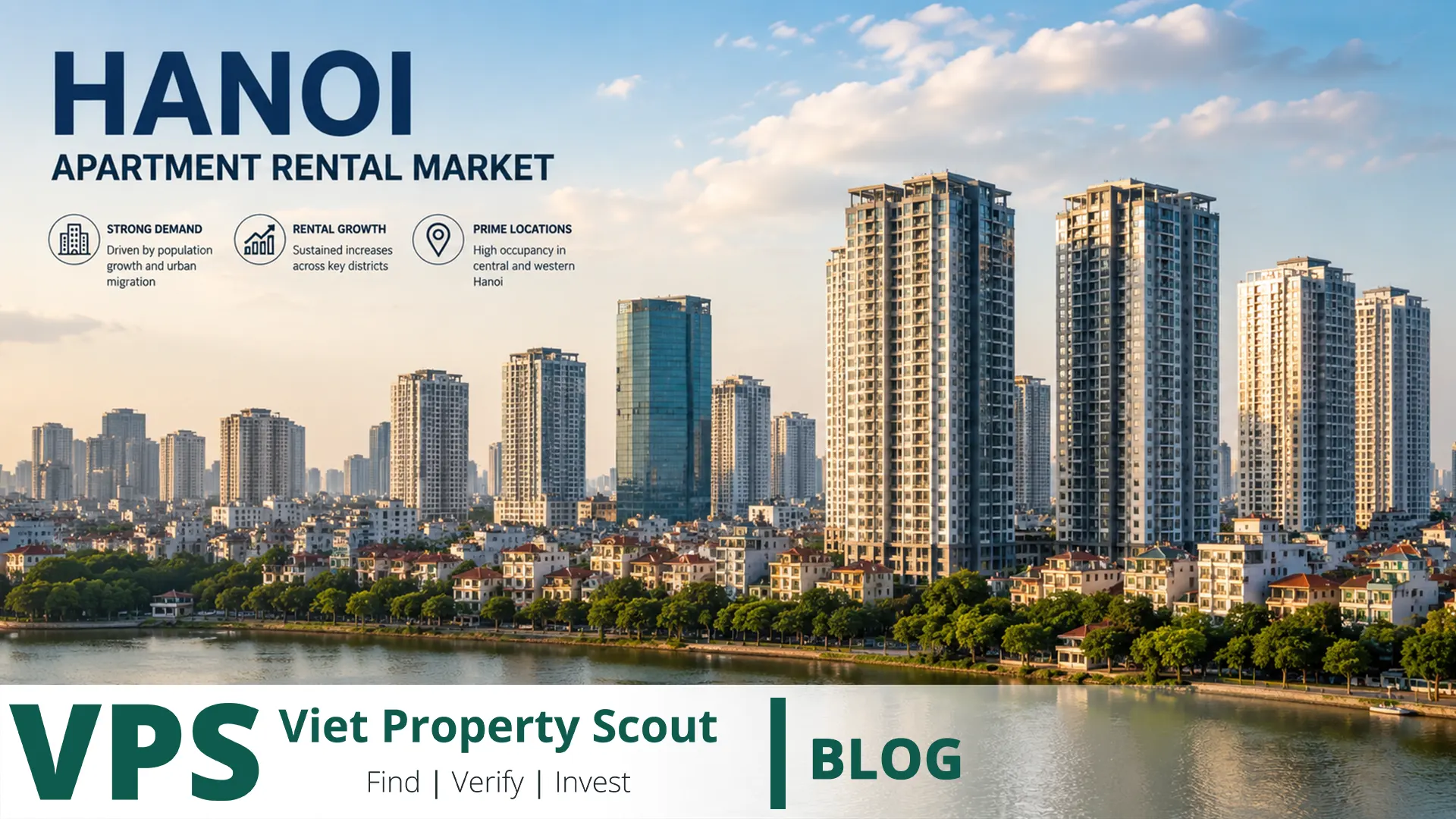
Short answer: Hanoi's apartment rental market is supported by several distinct tenant groups rather than one single source of demand. Foreign residents, executives, engineers and employees of domestic and international companies, Vietnamese families, students, researchers and people relocating within the capital all create housing demand. The strongest rental investment is therefore not necessarily the most expensive or luxurious apartment, but the unit that matches a clearly identifiable natural tenant, can be rented at a sustainable price and has manageable vacancy and operating costs. Tây Hồ is particularly strong for international tenants, Ba Đình for central and institutional demand, Cầu Giấy - Nam Từ Liêm for professionals and corporate employees, while Long Biên - Gia Lâm and Hà Đông - Hoài Đức serve broader family and long-term local demand. Investors should also avoid treating serviced-apartment statistics as if they describe the entire private condominium rental market.
What does Hanoi's rental market look like in 2026?
Hanoi entered 2026 after several years of strong condominium-price growth and substantial new apartment supply. In Q2 2026, more than 5,800 condominium units were sold, equal to approximately 68% of new supply launched during the quarter, while the secondary market recorded its first downward price adjustment since late 2022. Those are sales-market figures rather than rental data, but they matter to landlords because purchase prices that rise faster than rents can compress rental yields even when tenant demand remains healthy.
At the same time, international and professional accommodation demand remains meaningful. The latest broadly reported benchmark for Hanoi's professionally operated serviced-apartment sector showed approximately 6,246 units across 64 projects in Q1 2025, with occupancy around 84% and average rents about 2% higher year on year. Those figures demonstrate depth in the corporate and expatriate accommodation market, but they should not be used as an occupancy or rental benchmark for an ordinary privately owned apartment.
Four different tenant markets
| Tenant group | What matters most? | Common lease logic | Areas often suited to the segment |
|---|---|---|---|
| Foreign resident / expatriate | Furniture, internet, management, international services, access to school or work | 6-12 months or longer | Tây Hồ, Ba Đình, Cầu Giấy, Nam Từ Liêm |
| Professional / corporate employee | Commute, modern building, workspace and parking | 6-12 months | Cầu Giấy, Nam Từ Liêm, Ba Đình |
| Vietnamese long-term family | Schools, childcare, retail, space and predictable costs | 12 months or longer | Hà Đông, Hoài Đức, Long Biên, Gia Lâm |
| Company lease for an employee | Clear contract, invoicing, maintenance and professional administration | Often 12 months | Tây Hồ, Ba Đình, Cầu Giấy, Nam Từ Liêm |
Foreign tenants: potentially higher budgets, but higher expectations
A meaningful part of Hanoi's foreign housing demand is connected to FDI, international companies, manufacturing, technology, services and diplomatic activity. Reporting in 2025 indicated that roughly 10,000 new foreign workers are granted work permits in Hanoi each year, many of them skilled professionals. That figure should not be converted directly into apartment demand, but it helps explain why the capital maintains a substantial international housing segment.
Foreign tenants rarely compare apartments on rent alone. Furniture quality, reliable internet, air conditioning, hot water, washing facilities, security, lifts, parking, building management, English-language communication and genuine travel time to an office or international school can all influence the decision.
For landlords, this means a sensibly priced, practical apartment can outperform an overdecorated luxury unit in a poorly managed building or inconvenient street.
Professionals and corporate employees: commuting time is a major demand driver
In west Hanoi, proximity to employment clusters can matter more than a prestigious central address. A professional working around Cầu Giấy or Nam Từ Liêm may prefer a modern condominium with a shorter commute, shopping, gym facilities and parking rather than living in the historic core.
One- and two-bedroom apartments with a usable work area, strong internet, functional kitchen and professional management are particularly relevant. When the employer signs or pays for the lease, contract quality, invoicing and maintenance response can become part of the selection process.
Long-term tenants: less glamorous but often more stable
A tenant who remains for several years can produce a stronger net result than a higher-paying tenant who changes frequently. Every turnover can involve vacancy, brokerage, cleaning, repairs and furniture replacement. Families that renew annually therefore have significant economic value.
For this segment, schools, parks, supermarkets, parking, storage, quietness, building fees and kitchen quality often matter more than a premium skyline or lake view.
Where does each type of rental demand concentrate?
| Submarket | Natural tenant | Stronger product | Main risk |
|---|---|---|---|
| Tây Hồ / West Lake | Expats, diplomats, international families and executives | Furnished 1-3 bedroom units with strong management | Paying too much for the location premium |
| Ba Đình - Trúc Bạch | Diplomatic, corporate and central-city tenants | Furnished private apartments and serviced residences | Uneven age and quality of buildings |
| Cầu Giấy - Nam Từ Liêm | Professionals, technology and office staff, families | Modern 1-3 bedroom condominiums | Heavy competing supply |
| Long Biên - Gia Lâm | Families and tenants seeking more space | 2-3 bedroom units in complete communities | Commute dependency across the river |
| Hà Đông - Hoài Đức | Vietnamese families and long-term renters | Mid-market 2-3 bedroom apartments | Many substitutable units |
| Hoàn Kiếm | Tenants prioritising central location | Scarce and distinctive units | High acquisition cost and older stock |
Tây Hồ: Hanoi's clearest international rental market
West Lake has developed an international residential ecosystem over many years. International schools, restaurants, sports facilities, diplomatic facilities and professionally operated residences make it relatively easy to position a high-quality apartment toward foreign tenants.
The rental range is extremely wide. As an illustration of the premium end rather than the general market, current CBRE listings for some professionally operated West Lake serviced residences show asking rents above US$2,000 per month, with larger full-service units reaching materially higher levels. Those figures should never be used as the market rent for an ordinary privately owned apartment simply because it is located in Tây Hồ.
Ba Đình and Trúc Bạch: central and institutional demand
Proximity to government institutions, embassies, offices, hospitals and central-city amenities supports rental demand from foreign and Vietnamese professionals. The major challenge is inconsistent building stock. A professionally managed modern residence can perform very differently from an ageing building on the same street.
Cầu Giấy - Nam Từ Liêm: the largest modern professional tenant market
This corridor combines office clusters, technology businesses, universities, shopping centres and major residential developments. A landlord can potentially target both Vietnamese and foreign employees instead of relying on one tenant nationality or sector.
The trade-off is competition. Large projects can have dozens of similar furnished apartments advertised simultaneously. A better floor, orientation, natural light, view, layout and management structure can create more durable differentiation than expensive decoration alone.
Long Biên - Gia Lâm: more space and longer family leases
Modern planned communities east of the Red River increasingly appeal to families seeking more space and complete neighbourhood amenities. Nominal rents may be lower than in some central or western premium markets, but acquisition costs can also differ materially.
Commuting is the decisive variable. A unit that requires a difficult bridge crossing every day may be unattractive to someone working in west Hanoi, while the same apartment can be excellent for a family whose work and schools are located east of the river.
Hà Đông - Hoài Đức: value and genuine residential use
These markets rely more heavily on Vietnamese families and long-term residential demand than on diplomatic or premium expatriate demand. The landlord generally needs a clean, practical home, good kitchen, parking, school and retail nearby rather than hotel-style luxury.
The risk is high substitutability. If hundreds of similar two-bedroom apartments compete in the same catchment, rental pricing power is limited.
Serviced apartments are not ordinary private apartments
Serviced residences commonly include reception, housekeeping, internet, maintenance and sometimes breakfast, shuttle services or utility allowances. Their headline rent is therefore often higher, but so are their operating costs.
In Q1 2025, Hanoi's serviced-apartment stock was reported at approximately 6,246 units across 64 projects, with occupancy around 84%. This is useful evidence of corporate and foreign accommodation demand, but it does not prove that a furnished private apartment in an unrelated building will achieve the same occupancy or rent.
Furnished or unfurnished?
| Model | Advantage | Disadvantage | Best matched tenant |
|---|---|---|---|
| Fully furnished | Ready for foreigners and professionals | Higher wear and replacement cost | Expatriates, corporate tenants, medium-term leases |
| Partly furnished | Lower investment and flexible use | Narrower appeal in some international segments | Local families and long-term professionals |
| Unfurnished | Low furniture cost for the owner | Less attractive to many foreign tenants | Families planning to remain for several years |
The correct furnishing level is not the most expensive one. It is the level the natural tenant is willing to pay for. Premium furniture in a price-sensitive family market can reduce the landlord's return rather than improve it.
How should rental income be calculated?
A landlord should not simply multiply monthly rent by twelve. Vacancy, brokerage, repairs, building costs borne by the owner, furniture replacement and tax obligations need to be included.
Illustrative example only: assume an apartment is acquired for VND 6 billion and actually rents for VND 30 million per month for eleven months of the year. Gross annual rent is VND 330 million. If total vacancy, brokerage, repairs, replacement and other operating obligations cost VND 50 million, approximate net operating income is VND 280 million, or about 4.7% of the acquisition price. This is not a Hanoi market-return forecast; it simply shows the difference between headline monthly rent and actual net yield.
Vacancy can matter more than maximising monthly rent
A landlord may prefer VND 32 million per month, but two empty months can make the annual result worse than VND 29 million with a stable twelve-month tenant. Annual realised cash flow matters more than the highest achievable asking rent.
| Scenario | Assumption | Purpose |
|---|---|---|
| Upside | Fast renewal and modest rent increase | Measure realistic upper potential |
| Base | One month vacancy plus normal repairs | Main underwriting case |
| Stress | Two to three months vacancy and a rent discount | Test resilience |
Lease duration: stability has economic value
A good twelve-month tenant may be financially better than a shorter tenant paying a higher monthly price. The lease should clearly define deposit, payment date, any rent increase mechanism, building-management fee, electricity, water, internet, repair responsibility, pets, handover condition and termination notice.
Furnished apartments should have a detailed move-in inventory with photographs of furniture and appliances.
Corporate lease versus individual lease
When a company signs or pays the lease, payment reliability and administration can improve, but the company may require formal invoices, clearer documents, maintenance standards and more structured contractual terms. A landlord should know in advance whether the property and rental setup can meet those requirements.
Foreign owners can rent their homes, but obligations apply
Current housing law allows eligible foreign individual homeowners to lease their housing for uses that are not prohibited by law, while also imposing notification and tax obligations related to the rental activity. Because Vietnam's local administration has moved to a two-tier structure, the current receiving authority and procedure should be confirmed locally before signing rather than relying on an old district-level instruction.
Ownership of a residential apartment should also not be confused with permission to conduct any type of accommodation business. Long-term residential leasing and hotel-like short-stay accommodation are different operating and regulatory models.
Temporary-residence reporting matters for foreign tenants
From 21 May 2026, Vietnam's Ministry of Public Security implemented a unified system for accommodation notifications for Vietnamese citizens and temporary-residence declarations for foreigners. Owners, tenants and property managers should therefore establish clearly who is responsible for the required reporting. A commercially good lease can still create an operational problem if the foreign tenant cannot be properly registered.
Tenant screening is about reliability, not simply income
- Verify identity and legal residence status.
- Establish whether the individual or employer will pay rent.
- Request employment evidence or a reference where appropriate.
- Put repair promises in writing.
- Do not rely on a deposit transfer without a clear contract.
- Use a detailed move-in and move-out inspection record.
Common landlord mistakes
- Pricing from competing advertisements instead of completed leases.
- Using serviced-residence rents to value an ordinary private apartment.
- Overinvesting in furniture the target tenant will not pay for.
- Ignoring management, brokerage, repairs and vacancy.
- Depending on a single broker without checking competing evidence.
- Targeting expatriates with a building that does not meet expatriate expectations.
- Failing to organise foreign-tenant residence reporting.
- Calculating yield on twelve months of perfect occupancy every year.
Which rental model fits which landlord?
| Landlord objective | Usually stronger product | Location |
|---|---|---|
| Higher international rent | High-quality fully furnished apartment | Tây Hồ / Ba Đình |
| Diversified professional demand | Modern 1-2 bedroom apartment | Cầu Giấy / Nam Từ Liêm |
| Low tenant turnover | Family-friendly 2-3 bedroom unit | Long Biên / Gia Lâm / Hà Đông |
| Corporate-income strategy | Well-managed, documentation-ready unit | Tây Hồ / Ba Đình / west Hanoi |
| Conservative rental strategy | Mid-market unit with deep local demand | Established residential communities |
Checklist before buying an apartment to rent
- Identify the natural tenant before buying the apartment.
- Verify actual rents in the same building.
- Separate advertised asking rents from completed lease levels.
- Include at least one vacancy month in the base case.
- Check building-management and parking fees.
- Test internet, air conditioning, water pressure and sound insulation.
- Count the number of directly competing rental units.
- Budget for furniture and appliance replacement.
- Calculate net yield after tax and expenses.
- If you are a foreign owner, verify rental notification and compliance obligations.
- Understand the foreign-tenant residence-reporting process.
- Test whether local families would rent the unit if expatriate demand weakened.
Frequently asked questions
What is the best area for renting to foreigners in Hanoi?
Tây Hồ is one of the strongest established choices, while Ba Đình, Cầu Giấy and Nam Từ Liêm can also perform well depending on the tenant's workplace and the apartment type.
Do foreign tenants always pay more?
No. They may have higher budgets but often require better furniture, services, administration and building quality. Net income matters more than monthly rent alone.
Is a serviced apartment better than a private condominium?
Not automatically. Serviced residences can capture corporate demand and higher rents but have greater operating costs, while private apartments can produce lower-cost, longer leases.
Is a twelve-month lease always preferable?
It often improves stability, but rent, tenant quality, deposit strength and renewal probability should be considered together.
What is the biggest rental-investment risk?
Paying too much for the apartment based on an optimistic rent assumption. If acquisition prices rise much faster than rents, yields can fall even in a strong tenant market.
Can a foreign owner rent out an apartment?
An eligible foreign homeowner can lease housing within the legal framework, subject to applicable notification, tax and other compliance obligations. The current administrative procedure should be verified before contracting.
Conclusion: in Hanoi, the best rental apartment is designed for a clear tenant, not the broadest advertisement
Hanoi's rental strength comes from demand diversity. Tây Hồ serves the international community, Ba Đình central and institutional tenants, Cầu Giấy - Nam Từ Liêm professionals, while Long Biên - Gia Lâm and Hà Đông - Hoài Đức provide a deep long-term family base. This diversity allows investors to create resilient rental strategies when the property is matched correctly to its natural tenant.
In this market, Find | Verify | Invest means: find an apartment matched to a specific source of demand, verify actual rent, competing supply, expenses, legal obligations and tenant administration, and invest only when net income remains convincing after realistic vacancy and maintenance rather than assuming twelve perfectly occupied months every year.