
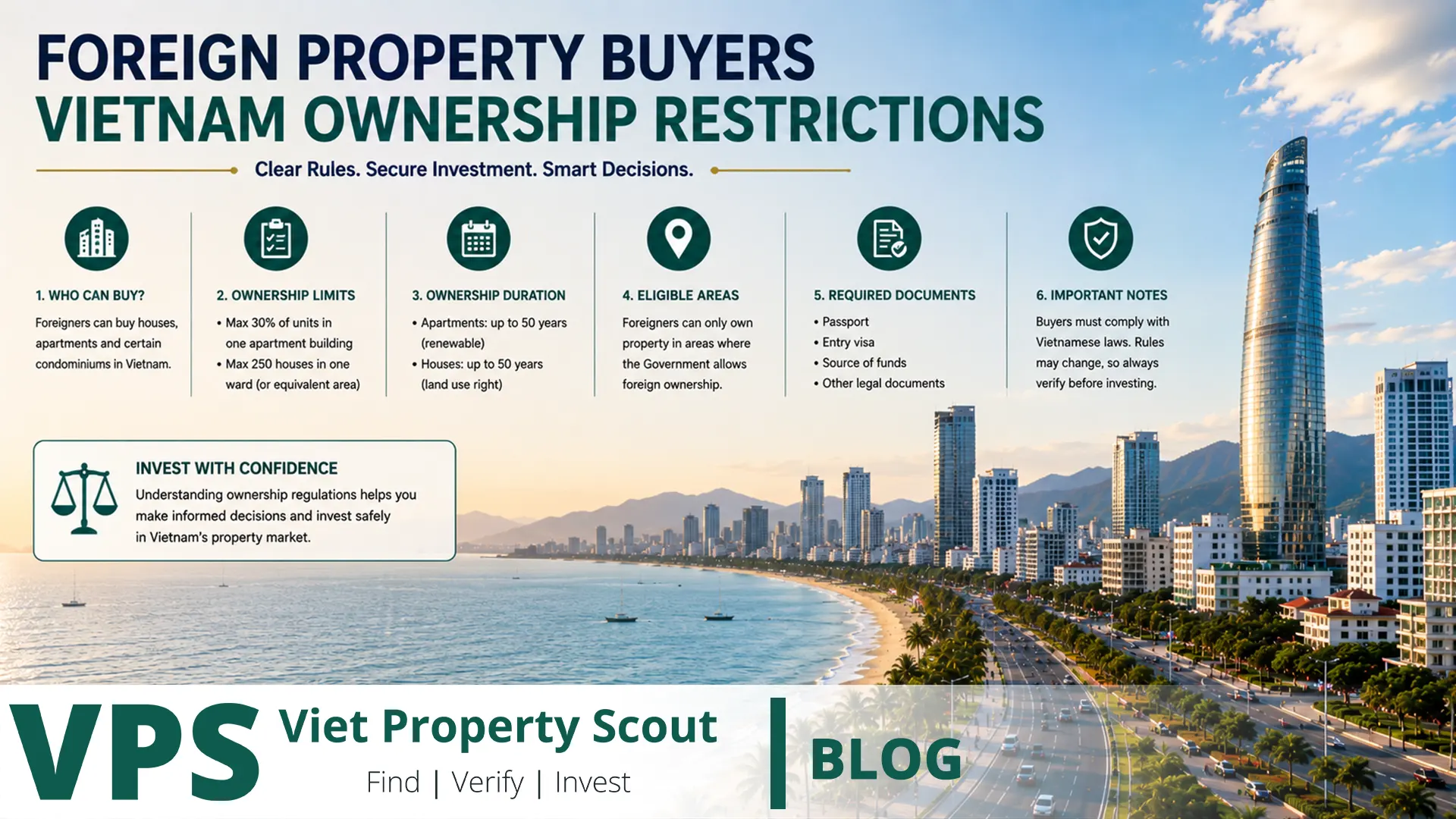
Short answer: qualifying foreign buyers can own certain residential property in Vietnam, but the statement “foreigners can buy property in Vietnam” is far too broad. The legal framework distinguishes between housing ownership, land-use rights, project eligibility, foreign-ownership quota, unit classification and ownership term. For an ordinary foreign individual, the clearest verifiable route is usually ownership of qualifying commercial housing within a project that is permitted for foreign ownership, not the acquisition of a standalone land parcel in the same way as an eligible Vietnamese buyer. In residential apartment buildings, foreign organisations and individuals are generally limited to up to 30% of the residential-purpose apartments in the relevant building or block. Individual houses are subject to a different numerical ceiling. A foreign individual's housing ownership term is generally capped at 50 years from issuance of the ownership certificate, with one extension of up to another 50 years possible if the statutory conditions remain satisfied. A foreign buyer should therefore never pay a deposit before verifying personal eligibility, project eligibility, remaining foreign quota, the unit's legal classification, land and mortgage status, certification pathway and contract.
What can a foreign individual actually own?
Vietnam's current Housing Law allows defined categories of foreign organisations and foreign individuals to own housing. For an ordinary foreign individual, the person must be permitted to enter Vietnam and must not fall within a disqualifying diplomatic or consular privilege and immunity category.
The central acquisition route is commercial housing in qualifying housing-investment projects outside areas where foreign ownership is restricted for defence or national-security reasons. Depending on the project and product, this may include residential apartments and certain individual houses such as villas or townhouses.
Housing ownership is not the same as unrestricted standalone land ownership
This is one of the most important distinctions for international investors. Vietnam's land system is not a conventional Western freehold-land system. Land belongs to the entire people, with the State acting as representative owner and manager, while eligible users hold land-use rights within the statutory framework.
A foreign individual's lawful ownership of a qualifying apartment or house should therefore not be interpreted as an unrestricted independent land-use right equivalent to that of an eligible Vietnamese citizen. The certificate may record information relating to the housing asset and associated land position, but foreign housing ownership and an independently transferable domestic-style land-use right are not interchangeable concepts.
This is why “put the land in a Vietnamese friend's name” is not an equivalent ownership solution. If the registered legal right belongs to someone else, the foreign investor may not control the asset in the way expected.
Which foreign-buyer categories matter?
| Category | Core requirement | Investment significance |
|---|---|---|
| Foreign individual | Permitted to enter Vietnam and not within the relevant diplomatic/consular immunity exclusion | Typical private foreign buyer |
| Foreign organisation operating in Vietnam | Valid Vietnamese investment or operating documentation | Use rights differ from an individual buyer |
| Foreign-invested entity developing housing | Lawful housing-project developer | Different legal structure from a private purchase |
| Overseas Vietnamese | Separate statutory status | Should not be treated as an ordinary foreign individual |
What evidence does a foreign individual normally need?
The implementing framework generally requires a valid foreign passport and evidence of lawful entry into Vietnam, or legally equivalent entry documentation, together with the required confirmation concerning diplomatic and consular privileges or immunities.
The relevant status must exist at the time of the housing transaction. Merely holding a foreign passport does not by itself establish every condition required for ownership.
Not every housing project is open to foreign ownership
Foreign ownership is project- and location-specific. Projects within areas that need to ensure defence or national security may be excluded. Provincial authorities are responsible for identifying and publishing relevant housing-project information for foreign ownership under the statutory system.
A sales statement such as “international project,” “foreigner-friendly,” or “many Korean and Singaporean owners already bought here” is not legal verification. The current position should be checked through the relevant local housing authority's published information.
An eligible project does not mean every unit is available
For a residential apartment building, foreign organisations and individuals together may generally own no more than 30% of the residential-purpose apartments in the relevant building or block.
For individual houses, including villas and townhouses, the statutory framework applies a general maximum of 250 houses within an area whose population size is treated as equivalent to a ward under the implementing rules.
Quota is dynamic. A project can remain eligible for foreigners while a particular building has already exhausted its foreign allocation. Quota should therefore be rechecked immediately before contract signing rather than relying on a developer spreadsheet or brochure produced months earlier.
What are the main statutory acquisition routes?
For a qualifying foreign individual, the Housing Law provides specific routes. These include buying or lease-purchasing commercial housing from the developer of a qualifying housing project, receiving qualifying housing by gift or inheritance within the statutory framework, and buying or lease-purchasing housing from a foreign organisation or foreign individual that already lawfully owns the housing under the foreign-ownership regime.
This creates an important secondary-market issue: a foreign buyer should not assume that every resale apartment currently owned by a Vietnamese individual can automatically be transferred to the foreign buyer. The seller's status, the permitted statutory acquisition route, project eligibility and quota must all be examined.
Gift and inheritance rights also have limits
If a foreign beneficiary receives housing that is outside an eligible project, located within a restricted area or exceeds the permitted quantitative limits, the beneficiary may be entitled only to the economic value of the housing rather than being entitled to register direct housing ownership.
International inheritance and family planning should therefore consider foreign-housing eligibility before assuming that a property can simply pass by will or gift.
The 50-year ownership term must be treated as part of valuation
For an ordinary foreign individual, the agreed housing-ownership term cannot generally exceed 50 years from the date the ownership certificate is issued. The term should be recorded on the certificate.
If the owner continues to satisfy the eligibility conditions, the implementing regime permits an application for one extension of up to another 50 years. An extension is a statutory possibility, not something an investor should underwrite as an automatic perpetual renewal.
Investment models should therefore be able to work economically within the original ownership term even before any extension assumption is added.
Marriage to a Vietnamese citizen can materially change the ownership position
Where a foreign individual is married to a Vietnamese citizen living in Vietnam, the Housing Law provides a materially different housing-ownership status, with owner rights comparable to those of a Vietnamese citizen under the specified framework. Separate provisions also apply where the spouse is an overseas Vietnamese person permitted to enter Vietnam.
This is a genuine legal status, not a nominee arrangement or marketing workaround. Marriage and legal status must be valid and documentable.
Can a foreign owner rent out the property?
Yes. A foreign individual who lawfully owns qualifying housing may generally lease it for purposes not prohibited by law, subject to the applicable notification, tax and related compliance obligations.
However, owning a residential apartment does not automatically grant a right to operate daily tourist accommodation. Airbnb and other short-stay models require separate verification of the unit's legal use, project rules, building rules and local implementation.
Why is foreign-organisation ownership different?
A foreign organisation operating in Vietnam needs valid investment or operating documents. Housing held under that route is subject to organisation-specific rules; for example, use is generally tied to accommodation for people working for the organisation, and the ownership term is linked to the organisation's permitted operating period.
Creating a company solely because a salesperson claims “a company can buy anything” is therefore not a safe shortcut. A foreign-invested enterprise or corporate structure has its own investment, land, tax, accounting and housing rules and is not an automatic bypass around restrictions applicable to individuals.
Four ownership structures that should never be confused
| Structure | What is legally held? | Primary risk |
|---|---|---|
| Direct foreign-individual ownership | Qualifying housing registered to the foreign individual | Project, quota and ownership term |
| Foreign-organisation ownership | Housing held under the organisation's legal status | Use limitations and operating-term dependency |
| FIE/company investment | Rights held by the corporate entity under investment, land and housing law | Structure, tax and compliance; not an automatic bypass |
| Local nominee structure | Registered legal title may belong to the local nominee | Control, enforcement, inheritance, creditors and divorce |
Why is nominee ownership particularly dangerous?
The concept can appear simple: the foreign investor provides the money, a Vietnamese friend, employee or partner is registered as owner, and a side agreement says the asset economically belongs to the foreign investor. The problem appears when legal ownership and the investor's economic expectation diverge during a dispute.
- The registered owner may refuse to sell.
- The owner may die and the property may enter an inheritance estate.
- Creditors, divorce or court enforcement may affect the registered owner's assets.
- Side agreements may be partly or wholly unenforceable.
- Every later transfer may require the nominee's signature.
- Banks and public authorities are not required to treat the claimed beneficial owner as though that person were the registered owner.
The safer principle is straightforward: do not use another person's name as a substitute for a property right that the investor cannot lawfully hold directly.
The word “Apartment” does not determine the legal product
| Marketing label | What needs verification |
|---|---|
| Luxury Apartment | Is it legally a residential apartment? |
| Condotel | Tourism use, land type, tenure, operator and certificate pathway |
| Serviced Residence | Residential ownership or managed hospitality product? |
| Villa | Residential house or tourism villa? |
| Beach Residence | Official use classification and expected certificate |
Marketing terminology does not create ownership rights. The investor should reconcile the project approvals, land classification, building function and certificate pathway.
The ownership certificate: what should a foreign buyer verify?
Before acquisition, determine whether a completed unit already has a certificate or what the certification pathway is after handover. For a foreign individual, the relevant foreign-ownership term should be reflected on the certificate.
For off-plan property, signing the sale contract, receiving the keys and receiving the ownership certificate are three separate milestones. One should never be used as evidence that the other has already occurred.
Bank-channel payment is part of the compliance structure
The Housing Law requires relevant purchase and lease-purchase payments by foreign organisations and individuals to be made through a credit institution or foreign bank branch operating in Vietnam.
From an investor's perspective, a clean financial trail is valuable beyond simple payment compliance: source of funds, international transfer, currency exchange, payment to the contractual seller, future rental income and eventual sale proceeds should all be capable of being documented.
Foreign buyers need an additional due-diligence layer
Every buyer should verify the developer, project land, planning, sale eligibility, mortgage and contract. A foreign buyer must additionally verify personal eligibility, foreign-ownership project status, defence/security restrictions, foreign quota, legal acquisition route, ownership term and certification.
Pre-deposit verification sequence
- Verify passport, lawful entry and personal eligibility.
- Identify whether the buyer is a foreign individual, foreign organisation or another statutory category.
- Verify that the project is eligible for foreign housing ownership.
- Check relevant defence and security restrictions.
- Determine the unit's official legal classification.
- Verify current foreign quota in the relevant building or block.
- For a resale, verify that the statutory acquisition route from that specific seller to a foreign buyer is permitted.
- Review land and project approvals.
- For off-plan property, verify current sale eligibility.
- Check mortgage status and the release mechanism for the unit.
- Understand the ownership term expected on the certificate.
- Review the deposit and sale contract before paying.
- Pay only the verified contractual counterparty through the proper banking channel.
- Define leasing, resale and exit routes before acquisition.
A foreign-buyer decision table
| Situation | Preliminary decision |
|---|---|
| Eligible project + available quota + clearly residential unit | Proceed to full legal and financial due diligence |
| Eligible project but quota unconfirmed | No deposit until confirmation |
| Condotel/Officetel classification unclear | Stop comparing it with a conventional residential apartment |
| Local seller says it can “be transferred to a foreigner later” | Verify the legal resale route before paying |
| Broker proposes a nominee | Treat as a major red flag |
| Developer cannot explain certificate tenure | Do not accept marketing words such as freehold or long-term |
Taxes and transaction costs must be included
The quoted unit price is not total invested capital. Depending on the product and transaction, costs can include VAT in a new project, apartment maintenance-fund contributions, management charges, registration and certification expenses, legal review, bank and FX charges and tax obligations arising from rental or resale.
Which party bears each item depends on law, contract and transaction type. Investment yield should be calculated after these costs rather than from the headline purchase price alone.
Model the exit before entering
Before buying, ask who can buy the property from you in five or ten years. Could another foreign buyer acquire it under the rules then in force? Is there a natural Vietnamese end-user market? How would remaining foreign-ownership tenure affect price and financeability?
Where ownership has a defined term, remaining tenure is part of the economic characteristics of the asset and should be included in the resale model from day one.
Stress test for a foreign buyer
| Scenario | Question |
|---|---|
| Foreign quota fills before contract signing | Is the deposit fully refundable? |
| Ownership certificate is delayed | What contractual protection and unpaid balance remain? |
| A quick resale becomes necessary | Is there a real Vietnamese and foreign buyer pool? |
| Unit use differs from what was expected | Was the official classification verified in documents? |
| Rent falls 15% | Does net yield remain acceptable? |
| A future extension is not approved | Does the investment still work within the original term? |
Red flags
- “Every foreigner can buy every apartment.”
- “Foreign quota guaranteed” without current verification.
- “Put the land in a Vietnamese friend's name.”
- “Foreign freehold villa” without a legal explanation.
- A condotel being presented as though it were a residential apartment.
- Refusal to provide project-eligibility evidence.
- No clear explanation of the certificate term.
- A large payment requested to a personal account.
- A company structure sold as an automatic solution to all land restrictions.
- An old quota spreadsheet presented as current availability.
Frequently asked questions
Can a foreigner buy an apartment in Vietnam?
Yes, where the buyer is personally eligible, the unit is qualifying housing in a project open to foreign ownership and the statutory foreign quota has not been exhausted.
Can an ordinary foreign individual buy standalone land like a Vietnamese citizen?
That should not be assumed. Foreign housing ownership and standalone land-use rights operate under different legal frameworks.
What is the foreign quota in an apartment building?
The general ceiling is up to 30% of the residential-purpose apartments in the relevant apartment building or block, subject to the detailed implementing rules.
How long can a foreign individual own the property?
Generally up to 50 years from the ownership certificate, with one extension of up to another 50 years possible if the eligibility conditions remain satisfied.
Can a foreign owner rent the apartment?
Generally yes, subject to applicable notification and tax obligations. Short-term tourist accommodation requires separate legal verification.
Does marriage to a Vietnamese citizen change ownership rights?
Yes. The Housing Law provides a materially different ownership position where the foreign individual is married to a Vietnamese citizen living in Vietnam, subject to valid legal documentation.
Does establishing a Vietnamese company solve the land-ownership issue?
Not automatically. A company has its own investment, land, tax and housing rules and should not be treated as a shell designed to circumvent individual restrictions.
What is the most important check before paying a deposit?
Project eligibility, remaining foreign quota, the unit's legal classification and the statutory acquisition route must all work simultaneously. If one fails, price and yield analysis may become irrelevant.
Conclusion: foreign ownership in Vietnam is possible, but it is conditional and verifiable ownership
Vietnam is not closed to foreign property buyers, but it is also not a market where a foreigner can acquire any apartment or parcel of land simply by having the purchase funds. The correct ownership analysis begins with the buyer's legal category, then moves to project eligibility, quota and unit classification before contract and certification.
Find | Verify | Invest means: find an asset you can actually own lawfully, verify buyer eligibility, project status, quota, documents, tenure and exit, and invest only when the marketing description matches the right that can genuinely be registered and enforced. For a foreign buyer, the best property is not merely the cheapest property; it is the property whose ownership right is clear, provable, enforceable and transferable.