
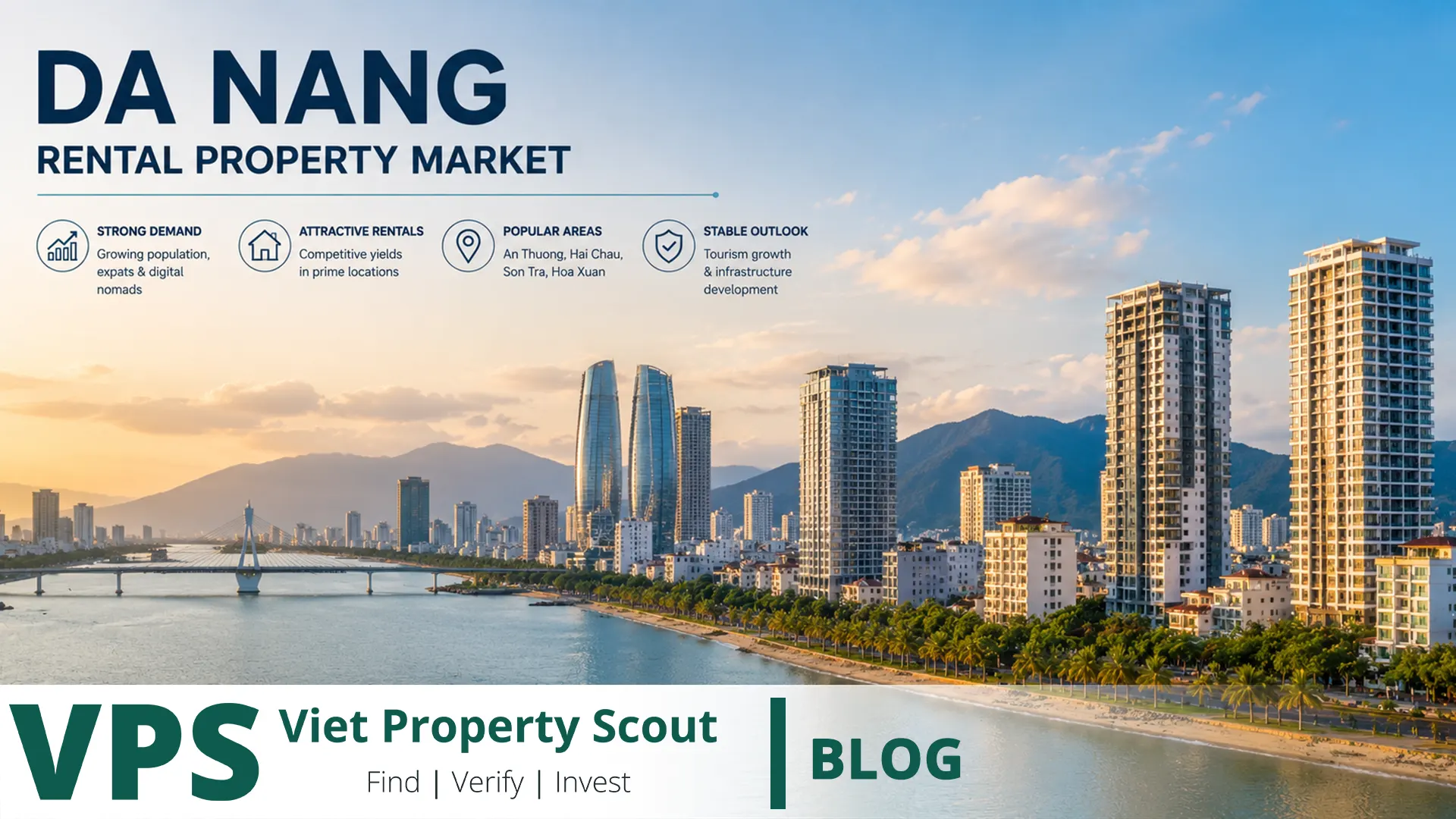
Investment takeaway: Da Nang's rental market in 2026 should not be treated as a tourism-only story. Three demand pools overlap: local households and employees seeking conventional long-term housing, foreign professionals and mobile residents seeking furnished accommodation for several months, and tourists supporting short-stay hospitality. The strongest rental asset can serve more than one of these groups. During the first half of 2026, Da Nang accommodation establishments served approximately 9.8 million visitors, including about 5.2 million international visitors, while accommodation and food-service revenue reached roughly VND32.4 trillion. At the same time, Q1 2026 office asking rents were about US$13 per square metre per month citywide and approximately US$16 in the CBD, with more than 100,000 square metres of additional office NLA projected through 2028. Tourism supports short stays, but offices, technology, corporate growth and a permanent workforce are what broaden the monthly and long-term rental base.
Today's Da Nang is larger than the old beach-city rental market
After the 2025 merger of the former Da Nang and Quảng Nam, the present city covers close to 12,000 square kilometres and has more than three million residents. Vietnam's local administrative structure was also reorganized into a two-tier system. Legacy district names remain common in rental advertising, but a lease and legal check should use the current ward and official address.
For rental analysis, the former urban core, the eastern beach belt, Liên Chiểu and the southern areas toward Hội An should not be treated as one market. Each has different tenants, incomes, transport patterns and property requirements.
The three main rental demand engines
| Demand source | Typical stay | What the tenant values | Best-fit product |
|---|---|---|---|
| Local residents, families and employees | 6–12+ months | Affordability, work access, kitchen, school, parking and quiet | Practical residential apartment or house |
| Foreigners and professionals | 1–12 months | Furniture, internet, washer, workspace, service and clear residence procedures | Furnished or serviced apartment |
| Tourists and short visitors | Nights to several weeks | Location, cleanliness, beach, reviews and easy check-in | Hotel or legally operable tourist accommodation |
Long-term tenants: the less visible but more defensive foundation
Beach imagery dominates Da Nang marketing, but a healthy rental market needs people who live in the city throughout the year. Local employees, families, tourism workers, university staff and students, port and logistics workers, IT professionals, healthcare staff, teachers and service employees create that base.
These tenants usually care more about total monthly cost than a dramatic sea view. Commute time, electricity pricing, kitchen usability, a washing machine, noise, motorbike parking, elevator access, building quality and maintenance response can have more impact on long-term rentability than resort-style facilities.
Why could foreign professional demand keep growing?
Da Nang is actively developing high technology, artificial intelligence, semiconductor, R&D and digital-economy sectors. A new city policy on developing and attracting semiconductor and AI human resources took effect in June 2026, with the stated objective of attracting specialists, scientists and highly skilled workers.
This matters to residential landlords because engineers, managers and project specialists frequently need furnished housing for several months or years. Competitive office rents also make Da Nang relevant for satellite offices and companies establishing new operations, which can convert business growth into residential rental demand.
Where does foreign rental demand concentrate?
An Thượng–My An–Mỹ Khê
This is the city's best-known expatriate and medium-stay cluster. Walkability to the beach, cafés, gyms, restaurants, convenience stores, coworking and English-friendly services lowers the friction of moving to Da Nang. That convenience also means some units command a premium over more local neighbourhoods.
An Hải and the east bank of the Hàn River
This area can combine coastal access with quicker connection to the river and city centre. It can suit professionals who want the beach lifestyle without living directly in the most tourism-intensive streets.
Hải Châu and the urban centre
More suitable for tenants whose priority is offices, banks, hospitals, government services and central urban life rather than daily beach access.
Liên Chiểu–Hòa Khánh
This is a different rental economy, driven more by industry, port activity, universities, logistics and technology. The right product is often practical and sensibly priced rather than luxury beachfront housing.
Rental levels: why there is no single reliable Da Nang average
There is no official citywide residential rent index that adequately captures every Da Nang micro-market. Private 2026 expat-oriented guides commonly place furnished one-bedroom apartments in popular foreign-resident areas at roughly US$300–500 per month, while current individual listings in An Thượng and My An can sit materially above that range for newer, larger or better-located units.
These are market indications, not official averages and not income guarantees. Two apartments on the same street can command very different rents because of floor area, building age, elevator, view, furnishing quality, whether utilities are included, contract duration and overall management quality.
Contract duration should change the monthly price
A flexible one-month rental and a 12-month lease are economically different products. Private 2026 market guides report meaningful discounts for longer commitments compared with rolling monthly pricing. A professional landlord should therefore not use one flat monthly rent for every lease length.
| Contract term | Pricing logic | Typical tenant |
|---|---|---|
| 1 month | Usually highest monthly price because flexibility and turnover are greatest | Temporary professional or medium-stay visitor |
| 3 months | Moderate discount for additional commitment | Consultant, digital nomad or short project |
| 6 months | More competitive monthly rate | Expat, corporate employee or student |
| 12 months | Usually lowest monthly rate in exchange for stability | Long-term resident or family |
The minimum acceptable rental period should also be stated clearly. If the owner requires a six-month minimum, one- and three-month pricing should not be offered as though those terms were actually available.
A tourist is not a substitute for a long-term tenant
Short-stay accommodation is an active hospitality business. It requires dynamic pricing, guest communication, cleaning, laundry, platform commissions, temporary-residence handling and management of vacant nights. A 12-month tenant may generate lower headline monthly revenue than the theoretical sum of peak tourist nights but also creates much lower turnover and operating cost.
Investors should therefore compare net income rather than gross booking revenue.
What does strong tourism mean for landlords?
Nearly 9.8 million visitors served by accommodation establishments in six months, including roughly 5.2 million international visitors, confirms that Da Nang has a genuine tourism engine. Coastal landlords benefit from that demand, but the most defensive property is usually one that can also move into monthly or long-term rental when tourism softens.
Foreign tenants and temporary-residence compliance
Vietnam launched a unified system for accommodation notifications for Vietnamese citizens and temporary-residence declarations for foreigners from 21 May 2026. Circular 87/2026/TT-BCA took effect on 24 July 2026 and regulates the methods for declaring and receiving foreign temporary-residence information.
For a landlord or accommodation operator, renting to a foreigner therefore involves more than signing a lease and collecting rent. The responsible accommodation provider must ensure the required residence-declaration process is handled correctly.
What should a good furnished long-term apartment actually include?
- A kitchen that can genuinely support several months of living.
- A private washing machine or clearly defined laundry service.
- Stable, high-quality internet.
- A proper desk and usable chair.
- Efficient air-conditioning and transparent electricity pricing.
- Enough storage for long-term occupants.
- Reasonable sound insulation.
- Elevator, security and motorbike parking where relevant.
- A written furniture and equipment inventory at move-in.
How should an investor calculate rental return?
Start with the achievable rent for a specific lease term, not the highest online asking rent. Calculate annual rent actually collected − vacancy − management − repairs and maintenance − furniture replacement − taxes and owner-paid expenses = net operating income.
Then compare net income with the complete acquisition cost. If apartment prices rise substantially faster than residential rents, rental yield can compress even while the city is attracting more tenants.
Eight major rental-market risks
- Overpaying for a beach address: long-term rent may not support the acquisition premium.
- New supply: additional apartments increase tenant choice and landlord competition.
- Expat-only dependence: changes in companies, visas or economic activity can affect demand.
- Tourism-only dependence: weaker travel periods can reduce income quickly.
- Poor term pricing: one rent for every lease duration can make the property uncompetitive.
- Unclear utilities: electricity, water and internet arrangements can create disputes.
- Residence compliance: foreign tenants require proper temporary-residence handling.
- Exit liquidity: a tourism-specific unit may appeal to fewer local resale buyers.
Viet Property Scout rental investment framework
| Check | Question |
|---|---|
| Legal use | Can this exact unit lawfully operate under the intended rental model? |
| Demand | Who will rent it if tourist demand disappears? |
| Contract pricing | What are realistic monthly rates for 1, 3, 6 and 12 months? |
| Minimum term | What is the shortest contract the owner will actually accept? |
| Utilities | What is included and what is paid separately? |
| Vacancy | How many vacant weeks per year should be underwritten? |
| Management | Who handles tenants, repairs and residence procedures? |
| Exit | Would an owner-occupier buy this property later, or only another investor? |
Frequently asked questions
Is Da Nang a good long-term rental market?
Yes, selectively. The strongest locations are supported not only by tourism but also by permanent employment, local residents, foreign professionals and services.
Where do foreigners commonly rent?
An Thượng, My An and Mỹ Khê are among the best-known foreign-resident areas because of the beach and walkability. An Hải and Hải Châu can be more suitable depending on workplace and lifestyle priorities.
Should a 12-month lease have the same monthly price as a one-month stay?
No. Flexibility has value, while a longer commitment reduces vacancy and turnover risk for the landlord.
Does strong tourism make nightly rental automatically better?
No. Net income after operations, seasonality and legal compliance should be compared with monthly and annual leasing.
Can foreigners rent apartments in Da Nang?
Foreigners can rent housing, but the lease should be properly documented and the applicable temporary-residence declaration should be completed correctly.
What is the strongest rental property?
Usually one that can serve several tenant groups: a medium-stay foreigner, a long-term professional or family, and where legally appropriate, tourist accommodation demand.
Conclusion
Da Nang's rental market is strongest when it is understood as a housing, employment and tourism market at the same time. International tourism gives the coastline powerful momentum, but offices, technology, education, industry and services support year-round occupancy. The objective for investors should not be the highest advertised rent. It should be durable net cash flow built around separate 1-, 3-, 6- and 12-month pricing, a clearly defined minimum contract term, transparent costs and reliable management. A flexible apartment that can move between long-term tenants, medium-stay foreigners and legally permitted tourism demand is generally more defensive than one dependent on a single renter profile.