
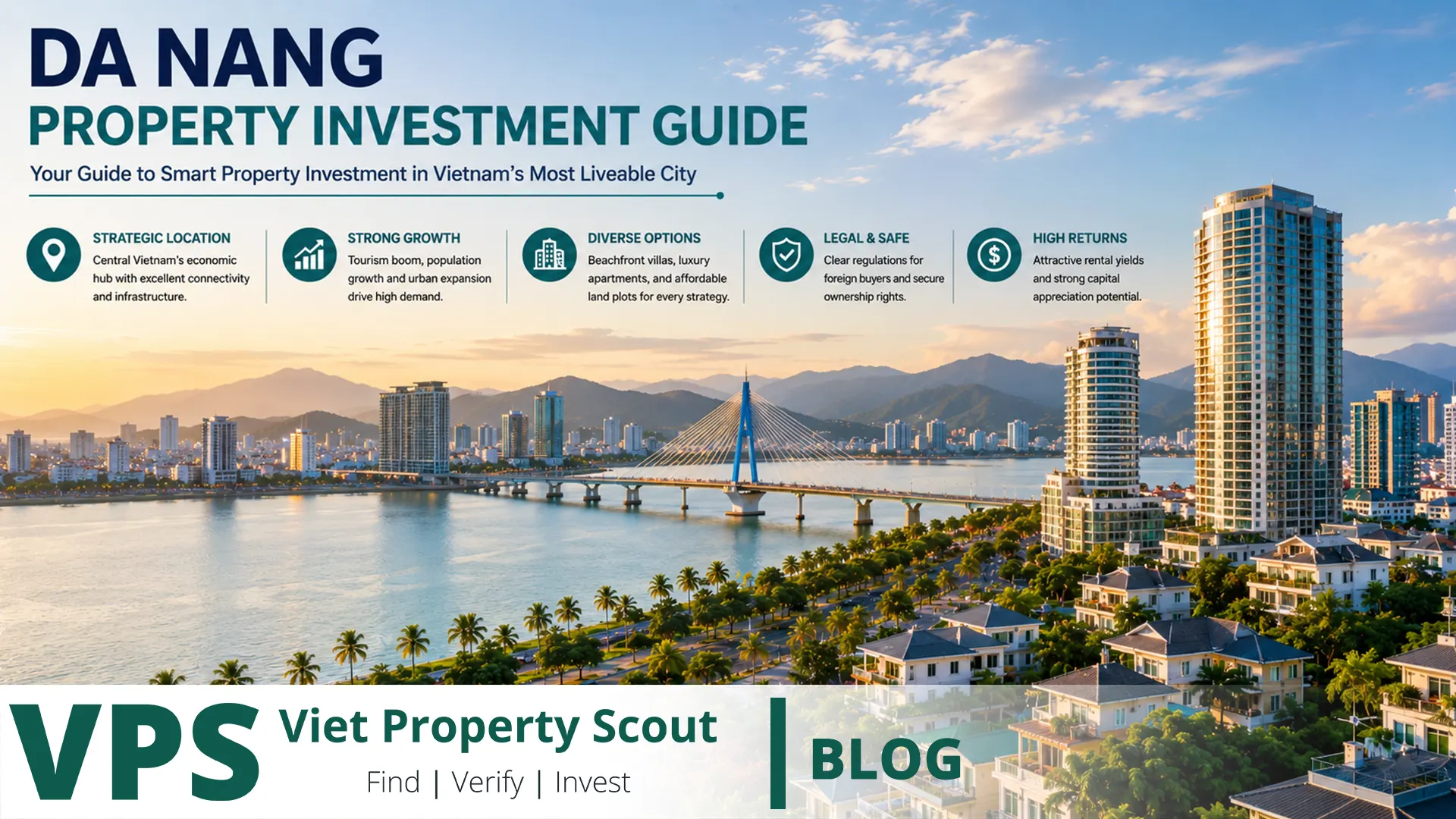
Investment takeaway: Da Nang in 2026 should no longer be viewed as a property market supported only by beaches and holiday tourism. Following the 2025 merger of the former Da Nang and Quảng Nam, the new city covers a much broader economic geography combining coastal living, international tourism, urban housing, technology, industrial activity, logistics, the Free Trade Zone and the heritage-tourism economy around Hội An. For investors, the critical distinction is between a property that looks attractive to a tourist and an asset that can generate durable demand from residents, employees, companies and tenants throughout the year. By Q1 2026, cumulative condominium supply in Da Nang had reached approximately 16,000 units, average primary pricing was around VND83 million per square metre and cumulative absorption was about 89%. In the first half of 2026, accommodation establishments served approximately 9.78 million visitors, including around 5.16 million international visitors. Those are strong numbers, but they do not make every beachfront development a strong investment. The best assets combine legal clarity, rational entry pricing, a real rental market, resale liquidity and exposure to more than one source of demand.
What does “Da Nang” mean after the 2025 administrative restructuring?
The merger of the former Da Nang and Quảng Nam created a much larger centrally governed city. Local administrative units were also reorganized, so legacy district and neighbourhood names remain useful in property conversations but should not replace the current ward and official address in legal documents and due diligence.
This matters because today's Da Nang is no longer simply an urban core plus an eastern beach strip. The enlarged city also incorporates the Hội An heritage economy, extensive industrial and logistics areas, coastal resort zones and new development corridors. These should not be treated as one homogeneous property market. A My Khe apartment, a Han River urban residence, employee housing near an industrial cluster and a resort property near the southern heritage corridor have fundamentally different demand drivers.
Da Nang property market snapshot for 2026
| Indicator | Recent reference | Investment implication |
|---|---|---|
| Cumulative condominium supply, Q1 2026 | Approximately 16,000 units | Still much smaller than HCMC, so new supply can have a larger impact on local competition |
| Average primary condominium price | Approximately VND83 million/m² | Da Nang is no longer automatically “cheap” merely because it is outside Hanoi and HCMC |
| Cumulative absorption | Approximately 89% | Underlying demand has been strong, but individual project valuation remains critical |
| New launches during 2024–2025 | More than 8,000 units | A major supply shift compared with pre-2024 annual launches of fewer than 1,000 units |
| Visitors served by accommodation establishments, H1 2026 | Approximately 9.78 million | Tourism remains a major demand engine |
| International visitors, H1 2026 | Approximately 5.16 million, +28.7% y-o-y | International demand is expanding faster than domestic demand |
| Accommodation and food-service revenue, H1 2026 | Approximately VND32.4 trillion, +21.6% | Visitor growth is translating into real hospitality spending |
What supports long-term demand?
1. International and domestic tourism
My Khe, Sơn Trà, Ngũ Hành Sơn, Hội An, Ba Na Hills and the broader central-Vietnam heritage circuit continue to draw substantial visitor volumes. During H1 2026, international arrivals to accommodation establishments grew faster than domestic demand and represented more than half of total guests served. This supports hotels, serviced apartments, restaurants, retail and professionally operated tourist accommodation.
2. Coastal lifestyle demand
Da Nang has an unusual structural advantage: a genuine urban beach can sit relatively close to the city centre, airport, offices and daily services. This makes the coastline relevant not only to tourists but also to affluent local residents, expatriates, entrepreneurs, remote professionals and households seeking a permanent coastal lifestyle.
3. Technology and the digital economy
The city is positioning itself around high technology, information technology, R&D, semiconductors and innovation. From a housing perspective, this matters because higher-skilled, higher-income employment can create more stable long-term rental demand than seasonal visitor flows alone.
4. Da Nang Free Trade Zone
The Da Nang Free Trade Zone was established in 2025 at approximately 1,881 hectares across seven non-contiguous locations. Planned functions include production, logistics, commerce, services, digital technology, IT and innovation. Buying property simply because a brochure says “near the FTZ” would be speculative. However, if the zone successfully attracts employers, it can generate genuine demand for housing, offices, retail, logistics and supporting services.
5. Industry, logistics and Liên Chiểu
Liên Chiểu Port, industrial areas and high-tech development give the northwest a different economic profile from the eastern beach. Its property demand is more closely related to employment, transport, manufacturing, trade and supply chains than tourism. That makes appropriately priced employee, professional and service housing potentially more relevant than luxury resort-style apartments.
6. Offices and urban services
CBRE reported average Da Nang office asking rents of about US$13 per square metre per month in Q1 2026 and approximately US$16 in the CBD. More than 100,000 square metres of additional office NLA was projected through 2028. Office growth matters to residential investors because expanding professional employment creates demand for convenient long-term housing.
Which submarkets fit which investment strategy?
| Submarket | Primary demand | Typically stronger product | Main risk |
|---|---|---|---|
| My Khe–An Hải–Sơn Trà | Tourism, lifestyle, expatriates, short and medium stays | Well-managed apartments, serviced residences and urban coastal housing | Overpaying for sea view or relying too heavily on nightly rentals |
| Ngũ Hành Sơn–Non Nước | Resorts, premium lifestyle, tourism and Hội An corridor demand | Legally clear residential or hospitality products with defined use | Confusing residential ownership with condotel or resort structures |
| Hải Châu–Han River core | Local residents, business, offices and services | Long-term urban apartments | Paying a premium for a project without genuine differentiation |
| Hòa Khánh–Liên Chiểu | Industry, university, port, technology and logistics | Mid-market housing, professional rental and local commercial services | Building or buying luxury product for the wrong user base |
| Southern corridor toward Hội An | Tourism, heritage, resorts and second homes | Well-positioned hospitality and lifestyle assets | Seasonality, legal complexity and weaker everyday residential demand |
Does proximity to the beach guarantee a good investment?
No. Beach access creates strong lifestyle value but can also generate excessive purchase premiums. Investors should ask whether the sea view is protected, whether the beach is genuinely accessible on foot, whether the neighbourhood functions year-round, and whether a future resale buyer is likely to pay the same premium.
A property 700 metres from the beach in a lively, service-rich neighbourhood may outperform a first-line unit if its entry price is substantially lower and its long-term tenant pool is broader. The investment objective is not to buy the closest possible property to the sand; it is to buy the best relationship between price, usability and future demand.
Strong tourism does not mean unlimited accommodation demand
During the first half of 2026, the average stay of overnight guests in Da Nang was approximately 1.79 days. International overnight visitors stayed around 1.89 days on average, while domestic visitors averaged approximately 1.64 days. Large visitor numbers therefore need to be translated into actual room nights, achievable daily rates and seasonal occupancy.
A resilient apartment is often one that can accommodate a leisure guest during peak season and a monthly professional or medium-stay tenant during quieter periods. Flexibility can be more valuable than maximizing a theoretical high-season nightly rate.
Why long-term demand matters more than tourism alone
Tourism can be affected by flight capacity, weather, airfares, currencies and the global economy. Population, offices, universities, technology, logistics, industry, healthcare and education create a more permanent demand base. A strong residential investment should therefore ideally remain useful even if tourism temporarily slows.
The most defensive question is simple: if tourism weakened for twelve months, would a real resident still want to live in this unit at a sensible monthly rent? If the answer is yes, the property has a more diversified demand foundation.
Residential apartment, condotel and resort residence are not the same product
Da Nang has a history of resort and hospitality development, so product classification matters. A residential condominium in an eligible commercial housing project, a hotel apartment, a condotel and a resort residence can differ materially in approved function, land-use term, ownership documentation, permitted occupation, rental operation and management obligations.
Foreign buyers should be particularly careful. Marketing statements such as “foreign quota available”, “long-term ownership”, “freehold” or “resort apartment” should never replace verification of the project's legal documents and the status of the exact unit.
Four different rental strategies
| Strategy | Typical tenant | Strength | Risk |
|---|---|---|---|
| Long-term rental | Locals, expatriates, professionals and families | More stable cash flow and lower operating intensity | Lower gross revenue than an ideal short-stay scenario |
| Monthly or medium stay | Executives, consultants and remote professionals | Useful balance between rate and stability | Requires furnishing and good management |
| Lawful tourist accommodation | Short-stay visitors | Potentially higher daily revenue | Seasonality, regulation and higher operating costs |
| Resort/operator program | Leisure guests booked through an operator | Centralized management for the owner | Heavy dependence on operator quality, contract terms and legal structure |
Major risks in Da Nang
- Overpaying for sea view: a beautiful outlook does not guarantee an adequate investment return.
- New supply: more than 8,000 launches in 2024–2025 materially changed the competitive environment.
- Tourism concentration: every investment should also be stress-tested under a long-term-rental scenario.
- Product confusion: residential, condotel and resort products can carry different legal rights.
- Weak operation: hospitality assets require genuine hospitality management rather than passive rent collection.
- Weather and seasonality: central Vietnam's wet and storm seasons can affect tourism patterns.
- Exit liquidity: very high-ticket niche products can have a narrow resale-buyer pool.
- Paying today for all future growth: the FTZ, port, technology and tourism expansion are catalysts, but entry pricing still matters.
How should an investment be underwritten?
Start with total acquisition cost, not only the advertised purchase price. Include transaction expenses, furnishing, fit-out, financing and any period before the unit becomes rentable. Use achievable rents rather than the highest online listing, then deduct vacancy, management, maintenance, taxes, utilities where applicable and furniture replacement.
For capital appreciation, “Da Nang will grow” is not enough. The specific unit should have a reason to outperform thousands of current and future competitors: scarce location, better entry price, stronger legal status, more efficient design, better management or a broader tenant pool.
Due-diligence checklist before buying
- Verify the current ward and official address after the administrative restructuring.
- Establish whether the unit is legally residential, tourist accommodation or resort product.
- Review land, project approval and unit documentation.
- For a foreign buyer, verify project and unit eligibility before paying a reservation.
- Compare the developer's primary price with genuine secondary-market evidence.
- Visit the location at different times and, where possible, in different seasons.
- Test practical access to the beach, employment, schools, retail and airport.
- Model long-term, medium-stay and short-stay rental scenarios separately.
- Review management fees, operator agreements and furnishing obligations.
- Stress-test weaker tourism and stronger future supply.
- Define the likely future resale buyer before purchasing.
Frequently asked questions
Is Da Nang still attractive after prices have risen?
Yes, selectively. Higher primary pricing and greater new supply mean that simply buying because “Da Nang is a growing coastal city” is no longer sufficient.
Is the best investment always closest to My Khe Beach?
No. Beach proximity is valuable, but legal status, purchase price, achieved rent, neighbourhood functionality and resale liquidity can make a less beachfront location economically stronger.
Can tourism alone sustain long-term property prices?
It is a major driver but should not be the only one. The most resilient value emerges where tourism overlaps with population, employment, technology, education, offices and services.
Is Liên Chiểu a tourism play?
Its primary logic is more closely tied to port activity, industry, high technology, university demand and logistics. The appropriate property strategy is therefore different from the eastern beach.
Can every coastal condominium be rented nightly?
No. Approved project function, unit status, building rules and accommodation regulations must be checked.
What is the single most useful investment question?
Ask whether somebody would still want to live in the property at a rational monthly rent if tourism weakened for a year. A clear yes indicates a more defensive demand profile.
Conclusion
Da Nang's real estate strength does not come from the beach alone; it comes from combining a coastal lifestyle with tourism, permanent employment, technology, services and logistics. In 2026 visitor growth is strong, condominium supply has expanded rapidly and economic initiatives such as the Free Trade Zone, high-tech development and port infrastructure are adding new sources of potential demand. At the same time, prices and competition have risen. Strong investors therefore do not simply “buy Da Nang”. They buy a specific legally verifiable asset at a defensible price, with several demand sources and a credible resale market. Coastal lifestyle is a powerful advantage, but it becomes a durable investment only when the underlying economics work throughout the year.