
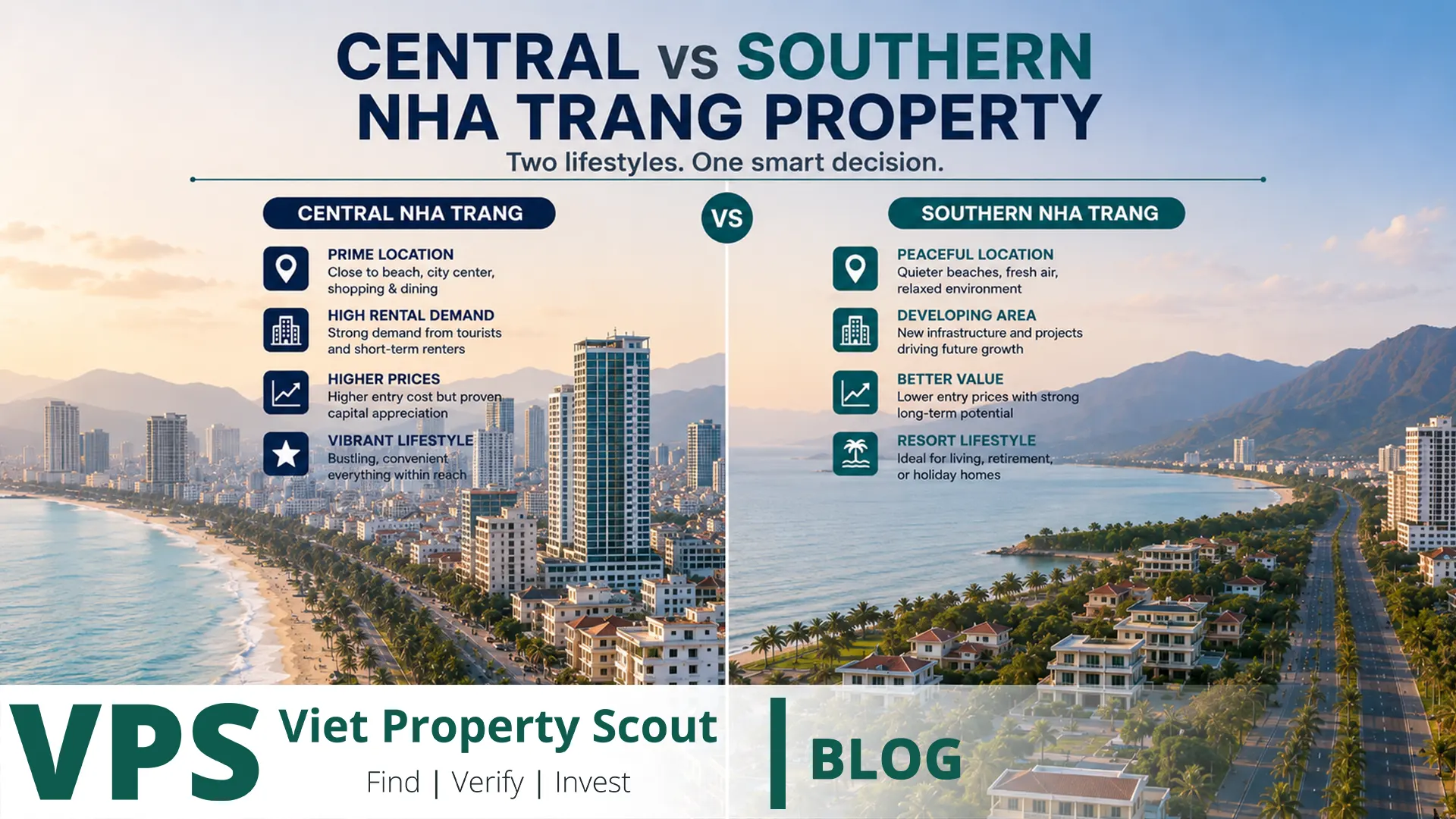
Short answer: Central Nha Trang generally has the stronger case for investors who prioritise liquidity, demand that already exists, walkability to the beach and services, and access to a broad tenant and buyer base. South Nha Trang can offer greater long-term optionality for investors willing to wait for urban expansion, infrastructure and new service centres to mature, often with the possibility of acquiring more space for the same capital. The trade-off is straightforward: central investors usually pay a higher entry premium for proven demand, while southern investors take more execution and planning risk in exchange for future growth potential. The right question is therefore not “Which area is better?” but “Which area's risk-return profile matches the investment strategy?”
What do Central and South Nha Trang mean in this comparison?
Central Nha Trang refers here to the established coastal core around Tran Phu, the residential and commercial fabric immediately behind the beachfront, and the former Nha Trang airport area that is planned as a new commercial, tourism, office and financial centre. South Nha Trang primarily refers to the Phước Đồng - Hòn Rớ - Nguyễn Tất Thành corridor and related southern and southwestern urban expansion areas. Bai Dai and Cam Ranh should be treated separately because they are more resort-oriented and operate under different demand and supply dynamics.
Official planning gives the two markets different long-term roles
Under Nha Trang's adjusted General Plan to 2040, the central coastal zone south of the Cái River is designated as a national tourism centre as well as an administrative, cultural and commercial centre. Its planning area covers approximately 676 hectares and is expected to accommodate around 140,000 people. The approximately 263-hectare former Nha Trang airport area is separately intended to become a new central district focused on tourism services, offices, commerce and regional financial functions.
By contrast, the roughly 4,626-hectare Phước Đồng - Hòn Rớ - north Cù Hin area, planned for around 64,100 residents, is positioned as a centre for education, sports and eco-tourism services, with mixed-use urban centres along Nguyễn Tất Thành. The southwestern expansion south of Phong Châu and west of the Tắc River is also planned for new administrative, urban, medical and service functions. Central Nha Trang therefore relies more heavily on already-established urban value, while part of the southern investment case depends on future functions being created successfully.
Investment comparison at a glance
| Factor | Central Nha Trang | South Nha Trang |
|---|---|---|
| Demand profile | Established tourism, residential, commercial and service demand | Emerging residential demand, urban expansion, services and eco-tourism |
| Entry price | Tends to be higher in strong locations | Can be lower in some segments but varies substantially |
| Liquidity | Usually stronger for legally clear, well-located assets | More dependent on project, roads and development stage |
| Short-stay rental | Stronger potential in appropriate and legally usable locations | Less consistent and highly product-specific |
| Long-term rental | Broad existing tenant base | Can expand as population and services grow |
| Space for the capital invested | Usually lower | Often higher in many segments |
| Planning risk | Relatively lower in mature neighbourhoods | Higher in expansion areas |
| Reliance on future infrastructure | Relatively limited | Material for some strategies |
| Development potential | Driven partly by central land scarcity | Driven by larger available development areas |
| Typical investment horizon | Short to long depending on the asset | Usually medium to long term |
Central Nha Trang's main strength: demand already exists
The biggest advantage of central Nha Trang is that investors do not need to wait for a new city district to become functional. Tran Phu, the beach, restaurants, cafes, hotels, schools, medical facilities, retail, administration and employment already create several layers of demand. A well-selected central asset may therefore appeal to tourists, Vietnamese long-term tenants, professionals, expatriate residents and owner-occupiers.
The scale of regional tourism reinforces this position. Khanh Hoa recorded approximately 11.9 million tourist arrivals in the first half of 2026, including more than 4.6 million international visitors, while average accommodation occupancy was around 60%. These are province-wide statistics rather than rental evidence for a particular central apartment, but they demonstrate the size of the visitor economy to which central Nha Trang has direct exposure.
The weakness of the centre: paying too much can destroy yield
Strong demand does not make every central purchase attractive. Properties may include large premiums for proximity to Tran Phu, sea view, project branding or limited land availability. If the acquisition price rises far beyond the income the asset can realistically generate, net yield can be poor even in an excellent location.
Investors must also distinguish residential apartments from tourism-oriented accommodation and condotels. In a dense visitor district, physically similar units may have different certificates, land-use purposes, ownership terms, operating models and rental rules. Legal classification should be established before price comparisons are made.
South Nha Trang: investing in the expansion of the city
The southern thesis is structurally different. Phước Đồng and Hòn Rớ contain considerably more development land than the mature central core. That makes it possible to create new neighbourhoods, public facilities and service centres. The 2040 plan envisages mixed-use urban centres along Nguyễn Tất Thành, education and sports functions, eco-tourism uses and a new tourism wharf near the Quán Trường River mouth adjoining Hòn Rớ.
If these functions are progressively implemented and population and services expand, value can be created not only through tourism but through the transformation of the southern corridor into a more complete part of the city. A strong South Nha Trang investment should therefore not depend solely on the assumption that tourists will suddenly migrate south. It should ideally be located where people can realistically live, work and use everyday services.
Nguyễn Tất Thành is the backbone of the southern investment case
Nguyễn Tất Thành is an important connection from southern Nha Trang toward Cam Ranh and Cam Ranh International Airport and is identified in planning as a southern gateway to the city. The 2040 transport framework includes a high-capacity public transport concept along this direction toward the airport, initially as BRT with possible future conversion to LRT if passenger demand eventually justifies it.
The plan also includes a new road and bridge across the Hòn Rớ mountain area to connect Tran Phu with Nguyễn Tất Thành and studies a possible tunnel through Cù Hin toward Cam Lâm. These can be significant long-term catalysts, but they are not all operating infrastructure today. Investors should distinguish completed infrastructure, projects under construction, approved projects and long-range planning concepts before capitalising them into a purchase price.
The centre sells scarcity; the south sells space and growth
Part of central Nha Trang's long-term value comes from physical scarcity. There can only be a limited amount of well-positioned real estate within walking distance of Tran Phu beach and the established city-service core. Scarcity can support high-quality assets when legal status, building management and acquisition price are also sound.
South Nha Trang has much larger development capacity. This supports urban expansion but also creates a risk of future competing supply. An investor buying a generic unit in a very large new project may later compete with hundreds or thousands of similar units. Developer quality, project phasing, accessibility and real amenities are therefore more important than the broad statement that “South Nha Trang is growing.”
Rental strategy comparison
| Strategy | Central Nha Trang | South Nha Trang |
|---|---|---|
| Tourism short stay | More logical in appropriate locations where the use is permitted | Less consistent unless the project and location are specifically suited to visitors |
| Long-term expatriate rent | Relatively strong because of services and central convenience | Can improve as services and new neighbourhoods mature |
| Local long-term rent | Existing demand, although high acquisition cost can compress yield | Some projects may offer a better purchase-price-to-monthly-rent relationship |
| Personal seasonal use | Strong for buyers prioritising beach walkability and convenience | Potentially better for buyers wanting more space and a quieter setting |
Which market is more dependent on tourism?
Central coastal property has more direct exposure to tourism, especially assets intended for visitor accommodation. That can increase revenue in strong travel periods but also introduce seasonality. The centre is not purely a tourism economy, however. Permanent residents, offices, administration, trade and services provide additional demand layers.
Most southern areas are less directly dependent on daily visitor volumes, but they are more dependent on successful urbanisation. The risk therefore changes rather than disappears. Central assets may suffer when tourism demand weakens; southern assets may take longer than expected to benefit from population growth, completed roads and commercial services.
Liquidity and resale
A future buyer can usually understand the value proposition of a central property more easily. The beach, established services, travel time and urban activity are visible today, and there are usually more comparable transactions and competing listings. Liquidity can still be poor if the asset is overpriced, legally unclear or badly managed.
In the south, liquidity may improve sharply once major infrastructure, service centres or successful projects are completed, but it varies substantially between locations. A legally clear house on a strong existing road may be much easier to resell than an apartment in a delayed mega-project whose value story depends on future infrastructure.
Flooding, drainage and topography
Water and drainage should be checked in both markets, but the risks take different forms. Some lower central areas may experience urban drainage pressure during heavy rain. Southern and southwestern expansion areas combine low-lying river environments with mountain terrain around Hòn Rớ and Cù Hin, which can introduce a wider range of risks including flooding, drainage, slope conditions, soil stability and access.
A dry-season site visit is not enough. Investors should investigate flood history, site elevation, basement and parking design, pumping systems and drainage. For land or low-rise housing near hills, slope stability and wet-weather access deserve separate investigation.
For foreign buyers, legal asset type matters more than location
A foreign investor should not begin with “central or south?” but with “Can I legally own this specific product?” In residential apartment projects, the eligibility of the project, remaining foreign ownership quota, legal unit type and certificate status should be checked. Standalone land and land-linked low-rise housing involve different legal rules and should not be assumed to be directly purchasable by an ordinary foreign individual.
This distinction can become particularly important in South Nha Trang because a larger part of the opportunity set may include land, villas, townhouses and newly developed low-rise products. Informal nominee arrangements through friends, partners or local entities should not be treated as a substitute for enforceable legal rights.
Price per square metre alone is a poor comparison tool
South Nha Trang may appear dramatically cheaper on a price-per-square-metre basis, but this can be misleading if a central asset can be occupied or rented today while a southern location requires years before the surrounding urban environment matures. Time has a financial cost and should be included in the comparison.
The reverse is also true. Paying an extreme premium for a mediocre central unit simply because it is close to Tran Phu can be inferior to buying a strong southern asset at a sensible entry price. Investors should ask: how much of today's purchase price reflects demand that already exists, and how much reflects a future scenario that has not yet occurred?
Investor decision matrix
| Objective | Usually more logical market | Reason |
|---|---|---|
| Immediate rental income | Central | Existing tenant and visitor demand with established services |
| Personal use near the beach | Central | Walkability and daily convenience |
| Seven-to-ten-year urban growth strategy | South | Greater exposure to infrastructure and city expansion |
| More space for a limited budget | South | Higher space-per-capital potential in many segments |
| Maximum possible resale liquidity | Often central | Recognised locations and broader buyer pool |
| Land or development strategy | South, with strict legal verification | Larger development areas but substantially greater legal and execution risk |
Stress-test the purchase before committing
- If tourism weakens for two years, can the property still attract tenants?
- If southern infrastructure is delayed by five years, can the investment be held without financial pressure?
- If property prices remain flat, does current income still justify the purchase?
- If major competing projects are delivered, does the asset retain a clear advantage?
- If the property must be sold within six months, who is the natural buyer?
- Do the certificate and legal use of the property genuinely support the intended strategy?
Verification checklist
- Define whether the objective is income, personal use, capital growth or development.
- Compare assets with the same legal classification rather than simply the same floor area.
- Verify the certificate, land-use purpose and owner's rights.
- Calculate management, maintenance and long-term repair costs.
- Request at least twelve months of real rental history when available.
- Review competing future supply in the actual catchment area.
- Test travel times during real peak traffic.
- Investigate flooding, drainage and topography.
- For southern assets, classify every infrastructure catalyst as completed, under construction, approved or merely proposed.
- Use independent legal review before paying a deposit.
Red flags
- “Central property cannot lose value because it is near the sea.”
- “South Nha Trang will definitely double because of the 2040 plan.”
- Residential apartments and condotels are compared only by price per square metre.
- Rental returns are calculated using peak season only.
- A future road or BRT line is priced as though it operates today.
- District-wide average asking prices are used instead of project- and street-level analysis.
- Resale liquidity is ignored because the planned holding period is long.
Frequently asked questions
Which area is easier for a first-time investor?
A legally clear central asset is often easier to underwrite because demand and infrastructure are already visible. South Nha Trang can be attractive for patient investors who are comfortable analysing planning, projects and infrastructure execution in greater detail.
Is Central Nha Trang always more expensive?
Not every asset, but scarce high-quality coastal and central locations generally command a location premium. Comparisons should be made between legally and functionally similar properties.
Does South Nha Trang have greater capital-growth potential?
It can if infrastructure, population and services mature and the entry price was sufficiently low. There is no guarantee. A weak project or overpriced purchase can eliminate the theoretical growth advantage.
Is Nguyễn Tất Thành the most important factor in the south?
It is a major strategic axis, but not the only factor. Internal road networks, schools, retail, employment, resident population and project quality are equally relevant to property value.
Which area is better for long-term rental?
Central Nha Trang currently has the broader established demand base. Selected southern projects may achieve a better relationship between acquisition price and monthly rent if local demand develops successfully.
Should investors buy as close as possible to a planned infrastructure project?
No. Proximity is valuable only when access is practical, the property is not adversely affected by acquisition, noise or restrictions, and the infrastructure itself has a credible implementation status.
Conclusion: Central buys more certainty; South buys more future optionality
Central and South Nha Trang are not simply two price points within the same market. Central Nha Trang is a more mature environment supported by scarcity, current demand, tourism, services and resale liquidity. South Nha Trang is an expansion market whose upside depends more heavily on infrastructure execution, new urban centres, population growth and the progressive creation of services.
In this comparison, Find | Verify | Invest means: in central Nha Trang, verify that the location premium is justified by real income, legal quality and liquidity; in South Nha Trang, verify that the purchase price does not already assume that every future infrastructure and planning promise succeeds. The better investment is not the area with the more exciting story, but the asset that remains economically rational under the base case rather than only under the perfect scenario.