
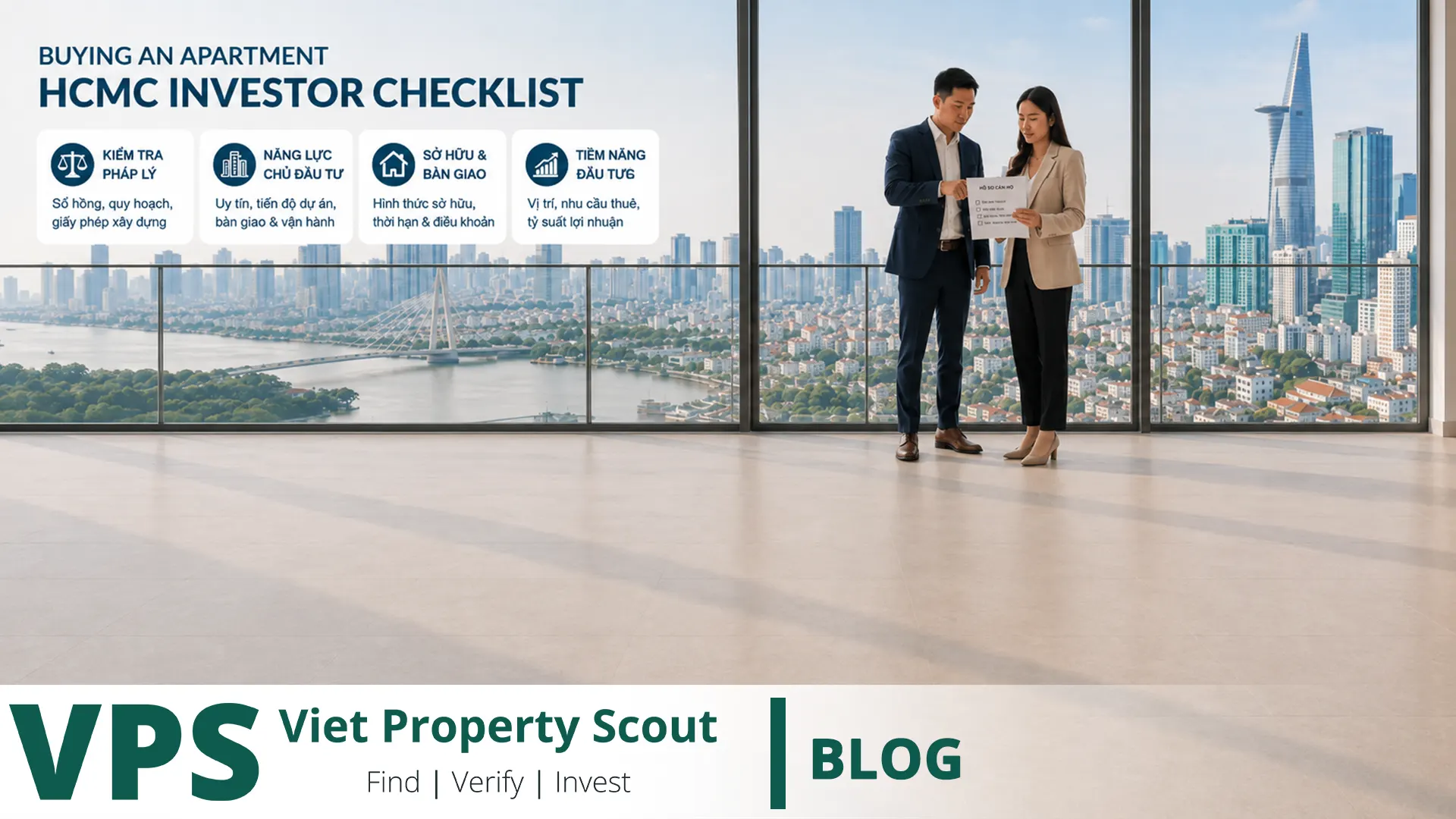
Quick answer: Before buying an apartment in Ho Chi Minh City, investors should not focus only on price, location or marketing images. A strong decision starts with verifying the seller or developer, the legal status of the project and the specific unit, the buyer’s eligibility, the realistic market price, building quality, ownership costs, rental demand, resale liquidity, contract terms and the payment schedule. A visually attractive apartment can still be a weak investment if the entry price is too high, rental demand is limited, the building is poorly managed or the documentation is unclear.
Ho Chi Minh City is a large and highly segmented property market. It includes luxury apartments in central locations, modern projects in Thu Duc and the eastern corridor, established residential communities in the south, older buildings in mature neighborhoods and new developments sold before completion. For that reason, investors should not apply a superficial one-size-fits-all checklist to every transaction. They should first define exactly what they are buying, who is selling it, what investment objective the purchase serves and which tenants or future buyers the apartment is intended for.
Investors can compare available apartments and properties on Viet Property Scout, review real estate projects and speak with local property advisors before moving from research to a financial commitment.
What Should Be Checked First Before Buying an Apartment in Ho Chi Minh City?
The first step is not negotiating the price. It is proving that the transaction can actually be completed legally and commercially. The investor should know who owns or develops the property, what exactly is being sold, what right or document will be received in exchange for the money and whether that specific buyer is eligible to acquire that specific unit.
Before any deposit or other commitment, the following questions should be answered:
- Who is the legal seller?
- Does the seller or developer have the authority to sell this unit?
- Does the apartment already exist physically or is it still under construction?
- What is the legal status of the project?
- Can this specific buyer legally acquire this unit under the proposed ownership structure?
- Are there restrictions relating to ownership, transfer or use?
- Is the requested payment a refundable reservation amount or a non-refundable commitment?
- What document confirms the payment?
- Which bank account should receive the money?
If these questions are not clear, a discount or promotion should never be used as a reason to skip verification.
Core Checklist Before Deciding to Buy an Apartment
| Verification Area | What Should Be Checked? | Why It Matters |
|---|---|---|
| Seller identity | Owner, developer, agent and each party’s authority | To confirm money is paid to the legally authorized party |
| Legal status | Project, unit, approvals, right to sell and documentation | To avoid acquiring an unclear or non-transferable right |
| Buyer eligibility | Whether a local or foreign buyer can acquire the unit | Eligibility can differ by project and specific unit |
| Price | Market comparisons, price per square meter and competing properties | To avoid paying more than a defensible market value |
| Rental | Actual rent, occupancy and tenant profile | To measure realistic income instead of marketing assumptions |
| Building | Management, maintenance, fees, elevators and amenities | Operational quality affects both rental demand and resale |
| Unit | Layout, natural light, view, noise and condition | Units within the same building can perform very differently |
| Contract | Payments, handover, penalties, cancellation and transfer | To understand obligations before signing |
| Exit | Who is the likely future buyer? | To assess future resale liquidity |
1. Verify the Developer Before Evaluating the Project
If the apartment is part of a new development, the quality of the developer becomes part of the investment risk. A sophisticated sales office or strong brand is not enough. Investors should examine whether the developer has completed projects before, whether handovers were delayed, how its buildings perform after years of use and how the projects are managed after completion.
Investors should review:
- the developer’s previous projects;
- actual handover history compared with promised dates;
- construction quality after several years of occupation;
- how defects and maintenance issues were handled;
- the reputation of post-handover project management;
- major differences between what was marketed and what was delivered;
- the current status of the specific project, not only the company’s overall reputation.
Even a well-known developer should be evaluated at the individual-project level. A strong track record can reduce some risks, but it does not remove the need to verify the documentation for the current transaction.
2. Verify the Project’s Legal Status, Not the Sales Brochure
Renderings, 3D plans and show apartments are not legal evidence. Investors need to understand the real status of the project: the land, approvals, construction progress, eligibility for sale and the agreements they are being asked to sign.
For a project under construction, there should be clear answers regarding actual construction progress, the current stage of development, which party receives payments and whether the unit can legally be sold at the current stage.
If the project is completed, investors should check handover status, actual building operation, ownership documentation and any delays in issuing ownership certificates or registering rights.
A statement such as “the project is fully legal” is not a substitute for documents. Each important claim should be supported by an identifiable piece of evidence.
3. Check the Buyer’s Eligibility Before Choosing the Unit
This is particularly important for foreign buyers. A foreign investor should never assume that every apartment advertised for sale can be acquired in exactly the same way as by a local buyer.
Investors should verify:
- whether the project is in an area where foreign residential ownership is permitted under the applicable rules;
- whether the specific unit is still available within the permitted foreign ownership limit;
- whether the buyer’s documents satisfy transaction requirements;
- the applicable duration and structure of ownership rights;
- the rules relating to later resale, inheritance or rental;
- whether the contract correctly reflects the buyer’s foreign status.
Under the current legal framework, foreign ownership of apartments in residential buildings is subject to quantitative limits, including the well-known rule that foreign owners may generally hold no more than 30% of the residential units in an apartment building, subject to the applicable legal conditions. The key point is to verify the specific unit and the specific project at the time of the transaction rather than relying on a broad statement such as “foreigners can buy here.”
4. Do Not Confuse the Asking Price With Market Value
The price shown in an advertisement is not necessarily the market value. A seller may ask for a high price because there is no urgency to sell. A new development price may also include marketing premiums, financing costs or future expectations that have already been priced in.
The apartment should be compared with genuinely similar properties based on:
- location, street and connectivity;
- building age;
- net and usable area;
- floor and view;
- number of bedrooms and bathrooms;
- condition of finishes and furniture;
- management quality;
- parking and amenities;
- handover date and ownership status.
Price per square meter should also be calculated, but that figure is not sufficient by itself. A smaller unit with an efficient layout may be more valuable than a larger apartment with long corridors or poorly usable space.
5. Check the Micro-Location, Not Just the Area Name
Two apartments in the same general area can produce very different investment results. Being near a business district, school or transport station does not automatically mean access is practical.
Investors should test the location in real life:
- travel time during peak hours;
- ease of entering and leaving the project;
- walking distance to retail and daily services;
- noise at different times of day;
- road quality and congestion;
- flooding or access risks where relevant;
- new projects that will enter the same local market;
- the type of residents and tenants already living there.
A good location is not simply a famous name. A good location works in practice for the end user.
6. Inspect the Apartment Beyond Its Size
Within the same building, apartment values can vary substantially because of orientation, floor, view, noise and layout. Units should therefore not be compared only by square meter area and bedroom count.
Investors should examine:
- orientation and sun exposure during the day;
- natural ventilation;
- daylight in living areas and bedrooms;
- the view and whether it is protected or could be blocked by future construction;
- proximity to elevators, waste rooms or technical areas;
- noise from roads, amenities or swimming pools;
- layout efficiency;
- storage space;
- condition of air-conditioning, plumbing and electrical systems;
- visible moisture, water leakage or cracks.
For resale apartments, physical inspection is especially important because repair costs after acquisition can directly reduce the real investment return.
7. Understand Exactly Which Area You Are Paying For
Two apartments with similar headline sizes can feel very different in actual use. Investors should understand how unit area is defined in project documents and contracts and whether the numbers used in marketing correspond with the area they can actually use.
Where possible, the architectural plan should be compared with the real unit. Investors should test whether bedrooms, furniture layouts and circulation spaces are practical. Inefficient area can reduce appeal to tenants and buyers even when the total square meter figure appears large.
8. Understand All Ownership Costs Before Calculating Returns
The purchase price is not the total cost of the investment. Investors should build a financial model that includes all material costs before calculating returns.
Costs may include:
- taxes and transaction-related fees depending on the parties and structure;
- agency fees where applicable;
- monthly management fees;
- car or motorcycle parking costs where applicable;
- furniture and fit-out;
- repairs and maintenance;
- long-term replacement of furniture and appliances;
- rental management;
- vacancy periods;
- future resale costs.
A lower-priced apartment is not always the cheaper investment if it requires substantial furnishing or carries high ongoing operating costs.
9. Calculate Rental Yield From Realistic Income, Not Advertisements
One of the most common mistakes is using the highest advertised rent in the building to calculate yield. Investors should instead identify what comparable units are actually achieving.
The analysis should include:
- realistic monthly rent;
- expected number of occupied months per year;
- management fees paid by the owner;
- property management or leasing commission;
- maintenance and repairs;
- furniture depreciation and replacement;
- the number of competing units in the building and immediate market.
Net yield is more useful than gross yield. An apartment with a high gross rent may look attractive, but after vacancy, management and maintenance it can perform worse than another unit with lower headline rent but stronger and more stable demand.
10. Define the Target Tenant Before Buying the Unit
Investors should not buy an apartment first and then try to determine who might rent it later. The target tenant should influence the purchase decision from the beginning.
| Tenant Type | What Might Matter Most? |
|---|---|
| Local professional | Convenient commute, reasonable price, modern building and practical layout |
| International executive or employee | Good location, professional management, quality furniture and services |
| Family | Schools, larger rooms, storage, green space and stable residential environment |
| Student or young professional | Smaller unit, transport access, services and affordability |
| Flexible rental guest | Central location, furniture, cleaning and easy access |
If the apartment type does not match the real tenant profile of the area, even a new or visually attractive unit may remain vacant.
11. Inspect the Building Management as Carefully as the Apartment
The quality of building management can directly affect long-term value. Broken elevators, weak security, poor cleaning, neglected common areas or operational disputes can make an apartment much less attractive to tenants and future buyers.
When visiting an existing project, investors should inspect:
- cleanliness of entrances and corridors;
- condition of elevators;
- security and access control;
- parking facilities;
- pool, gym and other amenities where available;
- how crowded common areas are;
- overall maintenance standard;
- how management responds to resident complaints.
If possible, speaking with actual residents can be useful because their daily experience may reveal issues that are not visible during a sales tour.
12. Check Monthly Fees and Internal Building Rules
Management fees and building rules can influence investment performance more than many buyers expect. Investors should know what the monthly fee covers, how it is calculated and whether there are additional charges for parking or certain amenities.
Rules relating to renting, pets, internal alterations, use of amenities and flexible or short-term rental should also be checked where relevant to the investment strategy. An investment that depends on an operating model prohibited by the building may fail even when the rest of the numbers look attractive.
13. Read the Reservation and Deposit Agreement Before Paying
A reservation should not be treated as a simple administrative step. The investor should know exactly:
- Is the amount refundable?
- Under what conditions can the reservation be cancelled?
- What happens if legal due diligence is unsuccessful?
- Is the amount credited against the final purchase price?
- Who holds the money?
- What deadline applies to signing the next agreement?
- What happens if the buyer or seller withdraws?
A verbal promise that “the deposit is refundable” is not enough. The conditions should be written clearly.
14. Understand the Payment Schedule for Off-Plan Apartments
For apartments that have not yet been handed over, the payment schedule is a core part of risk assessment. Investors should not look only at the monthly installment or first payment. They should examine how payments correspond with the real progress of the project.
The current legal framework places limits on payments for the sale of residential property formed in the future. Among the key safeguards, the first payment, including any deposit, is generally limited to 30% of the contract value, while cumulative payments before handover are also subject to legal limits. Under the applicable conditions, the seller may not collect the full contract value before completion of ownership certification procedures.
Each payment stage should be compared with actual construction progress, and funds should not be transferred to an unverified or undocumented bank account.
15. Check the Handover Date, Not Just the Price
In a new development, delay can change the entire investment economics. If an investor plans to start earning rent from a specific date, a one-year delay can mean one year of lost income while capital remains committed.
Investors should verify:
- the contractual handover date;
- any grace period available to the developer;
- compensation or penalties relating to delay;
- what legally qualifies as handover;
- whether amenities will actually be ready at handover;
- when the overall project is expected to become fully operational.
16. Do Not Rely on “Guaranteed Return” Promises Without Understanding the Source
If a guaranteed return is offered, investors should ask who is paying it, where the money comes from, how long the guarantee lasts and whether it continues after the initial marketing period.
Real long-term return depends on whether the apartment can attract a tenant willing to pay a market rent. If the advertised return relies only on temporary developer support, investment performance can change significantly when the program ends.
17. Check Competing Supply Before Assuming Rents Will Rise
Demand can be healthy, but if thousands of competing units are delivered at the same time, rental rates can come under pressure. Investors should therefore examine both existing and upcoming projects within a relatively small surrounding area.
Ask:
- How many comparable units already exist?
- How many new units are scheduled for delivery over the next few years?
- Are all of them targeting the same tenant profile?
- Does the apartment have an advantage that is difficult to reproduce?
- Are there already many vacant units in the market?
A strong city or neighborhood does not eliminate competition within a specific project or market segment.
18. Evaluate Resale Before Buying
The best time to think about the exit strategy is before entering the investment. Investors should know who may realistically purchase the unit several years later.
Liquidity is generally stronger when the property:
- falls within a price range affordable to a meaningful number of buyers;
- has a practical and easy-to-understand layout;
- is in a recognized and well-managed building;
- is in a location people genuinely use;
- has clear documentation;
- does not depend on an extremely narrow buyer group.
A property can increase in theoretical value and still be difficult to sell. Paper appreciation and liquidity are not the same thing.
19. Compare New and Existing Apartments Using Different Criteria
| Factor | New or Under-Construction Apartment | Existing Apartment |
|---|---|---|
| Construction quality | Partly depends on developer specifications and promises | Can be physically inspected |
| Rent | Often estimated | Can be measured from the current market |
| Occupancy | Unknown before handover | Can be verified |
| Community | May not yet be formed | Can be evaluated directly |
| Payment schedule | May be staged | Usually requires faster settlement |
| Execution risk | Higher | Relatively lower |
Neither option is universally better. A new development may offer growth potential or attractive payment terms, while an existing apartment provides more information that can be measured today.
20. Visit the Property at More Than One Time of Day if the Decision Matters
A midday inspection can create a completely different impression from an evening visit or a peak-hour visit. For a significant investment, visiting the area more than once can be worthwhile.
A second visit may reveal:
- traffic that was not visible during the first inspection;
- noise from restaurants, schools or roads;
- parking problems;
- overcrowded elevators;
- differences in evening security;
- nearby construction that may affect views or quiet enjoyment.
How Should an Investor Assess the Real Value of the Transaction?
A transaction can be evaluated through four layers:
| Layer | Core Question |
|---|---|
| Legal | Can this unit be acquired and the rights transferred safely? |
| Market | Is the price reasonable compared with alternatives? |
| Operational | Can the apartment be rented and managed at a reasonable cost? |
| Strategic | Does it support the investor’s objectives during the holding period and exit? |
If the transaction fails on one of these layers, good performance on the others may not compensate for it. A low price does not fix a legal problem, and a legally sound project does not make an overpriced unit a good investment.
The Biggest Mistakes When Buying an Apartment in Ho Chi Minh City
- Paying before verifying purchase eligibility. The legal position should be understood before a deposit is made.
- Buying the project instead of evaluating the unit. Even within an excellent project, some apartments are significantly better than others.
- Using advertised rent instead of achieved rent. Yield should be based on actual market behavior.
- Ignoring management and maintenance costs. Recurring expenses directly affect net returns.
- Relying only on the area name. Micro-location can completely change performance.
- Paying for a view that may disappear. Surrounding land and future development should be checked.
- Not reading the deposit agreement. A “reservation” can create a real financial obligation.
- Not thinking about the future buyer. Liquidity is part of the investment from day one.
- Confusing price appreciation with profit. Real profit must be calculated after all relevant costs.
Final Checklist Before Transferring Money
| Verification | Required Status Before Commitment |
|---|---|
| Seller identity | Verified |
| Right to sell | Supported by documentation |
| Buyer eligibility | Confirmed for the specific unit |
| Project legal status | Clear |
| Market price | Compared with suitable properties |
| Unit | Layout, condition and position in building checked |
| Rental | Compared with realistic market evidence |
| Costs | Included in return calculations |
| Contract | Fully understood before signing |
| Bank account | Verified |
| Exit strategy | Defined |
Frequently Asked Questions About Buying an Apartment in Ho Chi Minh City
What is the most important thing to check before buying an apartment?
The most important step is confirming that the seller has the right to sell and that the specific buyer can legally acquire the specific unit under the proposed ownership structure. Price, contract, physical condition and investment strategy should then be examined.
Should an investor pay a reservation deposit before legal due diligence?
Investors should avoid making a non-refundable commitment before understanding the legal status and refund conditions. If a reservation is necessary, the agreement should be reviewed carefully and the conditions under which the money can be returned should be clear.
Can foreigners buy apartments in Ho Chi Minh City?
Eligible foreign buyers can acquire certain types of residential property under the applicable rules, but ownership is subject to conditions and restrictions, including quantitative limits on foreign ownership in apartment buildings. The project, the specific unit and the remaining foreign ownership quota should be checked at the time of the transaction.
Is a new apartment better for investment than a resale apartment?
Not necessarily. A new apartment may offer modern design, staged payments and potential growth, but it also carries construction and handover risk. An existing apartment allows the investor to inspect the building, unit, rental market and occupancy directly.
How can I tell if an apartment is overpriced?
Compare price per square meter, similar units, actual rents, building condition, competing inventory and resale history. If the price only makes sense under assumptions of very strong future growth, the apartment may already be overpriced.
Does being close to the metro guarantee an increase in value?
No. Good transport can support value, but performance also depends on the purchase price, actual accessibility, amenities, project quality, rental demand and competition.
What is better for an investor: the highest rental yield or the best location?
It depends on the strategy. A high headline yield can come with higher risk or weaker liquidity. A prime location may produce a lower yield but preserve demand and resale value more effectively. The best result usually comes from balancing income, risk and liquidity.
Should an apartment be furnished for rental investment?
It depends on the target tenant. Some international professionals prefer furnished units, while long-term families may prefer more flexibility. The cost of furnishing should be compared with the realistic increase in rent it can generate.
When should resale be considered?
Resale should be considered before purchase. Understanding the likely future buyer helps the investor choose the unit size, price range, location and project type more systematically.
The Viet Property Scout Approach: Find, Verify, Invest
Buying an apartment should not begin with signing. It should begin with structured research and verification. Viet Property Scout divides the process into three clear stages:
- Find: identify apartments and projects that match the budget, objective, target tenant and investment strategy.
- Verify: check the seller, project, unit, price, documentation, contract, rental demand and physical condition.
- Invest: commit capital only when legal, commercial and physical evidence supports the decision.
Investors can begin by comparing available properties, reviewing current developments and speaking with Viet Property Scout advisors before entering a financial commitment.
Final Perspective
Buying an apartment in Ho Chi Minh City can be an attractive investment, but the quality of the decision depends more on what happens before payment than on how appealing the project looks on the day of sale. Investors should verify buyer eligibility, legal status, seller identity, price, project quality, unit condition, rental demand, operating costs, contract terms and resale liquidity.
The best investment is not the apartment that looks best in photographs and not necessarily the unit with the largest discount. The stronger investment is an asset whose price can be explained, whose right to purchase can be proven, whose income can be measured, whose risks can be understood and whose likely future buyer can be identified before entry.
That is the Viet Property Scout sequence: Find. Verify. Invest. Find the opportunity first, verify the facts second and invest only when the evidence is stronger than the sales pressure.