
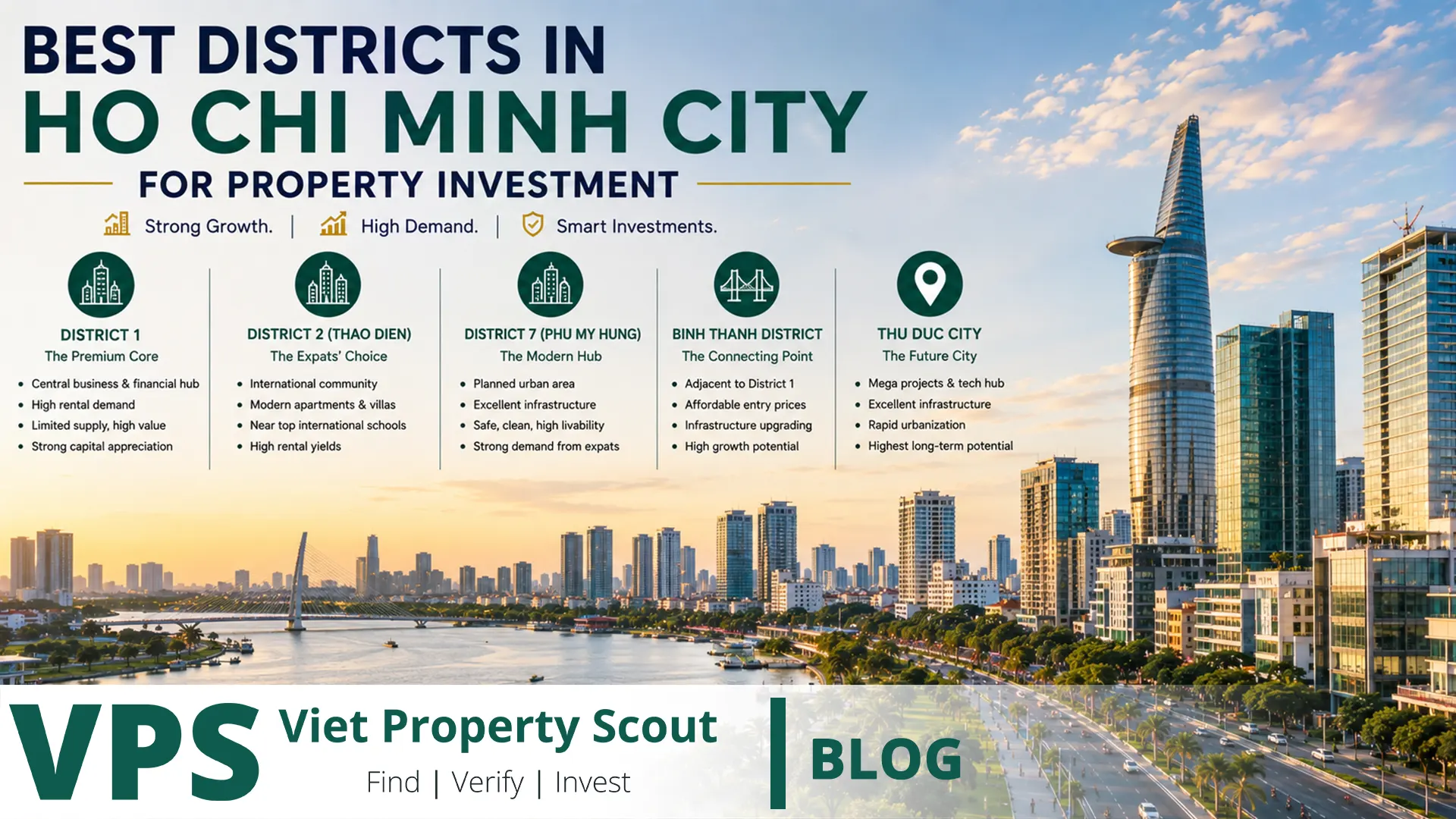
Quick answer: There is no single area in Ho Chi Minh City that is best for every long-term property investor. The right location depends on the strategy. Central areas are generally stronger for scarcity, capital preservation and resale liquidity. Thu Duc and the eastern corridor offer a stronger infrastructure-led growth story. Established southern communities can provide durable family and long-term rental demand, while western and northern expansion areas may offer greater long-horizon upside but require more patience and much stricter planning, legal and infrastructure verification.
Investors should also understand that the property market still commonly uses familiar geographic names such as District 1, District 3, District 7, Binh Thanh and Thu Duc when describing locations, even where administrative structures and boundaries have changed. For investment purposes, the real micro-location, transport access, surrounding services, employment demand, project quality, legal position and purchase price matter more than the administrative label alone.
A successful long-term investment in Ho Chi Minh City is usually an asset that can continue attracting residents, tenants and future buyers through different market cycles. Investors can compare available Viet Property Scout property listings, review real estate projects and speak with local property advisors to verify the conditions of specific locations and developments before committing capital.
What Does the Best Area for Long-Term Property Investment Actually Mean?
The best area is not necessarily the place where prices rose fastest in the past. For a long-term investor, a stronger question is whether there are sustainable reasons for people to continue living, renting, working, studying and buying in that location five or ten years from now.
A strong long-term investment area should combine several characteristics:
- real residential demand rather than investor demand alone;
- employment, business or education within practical reach;
- transport infrastructure that people can genuinely use;
- schools, healthcare, retail and everyday services;
- projects and communities with credible management and maintenance;
- a purchase price that does not already assume every future benefit will be delivered;
- a sufficiently broad pool of future buyers for resale;
- legal and planning clarity appropriate to the type of property being purchased.
Long-term investing means asking what will make a property desirable years from now, not simply what makes the sales presentation look attractive today.
Comparison of Major Long-Term Investment Areas in Ho Chi Minh City
| Area | Main Long-Term Driver | Best Suited For | Main Risk |
|---|---|---|---|
| Historic central areas and nearby locations | Scarcity, business activity, services and prestige | Capital preservation and liquidity | High entry price |
| Thu Duc and the east | Metro, infrastructure, education and technology | Long-term capital growth | Overpaying for future expectations |
| Binh Thanh and central-adjacent locations | Proximity to the core and existing residential demand | Rental income and resale | Large differences between streets and projects |
| Southern communities, former District 7 and Nha Be | Families, schools, services and established residential ecosystems | Long-term holding and family rental demand | Competitive new supply in some segments |
| Binh Chanh and western expansion | Urban expansion and improving connectivity | Patient investors seeking longer-term growth | Timing and liquidity |
| Cu Chi, Hoc Mon and northern growth areas | Land, infrastructure and future expansion | Very long-horizon strategies | Planning and speculation risk |
1. Central Ho Chi Minh City: Strong for Scarcity and Long-Term Liquidity
The historic central areas of Ho Chi Minh City, including locations still commonly identified in the property market by names such as District 1, District 3 and adjacent central neighborhoods, remain among the strongest options for investors who prioritize scarcity, liquidity and diversified demand.
The center concentrates offices, hotels, restaurants, international services, retail, culture and tourism. That means demand does not rely on only one category of user. A property can appeal to an executive tenant, a professional who wants to live close to work, a domestic buyer seeking a central address or an investor who wants an asset that future buyers can immediately understand.
The principal long-term advantage is that a genuine central location is difficult to reproduce. New developments can be built elsewhere, but a historic business and service core with existing roads, institutions, commercial activity and market recognition cannot simply be created again in another part of the city.
The main challenge is price. If an investor pays too much for the idea of scarcity, future appreciation may be limited and rental yield may become unattractive. Investors should therefore compare actual competing properties and realistic transaction economics rather than relying on the highest asking prices in the market.
When Does a Central Location Make Sense for Long-Term Investment?
- when the property is in a professionally managed building;
- when the unit has an efficient layout rather than depending only on a prestigious address;
- when there is a genuine pool of tenants and future buyers;
- when management and maintenance costs are transparent;
- when the purchase price can be justified against realistic competing assets.
2. Thu Duc and the East: The Strongest Infrastructure-Led Growth Story
Eastern Ho Chi Minh City, particularly Thu Duc, is one of the most important long-term growth corridors in the metropolitan property market. The area combines universities, technology-related activity, new residential development, large-scale projects and expanding urban transport connections.
Metro connectivity has increased the importance of transport when evaluating long-term property value. However, the existence of a metro line or station does not mean every nearby property will achieve the same performance.
The strongest opportunity appears where transport, real residential occupancy, employment, education and daily services work together. A station alone is not enough. Investors need to determine whether residents can access it easily, whether the surrounding area functions on foot, whether everyday services are available and whether genuine rental and owner-occupier demand exists.
Thao Dien and An Phu
Thao Dien and An Phu are well known for demand from international professionals, families and tenants who value schools, restaurants, services and an established residential environment. For long-term investors, these locations can be attractive when the strategy combines rental demand with resale flexibility.
Performance can nevertheless vary significantly between streets and buildings. Management standards, practical access, congestion, building age, views, noise and the number of competing rental units within a project can all influence returns.
Thu Thiem
Thu Thiem represents a different type of investment logic. Its appeal is more closely connected to high-value urban development, proximity to the traditional core and the creation of a modern business and residential district. It may therefore be better suited to an investor prioritizing long-term capital appreciation rather than the highest immediate rental yield.
The principal risk is the entry price. If a unit is already priced as though every expected improvement in business activity, infrastructure and prestige has been fully delivered, the investor may need a much longer holding period before attractive returns emerge.
Long Binh, Long Truong and Further Eastern Locations
The further an investor moves away from already established eastern communities, the more important it becomes to verify actual infrastructure, services and occupancy. Being part of the broader Thu Duc growth story is not enough. There should be evidence that people are genuinely moving into the area and that a functioning community is forming around the project.
3. Binh Thanh: A Bridge Between the City Core and the Wider Residential Market
Binh Thanh benefits from immediate proximity to central Ho Chi Minh City while offering a broader range of property types and price points. This combination makes it interesting for long-term investors who prefer existing demand instead of relying entirely on future development stories.
Some parts of the area benefit from convenient access to business districts and major urban corridors. This can attract local professionals, international residents, students, families and tenants who want access to the center without necessarily paying the highest prime-core prices.
Binh Thanh is not a uniform property market. Performance can change substantially from one street to another and from one project to the next. Investors should examine:
- real access during peak traffic periods;
- actual travel time to employment centers;
- building management quality;
- noise and the immediate surrounding environment;
- the number of competing units in the same project;
- achieved rents rather than advertised rents.
Binh Thanh can provide one of the more balanced combinations of rental demand, location and resale liquidity when investors choose carefully at the micro-location level rather than relying only on the area name.
4. The South and Former District 7: Investing in Established Residential Communities
Southern residential areas, particularly locations associated with the former District 7, Phu My Hung and the wider direction toward Nha Be, operate differently from the central and eastern markets. Schools, organized communities, green space, retail, healthcare and daily services play an especially important role in residential demand.
This matters for long-term investors because families often create more stable tenancy than short-term occupants. A practical apartment near schools, services and employment can continue attracting tenants even during weaker market conditions.
In this part of the city, the investor is not purchasing square meters alone. The investor is buying into an entire living environment. Important factors include:
- quality and maturity of the surrounding community;
- school access;
- retail and daily services;
- healthcare availability;
- roads and actual commuting times to employment areas;
- project management and common areas;
- the number of future projects competing for similar tenants and buyers.
The principal risk in some parts of the southern market is competing supply. An attractive community does not mean every building will perform equally well. Investors should compare prices, rents, occupancy and competing inventory between projects.
5. Nha Be: A Longer-Term Opportunity South of the City
Nha Be represents a natural extension of the southern residential growth story, but in many cases it requires a longer investment horizon than more mature locations. The area may benefit from better connectivity and continuing residential expansion, yet investors must distinguish between value that already exists today and value that the market expects to emerge later.
Projects located close to existing roads, services and functioning communities are generally less dependent on future promises than isolated developments. Investors should therefore examine how many people actually live in the area today, whether retail and schools are opening and whether daily services are developing rather than relying only on the final master plan.
6. Binh Chanh and the West: Investing in Urban Expansion
Western Ho Chi Minh City follows a different investment story from the center or the east. Binh Chanh forms part of the wider metropolitan expansion area and can interest long-term investors willing to wait longer in exchange for potentially lower entry prices in selected locations.
Urban expansion investments require discipline. A decision should not be based simply on the belief that “the city will eventually reach here.” The more important question is: what is genuinely bringing residents, jobs and services to this location?
Investors should look for:
- existing roads or infrastructure projects with visible progress;
- residential areas where genuine communities are already forming;
- employment, education or services nearby;
- purchase prices that do not already assume complete future development;
- resale demand from end users rather than only other investors.
The more an investment depends on the future, the more important the margin of safety in the purchase price becomes.
7. Cu Chi and Hoc Mon: Significant Potential but a Higher Verification Burden
Northern areas such as Cu Chi and Hoc Mon may be relevant for investors working with very long time horizons, particularly where the strategy involves land, infrastructure or metropolitan expansion. These investments are fundamentally different from buying a completed apartment with immediate rental demand in the city center.
Many land investments do not generate immediate rental income. Returns therefore depend more heavily on future appreciation, making planning, permitted use, access and infrastructure verification particularly important.
Investors should be cautious about:
- rumors concerning future planning changes;
- roads or infrastructure that have not been clearly approved or funded;
- prices justified by unrealistic comparisons;
- land without clear legal access;
- purchases where the only exit logic is finding another investor willing to pay more later.
These locations may offer real potential, but potential is not the same as certainty. Entry price should reflect both the risk level and the time required for the investment thesis to develop.
8. Can Gio: A Specialized Long-Term Strategy
Can Gio forms part of the broader southeast development story and is associated with the marine economy, tourism, environmental assets and large long-term projects. It is nevertheless a very different property market from central residential districts or Thu Duc.
Can Gio may suit investors with a very long investment horizon who are comfortable relying more heavily on future infrastructure and project implementation. It should not be treated as a direct substitute for a centrally located apartment with an established rental market.
Before investing, the purpose of the asset should be clearly defined. Is the objective rental income, capital appreciation or exposure to a future development zone? Each goal requires a different approach to risk.
Which Areas Fit Which Long-Term Investment Strategy?
| Investor Objective | Potential Areas | Reason |
|---|---|---|
| Capital preservation and liquidity | Central and central-adjacent locations | Scarcity, prestige and broader buyer pool |
| Long-term capital growth | Thu Duc and eastern Ho Chi Minh City | Transport, infrastructure and urban growth |
| Stable rental income | Binh Thanh and mature southern communities | Existing professional and family demand |
| Long-term family-oriented strategy | Former District 7 and carefully selected parts of Nha Be | Schools, services and residential environment |
| Longer-horizon growth with potentially lower entry price | Binh Chanh and selected peripheral locations | Urban expansion and connectivity |
| Higher-risk land strategy | Cu Chi, Hoc Mon and other outer areas | Future expansion and land-linked value |
Is It Better to Buy in an Established Area or a Growth Area?
An established area and an emerging growth area serve different investment strategies. Established markets usually provide more evidence that can be measured today: rent, occupancy, services, resale activity and actual resident behavior. Growth areas depend more heavily on future delivery.
| Factor | Established Area | Growth Area |
|---|---|---|
| Clarity of current demand | High | Variable |
| Ability to measure rent | Easier | More difficult in newer projects |
| Capital-growth potential | Often more stable | Can be higher |
| Dependence on future development | Lower | Higher |
| Execution risk | Generally lower | Higher |
Neither category is universally better. A conservative investor may prefer a mature market, while an investor with a longer horizon and greater risk tolerance may choose a growth corridor, provided the purchase price does not already include the full value of the expected future.
Why Is Micro-Location More Important Than the Area Name?
Two properties inside the same general area can perform very differently. One may be within easy walking distance of transport and daily services while another is isolated behind heavily congested roads. One building may be professionally managed with strong occupancy, while another nearby may suffer from poor maintenance and excessive competing rental inventory.
Investors should therefore analyze the immediate local environment:
- walking distance to retail and daily services;
- commuting time during peak periods;
- nearby schools and healthcare;
- street quality and immediate surroundings;
- noise, flooding or access issues where relevant;
- competing projects within a small radius;
- the type of residents already living in the area.
The area name is useful as a starting point, but it is not sufficient for an investment decision.
How Does the Metro Network Affect Long-Term Property Investment?
Urban rail is becoming increasingly important to the long-term development of Ho Chi Minh City and can gradually change the relationship between where people live and where they work. However, the benefits will not be distributed equally across every property.
A stronger transport-linked asset combines proximity to a station with practical access, walkability, services and genuine residential demand. A property marketed simply as “near the metro” without a functional daily connection may not receive the same investment benefit.
Investors should also distinguish clearly between infrastructure that is already operating, infrastructure genuinely under construction and infrastructure that exists only in long-term plans. These stages carry very different levels of investment certainty.
What Are the Strongest Indicators of Long-Term Demand?
Before buying, investors should look for evidence that demand can continue rather than relying only on future projections. Useful indicators include:
- growth in the number of actual residents;
- diverse nearby employment;
- increasing use of schools, retail and daily services;
- healthy occupancy in comparable projects;
- genuine resale transactions;
- a diversified buyer and tenant base;
- improving transport without excessive price inflation;
- strong management of buildings and communities.
The more independent sources of demand an area possesses, the less dependent the investment becomes on a single future scenario.
Common Mistakes When Choosing an Area for Long-Term Investment
- Choosing an area because prices increased strongly in the past. Historical performance does not guarantee future growth.
- Relying only on a famous district name. Micro-location can matter more than the broader geographic label.
- Buying future value at a future price. The entry price should still leave room for appreciation.
- Ignoring rental demand. Even capital-growth investors benefit from having a real tenant market.
- Ignoring future supply. A large amount of new inventory can increase competition for both tenants and buyers.
- Confusing planning with implementation. Planned infrastructure is not the same as functioning infrastructure.
- Failing to identify the future buyer. Investors should understand who could purchase the asset when they eventually exit.
Checklist Before Selecting an Investment Area
| Topic | Question |
|---|---|
| Objective | Am I targeting income, capital growth or a combination of both? |
| Holding period | Can I hold the property for five or ten years if necessary? |
| Demand | Who actually lives or rents here today? |
| Transport | Is connectivity functioning now or only planned? |
| Services | Are schools, retail and healthcare already available? |
| Price | Is the purchase price reasonable compared with competing properties? |
| Legal position | Is the project or property status clear and suitable for the buyer? |
| Exit | Who could realistically buy this property several years from now? |
Frequently Asked Questions About the Best Areas for Long-Term Property Investment in Ho Chi Minh City
What is the best area in Ho Chi Minh City for long-term property investment?
There is no single best location for every investor. Central areas are generally stronger for scarcity and liquidity, Thu Duc and eastern Ho Chi Minh City for infrastructure-led capital growth, mature southern communities for family and rental demand and selected peripheral areas for investors with longer time horizons.
Is Thu Duc good for long-term property investment?
Thu Duc can be attractive for long-term investment because of infrastructure, education, technology and residential growth. However, the project, micro-location and entry price must be evaluated individually. Not every property in Thu Duc will benefit equally.
Is central Ho Chi Minh City better than the outskirts?
It depends on the strategy. Central locations generally provide clearer demand, scarcity and liquidity. Carefully selected peripheral locations may provide lower entry prices and stronger growth potential, but usually involve greater uncertainty and longer holding periods.
Is the former District 7 area suitable for long-term investment?
Mature residential communities within the former District 7 area can be suitable for family rentals and long-term holding, particularly where projects have strong access to schools, services and employment. Investors should still compare competing supply, pricing and actual rental performance between buildings.
Is property near a metro station always a better investment?
No. Metro proximity is valuable only when the station creates a practical advantage for residents and tenants. Walkability, access, nearby services and the purchase price remain just as important as distance on a map.
What is better for long-term investment: an established market or a new growth area?
An established market usually offers clearer evidence of demand, rents and resale activity. A new growth area may provide stronger appreciation if infrastructure and population growth are successfully delivered. The correct choice depends on risk tolerance, holding period and entry price.
How can I tell if an area is already overpriced?
Compare price per square meter, actual rent, realistic rental yield, competing projects and resale transactions. If the purchase price depends heavily on future benefits that have not yet been delivered, much of the expected growth may already be priced into the asset.
The Viet Property Scout Approach: Find, Verify, Invest
Long-term property investment begins with selecting the right area, but location selection is only the first step. Investors must then move from the broad market story to the specific asset and verify the project, price, demand, legal position and future resale potential.
- Find: compare areas, micro-locations, projects and properties that match the investment objective.
- Verify: investigate the actual location, infrastructure, demand, pricing, project status and documentation.
- Invest: commit capital only when real evidence supports the long-term investment thesis.
Investors can begin by comparing available properties, reviewing real estate projects and speaking with Viet Property Scout advisors for more detailed location-specific evaluation.
Final Perspective
The best areas for long-term property investment in Ho Chi Minh City depend on the investor’s strategy. Central locations provide scarcity and liquidity, while Thu Duc and the east offer a strong growth story linked to transport and infrastructure. Binh Thanh and mature southern communities benefit from existing residential and rental demand. Western and northern expansion areas may provide longer-term opportunity but require more patience and deeper verification.
The strongest decision does not begin with the question, “Which area will rise in price the most?” A more disciplined question is: where are there real reasons for people to continue living, working, renting and buying over the coming years, and does today’s price still leave the investor a reasonable margin for future growth?
That is the principle behind Viet Property Scout: Find. Verify. Invest. Find the opportunity first, verify the evidence second and invest only when the facts are stronger than the marketing story.