
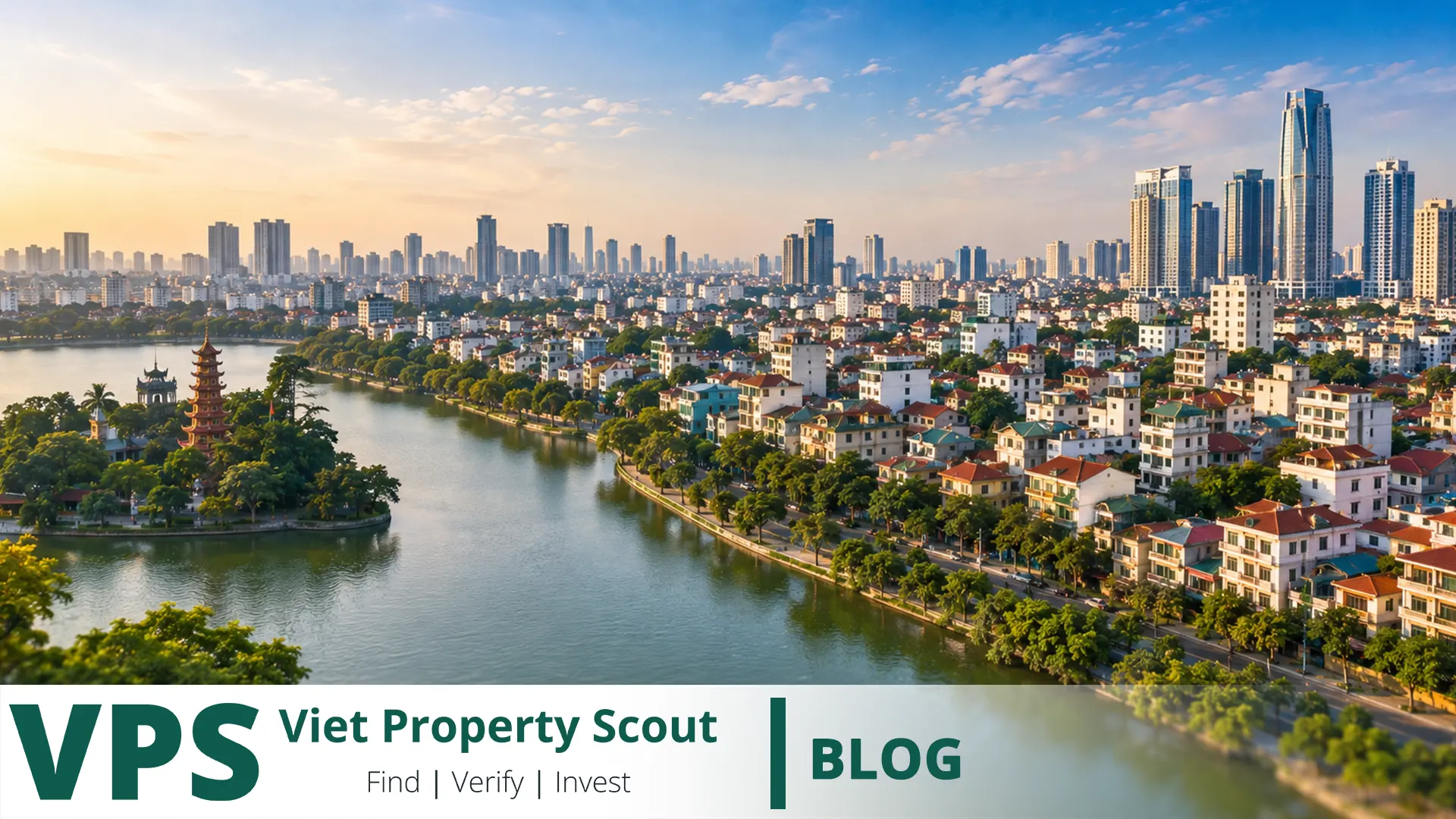
Short answer: There is no single “best” residential investment area in Hanoi for every investor. Tây Hồ and the West Lake area remain among the strongest choices for capital preservation, international rental demand and premium housing. Cầu Giấy - Nam Từ Liêm offers one of the most balanced combinations of modern apartments, employment-driven rental demand and resale liquidity. Long Biên - Gia Lâm is a compelling medium- to long-term east-Hanoi growth story, while Đông Anh provides greater exposure to long-term northern urban expansion. Hà Đông - Hoài Đức can be attractive for investors targeting Vietnamese end-user demand and more space for the capital invested. Hòa Lạc is a much longer-duration technology and knowledge-economy strategy rather than a mature central residential market. In Hanoi's more selective 2026 market, the individual project, unit and acquisition price matter more than simply choosing a fashionable district name.
What actually makes an area “best” for residential investment?
A residential location should not be ranked only by past appreciation or headline price per square metre. A strong investment area should combine five things: genuine demand today, a demand source that can persist, verifiable infrastructure, legally clear property products and reasonable exit liquidity. Investors should first identify the property's natural tenant or future buyer. An apartment for a Vietnamese family working in west Hanoi does not need the same features as a diplomatic or expatriate rental near West Lake.
This approach is particularly important in 2026. After several years of strong price appreciation, Hanoi's condominium market has become more selective. Q2 2026 data indicated sales equal to roughly 68% of new supply during the quarter, while the secondary market recorded its first downward price adjustment since late 2022. That does not mean Hanoi has become a weak property market. It means the period when investors could rely on broad market momentum to rescue a mediocre purchase has become less dependable.
Important note on area names after Hanoi's 2025 administrative reorganisation
Hanoi has operated under Vietnam's two-tier local-government model since 1 July 2025. After reorganisation, the capital has 126 commune-level administrative units, including 51 wards and 75 communes. Legacy names such as Cầu Giấy, Tây Hồ, Long Biên, Gia Lâm, Đông Anh, Hà Đông and Hoài Đức remain widely used as geographic and real-estate submarket labels even though the former district structure no longer operates as the same official administrative layer. Legal certificates, contracts, addresses and planning checks should therefore use the property's current official ward or commune designation.
Practical ranking by investment objective
| Area | Best suited to | Core advantage | Main risk |
|---|---|---|---|
| Tây Hồ / West Lake | Capital preservation, expatriate rents, premium housing | Scarcity and established international demand | High acquisition prices and uneven building quality |
| Cầu Giấy - Nam Từ Liêm | Best all-round balance of rent and resale | Employment, schools, technology and modern services | Large pipeline of competing supply |
| Long Biên - Gia Lâm | Medium- to long-term east-Hanoi growth | Development land and improving cross-river connectivity | Some projects depend heavily on future roads and bridges |
| Đông Anh | Long-term northern urban expansion | Nội Bài Airport and major northern growth corridors | Speculation before full residential demand forms |
| Hà Đông - Hoài Đức | Local end-user demand and more space per budget | Large residential population and modern projects | High competing supply and congestion |
| Hoàn Kiếm - Ba Đình and established central areas | Scarcity and capital preservation | Irreplaceable central location | High entry price and older building stock |
| Hòa Lạc | Very long-term growth strategy | Technology, research and education | Long holding period and uneven liquidity |
1. Tây Hồ and West Lake: strongest for capital preservation and international demand
West Lake combines a rare natural setting with proximity to the city centre, embassies, international schools, restaurants and services used by foreign residents. Its tenant base can include diplomats, executives, specialists and international families alongside higher-income Vietnamese households.
Hanoi also approved major West Lake conservation and redevelopment directions in 2026, aiming to strengthen the area as a cultural, tourism, service and creative-economy destination while improving public space, the lakeside environment and connectivity. These initiatives may support long-term desirability, but an investor should not pay today's price as though every planned improvement has already been completed.
What works best in Tây Hồ?
- Professionally managed apartment buildings.
- Good road access and practical parking.
- Family-friendly layouts and functional kitchens.
- Quiet units despite the central location.
- Properties with genuine tenant demand beyond a lake-view marketing premium.
The biggest mistake is paying a large “West Lake” premium for a mediocre building. Actual achievable rent and resale demand should justify the acquisition premium.
2. Cầu Giấy - Nam Từ Liêm: the strongest all-rounder for modern apartments
West Hanoi combines office clusters, technology employers, universities, schools, shopping centres and large modern residential developments. This creates diversified demand from Vietnamese professionals, families, managers, students and foreign employees.
For a typical apartment investor, diversified employment-based demand is a major advantage. The weakness is supply competition. Hanoi's western and suburban markets have received substantial new inventory, so a generic unit in a very large project may compete against hundreds of similar listings.
A stronger project usually offers:
- Reasonable real-world commuting times to employment clusters.
- Schools, health care, retail and daily services nearby.
- Professional management with defensible ongoing fees.
- A floor plan designed for actual living rather than marketing.
- Clear differentiation from competing units of the same size.
As buyers become more price-sensitive in 2026, an apartment that works well as a home can outperform a more glamorous project with weaker practical utility.
3. Long Biên - Gia Lâm: a compelling east-Hanoi growth market
East Hanoi combines relative geographic proximity to the traditional core with much larger development areas. Historically, the Red River has acted as a practical barrier because crossing capacity matters more than straight-line distance. Every meaningful improvement in bridges and arterial roads can therefore reduce friction and change residential demand.
The strongest investment is not simply one located “near a future bridge.” It is a property that already functions today and becomes even better if connectivity improves. A unit that only makes economic sense if one specific future project is completed on time carries greater execution risk.
Long Biên or Gia Lâm becomes more attractive when:
- The project already has reliable access to existing river crossings.
- Schools, retail and everyday services are operational.
- There is a growing community of genuine residents rather than investors only.
- The entry price remains sufficiently below comparable established central markets.
- The investment thesis does not depend entirely on one unbuilt bridge.
4. Đông Anh: strongest long-term northern expansion option
Đông Anh has a powerful strategic story because of Nội Bài International Airport, the Nhật Tân - Nội Bài corridor and Hanoi's long-term intention to develop the northern urban region. The city's approved 2045 planning framework is explicitly multi-centred, and the northern side of the Red River is an important part of that future structure.
However, Đông Anh also demonstrates the difference between investment and speculation. Land values can move quickly when a road, bridge or urban-centre announcement appears, while actual households, schools, retail and employment may take much longer to arrive. For residential investment, a functioning development with current utility is generally safer than raw land whose value depends entirely on a future planning narrative.
What makes the north stronger?
The investment case improves as airport and city connectivity is matched by schools, retail, employment, services and actual population. The less the asset depends on promises and the more useful it is today, the stronger its risk profile.
5. Hà Đông - Hoài Đức: strong for Vietnamese family demand and value per square metre
West and southwest Hanoi have absorbed significant population growth as families seek larger, newer housing outside expensive central neighbourhoods. In selected projects, investors can acquire materially more residential space for the same capital than in prime central locations.
The demand base here is primarily residential rather than tourism- or diplomacy-led. Schools, childcare, parking, supermarkets, parks and commuting time therefore matter more than prestige branding.
The main risk is substitutability. If ten nearby towers offer essentially the same two-bedroom apartment, landlords have limited pricing power. Investors should look for better building position, view, internal layout, access or management.
6. Hoàn Kiếm - Ba Đình and established central Hanoi: excellent scarcity, but not always the best yield
Central Hanoi has a feature new urban areas cannot reproduce: true location scarcity. Government institutions, embassies, major offices, hospitals, cultural areas and established commercial streets support deep demand and resale recognition.
Residential investors must nevertheless inspect the building rather than simply buying the postcode. Older stock can suffer from parking constraints, ageing lifts, maintenance issues, fire-safety upgrades or future reconstruction complexity. Because acquisition prices are high, rental yield may be lower than in a strong western or eastern project. The centre is often more suitable for investors prioritising location quality and capital preservation over maximum annual income.
7. Hòa Lạc: a very long-term technology and knowledge-economy strategy
Hòa Lạc matters because of the Hi-Tech Park, universities, research facilities and Hanoi's broader strategy to develop the western knowledge and technology corridor. It should not, however, be treated as a mature residential alternative to Tây Hồ or Cầu Giấy.
Investors should verify current employment, land use, roads, project delivery, utilities, residential population and resale depth. Buying because “Hòa Lạc will become a technology city” without those checks is a speculative strategy.
Ring Road 4: which residential areas benefit most?
Ring Road 4 is one of the Capital Region's most important transport investments. By 2026, land clearance across the Hanoi section had largely progressed and major construction components were advancing. The road can improve connectivity between western, northern and eastern growth areas without forcing all trips through the core.
The property closest to the ring road is not necessarily the best investment. Useful interchanges, local road access, noise exposure, land-acquisition risk and genuine residential demand matter more. In some cases, being several minutes from a major highway is better for housing than directly fronting it.
Metro and public transport: buy useful access, not a radius on a map
Hanoi's expanding mass-transit system can support residential values along selected corridors, but a future station does not guarantee a property premium. Walkability, safe crossings, last-mile access, noise and connections to actual workplaces all matter.
The stronger investment is a home that is attractive today and becomes better with future transit, rather than a weak property whose entire case depends on a metro project arriving exactly as planned.
How does the 2026 market change area selection?
Hanoi entered 2026 after substantial apartment-price growth. Primary prices remain elevated, new supply is substantial and a greater proportion of new launches is shifting outside the traditional urban core. Buyers are therefore more selective and liquidity is becoming more sensitive to pricing and product quality.
Investors should no longer underwrite on the assumption that “all Hanoi apartments will rise.” Well-designed units, good building management, genuine occupancy demand and a defensible acquisition price are becoming more important than broad market momentum.
Strategy comparison
| Investor objective | Often strongest area | Investment logic |
|---|---|---|
| Expatriate rental income | Tây Hồ | Established international tenant base |
| Best all-round balance | Cầu Giấy - Nam Từ Liêm | Jobs, services and resale depth |
| East-Hanoi growth | Long Biên - Gia Lâm | Urbanisation and cross-river infrastructure |
| Long-term northern growth | Đông Anh | Airport and new urban centres |
| Vietnamese family demand | Hà Đông - Hoài Đức | More space and large end-user population |
| Scarcity and capital preservation | Hoàn Kiếm - Ba Đình | Irreplaceable central location |
| 10+ year technology strategy | Hòa Lạc | Knowledge-economy growth |
Foreign buyers: the best area is useless if the asset is not legally purchasable
Eligible foreign buyers can acquire qualifying housing only within the projects and statutory limits that permit foreign ownership. Current rules generally cap foreign ownership at 30% of residential-purpose apartments in an apartment building or relevant building block, subject to additional eligibility and term conditions. Before paying a deposit, the buyer should verify that the project is open to foreign ownership and that quota remains available.
A foreign buyer should not assume that standalone land or land-linked housing can be acquired in the same manner as a qualifying apartment. Informal nominee ownership through a Vietnamese friend or partner is not equivalent to enforceable legal ownership.
Area-selection checklist
- Define whether the goal is income, capital preservation or growth.
- Identify the area's natural tenant.
- Test commuting times during actual peak traffic.
- Compare direct competing projects.
- Review expected new supply over the next two to five years.
- Separate completed infrastructure from planned infrastructure.
- Include management, repairs and vacancy in the yield model.
- Verify legal status and certificate documentation.
- For foreign buyers, confirm remaining foreign quota.
- Compare only genuinely similar properties.
- Ask who would naturally buy the unit from you in five years.
- Stress-test the investment if a road or metro project is delayed.
Red flags
- “This area is guaranteed to rise because of one project.”
- A future metro station is fully capitalised into today's price.
- A broad area average is used to justify an ordinary unit.
- The project has no obvious natural tenant.
- Hundreds of identical units compete for the same renter.
- A luxury project is located where luxury rental demand is weak.
- A foreign buyer proceeds without checking quota.
- A legacy district name is used without verifying the current official address.
Frequently asked questions
What is the best area for a first-time Hanoi investor?
Cầu Giấy - Nam Từ Liêm is often one of the most balanced starting points because its demand comes from multiple employment, family and service segments rather than a single catalyst.
What is the best area for renting to foreigners?
Tây Hồ is one of Hanoi's strongest established choices, provided the building, access and management are appropriate.
Where is the strongest long-term growth potential?
Long Biên - Gia Lâm and Đông Anh provide significant exposure to urban expansion and new infrastructure, while Hòa Lạc represents a longer and more specialised technology thesis.
Is central Hanoi always better than the suburbs?
No. Central property offers scarcity and recognition, while outer markets can offer greater growth potential or more space for the same capital.
Should investors buy the property closest to a metro station?
No. Useful walking access and a complete residential environment matter more than simple distance.
Is Hanoi still attractive after strong price growth?
Yes, but it is a more selective market. Acquisition price, real demand and resale liquidity matter more than they did during a broad rising cycle.
Conclusion: the best area combines real demand today with credible improvement tomorrow
For many investors, Tây Hồ is strongest for international rental demand and capital preservation; Cầu Giấy - Nam Từ Liêm offers the best overall balance; Long Biên - Gia Lâm and Đông Anh provide growth exposure; Hà Đông - Hoài Đức is supported by local family demand; and Hòa Lạc is a very long-term technology strategy. The historic core remains an excellent scarcity market but is not automatically the highest-yield option.
In Hanoi, Find | Verify | Invest means: find an area with identifiable real demand, verify the specific project, current infrastructure, legal status, competing supply and exit liquidity, and invest only if the unit still makes sense when the market slows or the infrastructure project behind the investment story is delayed.