
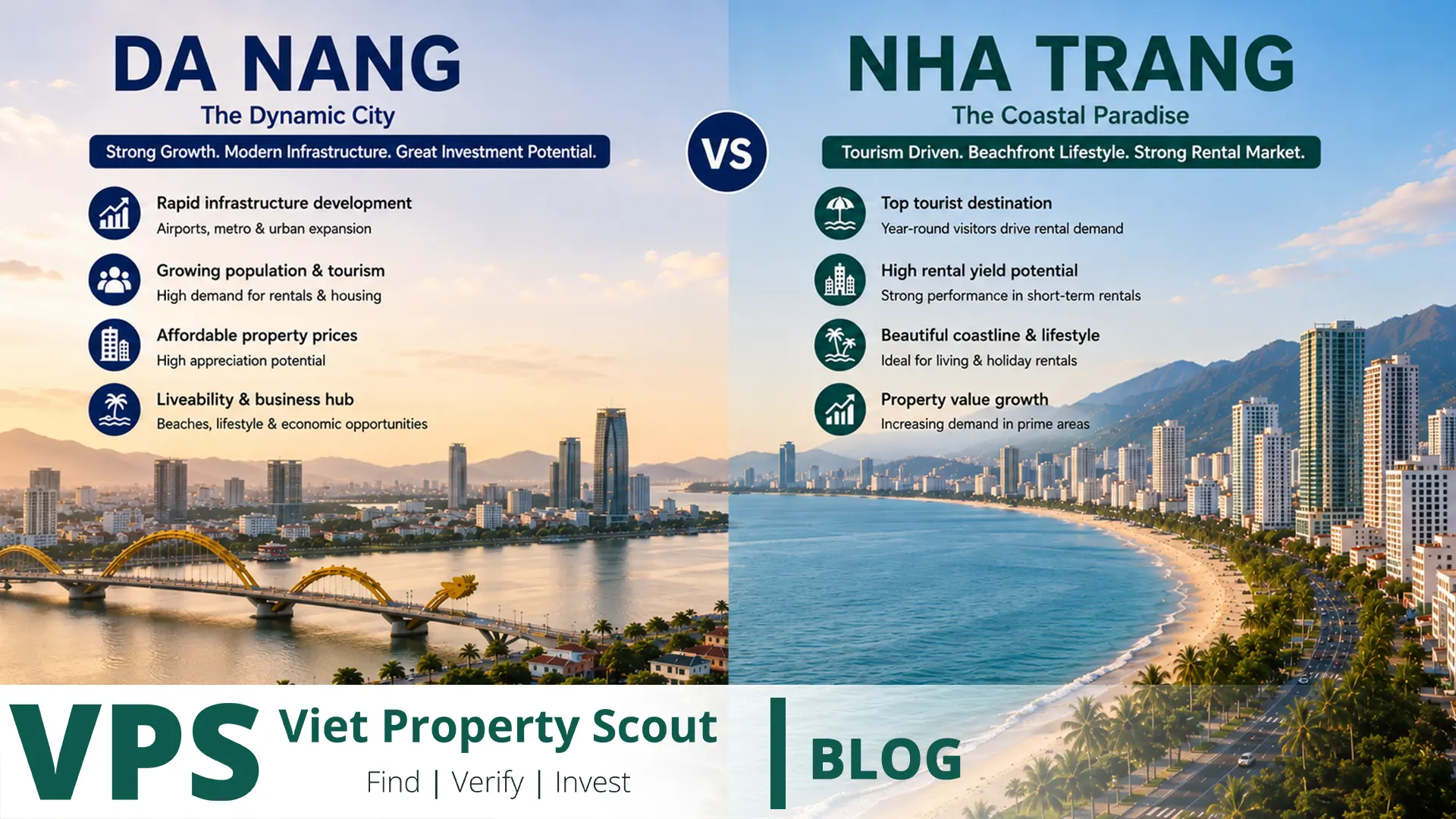
Short answer: if the objective is a Vietnamese coastal property with more diversified year-round demand, a broader urban economy, an airport embedded in the city and a currently deeper new-condominium market, Da Nang is generally the more balanced investment proposition. If the objective is deliberately higher exposure to international beach tourism, holiday accommodation and resort-style demand, and the investor is comfortable with greater seasonal, operational and legal-use risk, Nha Trang can offer the more specialised tourism proposition. The real choice, however, is not between two city names. It is between a qualifying long-term residential apartment, a tourism unit, condotel, villa, development land or owner-occupied lifestyle property. The comparison also became more complicated after Vietnam's 2025 administrative restructuring: the new Da Nang merged the former city with Quảng Nam, while the new Khánh Hòa Province merged the former Khánh Hòa with Ninh Thuận. New population and tourism totals therefore cannot be treated as statistics for only old central Da Nang or Nha Trang.
The fundamental difference: a diversified coastal city versus a more tourism-specialised resort city
Da Nang is no longer only a beach destination. Its economic base includes tourism, technology, offices, logistics, high-tech industry, education and finance. After the merger with Quảng Nam, the new administrative city also encompasses Hội An, Chu Lai and extensive industrial, logistics and port areas. Vietnam's International Financial Center in Da Nang formally opened in January 2026, reinforcing the city's attempt to generate higher-value finance, technology and international-service employment in addition to tourism.
Nha Trang has a different profile. It is one of Vietnam's best-known marine resort cities, with real-estate demand more visibly connected to the beach, hotels, tourism services, entertainment, cruises and international arrivals through Cam Ranh. That can produce strong performance for the right holiday asset, but it makes seasonality, source-market concentration and hotel competition more important.
For investors, the simplest distinction is that Da Nang more often offers a city-plus-tourism demand base, while Nha Trang offers a clearer tourism-plus-coastal-lifestyle thesis. The more a deal needs tourists in order to work, the more carefully its operating assumptions should be stress-tested.
A critical statistical warning after the 2025 restructuring
| Factor | Da Nang | Nha Trang / Khánh Hòa |
|---|---|---|
| Restructuring | Former Da Nang merged with Quảng Nam | Former Khánh Hòa merged with Ninh Thuận |
| New structure effective | 1 July 2025 | 1 July 2025 |
| New administrative scale | About 11,859.59 sq km and more than 3.06 million people | About 8,555.86 sq km and more than 2.24 million people |
| Analytical problem | City statistics can include former Quảng Nam and Hội An | Provincial statistics include former Ninh Thuận and are not Nha Trang-only |
As a result, a headline such as “Da Nang served 9.77 million guests” or “Khánh Hòa welcomed 11.9 million visitors” should never be used as a direct occupancy assumption for a specific beachfront apartment. The geographies and statistical definitions differ.
Tourism in 2026: both markets are strong, but the demand structure differs
During the first half of 2026, accommodation establishments across the new Da Nang served more than 9.77 million guest visits, including approximately 5.16 million international and 4.61 million domestic guest visits. That is evidence of substantial international tourism demand, but the statistic covers the enlarged city after the merger.
Over the same period, the enlarged Khánh Hòa Province recorded roughly 11.9 million tourist visits, including more than 4.6 million international visitors. Province-wide average accommodation occupancy was around 60%, while tourism revenue exceeded VND 42.5 trillion. Again, these are not Nha Trang city-centre apartment figures.
The correct conclusion is therefore that both destinations are benefiting from powerful international tourism recovery, not that one is automatically the better property market because it reported the larger total.
Visitor diversification: a meaningful Da Nang advantage and a Nha Trang risk factor to monitor
In H1 2026, South Korea remained Da Nang's largest international source market but accounted for about 20.55% of international visitors. China, India, the United States, Taiwan, Australia, the United Kingdom, Thailand, Russia and Japan followed. This wider mix reduces dependency on one country.
Khánh Hòa's international mix was more concentrated. Local tourism authorities reported South Korea at roughly 40%, Russia and CIS markets at about 24%, and China at around 12%. For Nha Trang, that concentration can be highly profitable when those routes and economies are strong, but changes in aviation capacity, currency, visa conditions or outbound spending in one major market can be reflected quickly in hotel and short-stay demand.
An investor underwriting holiday rental should therefore treat source-market concentration as a financial risk, not merely a tourism statistic.
Airport connectivity: Da Nang has urban convenience, Nha Trang has a powerful international gateway outside the city
Da Nang International Airport sits within the urban area and is relatively close to the traditional centre, beaches and business districts. It handled more than 15.29 million passengers in 2025. A 2026 airport plan provides for capacity of roughly 20 million passengers per year by 2030. For residents, business travellers and short-stay guests, airport-to-property time is a real amenity.
Nha Trang is served by Cam Ranh International Airport, located in Cam Ranh rather than central Nha Trang. The airport handled nearly 7.3 million passengers in 2025, including almost 4.7 million international passengers. That unusually strong international share supports the tourism thesis, although a Nha Trang city-centre property still depends on a road transfer between the airport and city.
Da Nang therefore has a structural convenience advantage for professionals and frequent flyers, while Cam Ranh remains a strong international tourism gateway for Nha Trang and the wider resort corridor.
Apartment-market depth: Da Nang currently has a deeper institutionally documented new-build cycle
In CBRE's tracked Da Nang condominium market, more than 8,000 new units were launched during 2024-2025. By Q1 2026, cumulative condominium supply had reached approximately 16,000 units. Average primary pricing stood at around VND 83 million per square metre and the cumulative sales rate was approximately 89%.
Those figures demonstrate substantially greater new-build market depth than Da Nang had before 2024, but they are also a warning against buying indiscriminately. Entry prices are already elevated, new project competition is increasing and some buyers are paying a significant premium for newly launched coastal stock. Strong historical absorption does not guarantee future appreciation.
For Nha Trang, there is not currently an equally comparable public institutional 2026 citywide dataset using the same methodology. A disciplined investor should not manufacture a precise Nha Trang “average” and compare it directly with the CBRE Da Nang number. Building-to-building evidence, real leases, certificates, project classification and resale transactions are more useful.
Da Nang: where the main investment submarkets differ
Central Da Nang / Hải Châu / Hàn River
This is the more urban investment case. Business activity, administration, services, the airport and city lifestyle can support year-round demand. A riverfront apartment may therefore rely less exclusively on beach holiday demand than a pure resort unit.
My Khe - An Thượng coastal market
This is one of the strongest areas for tourism, foreigners and beach-oriented living. Walkability to the sea, restaurants and services supports both short stays and longer leases. The trade-off is high hotel and apartment competition, making achieved rents more important than online asking rents.
An Hải / the former Sơn Trà market area
The area between the Hàn River and coast combines access to the centre and beach. Legacy district names remain common as market labels, but legal due diligence should use the current administrative address after the 2025 two-tier restructuring.
Southern corridor toward Hội An
The merger places this broader geography inside the new Da Nang administration, but Hội An and southern resort corridors remain economically distinct from an urban condominium in My Khe. They should be underwritten as a different tourism and resort submarket.
Nha Trang: the principal investment submarkets
Trần Phú and the central beachfront
This is the clearest scarcity and tourism address. Beach access, hotels, restaurants and services make the demand proposition easy to understand, but acquisition prices can already capitalise a large share of those advantages. A view premium should also be checked against the risk of future obstruction.
Phạm Văn Đồng and northern Nha Trang
This area can provide beach and view products at a different price structure from the core. Building quality, road access and neighbourhood services matter more than simple distance from the shoreline.
Western and southern urban expansion
The approved Nha Trang 2040 General Plan establishes a multi-centre structure and expansion toward the north, northwest, west and south, among other directions. These areas can be more closely tied to permanent residential population and services than daily tourism, but normally require a longer holding period and stronger planning due diligence.
Cam Ranh is not Nha Trang
Cam Ranh resort projects and central Nha Trang apartments are separate markets. Airport-resort corridor demand, operator agreements and holiday inventory should not be mixed with Trần Phú condominium data to create a single “Nha Trang yield”.
Long-term leasing versus holiday rental
| Strategy | Da Nang | Nha Trang |
|---|---|---|
| Long-term professional rental | Generally more defensible because of broader employment and urban economy | Exists, but the total market is more tourism/service oriented |
| Foreign family tenant | Good potential in areas combining schools, services and beach access | Possible in quality projects, but a smaller overall pool |
| Short-stay tourism | Strong with a diversified international base | Very strong in the right tourism-classified product |
| Fallback if tourism weakens | Often easier in selected urban submarkets | Highly dependent on location and legal product type |
A deal requiring 70-80% holiday occupancy throughout the year is structurally riskier than a unit that can legally and practically shift to a six- or twelve-month tenancy. The strongest coastal asset often has more than one genuine demand source.
The biggest legal mistake: assuming every beachfront unit can operate as daily accommodation
Vietnam distinguishes between residential apartments, tourism-accommodation units, condotels, officetels and other commercial products. Housing and condominium-management rules require units to be used according to approved function and project design. A residential apartment should not automatically be treated as a hotel room simply because it is near the sea.
Khánh Hòa issued Decision 620/QĐ-UBND in February 2026 governing coordinated management of tourism-accommodation services in tourist apartments and tourist villas. This is an important reminder that tourism operation has a separate regulatory track.
Before buying for Airbnb-style operation, verify the legal function of the unit, project classification, management rules, guest registration, taxes, fire safety and whether the individual owner is permitted to self-operate or must participate in an operator programme.
Foreign buyers: the national ownership framework is the same in both markets
Eligible foreign organisations and individuals may own qualifying housing in permitted commercial housing projects, subject to national-security restrictions and quantity limits. For residential apartment buildings, the general foreign-ownership cap is up to 30% of residential-purpose apartments in the relevant building or block.
This is particularly important in coastal markets because some areas may involve defence and security considerations. A salesperson saying “foreigners can buy” is not enough; the exact project, unit classification and remaining foreign quota should be independently confirmed.
An ordinary foreign individual should also not assume the ability to acquire standalone land-use rights in the same way as a Vietnamese citizen. Nominee structures using another person's name can create substantial ownership and enforcement risk.
Coastal buildings require a different physical due-diligence checklist
- Salt corrosion on façade, balcony and metal systems.
- Waterproofing around windows, balconies and roof areas.
- Humidity, mould and ventilation inside the unit.
- Air-conditioning wear caused by marine air.
- Wind exposure, glazing and balcony doors.
- Stormwater drainage and basement flooding.
- Backup generators, pumps and fire systems.
- Future façade-repair reserve after five to ten years.
- Whether management fees are sufficient or likely to rise sharply.
- Clear legal and practical parking rights.
A coastal new build can look perfect at handover but require significant capital expenditure several years later if waterproofing, façade materials or management are poor. “New” should never be treated as synonymous with “low-maintenance”.
Land and urban-expansion investment
The new Da Nang became geographically enormous after the Quảng Nam merger. The city's 2026 planning adjustment moves toward a multi-polar, multi-axis, multifunctional structure combining tourism, technology, finance, logistics and industry. That creates many growth themes, but it also makes the phrase “land in Da Nang” too broad to be analytically useful.
Nha Trang's 2040 General Plan, approved by the Prime Minister in 2024, divides the urban structure into 14 areas and directs expansion toward the north, northwest, west, south and other areas. However, a general plan is not parcel-level development entitlement. Detailed zoning, land-use purpose, road reservation, access, compensation and acquisition risk still require verification.
Both markets can punish investors who buy land solely because of a rumoured road, future land conversion or general planning map.
Which city fits which investor?
| Investor profile | Usually stronger fit | Reason |
|---|---|---|
| Long-term professional landlord | Da Nang | More diversified employment, technology, offices and airport convenience |
| Specialist holiday-rental investor | Either; Nha Trang is more tourism concentrated | Strong international leisure demand |
| Owner-user wanting city + beach | Da Nang | Easy combination of urban services, beach and airport |
| Owner-user wanting stronger resort identity | Nha Trang | More specialised marine-tourism lifestyle |
| New condominium investor | Da Nang currently has deeper tracked supply | Larger institutional new-build cycle, though entry prices are high |
| Long-horizon land investor | Both | Only sensible with parcel-level planning and legal review |
| Conservative foreign buyer | Project-specific | Eligibility, quota, certificate and use matter more than city |
How to compare rental yield properly
Do not annualise a summer nightly rate or Tet holiday price. For short stays, deduct platform fees, management, cleaning, utilities, furniture, maintenance, tax, vacancy and refurbishment. For long-term leasing, deduct management, brokerage, repairs, tax and turnover vacancy.
Illustrative example only: a VND 6 billion apartment generates VND 360 million of annual gross rental revenue. If operating expenses, vacancy and reserves total VND 120 million, net income before financing is VND 240 million, or about 4% of acquisition price. If the deal only becomes attractive after assuming strong annual capital appreciation, it is primarily an appreciation strategy rather than a yield strategy.
A common stress test for Da Nang and Nha Trang
| Scenario | Question |
|---|---|
| International tourism falls 20% | Can the unit legally shift to long-term rent? |
| Rent falls 15% | Is net return still acceptable? |
| Two extra vacancy months | Can cash flow absorb it? |
| A major competing project opens nearby | Does the building retain a real advantage? |
| Furniture/façade refurbishment after five years | Has sufficient capital reserve been budgeted? |
| Infrastructure is delayed three years | Does the location work today? |
| Sale required within six months | Who is the natural buyer and what discount might be needed? |
Due-diligence checklist before buying
- Identify whether the unit is legally residential, tourism accommodation or commercial.
- Define the natural tenant: tourist, professional, family or owner-occupier.
- Verify the current administrative address after the 2025 restructuring.
- Use building- and submarket-level evidence rather than regional tourism totals.
- Request evidence of achieved rent where possible.
- Verify certificate, project status, land position and mortgages.
- If foreign, verify project eligibility and remaining quota.
- Inspect moisture, corrosion, waterproofing, façade and lifts.
- Calculate all management and operating costs.
- Map competing supply due over three to five years.
- Separate operating infrastructure from planned projects.
- Never treat a general plan as parcel-level entitlement.
- Identify the natural resale buyer before purchase.
Red flags
- “Da Nang is better because it has more tourists” without adjusting for enlarged boundaries and methodology.
- “Nha Trang is better because it is more touristy” without building-level evidence.
- A residential apartment sold using unverified daily-rental assumptions.
- A condotel marketed as if it were a conventional long-term residential apartment.
- High “guaranteed” rental return without enforceable financial security.
- Asking rent treated as achieved rent.
- Large premium for a sea view that could be obstructed.
- Salt corrosion and long-term façade cost ignored.
- Land purchased because of a road or rezoning rumour.
- Foreign ownership proceeding without quota and defence/security checks.
Frequently asked questions
Which is better overall, Da Nang or Nha Trang?
For a balanced long-term residential investment, Da Nang currently has the more diversified case. For a deliberately tourism-led holiday product, Nha Trang can be very strong if the unit's legal classification and operating model are appropriate.
Which has stronger international tourism?
Both do. Da Nang currently has a more diversified source-market mix, while Khánh Hòa/Nha Trang has particularly strong exposure to Korea, Russia/CIS and China. Regional totals should not be confused with unit-level occupancy.
Which is better for long-term rent?
Da Nang is generally easier to defend because its economy includes technology, offices, finance, education and services in addition to tourism. Building quality and price still matter more than the city label.
Is Nha Trang better for daily rental?
Some properly classified tourism units can perform very well, but a normal residential apartment should not be assumed to operate legally like a hotel room.
Can a foreign individual buy land in either city?
An ordinary foreign buyer should not assume Vietnamese-citizen-style standalone land-use rights. Qualifying residential apartments in eligible projects generally provide the clearer ownership route.
Which city has better capital-appreciation potential?
Neither offers guaranteed appreciation. Da Nang now has a larger new-apartment cycle and elevated primary pricing; Nha Trang is more fragmented by building, legal classification and location. Entry price and real utility are more important than the city brand.
Conclusion: Da Nang is more balanced; Nha Trang is more specialised
If an investor wants a coastal city where the property can be supported by tourism and by urban professional demand, Da Nang currently presents the more diversified thesis. If the goal is direct exposure to international marine tourism and a resort-oriented tenant base, Nha Trang offers a clearer specialist proposition, but the outcome depends more heavily on source markets, seasonality, legal product type and operating execution.
Find | Verify | Invest means: find the genuine demand source, verify legal use, documents, achieved net rent, building management, competing supply and planning, and invest only if the property still works in a weaker tourism season, with delayed infrastructure and without rapid price appreciation. The better coastal city is not the one with the prettier beach; it is the one where the specific asset remains legally usable, rentable and saleable across more than one scenario.