
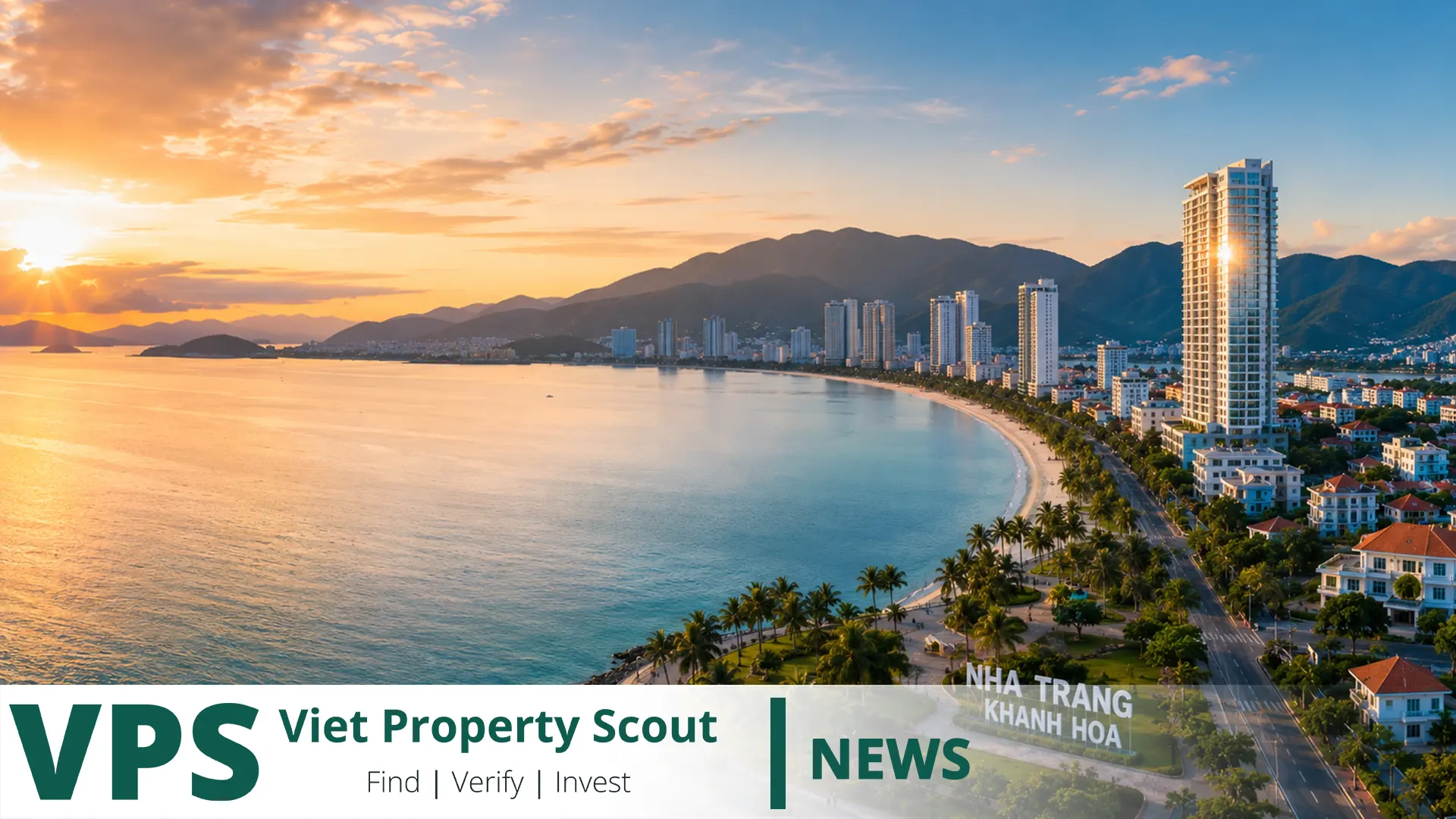
The Nha Trang–Khánh Hòa coastal property market requires a more disciplined reading in 2026 than the old formula that more tourists automatically mean higher beachfront property prices. Tourism is expanding rapidly, Cam Ranh Airport is growing, Bãi Dài has become a major international resort corridor and the province itself has become substantially larger following the merger of the former Khánh Hòa and Ninh Thuận. At the same time, both residential and tourism-related supply are becoming more diverse, buyers are paying closer attention to legal status and cash flow, and different asset types are behaving very differently. The new balance is therefore not simply about proximity to the sea. It is about asset type, demand source, legal structure, operating model and acquisition price.
Khánh Hòa in 2026 Is a Much Larger Market
Since 1 July 2025, the new Khánh Hòa Province has incorporated the former Khánh Hòa and Ninh Thuận territories. It covers approximately 8,555.86 square kilometres, has a population above 2.24 million and retains its administrative centre in Nha Trang. This matters enormously when interpreting 2026 data because provincial tourism and property transaction figures can now describe a much wider geography than the traditional Nha Trang–Cam Ranh market.
An increase in provincial visitor numbers or transaction volume should therefore not automatically be treated as evidence that beachfront apartments in central Nha Trang are rising at the same rate. Current data also include Cam Ranh, the expanded southern part of the province, social housing, residential land and other urban markets.
The Numbers Defining the 2026 Market
| Indicator | 2026 Position | Investment Meaning |
|---|---|---|
| New provincial scale | About 8,555.86 km² and more than 2.24 million residents | The market has become geographically broader and more diverse |
| H1 tourism | About 11.9 million visitors | Extremely strong demand foundation for hospitality and coastal services |
| International visitors | More than 4.6 million, up 66.1% year on year | Strong international tourism recovery |
| Tourism revenue | More than VND 42.5 trillion | Visitor spending is growing alongside arrivals |
| Average room occupancy | About 60% in H1 | Healthy market, but not year-round full occupancy |
| Cam Ranh Airport H1 | 4.1 million passengers, nearly 2.6 million international | Air connectivity is a major tourism-property demand engine |
| Q2 real estate transactions | 17,924 transactions worth about VND 19.49 trillion | Active market, but figures combine multiple asset classes |
Tourism Growth Is Powerful, but the Type of Growth Matters
Khánh Hòa welcomed approximately 11.9 million visitors during the first six months of 2026, 41.6% more than a year earlier. International visitors exceeded 4.6 million, an increase of 66.1%, while tourism revenue surpassed VND 42.5 trillion. July alone brought close to 3.1 million visitors.
During the 2026 Sea Festival, average room occupancy across the province exceeded 85%, while central Nha Trang hotels and a number of four- and five-star coastal resorts exceeded 90%. These figures are highly positive for hospitality property, but they also demonstrate why seasonality must be measured properly. A resort that is full during a major event or summer weekend does not necessarily maintain that occupancy for twelve months.
An investment model should therefore use monthly occupancy, achieved room rates, operating expenses and annual net revenue rather than peak-season marketing photographs.
Nha Trang: A Mature Coastal Market Rather Than a New Discovery Story
Central Nha Trang already has a functioning tourism economy, a recognised beach, restaurants, healthcare, schools, retail, hotels and a substantial local residential population. A well-positioned property can therefore draw demand from several groups at once: tourists, long-stay foreigners, local households, professionals, retirees and seasonal residents.
This is an important advantage over isolated resort developments. However, Nha Trang's maturity also means a sea view alone is not enough to justify a purchase. Building management, parking, actual rental permissions, service charges, noise, future obstruction of views, physical condition and resale liquidity all matter.
North and South Nha Trang Are Adding a Different Type of Housing Supply
Bắc Nha Trang and Nam Nha Trang are seeing new residential, social-housing and urban development activity. Across the province, 13 social-housing projects representing around 20,000 units were under implementation in 2026, while significant projects in Nha Trang itself are adding both social and commercial housing.
This is important because the city's housing story is broader than tourist apartments along Trần Phú. Long-term residential property may be less visually exciting than a beachfront tower, but it can be supported by more consistent end-user demand and lower seasonality.
Cam Ranh and Bãi Dài: Where the Airport Meets the Resort Economy
Bãi Dài on the northern Cam Ranh peninsula has become one of Vietnam's major resort clusters, with international hotel brands, large resorts, villas and entertainment-oriented developments along a long coastal strip. Its proximity to Cam Ranh International Airport is a structural advantage: international visitors can reach the resort corridor quickly without first travelling through central Nha Trang.
Cam Ranh International Airport served approximately 4.1 million passengers in the first half of 2026, including nearly 2.6 million international passengers, and handled more than 21,500 commercial flights. The airport is expected to serve roughly 8.3 million passengers for the full year. A newly approved master plan targets capacity of approximately 19 million passengers annually by 2030.
This is a genuine infrastructure advantage for Cam Ranh and Bãi Dài. It does not, however, make every condotel or resort villa an attractive investment. Operator-dependent assets need detailed examination of occupancy, average daily rate, management fees, owner revenue share, renovation reserves, operator track record and legal rights.
Environmental Infrastructure Is Part of Resort Value
In 2026, the wastewater collection and treatment system serving the northern Cam Ranh peninsula tourism area was approaching completion. Infrastructure of this kind attracts less attention in property advertising than beaches and swimming pools, but it is fundamental to the long-term sustainability of a destination containing thousands of hotel rooms, villas and entertainment facilities.
The Real Estate Market Is Active, but Transaction Numbers Need to Be Separated
Khánh Hòa recorded 16,650 real estate transactions worth approximately VND 20.64 trillion in Q1 2026. In Q2, transaction volume rose to 17,924 with total value of approximately VND 19.49 trillion. This confirms meaningful market activity, but it should not be translated into a simplistic conclusion that every type of coastal real estate is appreciating.
Residential apartments, low-rise houses, residential land, tourism accommodation, condotels and resort villas have different users, legal structures and resale markets. They must be analysed separately.
The Most Important Legal Distinction: Residential Apartment Is Not Condotel
A residential apartment in an approved housing project is not legally the same product as a condotel or tourist accommodation unit. Tourism property can sit on commercial or service land with a defined land-use or project term and may be tied to a hotel-management structure.
Investors must verify the land classification, project duration, certificate status, permitted use, rental and operating rights and what happens when the underlying project term expires. Phrases such as “long-term ownership,” “guaranteed return” or “individual certificate” should be accepted only when supported by the relevant official documents and enforceable contractual structure.
The 2026 Coastal Investment Map
| Area | Primary Demand Driver | Opportunity | Main Risk |
|---|---|---|---|
| Central Nha Trang | Tourism, residential demand and services | Deepest rental and resale market | Higher entry basis and uneven building quality |
| Bắc Nha Trang | Residential expansion and new services | Longer-term local housing demand | Community formation still matters |
| Nam Nha Trang | New urban and housing projects | Greater capacity for expansion | Future supply pipeline |
| Bãi Dài–Cam Lâm | Airport and international resort tourism | High-quality tourism positioning | Seasonality and operator dependence |
| Cam Ranh | Airport, urban housing and logistics | More diversified demand than resorts alone | Micro-location is critical |
Foreign Investors: Identify the Asset Type Before Applying the Ownership Rules
In an eligible residential housing project, foreign buyers can acquire apartments subject to statutory conditions. Foreign ownership in an apartment building is generally limited to a maximum of 30% of residential units. A foreign individual's ownership term is generally up to 50 years and may, subject to the legal conditions, be extended once.
Those residential ownership rules do not automatically convert a condotel or resort villa into residential housing. The first question must be whether the asset is legally classified as housing. Only then should the investor verify project eligibility, security-area restrictions, available foreign quota and the exact unit.
The Viet Property Scout Method
- Find: Identify the real user: short-stay tourist, long-stay foreign resident, local household, airport employee or future resale buyer.
- Verify: Check land classification, use purpose, term, developer, operator, unit certificate, mortgages, restrictions and foreign quota.
- Invest: Calculate net income after vacancy, management, maintenance and renovation, then test a realistic resale scenario.
Three Scenarios for 2026–2028
Base case: Tourism and aviation continue growing while residential supply expands gradually. Nha Trang retains the advantages of a mature city market, while Bãi Dài benefits from international tourism without every resort product appreciating equally.
Upside case: Airport expansion, additional international routes and investment in roads, ports and rail improve accessibility, length of stay and visitor spending. Properties with strong management and genuine connectivity outperform.
Risk case: New tourism accommodation grows faster than real demand, operating costs rise and older guaranteed-return promises prove unsustainable. Legally weak or poorly operated condotel and resort projects face the greatest pressure.
Frequently Asked Questions
Is a beachfront apartment in Nha Trang automatically the best investment?
No. It can be an excellent asset if price, legal status, rental performance and liquidity are attractive, but some residential locations can provide more stable income.
Is Bãi Dài better than Nha Trang?
They serve different markets. Nha Trang functions more like a year-round city, while Bãi Dài is more directly dependent on resort tourism and aviation.
Does tourism growth guarantee condotel returns?
No. Returns depend on the operator, contract, actual occupancy, operating expenses, competing supply and legal structure.
Will Cam Ranh Airport expansion lift all nearby property?
No. The airport strengthens the corridor, but an asset still requires a genuine user base, services and a defensible entry price.
Conclusion: The New Balance Is About Demand Quality, Not Just Coastline
The 2026 Nha Trang–Khánh Hòa property story contains three distinct markets: mature urban and coastal Nha Trang, the Bãi Dài–Cam Ranh resort economy and the broader residential market of the enlarged province. Tourism growth and aviation are exceptionally strong tailwinds, but they do not remove legal, pricing or seasonality risk.
The strongest investment is therefore not automatically the unit closest to the sea. It is the asset for which demand can be explained, legal rights can be documented, net income can be measured, management quality can be evaluated and a realistic resale market exists. That is where an attractive coastline becomes verifiable property value rather than simply a marketing image.