
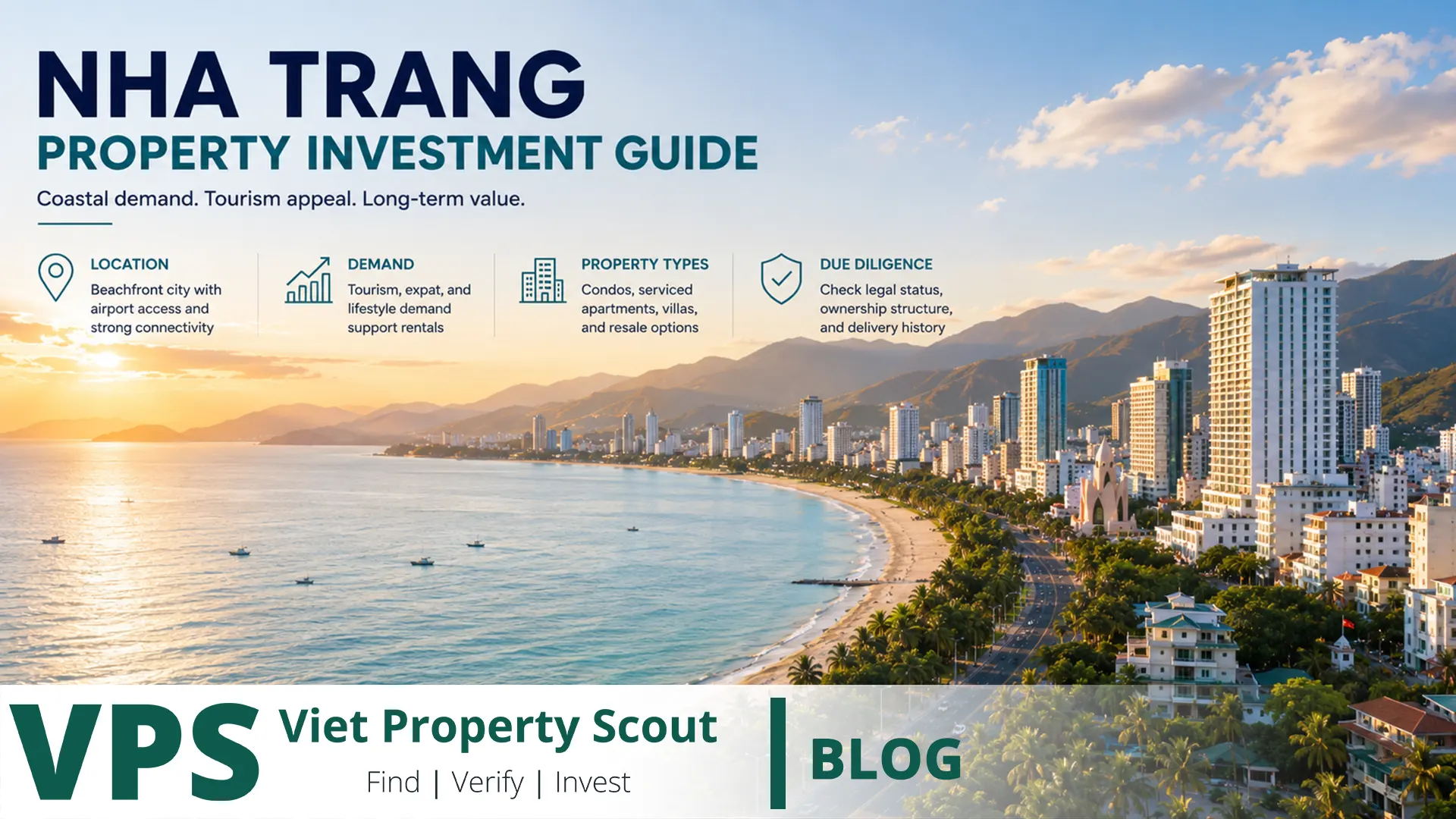
Investment takeaway: Nha Trang has one of Vietnam's clearest coastal-tourism property stories, but “near the beach” is not an investment thesis by itself. Following the administrative restructuring effective 1 July 2025, the former Nha Trang city was reorganised into four principal wards: Nha Trang, Bắc Nha Trang, Tây Nha Trang and Nam Nha Trang. At provincial level, the former Khánh Hòa and Ninh Thuận were also merged into the enlarged Khánh Hòa Province. This matters because the province's exceptionally strong 2026 tourism figures should not be converted directly into the expected rent of an individual apartment in central Nha Trang. A strong investment combines a clear legal function, a location serving an identifiable user, a disciplined entry price, sustainable net rental economics and a resale market that does not depend solely on another speculative investor paying a higher price.
Nha Trang in 2026: one market identity, four current administrative wards
Legacy names such as Lộc Thọ, Vĩnh Hải, Vĩnh Hòa, Phước Long and Vĩnh Trường remain very useful for understanding micro-location, but they are no longer sufficient as current legal addresses. Investors should use both the new ward and the historical neighbourhood when analysing comparable property.
| Current ward | Major historical areas included | Property-market identity |
|---|---|---|
| Nha Trang | Vạn Thạnh, Lộc Thọ, Vĩnh Nguyên, Tân Tiến, Phước Hòa | Core city, Trần Phú, tourism, services, coastal apartments |
| Bắc Nha Trang | Vĩnh Hòa, Vĩnh Hải, Vĩnh Phước, Vĩnh Thọ, Vĩnh Lương, Vĩnh Phương | Northern coast, established housing and major future urban supply |
| Tây Nha Trang | Ngọc Hiệp, Phương Sài, Vĩnh Ngọc, Vĩnh Thạnh, Vĩnh Hiệp, Vĩnh Trung | Local residential demand and inland expansion |
| Nam Nha Trang | Phước Hải, Phước Long, Vĩnh Trường, Vĩnh Thái, Phước Đồng | Family housing, marina-related demand and southern urban growth |
Tourism is exceptionally strong, but the numbers need to be read correctly
During the first seven months of 2026, enlarged Khánh Hòa Province recorded approximately 15.1 million tourist arrivals, including around 5.5 million international visitors. Average hotel-room occupancy was approximately 63.4%, while tourism revenue was estimated above VND82.234 trillion.
These figures are highly supportive of the region's economy. They are not a direct rental series for privately owned Nha Trang apartments. The statistics cover the entire post-merger province, including Cam Ranh, Bãi Dài and southern destinations. A buyer should therefore avoid saying: “Khánh Hòa received 15.1 million visitors, therefore this one-bedroom apartment will achieve a particular yield.”
International demand is diversified but still exposed to aviation cycles
South Korea and Russia remained major international source markets in 2026, alongside China, Kazakhstan and a growing Southeast Asian segment. Russian and CIS demand rebounded strongly while South Korea remained a fundamental base market. The Chinese market, meanwhile, faced some direct-flight constraints during parts of the year.
This diversification reduces reliance on one country, but it does not remove source-market risk. Direct-flight frequencies, fuel costs, exchange rates and geopolitical conditions can change occupancy and room pricing more quickly than a long-term property investor might expect.
There are at least three different meanings of “coastal property”
A genuine first-line unit with protected or direct sea orientation, an apartment within practical walking distance of the beach, and a project marketed as “coastal” but requiring a vehicle are economically different products.
The relevant question is not whether the view commands a premium, but whether the rental or resale premium is large enough to justify the additional purchase price. Paying 30% more for direct ocean view when sustainable rent is only 15% higher can reduce investment yield even though the apartment is objectively more desirable.
Trần Phú and central Nha Trang: deepest tourism demand, highest competition
The traditional Trần Phú corridor and the former Lộc Thọ area inside today's Nha Trang ward have the city's strongest tourist identity. Beach access, hotels, restaurants, retail, nightlife and recognisable urban form make the district easy for an international visitor to understand.
That same familiarity creates intense property competition. Hotels, condotels, tourist apartments and residential condominiums all monetise variations of the same location advantage. If a new project prices several years of tourism growth into the launch price, the buyer may receive a superb property but only an average investment return.
Bắc Nha Trang: the northern coast is becoming a broader urban story
Former Vĩnh Hải, Vĩnh Hòa, Vĩnh Phước and Vĩnh Lương are now within Bắc Nha Trang. Parts of the ward already have established housing and beach access; others are associated with significant future urban development.
In August 2026, the planned Vĩnh Lương mixed-use urban area was placed on the investor-selection pipeline. The project covers nearly 255 hectares and is planned with thousands of commercial homes, social housing and tourism, medical, education and leisure functions. This is a meaningful long-term catalyst, but future supply is also future competition. Investors should not price the area as though the entire masterplan already existed.
Tây Nha Trang: closer to the economics of real residential demand
Western Nha Trang is less dependent on beach tourism and more sensitive to households, schools, jobs, roads, retail and commuting. That can make the area less exciting in a tourism brochure but more defensible for long-term residential demand.
For a rental investor, the question becomes whether the monthly rent is affordable to the natural tenant and whether the unit is practical for six- or twelve-month occupation, rather than how many tourists arrive at Cam Ranh Airport.
Nam Nha Trang: family housing and southward urban growth
Former Phước Long, Vĩnh Trường, Vĩnh Thái and Phước Đồng are now major components of Nam Nha Trang. These areas combine established household demand with newer development and southern transport corridors.
Residential apartments, townhouses and legally clear land can therefore make sense for investors who prefer end-user demand over nightly hospitality income. Flood, road, drainage and planning conditions still need parcel- or project-level verification.
The Nha Trang 2040 plan explains the long-term growth direction
The Nha Trang General Plan to 2040, approved before the 2025 administrative reform, uses a polycentric urban model and identified expansion toward the north, northwest, west, south and selected coastal/island areas, including Vĩnh Lương and Phước Đồng. The plan projected a population of roughly 630,000–640,000 by 2030 and 750,000–780,000 by 2040.
It remains an important spatial reference, but it should now be read together with current post-reform subdivision planning and ward-level implementation. A 2040 growth direction is not evidence that a specific project will be completed on a particular date.
Nha Trang has several different rental-demand pools
| Demand pool | Typical stay | Best-fit location | Main risk |
|---|---|---|---|
| Short-stay leisure | Days | Central ward, Trần Phú and beachfront | Seasonality, legal operation and management |
| International medium stay | Weeks to months | Walkable central/coastal locations | Dependence on international connectivity |
| Corporate/professional | 1–12 months | Location depends on workplace | Smaller tenant pool than tourism |
| Local residential | 6–12+ months | Western, southern and established neighbourhoods | Lower headline rent but potentially greater stability |
Do not turn hotel occupancy into apartment yield
Hotels being full on a festival weekend does not prove that a residential condominium can be legally or sustainably operated as nightly accommodation. Project use, building rules, temporary-residence obligations, fire and safety requirements, taxation and local enforcement need to be checked.
A defensible rental model begins with what the specific unit is legally permitted to do and then applies the relevant tenant market.
Residential condominium and condotel are not interchangeable
Nha Trang has a substantial historical condotel market. A unit can physically look like an apartment while legally functioning as a tourist apartment or condotel on commercial-service land. Rights, duration and resale economics may therefore differ materially from a conventional residential condominium.
Investors should verify land purpose, project term, certificate status, operating agreement and exit conditions. The word “apartment” in the marketing material is not a legal conclusion.
How should rental yield actually be calculated?
Gross rent should be reduced by realistic vacancy, property management, OTA or brokerage commissions, cleaning, repairs, furnishings, utilities paid by the owner, taxes, building fees and renovation reserves.
A tourism-oriented apartment producing 7% gross may generate less net income than a residential apartment producing 5% gross under a stable twelve-month contract. Net operating income, not headline rent, should drive comparison.
The coast has a maintenance cost
- Salt air accelerates corrosion of metal components.
- Humidity affects furniture, paint and air-conditioning systems.
- High-rise façades and windows require regular maintenance.
- Today's sea view may be affected by future construction unless physically protected.
- Poor building management can erode a coastal premium very quickly.
Khánh Hòa transaction activity is strong, but it is not a Nha Trang price index
During Q2 2026, Khánh Hòa recorded 17,924 real-estate transactions with a total value of approximately VND19.49 trillion. Around two-thirds of transaction count was residential land.
The figures show substantial regional liquidity and a market increasingly focused on legally clear and real-use products. They should not be used as a direct comparable for a specific central Nha Trang condominium.
Foreign buyers: verify the project and the unit, not merely the national rule
Under the current Housing Law framework, qualifying foreign buyers may generally own up to 30% of residential apartments in an eligible apartment building. A foreign individual's ownership term stated on the certificate is up to 50 years and, subject to conditions, can be extended once for up to another 50 years.
Defence and security restrictions still apply, and the project's actual available foreign quota should be checked before reservation. “Foreigners can buy in Vietnam” is not sufficient due diligence.
Which investment logic fits which objective?
| Objective | Priority |
|---|---|
| Short-stay income | Legal hospitality function, operation, location, seasonality and distribution |
| Monthly rental income | Clear residential status, functional kitchen, laundry, internet and management |
| Capital growth | Entry price, infrastructure, competing supply, end users and exit liquidity |
| Personal use + investment | Liveability combined with a broad rental pool and clear rights |
15-step Nha Trang due-diligence checklist
- Confirm the current ward and legal address.
- Identify the historical micro-location for market comparison.
- Verify project and land function.
- Check certificate status and remaining term.
- For foreign buyers, verify project eligibility and available quota.
- Compare only like-for-like property types.
- Obtain evidence of actual rents, not asking rents alone.
- Separate nightly, monthly and long-term rental scenarios.
- Model full operating expenses.
- Review building management and maintenance reserve.
- Inspect corrosion and moisture near the coast.
- Map competing future supply.
- Check planning that could affect access or views.
- Identify the natural resale buyer.
- Stress-test the investment with zero capital appreciation.
Red flags
- “Tourism rose 40%, so property must rise 40%.”
- “Hotels are full, therefore you can rent this residential apartment nightly.”
- “Ocean view guarantees yield.”
- “This condotel is basically the same as residential ownership.”
- “We will solve the foreign quota after your deposit.”
- “The new northern masterplan guarantees every nearby parcel will appreciate.”
- “Management and renovation costs are insignificant.”
Frequently asked questions
Is Nha Trang still administratively the same city as before 2025?
No. Its former urban territory was reorganised into new wards, although “Nha Trang” remains the dominant city, tourism and real-estate market identity.
Is Trần Phú automatically the best place to invest?
No. It has the deepest tourism demand but also high acquisition prices and heavy competition.
Does Bắc Nha Trang offer better capital growth?
It has meaningful urban-expansion catalysts, but the same new projects creating growth can also add substantial competing supply.
Does strong tourism guarantee rental income?
No. Tourism supports demand, but legal use, product quality, pricing and operations determine actual income.
Can a foreign buyer purchase any apartment?
No. Project eligibility and foreign quota must be verified at unit level.
Conclusion
Nha Trang's investment potential is real because international tourism, coastal identity, local housing demand and urban expansion overlap in the same market. Central Nha Trang offers the deepest tourism economy; Bắc Nha Trang combines coastal appeal with major new development; the west is more closely tied to local end users; and Nam Nha Trang combines family housing with urban expansion. The professional investor should not buy “Nha Trang” as a brand. Buy a precise location, a verified legal property function and a measurable demand pool. If the asset still makes sense after all costs are deducted and capital appreciation is set to zero, tourism and coastal growth become valuable upside rather than the only assumption keeping the investment alive.