
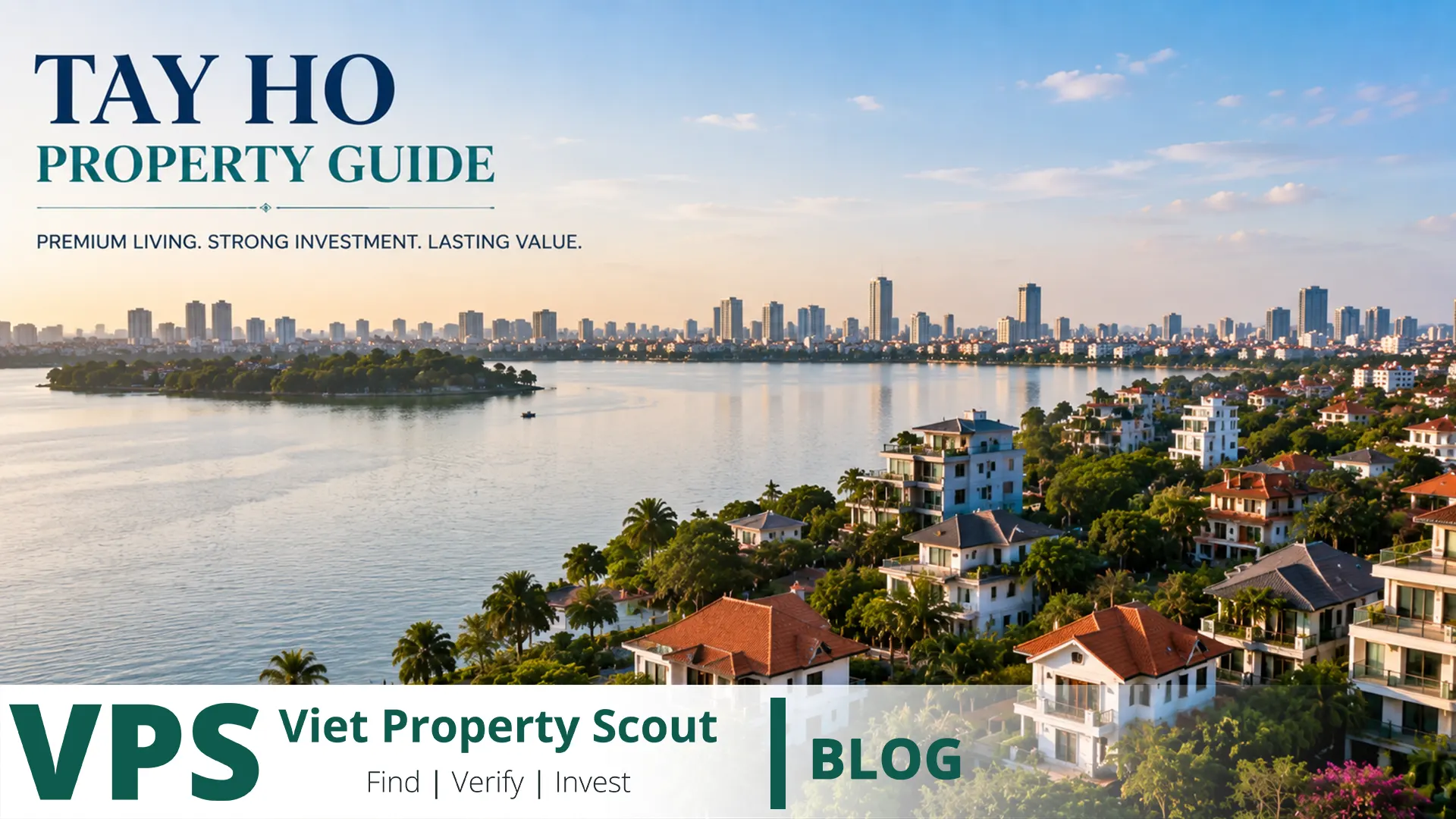
Short answer: Tây Hồ and the wider West Lake area are among Hanoi's most distinctive residential property markets for investors targeting international demand, premium living and medium- to long-term rental income. Its strength does not come from the lake alone. It comes from the combination of a long-established international community, international schools and services, restaurants and leisure, diplomatic activity, relatively convenient access to central Hanoi and Nội Bài Airport, and significant public plans to improve West Lake and its surroundings. However, “Tây Hồ property” is not one investment category. A privately owned apartment near Xuân Diệu, a modern condominium along Lạc Long Quân, a property in Phú Thượng or West of West Lake, and an internationally managed serviced residence can have very different acquisition prices, tenants, operating costs, liquidity and net yields. The correct strategy is to buy a real demand system rather than simply paying for the West Lake name.
Important clarification: what does Tây Hồ mean after the administrative reorganisation?
Since 1 July 2025, Tây Hồ has existed as a newly reorganised ward under Hanoi's two-tier local-government structure. The current ward covers approximately 10.72 km² and has a population of more than 100,000. It was formed from territory and population associated with several former wards around West Lake.
The property market still uses “Tây Hồ” more broadly, however. Investors should distinguish between the current administrative Tây Hồ ward, the wider commercial West Lake residential market, and Tây Hồ Tây or West of West Lake, which is a separate but related development corridor to the west and northwest. A listing saying only “Tây Hồ” is therefore not precise enough for investment underwriting.
Why is Tây Hồ different from most Hanoi residential markets?
The area combines several demand groups: diplomats, foreign executives, technology specialists, employees of international companies, foreign families, higher-income Vietnamese households and renters who value a lower-density lifestyle with international services. Reporting in 2025 indicated that approximately 10,000 new foreign workers receive work permits in Hanoi each year, many of them highly skilled professionals. That figure is not equivalent to 10,000 new Tây Hồ tenants, but it helps demonstrate one structural source of international housing demand in the capital.
The second differentiator is lifestyle infrastructure. West Lake is more than a geographical landmark. Restaurants, cafés, fitness facilities, international schools, health services and a long-established foreign community create a social and commercial ecosystem that is difficult for a new development to replicate quickly.
The 2026 West Lake plan: why it matters to property
In January 2026, Hanoi approved an official plan for the preservation and promotion of West Lake and surrounding areas. The plan aims to strengthen the zone by 2030 as a cultural, tourism and integrated service centre, with improvements to public space, entertainment, cultural activity, the night-time economy and the wider urban environment. The longer-term direction also includes heritage preservation, creative and artistic spaces, more green areas and ecological rehabilitation.
In 2026, preparatory work also advanced for a large environmental-improvement and dredging project covering more than 525 hectares of West Lake. For property investors, these initiatives can improve long-term place quality, but they are not guaranteed price appreciation. A disciplined investor separates an approved plan from a project physically under construction and from benefits that are already visible in everyday living conditions.
The main micro-markets within and around Tây Hồ
| Functional area | Natural demand | Core strength | Main risk |
|---|---|---|---|
| Quảng An - Xuân Diệu - Từ Hoa | Expats, diplomats, executives, couples and international families | Hanoi's most mature international lakeside lifestyle ecosystem | Narrow streets, noise in some locations and highly uneven building quality |
| Yên Phụ - Trúc Bạch interface | Professionals seeking central, water-oriented living | Closer access to the historic and administrative core | Limited supply and highly varied building stock |
| Lạc Long Quân - Xuân La | Families, professionals and buyers seeking newer buildings | Modern condominium supply and strong west/north connections | Traffic and project-specific rental depth |
| Nhật Tân - Tứ Liên - Âu Cơ | International and local tenants plus growth-oriented investors | Lake/river proximity and infrastructure optionality | Planning, construction and execution risk |
| Phú Thượng and northwest | Higher-income families and long-horizon buyers | Newer projects, larger formats and airport connectivity | Not every location shares the traditional Xuân Diệu expat demand profile |
| Tây Hồ Tây / West of West Lake | Premium families, international employees and office-linked demand | Modern master-planned environment | Often marketed as if it were identical to traditional lakeside Tây Hồ |
Quảng An and Xuân Diệu: the traditional expatriate core
This part of West Lake is the area most strongly associated with Hanoi's expatriate lifestyle. Walkable access to cafés, restaurants, everyday services and an established international community creates genuine rental value that is not merely marketing.
Building quality varies dramatically, however. Professionally operated residences sit alongside small apartment buildings on narrow streets with limited parking and less consistent management. Investors should not use one “Xuân Diệu rent” across the whole area. The relevant comparison is the same building class, service level, street quality and apartment format.
Lạc Long Quân and Xuân La: newer housing with a broader tenant base
The western side of West Lake offers more modern condominium projects, generally stronger parking and internal facilities, and a tenant profile that can include Vietnamese families, professionals and foreign residents. For investors who prefer a conventional condominium rather than a small expatriate-focused apartment building, this can be a strong alternative.
Rental performance is more project-dependent. Building management, actual owner-occupier ratio, number of competing rentals, access to schools and offices and travel time to the airport should all be checked.
Phú Thượng and Tây Hồ Tây: do not confuse them with the traditional West Lake expatriate core
The west and northwest contain new premium developments linked to modern infrastructure, international schools, office clusters and major planned communities. These can work very well for families and international employees, but the demand system is different from the organic expatriate lifestyle around Quảng An.
Investors should not pay a full traditional “West Lake expat premium” for a project whose natural tenants are primarily new-office workers and Vietnamese families simply because its marketing uses the Tây Hồ name.
Private condominium or serviced residence?
| Product | Main advantage | Cost/risk | Natural tenant |
|---|---|---|---|
| Privately owned furnished condominium | Lower operating structure and pricing flexibility | More direct landlord responsibility | Expats, professionals and families on 6-12+ month leases |
| Serviced residence | Reception, housekeeping and institutional management | Higher operating and service cost | Executives, corporate tenants and medium/long stays |
| Partly furnished or unfurnished family apartment | Potentially longer tenancy | May produce lower headline rent | Families planning to remain several years |
| Villa or low-rise house | Space and privacy | Higher maintenance, ownership and access complexity | Large families and selected diplomatic profiles |
Serviced-apartment growth confirms demand, but does not prove every apartment's yield
Savills reported that seven serviced-apartment projects were scheduled to add approximately 1,040 units in Hanoi during 2025, with Tay Ho View Complex expected to be the largest contributor to new Grade A supply. International operators were expected to account for up to 83% of the new pipeline. This is meaningful evidence that professional accommodation operators see continuing demand in Hanoi.
It is also evidence of rising competition. An international serviced-residence operator is selling not just an apartment but a package of reception, housekeeping, maintenance, brand confidence and corporate contracting. A private landlord should therefore not assume that good furniture alone justifies the same rent.
Which apartment size works best?
| Unit format | Likely demand | Investment advantage | Main risk |
|---|---|---|---|
| Studio | Single tenant, shorter or medium stay | Lower acquisition ticket | More competition and turnover |
| 1 bedroom | Single professional or couple | Strong international rental relevance | Highly sensitive to furniture and building quality |
| 2 bedrooms | Couples, small families, remote workers | Best flexibility across several tenant groups | High supply in large projects |
| 3 bedrooms | International and Vietnamese families | Longer leases and lower turnover potential | Higher purchase price and narrower tenant base |
| 4+ bedrooms / villa | Senior executives and larger families | High nominal rent | Longer vacancy if the tenant leaves |
Lifestyle is part of value, but it is not a guarantee
Investors can easily treat lake views, cafés and the international community as a permanent premium. In practice, lifestyle value exists only when daily life works: convenient road access, tolerable noise, a pleasant immediate environment, safe walking, nearby services and professional building management.
A partial-lake-view unit with an easy entrance and parking may outperform a full-view unit on a difficult alley. The property should be inspected in the morning, evening and at weekends rather than during one broker-led viewing.
Nội Bài Airport access is a real advantage, but measure it
Tây Hồ is relatively well positioned for trips to Nội Bài compared with many central-southern Hanoi locations. This matters to executives and frequent international travellers. However, “close to the airport” should always be converted into realistic travel time from the specific property under normal and peak traffic conditions.
How much is a lake view really worth?
A West Lake view can support both rent and resale, but it has no fixed investment value. Width of view, potential future obstruction, floor level, orientation, direct sun exposure, noise, balcony usability and glazing quality all affect the premium.
A disciplined investor can compare two similar units in the same project, one with a lake view and one without. How much more is the acquisition price, and how much more rent can actually be achieved? If the purchase premium is very large but the rental premium is small, the non-view unit may produce the superior yield.
Rental-yield example: why net income matters
Illustrative example only, not a Tây Hồ market forecast: assume an apartment is acquired for VND 10 billion and rents for VND 50 million per month for eleven occupied months per year. Gross annual rent is VND 550 million. If vacancy, repairs, brokerage, furniture replacement, owner-paid fees and other operating obligations total VND 100 million, approximate net operating income becomes VND 450 million, or about 4.5% of the acquisition price before financing and other individual costs. If the same income is purchased for VND 12 billion instead, the yield compresses materially.
This is one of the defining risks of premium markets: a very high monthly rent can coexist with only a moderate percentage yield because the acquisition price is also very high.
A Tây Hồ-specific stress test
| Scenario | Assumption | Investment question |
|---|---|---|
| Base | Eleven months occupied and stable lease | Is today's net yield acceptable? |
| Higher competition | New serviced residences enter the market | Can the unit differentiate on price, space, location or management? |
| Weaker expatriate demand | International demand temporarily falls | Would a higher-income Vietnamese family rent the property? |
| Fast exit | Sale required in 6-12 months | Is there a natural local or foreign buyer without a major discount? |
Foreign buyers: attractive location does not mean every unit is legally purchasable
Current housing law allows eligible foreign individuals to own qualifying housing in projects where foreign ownership is permitted, subject to eligibility, ownership-term and quantitative restrictions. For residential apartments, the general foreign-ownership limit is up to 30% of residential-purpose apartments in an apartment building or in each relevant block where the development structure requires separate calculation.
Before paying a deposit, buyers should verify that the project is eligible for foreign ownership, that foreign quota remains available, that the unit is legally classified as qualifying residential housing rather than a different tourism or commercial product, and that the certificate position is clear. Mortgages, disputes and other encumbrances should also be checked.
Do not use informal nominee ownership to bypass restrictions
Registering a property in the name of a Vietnamese friend or partner simply to avoid foreign-ownership rules does not give the foreign investor the same legal protection as properly registered ownership. Economic control and a private agreement are not equivalent to an enforceable property right.
Long-term residential leasing is different from short-stay accommodation
Tây Hồ's international demand can tempt investors to assume that Airbnb-style or hotel-like short stays are automatically allowed. They are not something to assume. The legal use of the unit, building-management rules, registration, tax and accommodation-business requirements should be checked independently. A six- or twelve-month residential lease is a different legal and operating model from short-stay accommodation.
Due-diligence checklist before buying in Tây Hồ
- Clarify whether the property is in the current Tây Hồ ward, the wider West Lake market or Tây Hồ Tây.
- Identify the natural tenant before selecting the unit.
- Verify completed rents in the same building, not advertisements alone.
- Inspect access, traffic, noise and parking at different times of day.
- Test internet, water pressure, air conditioning and sound insulation.
- Review building management and service fees.
- Count directly competing rental units.
- Separate the lake-view purchase premium from the rental premium it actually creates.
- Calculate net yield using realistic vacancy.
- Review nearby construction that could affect views or access.
- For a foreign buyer, verify project eligibility and remaining foreign quota.
- Check certificate status, mortgages, disputes and legal use.
- Do not assume short-term rental is permitted.
- Identify the natural resale buyer before purchasing.
Red flags
- “Everything near West Lake is automatically premium.”
- The highest serviced-residence rent is used to value an ordinary private apartment.
- A large lake-view premium is paid without checking potential future obstruction.
- Poor road access or parking is ignored because of the area name.
- The investment depends entirely on expatriate tenants with no local fallback.
- Tây Hồ and Tây Hồ Tây are presented as one identical market.
- Guaranteed rental returns based on international demand.
- A foreign buyer proceeds without verifying quota.
- Future environmental improvements are treated as guaranteed price appreciation today.
Which strategy fits which investor?
| Objective | Product that often fits | Typical micro-market |
|---|---|---|
| Expatriate rental | Well-managed furnished 1-2 bedroom apartment | Quảng An - Xuân Diệu |
| Long-term international family | 2-3 bedroom apartment or quality villa | Quảng An / western lakeside / selected projects |
| Broader professional demand | Practical modern condominium | Lạc Long Quân - Xuân La / Tây Hồ Tây |
| Premium capital preservation | Genuinely scarce location or durable lake view | West Lake proximity with strong access |
| Conservative rental income | Unit that does not depend only on luxury expat demand | Projects with both local and international tenant depth |
Frequently asked questions
Is Tây Hồ the best area in Hanoi for expatriates?
It is one of the most established, especially around West Lake. Depending on workplace and school location, Ba Đình, Cầu Giấy or Nam Từ Liêm may still be more practical for some tenants.
Does a lake view guarantee higher rent?
It can support rent, but the rental premium must be compared with the additional acquisition price. Not every view creates an attractive return.
Are serviced apartments a better investment?
Not automatically. They can access corporate demand and higher headline rents but face higher operating costs and professional competition. A private apartment bought at the right price can produce better net economics.
Is all of Tây Hồ an expatriate market?
No. Quảng An, the western lakeside, Phú Thượng and Tây Hồ Tây have different tenant profiles and pricing structures.
Do West Lake improvement plans guarantee appreciation?
No. They are potentially positive catalysts, but implementation, timing and the price paid by the investor remain decisive.
Can a foreigner buy an apartment in Tây Hồ?
An eligible foreign buyer can acquire qualifying residential units in permitted projects within the statutory foreign-ownership limits. The specific project, unit and available quota should be verified before payment.
Conclusion: buy the demand ecosystem, not simply a West Lake address
Tây Hồ's strength comes from the combination of natural environment, international community, services, diplomacy, schools and premium residential demand, reinforced by long-term public investment around West Lake. But that strength is distributed unevenly between streets, buildings and property types. A relatively simple apartment in a well-managed building with excellent access may be a better investment than the most expensive unit with the largest view.
In Tây Hồ, Find | Verify | Invest means: find the street, building and unit format that serves a real tenant, verify completed rents, daily living conditions, competing supply, legal status, foreign quota, operating costs and resale liquidity, and invest only when net income still makes sense after vacancy, maintenance and additional future supply.