
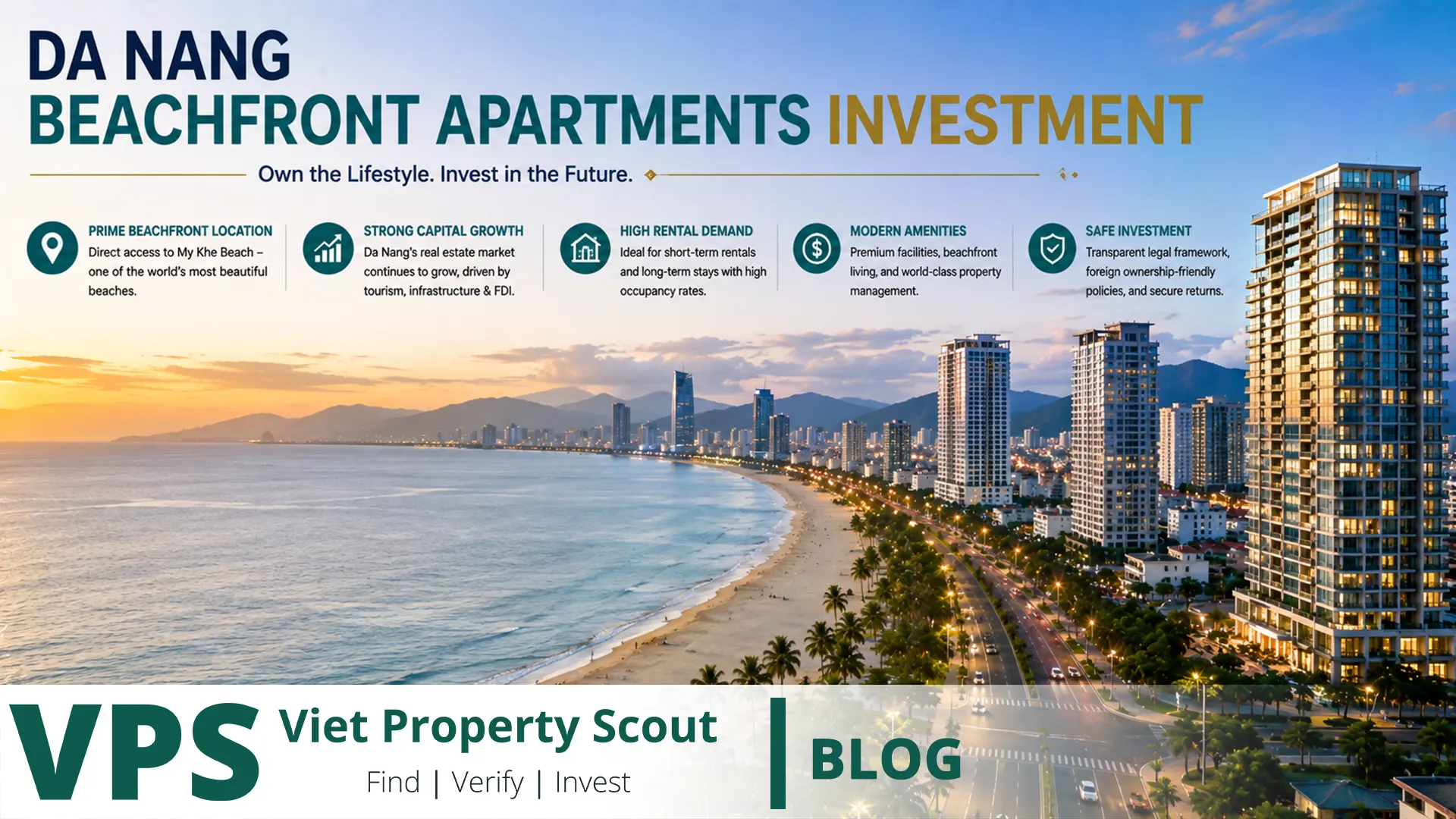
Investment takeaway: A beachfront apartment in Da Nang can be an excellent asset, but it is not automatically a good investment simply because the ocean is outside the window. Da Nang's overall average primary condominium price was approximately VND83 million per square metre in Q1 2026. Current coastal asking prices, however, show a much wider spread: older or secondary units near Mỹ Khê and My An can appear around VND50–73 million/m², selected newer coastal residential products around VND54–65 million/m², while premium and branded residences can exceed VND120–170 million/m². Some current premium project listings ask considerably more. These are asking-price observations rather than uniform transaction evidence, and that distinction is central to the investment question. “Beachfront” covers legally and economically different products. A unit becomes an opportunity when its coastal premium is supported by genuine scarcity, clear legal status, achievable rent, good building management and resale liquidity. It becomes overpriced when the buyer pays today for the sea view, tourism story and years of expected future growth without rents or future buyers being able to support that premium.
What does “beachfront” actually mean in Da Nang?
The marketing term needs to be unpacked. Many projects described as beachfront sit on the urban side of roads such as Võ Nguyên Giáp or Trường Sa, facing the public beach. There may be a coastal road, park or public promenade between the building and the sand. That can still be genuine first-line real estate, but it does not mean a private beach or a building physically sitting on the shoreline.
Investors should distinguish at least four categories: direct and substantially unobstructed ocean frontage, first line across the coastal road, walk-to-beach property without true frontage, and more distant or partial sea-view property. They should not command the same price premium.
The 2026 market: a coastal premium exists, but it is not one number
| Reference | Price / observation | How to interpret it |
|---|---|---|
| Da Nang overall primary condominium market, Q1 2026 | Average approximately VND83 million/m² | Citywide primary benchmark, not a pure beachfront index |
| Secondary apartments around Mỹ Khê/My An | Current asks roughly VND50–73 million/m² | Older, more conventional housing can provide a much lower entry point |
| Newtown Diamond coastal examples | Current asks roughly VND54–65 million/m² | Shows that sea-facing marketing does not automatically mean ultra-luxury pricing |
| Times Square recent 1BR example | About VND124 million/m² | Large premium for central beach position and newer residential product |
| Nobu Residences recent 2BR example | About VND171 million/m² | Branded-residence economics, not directly comparable with standard apartments |
| Some current Times Square asking listings | Approximately VND200–360+ million/m² | An asking price does not prove transactions occur at that level |
The essential rule: a listing is not a transaction. A high advertised price is evidence of seller expectation, not necessarily market value. Investors should seek comparable secondary evidence within the same building, street, legal category and quality tier.
Why do buyers pay a first-line premium?
- Scarcity: the amount of true coastal frontage cannot be expanded indefinitely.
- Ocean view: a genuinely open view can support both rent and resale appeal.
- International marketing: “Mỹ Khê beachfront” is easier to understand globally than an unfamiliar inland ward.
- Lifestyle: immediate beach access combined with restaurants and urban services creates real user value.
- Tourism: Da Nang continues to have a very large international visitor base supporting hospitality demand.
- Resale: a scarce, legally clear coastal product can be easier to market later.
When does the coastal premium become excessive?
If a comparable inland apartment costs VND80 million/m² and the coastal product costs VND160 million/m², the buyer is paying twice as much. That can only be economically rational if the additional price is justified by a meaningful difference in rent, scarcity, project quality or exit liquidity. A sea view alone does not double rental income.
A common risk is paying for all of the future in advance. Sales pitches can capitalize anticipated tourism growth, foreign demand, infrastructure, land scarcity and future appreciation into today's price. The more optimism already embedded in the entry valuation, the less upside remains if the future merely turns out to be good rather than exceptional.
The yield test: can income support the purchase price?
Consider an illustrative example, not a market forecast. A 60 m² apartment at VND120 million/m² costs VND7.2 billion before transaction costs and furnishing. If it produces VND360 million of annual net operating income after all expenses, net yield on the purchase price is about 5%. If net income is only VND240 million, the yield falls to roughly 3.3%. The ocean has not changed; the difference is created by entry price and actual net income.
Investors should model at least three separate rental scenarios: a 12-month lease, a 3–6-month medium stay, and tourist accommodation where legally permissible. A peak-season nightly rate should never be multiplied by 365 and presented as investment income.
An ocean view is not automatically permanent
The term “sea view” should be physically and planning-tested. Is there developable land between the tower and the coast? Is the unit low enough to be blocked by future construction? Is the view truly direct or only a narrow lateral angle between buildings?
Floor level, view corridor, planning context and future building risk can make two nominally “sea-view” units economically very different.
The ocean also increases building costs
Salt-laden coastal air, humidity, strong winds and driving rain can accelerate deterioration of metal components, railings, façades, outdoor air-conditioning equipment, windows, seals and waterproofing. Beachfront due diligence should therefore include construction quality, maintenance schedule, reserve fund, façade condition and management budget.
An older building may appear cheap while hiding future façade, elevator, waterproofing or mechanical capital expenditure. A new luxury building may be better engineered but carry significantly higher service charges. Both affect net yield.
Seasonal erosion and storm exposure are part of the underwriting
Da Nang authorities have documented recurring seasonal erosion at sections of Mỹ Khê and the eastern coastline associated with strong waves and northeast monsoon conditions during rainy and storm periods, with some seasonal natural sand replenishment occurring later.
This does not make coastal property inherently unsafe or unattractive. It means coastal due diligence should include drainage, entrance elevation, historical water ingress, wind-resistant glazing, backup power, insurance and the building manager's extreme-weather procedures.
Residential apartment, condotel and branded residence are not the same asset
Da Nang's coast contains standard residential condominiums, condotels, tourist apartments, resort residences and branded residences. They may differ materially in approved land use, project function, certificate structure, permitted occupation, ownership duration and operator obligations.
Da Nang Times Square illustrates why legal documents matter. Parts of that beachfront development were formally converted from commercial-service/condotel use to residential land for apartment development. Such a conversion required official approval. A salesperson cannot create residential legal rights simply by using phrases such as “long-term ownership”.
What should foreign buyers verify?
For qualifying residential developments, Vietnam's current housing framework allows eligible foreign organizations and individuals to own up to 30% of the residential apartments in an apartment building, subject to project eligibility, national-security restrictions and other legal requirements. This rule does not turn every condotel or resort unit into an eligible residential apartment.
A foreign buyer should verify the exact project, the unit's eligibility, remaining foreign-ownership capacity, ownership structure and duration, certificate pathway, payment route and future resale process before paying a reservation.
What type of beachfront apartment is more defensive?
- A legally clear residential unit rather than a vaguely described tourism product.
- An efficient one- or two-bedroom layout that a real resident can use.
- A genuinely difficult-to-obstruct ocean view rather than a marginal sea glimpse.
- True walkability to the beach and daily services.
- An entry price that does not require perfect tourism growth forever.
- Management fees that are proportionate to achievable rent.
- Long- and medium-stay rental demand in addition to tourism.
- A genuine resale market including owner-occupiers, not only investors.
When is a beachfront apartment an opportunity?
It becomes attractive when the price is reasonable relative to the wider market, the unit has a real scarcity advantage in view or access, legal status is verifiable, several tenant groups can use the property, building maintenance is credible and resale demand exists beyond speculative investors.
The strongest opportunity is usually not the property with the most dramatic marketing. It is the one whose investment case still works with conservative rental and capital-growth assumptions.
When is it overpriced?
Warning signs include a price per square metre far above comparable residential stock solely because of the beachfront label, weak net yield, dependence on perfect tourist occupancy, unclear legal classification, high management costs and a resale market in which nearly every buyer is another yield-seeking investor.
At that point the asset starts behaving less like defensive housing and more like a speculative financial product.
Beachfront due-diligence checklist
- Confirm whether the unit is genuinely first line, across the road, walk-to-beach or simply sea view.
- Compare with citywide primary pricing and genuine same-project secondary evidence.
- Verify land, project and unit legal status.
- Foreign buyers should confirm eligibility and available ownership capacity before reservation.
- Investigate future view-obstruction risk.
- Review management fees, reserve funding and maintenance history.
- Inspect corrosion, windows, waterproofing, HVAC and façade condition.
- Model 12-, 6- and 3-month rental separately from tourism.
- Use net income after vacancy, operating costs and taxes.
- Identify the likely resale buyer before you purchase.
Frequently asked questions
Are Da Nang beachfront apartments overpriced in 2026?
Some may be, others are not. Current asking-price dispersion from roughly VND50–70 million/m² in parts of the secondary coastal market to well over VND120–170 million/m² for newer premium products shows that “beachfront” is not one valuation category.
Does a sea view guarantee capital appreciation?
No. Scarcity helps, but entry price, view protection, legal quality, building condition and resale liquidity determine the result.
Is a branded residence automatically a better investment?
No. A strong brand can support service, pricing and international marketing, but it can also substantially increase purchase price and operating charges. The premium still needs to earn a return.
Are condotels and residential condominiums equivalent?
No. Their land use, legal function, occupation rights and operating structure can be fundamentally different.
What is the simplest investment test?
Remove the word “beachfront” from the sales brochure. If the legal status, building quality, realistic rent and purchase price still make sense, you may have a strong asset. If the entire case collapses without the view story, you may be buying marketing rather than value.
Conclusion
A beachfront apartment in Da Nang is neither automatically an opportunity nor automatically a bubble. Ocean frontage is scarce and has genuine user value, but investment value comes from the relationship between the premium paid, achievable income, legal certainty and resale liquidity. A legally clear apartment with a defensible entry price, protected view, medium- and long-stay demand and strong building maintenance can be an excellent coastal asset. A unit that requires the buyer to prepay years of expected tourism and appreciation simply because it carries the word “beachfront” can be significantly overpriced, even if the sunrise is spectacular.