
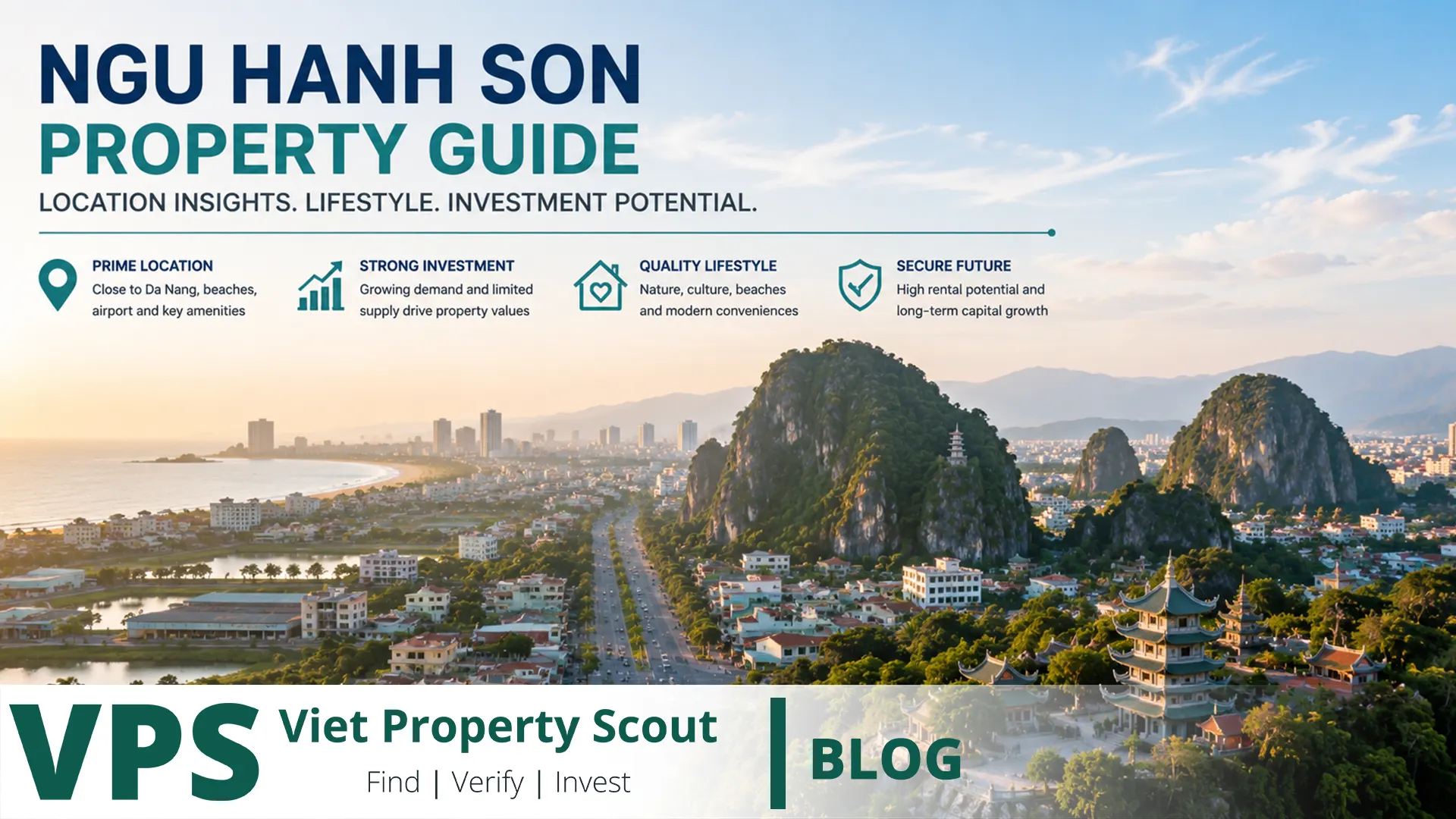
Investment takeaway: Ngũ Hành Sơn is one of Da Nang's most diverse property markets because its value is driven by several distinct demand engines rather than one single coastal story. It combines the international rental and lifestyle cluster around Mỹ An, more established residential neighbourhoods around Khuê Mỹ, the Marble Mountains cultural-tourism core and Non Nước coastal corridor in former Hòa Hải, and newer urban, technology and end-user growth around Hòa Quý. Following the administrative restructuring effective 1 July 2025, the former Ngũ Hành Sơn District no longer exists in the same administrative form. Mỹ An, Khuê Mỹ, Hòa Hải and Hòa Quý were combined into the new Ngũ Hành Sơn ward, covering approximately 40.19 km² with a population of around 115,944. For property investors, this is more than a naming detail: a listing labelled “Ngũ Hành Sơn” can describe four materially different micro-markets. Investment works best when the asset matches the real demand source: expatriate and medium-term rental demand around Mỹ An, established household demand in Khuê Mỹ, tourism and coastal scarcity in Hòa Hải–Non Nước, or longer-term urbanisation and technology-linked end-user growth in Hòa Quý.
One current ward, four historical property markets
The four former wards now share one administrative name, but their property economics did not become identical overnight. Investors should therefore avoid using a single “Ngũ Hành Sơn price per square metre” as though the whole ward were homogeneous.
| Historical area | Property identity | Main demand | Best-fit product |
|---|---|---|---|
| Mỹ An | Urban beach, international, service-led | Expats, professionals, medium- and long-stay residents | 1–2BR apartments and furnished rentals |
| Khuê Mỹ | More mature residential neighbourhoods | Families, local residents and professionals | Residential apartments, houses and townhouses |
| Hòa Hải | Marble Mountains, Non Nước, coast and resorts | Tourism, lifestyle and selected premium residential demand | Coastal residential, villas and resort-related products |
| Hòa Quý | New urban growth, Cổ Cò River and technology corridor | Future end users, employees and families | Legal residential land, townhouses and new communities |
Why tourism remains a structural demand engine
The Marble Mountains are central to the area's cultural and visitor identity. Non Nước Beach and the traditional Non Nước stone-carving village add coastal and heritage demand. The 2026 Quán Thế Âm Festival again drew tens of thousands of monks, Buddhist followers, residents and visitors, confirming that Ngũ Hành Sơn remains an active cultural and spiritual destination rather than a static monument.
The Non Nước stone-carving tradition is also a nationally recognised intangible cultural heritage activity and an operating local economic ecosystem. Tourism in this part of the ward is therefore supported by a combination of landscape, religion, craft, beach and resort infrastructure.
Tourism does not make every property a tourism investment
Proximity to the Marble Mountains or Non Nước Beach does not automatically make an apartment suitable for nightly hospitality. Standard residential condominiums, condotels, tourist apartments, resort residences and branded residences can have materially different legal functions, operating rules, ownership structures and cost profiles.
Heritage proximity can also create scarcity while introducing planning, landscape or development constraints. An investor should not assume that land beside a famous attraction has greater development freedom simply because the location is valuable.
The wider Da Nang apartment market supports demand but raises competition
As of Q1 2026, Da Nang's cumulative condominium supply had reached approximately 16,000 units. The average primary price was about VND83 million per square metre and cumulative absorption was approximately 89%. More than 8,000 new condominium units were launched during 2024–2025, a significant shift from the period before 2024 when annual new supply was typically below 1,000 units.
This is encouraging because it demonstrates depth of demand and renewed development activity. It is also a warning: buyers and tenants now have more options. A new Ngũ Hành Sơn project needs to justify its price through legal certainty, product quality, location, management and an identifiable tenant or end-user group.
Mỹ An: the strongest international rental logic
Former Mỹ An sits beside the An Thượng lifestyle cluster and the beach. Restaurants, cafés, gyms, coworking spaces, convenience retail and English-friendly services make it one of the easiest parts of Da Nang for a foreign resident to enter.
For investment, the strongest apartment is not necessarily the largest or most luxurious. An efficient one- or two-bedroom unit with a real kitchen, washing machine, workspace, reliable internet and good sound insulation can serve three-, six- and twelve-month tenants and reduce dependence on tourist occupancy.
Khuê Mỹ: more end-user and family-oriented demand
Khuê Mỹ sits between the beach corridor and more traditional urban residential areas. Many streets provide a quieter living environment than the busiest parts of An Thượng while retaining reasonable access to the coast, central Da Nang and daily services.
Investment here is more sensitive to street quality, supermarkets, schools, parking, traffic and practical housing layout than to tourism branding. That makes it particularly relevant for long-term residential apartments, houses and townhouses.
Hòa Hải and Non Nước: coast, heritage and premium development
Former Hòa Hải contains one of Da Nang's most unusual combinations: the Marble Mountains, the Non Nước craft village, the coast and resort-oriented development. Apartments, villas and land can therefore carry meaningful location premiums.
However, investors must analyse the exact asset class. A resort villa, ordinary residential condominium, condotel and branded residence can sit within the same coastal corridor while having very different rights, operating costs, tenant pools and resale liquidity.
Hòa Quý: a longer-duration housing-growth thesis
Former Hòa Quý is less tourism-dependent and more closely tied to urban expansion. The FPT Technology Urban Area, new residential communities and the Cổ Cò River corridor contribute to a growth story based on residents, technology, education and services rather than hotel demand alone.
This can create more accessible entry prices than prime beachfront locations, but timing risk is higher. A planned road, urban project or masterplan is not the same as an occupied neighbourhood. Investors should measure real residents, open shops, schools, transport, infrastructure completion and occupancy.
The Cổ Cò corridor could connect housing and tourism
During the 2026 planning-adjustment process, Ngũ Hành Sơn ward proposed stronger tourism directions involving the Non Nước craft village, ecological/traditional-village tourism and a water-tourism route on the Cổ Cò River connecting with neighbouring areas. This is relevant because it points toward a southern growth model mixing housing, recreation, waterfront activity and services.
It should still be underwritten according to project status. A planning direction should not be capitalised into today's property price as though the full amenity network were already operating.
Citywide tourism gives the area a large demand base
Da Nang accommodation establishments served nearly 9.8 million visitors in the first half of 2026, including approximately 5.2 million international visitors. That creates a very large external demand base for the southeastern coastal corridor.
But investors should identify the transmission mechanism. A legally operable hotel or serviced residence captures tourists directly. A residential apartment may benefit indirectly through foreign residents, tourism employees or professionals choosing a coastal lifestyle.
Which property types have the clearest investment logic?
| Product | Best-fit area | Strength | Main risk |
|---|---|---|---|
| 1–2BR apartment | Mỹ An/Khuê Mỹ | Rental depth and liquidity | Competitive new supply |
| Coastal residential | Hòa Hải/Non Nước | Scarcity, lifestyle and international marketing | Price premium and maintenance |
| Resort/condotel | Coastal strip | Direct tourism exposure | Legal function, operations and seasonality |
| Townhouse | Khuê Mỹ/Hòa Quý | Families and owner-occupiers | Street-level liquidity varies |
| Legal residential land | Hòa Quý and growth corridors | Longer-term appreciation potential | Timing and planning risk |
What determines resale value?
- Clear legal status and approved project use.
- Ability to appeal to a genuine resident rather than investors only.
- Practical access to beach, workplace, schools and daily services.
- Depth of rental demand at the property's price point.
- Quality of building or community management.
- Competing new supply.
- The future buyer's ability to own and finance the asset.
Key investment risks
- Administrative confusion: legacy District Ngũ Hành Sơn labels may not describe the current legal address.
- Tourism premium: acquisition prices can rise faster than sustainable rent.
- Product confusion: residential, condotel and resort products are not equivalent.
- New supply: Da Nang has entered a materially more competitive development cycle.
- Hòa Quý timing: new communities can take years to mature.
- Heritage and planning: proximity to the Marble Mountains may bring additional planning considerations.
- Flood and drainage: river-related and low-lying locations require site-specific checks.
- Foreign-buyer eligibility: the exact project, unit and available foreign ownership capacity must be verified before reservation.
Viet Property Scout analysis framework
| Question | What must be verified |
|---|---|
| Where exactly? | Current ward, historical micro-location and street |
| Who is the user? | Tourist, expat, family, employee or investor |
| What is the legal function? | Residential, tourist, land-use status and unit rights |
| Does demand exist today? | Actual rents, occupancy, residents and services |
| What are the alternatives? | Compare Mỹ An, Khuê Mỹ, Hòa Hải and Hòa Quý separately |
| What is the exit? | Identify the natural resale buyer five to ten years from now |
Due-diligence checklist
- Confirm the current Ngũ Hành Sơn ward address.
- Identify whether the historical micro-location is Mỹ An, Khuê Mỹ, Hòa Hải or Hòa Quý.
- Verify the legal function of the project and unit.
- Compare pricing with the correct micro-market, not the entire ward.
- Test travel time to beach, workplace and schools during peak traffic.
- Map existing and under-construction competing projects.
- For coastal assets, inspect corrosion, humidity and management costs.
- For river and low-lying areas, check elevation and drainage.
- For new communities, verify actual residents and operating services.
- Build a net rental model before relying on capital appreciation.
Frequently asked questions
Is Ngũ Hành Sơn still a district?
No. Since the 2025 administrative restructuring, the four former wards were consolidated into the present Ngũ Hành Sơn ward. The legacy district name remains common in property marketing and older records.
Which part is best for investment?
There is no universal winner. Mỹ An is generally stronger for international rental demand, Khuê Mỹ for practical residential demand, Hòa Hải for coastal and tourism exposure, and Hòa Quý for longer-term urban growth.
Does proximity to the Marble Mountains increase value?
It can support scarcity, identity and visitor appeal, but planning and heritage constraints must also be checked.
Is Hòa Quý cheaper and therefore more profitable?
Entry prices may be lower, but demand and resale liquidity can take longer to mature.
Is tourism alone a sufficient investment thesis?
No. More defensive assets usually have residential or medium-stay demand as well.
Conclusion
Ngũ Hành Sơn's real strength is not simply that it is a coastal area; it is the combination of tourism, established housing, southward urban expansion and technology/service-driven growth. That diversity creates opportunity but makes ward-level generalisation dangerous. Investors need to know whether they are buying established international demand in Mỹ An, residential stability in Khuê Mỹ, coastal and cultural scarcity in Hòa Hải, or long-duration end-user growth in Hòa Quý. The strongest investment is one whose price can be justified by today's legal status and current demand, with future urban development providing additional upside rather than being the only reason the deal works.