
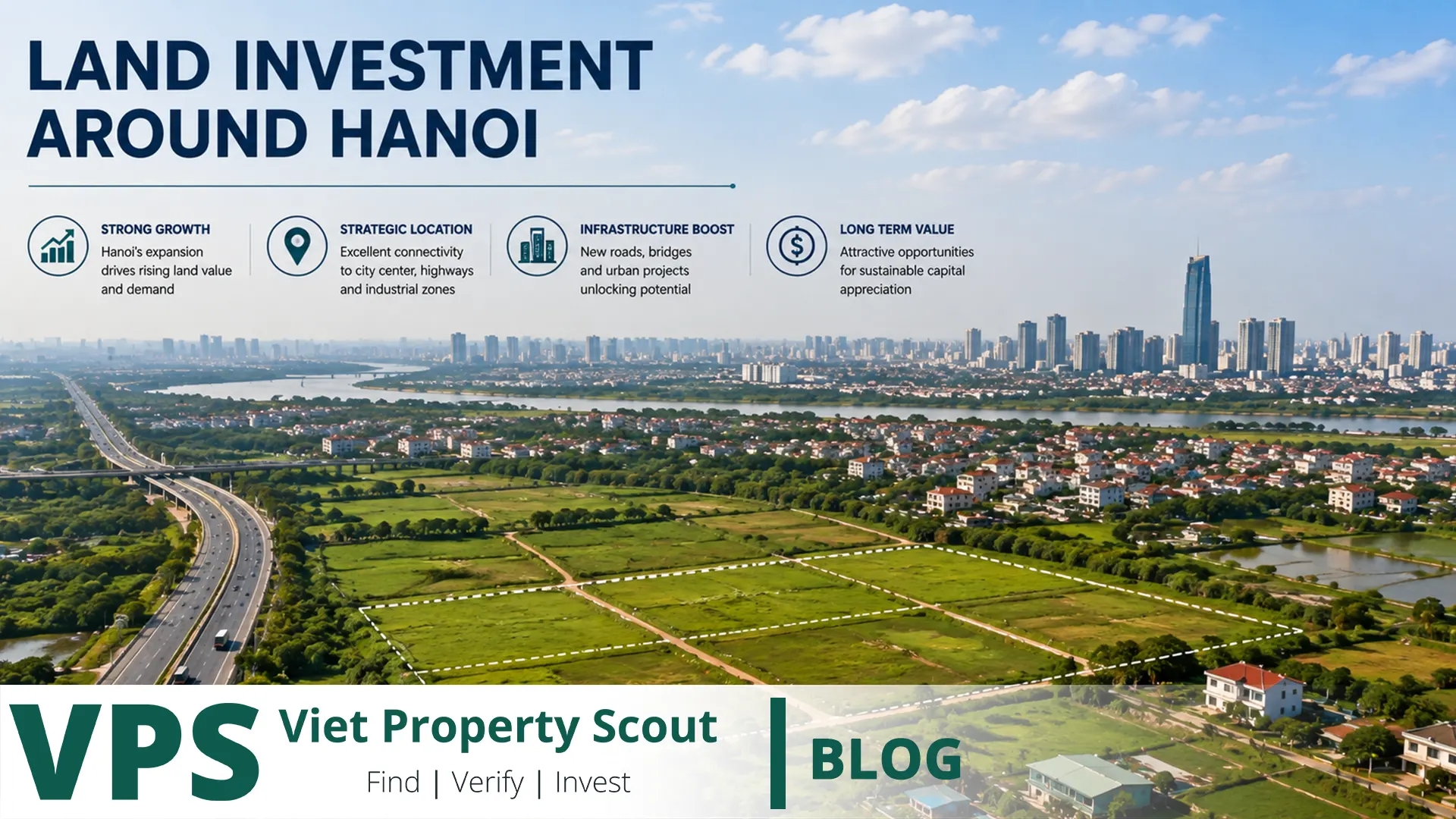
Short answer: Land around Hanoi can benefit from the capital's transition toward a multi-polar, multi-centre development model, including growth around Hòa Lạc, Sơn Tây, Xuân Mai, the northern Đông Anh - Mê Linh - Sóc Sơn corridor, Ring Road 4 and new road, rail, logistics and industrial infrastructure. But buying a parcel simply because a future road or metro appears on a planning map is not a sound investment strategy. Sustainable land value is more likely to emerge when infrastructure becomes usable access and is followed by real residents, jobs, schools, retail and services. Major risks include buying agricultural land based on an assumed residential conversion, paying today's price for infrastructure that remains only planned, acquiring land inside a future road or compulsory-acquisition corridor, ignoring drainage and flood exposure, and accepting unclear land-use rights. Foreign investors face an additional distinction: owning qualifying housing is different from directly acquiring a standalone vacant or residential land-use-right parcel. An ordinary foreign individual should not assume they can buy such land in the same way as a Vietnamese individual.
Is the old “five satellite cities” model still enough to understand Hanoi?
Earlier Hanoi planning became widely associated with five satellite cities: Hòa Lạc, Sơn Tây, Xuân Mai, Sóc Sơn and Phú Xuyên. That framework remains useful for understanding the capital's expansion history, but it is no longer the complete way to read the market in 2026. Hanoi's comprehensive master plan approved in May 2026 is explicitly multi-polar, multi-centre and multidirectional, with nine growth poles or corridors and new multi-purpose urban areas to be distributed along major transport corridors and public-transit hubs.
For a land investor, this matters because “satellite city” is not itself an investment thesis. The economic function of each corridor is more important: technology and education in Hòa Lạc, airport logistics in the north, university and gateway services in Xuân Mai, heritage and regional services in Sơn Tây, housing expansion along ring-road corridors, and industry/logistics in Phú Xuyên.
Major land-investment corridors around Hanoi
| Corridor | Potential demand engine | What may support land value? | Main risk |
|---|---|---|---|
| Hòa Lạc | Technology, R&D, universities, innovation and health | Hòa Lạc Hi-Tech Park, Đại lộ Thăng Long and new research/education investment | Pricing every nearby parcel as if technology employment has already fully arrived |
| Sơn Tây | Regional housing, heritage, tourism and services | Connections with Hòa Lạc, QL21 and QL32 | Overestimating spillover from Hòa Lạc |
| Xuân Mai | Education, services and the southwest gateway | QL21, university functions and planned urban expansion | Ecological, drainage, flood and restricted land-use areas |
| Đông Anh - Mê Linh - Sóc Sơn | Airport economy, logistics, free trade, industry and services | Nội Bài, Ring Road 4, bridges and new regional corridors | Fully pricing long-term airport or logistics concepts before execution |
| Hoài Đức - Đan Phượng / northwest corridor | Residential expansion and western connectivity | Ring Road 4 and West Thăng Long | Large substitutable land supply and prices rising before amenities arrive |
| Phú Xuyên | Logistics, industry and multimodal freight | Industrial parks, inland port, QL1A and rail | Confusing residential, industrial and agricultural land |
Hòa Lạc: the strongest western growth story, but buy the economy rather than the rumour
The 2026 comprehensive plan positions Hòa Lạc as a western urban pole focused on science, technology, innovation, education and health, with Hòa Lạc Hi-Tech Park at the core of Hanoi's innovation ecosystem. Current 2026 investment initiatives also target semiconductors, software, artificial intelligence and related research capacity around Hòa Lạc.
This gives Hòa Lạc one of the clearest long-term economic stories in Hanoi's peripheral land market. But the quality of a parcel still depends on its real position within the road, employment and residential network. “Near Hòa Lạc” can mean ten minutes from a university campus and employment zone, or it can mean an isolated rural parcel reached by narrow local roads.
Investors should measure actual employment, occupied educational and service facilities, and real travel time to Đại lộ Thăng Long and established residential centres rather than relying on a broad location label.
Sơn Tây: a different market from Hòa Lạc
Sơn Tây has its own heritage, tourism, regional-service and residential logic. It may benefit from improvements to QL21 and stronger Sơn Tây - Hòa Lạc - Xuân Mai connectivity, but it should not be valued as if every Hòa Lạc technology worker will naturally live there.
The more defensible land investment usually has clear legal use, existing settlement, road access and nearby daily services. Very cheap peripheral land can remain cheap for years even if Sơn Tây appears prominently in strategic planning.
Xuân Mai: university and gateway growth, but not all land is developable
Xuân Mai has long been positioned as a university, service and southwest-gateway urban area. Earlier subdivision plans differentiated between existing/new urban development zones and areas intended for restricted construction, village and landscape conservation, water management and flood drainage.
That distinction is critical. A parcel being “in Xuân Mai” does not make it residential development land. Investors need the land-use function of the exact parcel, not the broad colour of a marketing map.
Đông Anh - Mê Linh - Sóc Sơn: an airport and logistics corridor, not simply a suburb
Hanoi's 2026 investment direction prioritises the Nội Bài - Đông Anh - Sóc Sơn - Mê Linh area for aviation logistics, airport-linked economic activity, free-trade concepts, industry and services. This makes northern Hanoi one of the capital's most important expansion directions.
But an “airport corridor” is not automatically a premium residential zone in every direction. Airport and logistics infrastructure requires land for roads, safety areas, warehousing, industry and heavy transport. A parcel may benefit from regional access while becoming less attractive for housing because of truck traffic, noise or acquisition risk.
Hoài Đức and Đan Phượng: Ring Road 4 changes access but does not guarantee appreciation
Western and northwestern land markets receive substantial attention because Ring Road 4 and West Thăng Long can improve regional connectivity and reduce the need to cross the historic centre. This can support new employment and residential clusters.
However, a ring road creates mobility, not a complete neighbourhood by itself. Schools, hospitals, drainage, local roads, retail and real population growth still determine whether a land market becomes genuinely urban rather than purely speculative.
Phú Xuyên: a logistics and industrial thesis rather than a second west-Hanoi story
Southern Hanoi is positioning Phú Xuyên more strongly around logistics, high-tech industry and multimodal freight. The city's current investment pipeline includes the proposed Bắc Phú Xuyên Industrial Park, expected at roughly 215 hectares for 2026-2030, and the proposed Vạn Điểm - Phú Xuyên inland port with planned capacity of approximately two million tonnes per year.
Those projects can create jobs and support housing and services, but the residential implications are highly location-specific. Land beside truck yards, warehouses or heavy logistics does not necessarily receive the same benefit as land in a liveable nearby residential catchment.
Use four infrastructure-confidence levels
| Status | How an investor should treat it |
|---|---|
| Operational | Real travel times and usage can be measured today |
| Physically under construction | Completion can be modelled with delay and execution risk |
| Approved / in investment procedures | Potential upside, but do not prepay the full future benefit |
| Planned / long-dated | Optionality only; it should not be the sole reason to buy |
Ring Road 4: real and advanced, but not yet a fully completed operating ring road
By the end of 2025, land clearance across Hanoi, Bắc Ninh and Hưng Yên had effectively been completed. Official updates during the first half of 2026 showed the parallel-road components well advanced, with Hanoi targeting completion of its parallel-road section in September 2026.
This is meaningful physical progress. It still does not justify marketing every nearby parcel as if the entire Ring Road 4 system is already operating at its final capacity. The relevant questions are where the real interchange is, whether the parcel has practical access to it, and whether local roads can handle the new connectivity.
QL21: Sơn Tây - Hòa Lạc - Xuân Mai remains a 2026-2030 investment project
Hanoi's official investment platform lists the upgrade of National Highway 21 between Sơn Tây, Hòa Lạc and Xuân Mai with a proposed 2026-2030 implementation schedule, preliminary investment of approximately VND 26.087 trillion and a PPP structure. Its objective is to strengthen a major western corridor and improve connections with Đại lộ Thăng Long, QL32 and other roads.
That is a serious infrastructure signal, but land should be valued according to the project's current stage rather than as if the final widened corridor were already operational.
Urban rail to the west: strategically important but long-dated
Hanoi's current planned urban-rail network includes Line 8 from Hòa Lạc through Sơn Đồng, Mai Dịch, Ring Road 3, Lĩnh Nam and Dương Xá toward Gia Bình, with a planned total length of about 94 km. Its implementation is divided between 2026-2035 and 2036-2045. Some other Hòa Lạc-related rail links sit even further out in the planning horizon.
The correct investment conclusion is not “buy land now because the metro is coming.” It is to determine whether the route, station, funding and timetable are sufficiently concrete to affect land use during your own investment horizon.
The biggest land-investment mistake: buying a future land-use conversion
Vietnam operates a land-use-right system in which each parcel has a defined legal purpose, such as residential, agricultural, commercial/service or industrial use. Cheap agricultural land is not simply discounted residential land. A change of use requires consistency with planning, approval, procedure and applicable financial obligations.
If an investment only works financially when agricultural land is later converted to residential use, the investor is effectively buying regulatory speculation. That risk should be priced explicitly.
Being directly on an infrastructure route can reduce value
“The road will pass here” is not always positive. A parcel inside a planned road reserve, public project or compulsory-acquisition area may lose some or all of its usable land under the applicable acquisition and compensation process.
Functional proximity to a future interchange while remaining outside acquisition and technical corridors is often more valuable than being the parcel closest to the line on a map.
Flooding, drainage and elevation need to be priced
Hanoi's new comprehensive planning gives explicit priority to climate adaptation, flood management, water systems, river protection and green buffers. Peripheral land differs materially in elevation and drainage.
Check flood history, the height of the road relative to the parcel, canals and drainage channels, protected water corridors and whether proposed filling is legally and technically possible. A dry-season site visit can conceal material wet-season risk.
Foreign investors: land is legally different from qualifying housing
Vietnam's current Land Law specifies categories of land users and ways land-use rights may be received. An ordinary foreign individual is not simply treated like a domestic individual who can acquire a standalone residential or vacant land-use-right parcel. Different rules apply to persons of Vietnamese origin residing abroad, foreign-invested economic organisations and approved investment projects.
Using a Vietnamese friend or partner as an informal nominee is not equivalent to having a registered property right in the investor's own name. If a foreign investment requires a corporate or licensed-project structure, it should be assessed as a regulated business investment rather than disguised as a simple personal land purchase.
Legal and technical due-diligence checklist
- Verify the original land-use-right certificate and registered holder.
- Match certified area and boundaries to actual survey conditions.
- Check the current legal purpose of every part of the parcel.
- Confirm the land-use term where applicable.
- Obtain current official planning and land-use information.
- Check road, bridge, rail and utility reserves.
- Check any announced acquisition or public project affecting the parcel.
- Verify mortgages, disputes, enforcement and other restrictions.
- Confirm legal access to a public road rather than an informal path.
- Check subdivision rules and minimum parcel size if the strategy relies on splitting.
- Inspect elevation, drainage and flood history.
- Verify electricity, water, sewerage and telecommunications in reality.
- Compare completed transactions in the same micro-location rather than broad online asking prices.
- Include tax, fees, brokerage, financing and holding cost.
- Identify the natural resale buyer before purchase.
How should land returns be calculated?
Vacant land often produces no operating cash flow, so the return must come from capital appreciation after acquisition, sale, taxes, fees, financing and opportunity cost. Selling a parcel for a nominally higher price five years later does not automatically mean the investment produced an attractive return.
The longer the investor waits for a road, metro or land-use change, the more appreciation is required to compensate for the absence of income and the capital tied up.
Land stress test
| Scenario | Assumption | Question |
|---|---|---|
| Base | Infrastructure advances on a reasonable schedule | Does the parcel have use value before completion? |
| Five-year delay | Road or rail is delayed | Can the capital remain tied up? |
| No conversion | Land remains in its current category | Is today's price still rational? |
| Partial acquisition | Part of the site is taken for infrastructure | Is the remaining land functional? |
| Flat market | No price growth for three years | Is there another economic reason to hold? |
| Fast exit | Sale required within six months | Is there real liquidity without a major discount? |
Common red flags
- “The metro is coming, so prices will double” without a confirmed station or schedule.
- Agricultural land marketed as guaranteed future residential land.
- An old planning screenshot is used instead of current official information.
- Prices rise mainly through speculative resale between investors.
- The parcel sits inside a road or acquisition corridor.
- No clear legal road access.
- No meaningful residents, schools, retail or employment nearby.
- Flood risk is ignored because the inspection took place in the dry season.
- A foreign investor relies on informal local nominee ownership.
- “Hòa Lạc” or “Ring Road 4” is used as a substitute for exact parcel analysis.
Which corridor fits which strategy?
| Investor objective | Often logical corridor | Reason |
|---|---|---|
| Technology and education-led growth | Hòa Lạc | Strong institutional employment engine in western Hanoi |
| More conservative growth around an existing town | Sơn Tây | Existing population and service base |
| University and gateway services | Xuân Mai | Clear education and regional function |
| Airport and logistics | Đông Anh - Mê Linh - Sóc Sơn | Nội Bài and regional transport |
| Ring-road residential expansion | Hoài Đức - Đan Phượng | Ring Road 4 and western radial connectivity |
| Southern industry and logistics | Phú Xuyên | Industrial, port, road and rail infrastructure |
Frequently asked questions
What is the best area for land investment around Hanoi?
There is no single best area. Hòa Lạc has the strongest technology-and-education thesis, the north has airport and logistics exposure, Hoài Đức - Đan Phượng is tied more closely to residential expansion and Ring Road 4, while Phú Xuyên has a more industrial-logistics profile.
Will every parcel near Ring Road 4 appreciate?
No. Interchange access, legal land use, utilities, local services and genuine end-user demand matter more than simple distance to the road.
Is buying agricultural land for later conversion a good strategy?
It can be highly speculative. Conversion is not automatic and depends on planning, eligibility, procedures and financial obligations.
Is a planned metro enough reason to buy land?
No. Route, station location, funding, construction phase and realistic delivery horizon all matter. Some western rail plans extend well beyond 2035.
Can a foreign individual buy a standalone land parcel in Hanoi?
An ordinary foreign individual should not assume they can acquire standalone land-use rights in the same way as a Vietnamese citizen. Qualifying housing ownership, overseas Vietnamese status and foreign-invested economic organisations operate under different frameworks.
What should be checked before paying a deposit?
No single document is enough. The land certificate, current planning and land-use information, mortgages and disputes, project reserves and physical boundaries all need to be checked together.
Conclusion: buy access, legal use and demand, not the planning map alone
Hanoi's expansion around Hòa Lạc, Sơn Tây, Xuân Mai, the northern airport corridor, Ring Road 4 and Phú Xuyên creates real long-term opportunities. The 2026 comprehensive master plan confirms a multi-polar and multi-centre direction in which technology, logistics, education and transport will redistribute jobs and population.
A parcel does not become valuable merely because it sits inside a large strategic planning area. Find | Verify | Invest means: find the correct growth corridor, verify the exact parcel and the actual stage of every infrastructure project, and invest only when the land still makes sense if a road or metro is delayed and the hoped-for land-use conversion never occurs.