
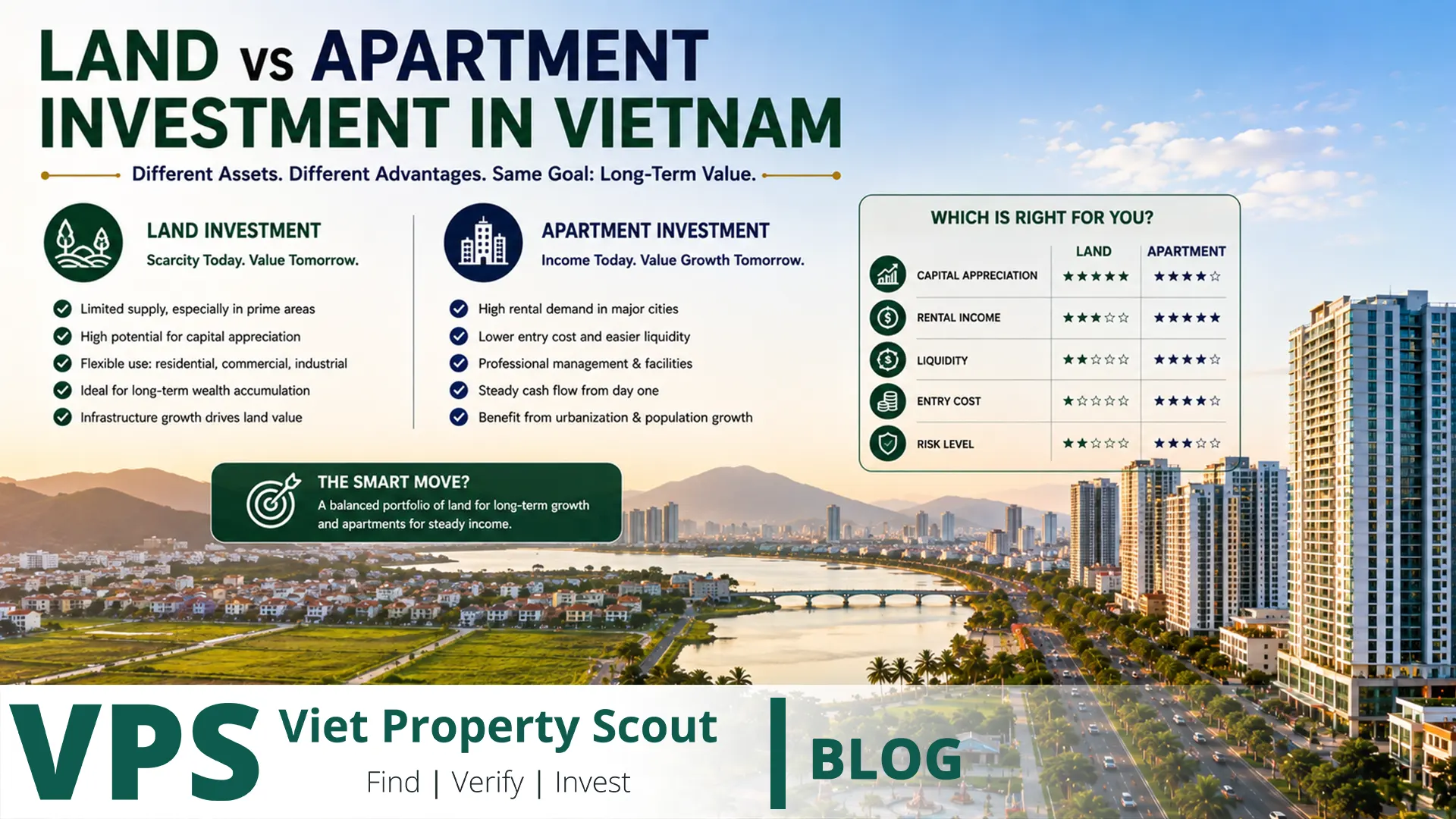
Short answer: there is no defensible rule that land always delivers better returns than apartments in Vietnam. Land, more precisely a land-use-right investment where legally available to the buyer, can generate substantial capital appreciation when infrastructure, employment and urbanisation genuinely transform an area. It also carries much higher planning, land-use, access, legal-structure, liquidity and holding-period risk. An apartment is normally easier to value, can produce rental income during the holding period and has more observable comparable transactions, but the investor assumes developer, building, management, maintenance, future-supply and entry-price risk. This distinction matters especially in 2026 because Vietnam's property market has become more selective. Ministry of Construction data for Q2 2026 recorded roughly 100,005 successful property transactions nationwide, materially below both the previous quarter and the same quarter of 2025. Land-plot transactions contracted more sharply than apartment and individual-house transactions. Neither “land never falls” nor “apartments are always liquid” should therefore be treated as an investment principle.
First principle: buying “land” in Vietnam is not the same as buying Western-style freehold land
Vietnam's land system is based on land belonging to the entire people with the State acting as representative owner and manager. Eligible users hold land-use rights under the legal framework. Investors should therefore distinguish the ownership of a house or apartment from the legal rights relating to the underlying land.
This distinction is crucial for a foreign individual. Vietnam's housing framework permits qualifying foreign organisations and individuals to own eligible housing in permitted commercial housing projects, subject to defence, security and quantitative restrictions. An ordinary foreign individual should not assume that this creates the same route to acquire a standalone land-use right that is available to an eligible Vietnamese citizen. Buying through a local nominee is not a safe workaround: control, inheritance, enforcement and beneficial-ownership assumptions can fail precisely when a dispute occurs.
Land versus apartment: direct investment comparison
| Factor | Land / land-use-right asset | Apartment |
|---|---|---|
| Income during holding period | Often little or none for raw land | Can generate monthly rent |
| Capital-appreciation potential | Can be high if an area genuinely transforms | Driven by location, project quality and end-user demand |
| Ease of valuation | Harder because each parcel differs | Usually more comparable units |
| Planning risk | Very high | Lower for a completed legally clean project |
| Liquidity | Can disappear quickly in a weak market | Often better in buildings with natural buyer demand |
| Day-to-day management | Low | Medium due to tenant and building issues |
| Technical risk | Boundary, road, drainage, terrain and access | Construction, lifts, fire safety, management and façade |
| Foreign-buyer accessibility | Highly restricted/complex for an ordinary foreign individual | Clearer route in qualifying housing projects within quota |
Why is land so attractive to Vietnamese investors?
Land has a powerful cultural and financial reputation as a store of value. Good locations are finite, the parcel itself does not have an ageing lift or façade, and prices can re-rate sharply when a previously peripheral area gains roads, jobs, schools and permanent residents.
The weakness of that argument appears when the investor pays today for several future events simultaneously. If today's price assumes that a road, bridge, metro, industrial park, residential rezoning and higher development density will all arrive on schedule, much of the future upside may already be embedded in the purchase price.
When can land genuinely generate attractive returns?
- The current land-use purpose and transferability are legally clear.
- The parcel has documented legal access rather than only informal physical access.
- The relevant infrastructure is operational or physically under construction.
- Jobs, residents and services are growing, not merely asking prices.
- The investment does not require an uncertain change of land use.
- The entry price still discounts execution and timing risk.
- A natural future buyer can be identified.
The biggest land mistake: treating a master plan as parcel-level development entitlement
A general plan shows the direction in which a city or province intends to develop. It does not mean that every parcel shown inside a future urban corridor automatically has the building density, residential classification or road access assumed by the buyer. Detailed zoning, current land use, boundaries, road reservations, public projects, setbacks and permitted construction must be checked separately.
Vietnam approved an adjustment to the national land-use plan for 2021-2030 with a vision to 2050 in June 2026. The revised framework prioritises infrastructure, industry, services and urban development while continuing to protect important agricultural and forest categories. For an investor, the lesson is that land allocation remains an active planning process. “This area will become urban” is not a substitute for parcel-specific documentation.
Core legal checks for a land investment
- Verify the land-use-right certificate and legal origin.
- Match actual area and boundaries against cadastral records.
- Check mortgages, attachments and disputes.
- Verify land-use purpose and remaining duration where relevant.
- Check detailed planning, road corridors and public-acquisition plans.
- Confirm legally registered access.
- Never assume a change of land-use purpose will be approved.
- Identify spouses, heirs and all co-right-holders.
- Check taxes and outstanding financial obligations.
- Do not pay today for an undocumented future entitlement.
Liquidity risk: land can rise quickly and then become difficult to sell
Land tends to be especially sensitive to credit conditions and speculative sentiment. In a strong cycle, plots can trade quickly between investors. When credit tightens or sentiment weakens, speculative buyers can disappear faster than owner-occupiers because raw land usually provides little or no income while the owner waits.
Vietnam's Q2 2026 data illustrate this clearly. Approximately 73,438 successful land-plot transactions were reported nationwide, equivalent to only about 67.4% of Q1 2026 volume and 59.9% of the same quarter in 2025. This does not prove that every parcel lost value. It does prove that “land is always liquid” is false.
Apartments: why are they usually easier to underwrite?
An apartment normally has more comparable evidence. Investors can compare units within the same building and competing developments by size, floor, orientation, view, furnishing and condition. Achieved rents, vacancy, service charges, building management and resale listings can also be observed.
That does not make apartments low-risk. A buyer who pays a large new-launch premium over completed competing buildings may need several years of market growth merely to justify the entry price. A project can also lose tenant preference when thousands of newer competing units are delivered nearby.
The apartment market also requires greater discipline in 2026
Nationwide, approximately 26,567 successful transactions involving apartments and individual houses were recorded in Q2 2026. That was about 86.1% of the previous quarter and 77.1% of the same period in 2025. Reported developer inventory included 12,823 unsold apartments, up about 22.2% quarter-on-quarter.
Hanoi alone recorded more than 5,800 condominium sales in Q2 2026, but sales represented only about 68% of new supply launched during the quarter, materially below the frequent 90%+ absorption rates seen in 2024-2025. The secondary market also recorded its first downward price adjustment since late 2022. Buying an apartment simply because a developer is famous or because the market rose in the past is therefore no longer a sufficient strategy.
An apartment offers something raw land often cannot: operating income
A well-selected apartment can produce rent while the investor waits for longer-term capital growth. Depending on location and legal use, the tenant may be a professional, family, student, corporate employee or other legitimate residential user. Rental income does not guarantee a good investment, but it reduces complete dependence on appreciation.
Raw land with no operating use often provides no equivalent income. The investor still bears opportunity cost and possibly finance, tax or maintenance expenses. For that reason, the correct comparison is total return, not appreciation alone.
Illustration: land can appreciate more yet produce a weaker total result than it appears
Illustrative example only: an investor places VND 5 billion into a land asset that generates no income and sells it five years later for VND 7 billion. The nominal gain is VND 2 billion, or 40% over five years before transaction costs, not 40% per year. Another investor buys a VND 5 billion apartment that rises only to VND 6.2 billion over the same period but generates an average VND 220 million of net annual rental income. Five years of operating income totals about VND 1.1 billion, plus VND 1.2 billion of capital appreciation. Before sale costs and financing, the combined economic gain is about VND 2.3 billion. The example shows why headline appreciation alone is incomplete.
But apartments physically age; raw land does not have an ageing lift
This is one of the strongest arguments in favour of land. An apartment building requires lifts, waterproofing, façade work, fire-safety systems, pumps, generators, parking systems and periodic capital expenditure. If management is poor, tenants and future buyers may migrate to newer competing projects.
An apartment investor should therefore underwrite the building, not just the unit. Review maintenance reserves, management fees, owner governance, developer after-sales performance, fire safety, lifts, parking, common areas and likely medium-term capital expenditure.
Developer risk versus parcel risk
| Risk | Land | Apartment |
|---|---|---|
| Developer dependence | Lower for a legally independent completed parcel | Material for off-plan purchase |
| Handover delay | Usually not relevant | Important for new projects |
| Planning risk | Very high | More concentrated within the project |
| Physical ageing | Low for the land itself | Increases with building age |
| Rental income | Usually weak for raw land | Clear advantage |
| Comparable evidence | Weaker | Usually stronger |
Buying a new apartment: do not confuse a payment plan with a cheap price
Vietnam's current Real Estate Business Law imposes controls on payments for future-formed housing and construction products. For such transactions, the first payment is generally capped at 30% of contract value including the deposit, with further cumulative limits before handover.
A long payment schedule, interest subsidy, furniture package or rental guarantee can improve financing convenience, but none proves that the underlying apartment is attractively priced. Convert every incentive into cash value and compare the effective delivered price with completed competitors.
Which asset is more liquid?
There is no national answer. A practical two-bedroom apartment in a completed project near jobs and schools may be far more liquid than a speculative plot requiring five years of infrastructure. Conversely, legally clean residential land in a mature neighbourhood may be more liquid than an overpriced luxury condominium with hundreds of identical units.
The best liquidity test is simple: if you had to sell within six months, who would buy from you and why? If the only answer is “another investor expecting the price to rise,” liquidity is fragile. If an end-user family or rental investor can independently justify the asset, demand is deeper.
How the thesis changes by major market
| Market | Land thesis | Apartment thesis |
|---|---|---|
| Hanoi | Ring Road 4, Hòa Lạc, eastern and northern growth, but planning and timing matter | Strong family and professional demand, offset by elevated prices and new supply |
| Ho Chi Minh City | Broader industrial, logistics and residential corridors after the 2025 merger | Strong corporate demand, but the enlarged city must be segmented carefully |
| Da Nang | Urban, tourism and logistics expansion across a much larger post-merger geography | Deeper new-condominium cycle plus urban/coastal rental demand |
| Nha Trang / Khánh Hòa | Tourism and expansion themes with substantial planning and use-classification risk | Residential and tourism demand in specific locations; product classification is critical |
Vietnamese and foreign investors do not start from the same legal position
For an eligible Vietnamese buyer, land can be a natural portfolio asset once title, planning and access are verified. For an ordinary foreign individual, the analysis is fundamentally different because qualifying residential housing provides a clearer ownership route than standalone land-use rights.
Eligible foreigners can own housing in permitted commercial housing projects within statutory limits. For residential apartment buildings, the general foreign-ownership cap is up to 30% of residential-purpose apartments in the relevant building or block, with separate restrictions for individual houses and defence/security areas.
A foreign investor should therefore ask one question before comparing return projections: can I legally hold and enforce the exact right I think I am buying?
When can land be better than an apartment?
- The buyer is legally eligible to hold the relevant right.
- Title, land use, planning and access are clean.
- The investor can hold for years without rental income.
- Urbanisation is being purchased before it is fully priced in.
- The infrastructure catalyst is real, not a rumour.
- The exit buyer is identifiable.
- The return does not require speculative rezoning.
When can an apartment be better than land?
- The investor wants income during the holding period.
- Greater comparability and resale depth are important.
- The buyer is foreign and requires a clearer legal ownership pathway.
- There is genuine rental demand from jobs, schools or transport.
- Developer and handover risks are controlled.
- The acquisition price is rational against completed competitors.
- Building management and service charges are sustainable.
Land stress test
| Scenario | Question |
|---|---|
| Road delayed five years | Is the parcel still worth holding? |
| Rezoning never occurs | Does the investment work under current land use? |
| Liquidity disappears for 12 months | Can the investor hold without income? |
| Part of the parcel enters a public project | Are acquisition and compensation risks understood? |
| Prices stay flat for five years | What is the opportunity cost? |
Apartment stress test
| Scenario | Question |
|---|---|
| Rent falls 15% | Does net yield remain acceptable? |
| Two extra vacancy months | Can cash flow absorb it? |
| 1,000 competing units are delivered | Why should a tenant choose this building? |
| Management fees rise 20% | Does net income remain attractive? |
| Secondary prices stay flat for three years | Does the investment work from rent alone? |
Land due-diligence checklist
- Verify the land-use-right certificate.
- Verify the right-holder and all co-right-holders.
- Confirm physical boundaries and measured area.
- Check land-use purpose and duration.
- Review general and detailed planning.
- Check road reservations, recovery and compensation risk.
- Confirm legal access.
- Check mortgages, disputes and attachments.
- Never assume future conversion approval.
- Identify the natural exit buyer.
Apartment due-diligence checklist
- Verify project and unit legal status.
- Review the developer and delivery record.
- Compare pricing with completed buildings.
- Check certificate status or issuance pathway.
- Review building management and service charges.
- Inspect fire safety, lifts and parking.
- Obtain evidence of achieved rent.
- Map competing supply for the next three to five years.
- If foreign, verify project eligibility and remaining quota.
- Identify the natural resale buyer.
Red flags
- “Land never loses value.”
- Buying because a bridge or road is “definitely coming.”
- Treating a master plan as parcel-level building permission.
- Buying agricultural land based on an undocumented residential-conversion promise.
- Using a nominee structure to bypass foreign-buyer restrictions.
- Buying an apartment only because the developer is famous.
- Accepting a launch price without comparison with completed stock.
- Ignoring hundreds of identical competing units.
- Using gross rather than net yield.
- Failing to identify the future exit buyer.
Frequently asked questions
Does land offer higher returns than apartments in Vietnam?
It can during a strong urbanisation cycle, but it is more dependent on planning, timing and liquidity. An apartment can deliver a superior risk-adjusted total return once rental income is included.
Which is more liquid?
It depends on the asset. A practical apartment in a functioning submarket can be much more liquid than speculative peripheral land. Mature legally clean residential land can be more liquid than an overpriced luxury condo.
Which is more suitable for a foreign investor?
In most cases, a qualifying residential apartment in an eligible project provides the clearer legal ownership route. Project eligibility and foreign quota should be verified before deposit.
Does a ring road, bridge or metro guarantee land appreciation?
No. Real access, economic activity, population, services and actual infrastructure delivery all matter. Proximity to a line on a planning map is not sufficient.
Does an apartment always generate rent?
No. An overpriced, poorly managed or badly located apartment can remain vacant or require major rent discounts.
Can land and apartments be combined in one portfolio?
Yes. Apartments can provide income and greater ongoing liquidity, while land can provide longer-horizon growth exposure, provided the investor is legally eligible and can tolerate the holding period.
Conclusion: land is a bet on transformation; an apartment is a bet on use
Land in Vietnam can create substantial wealth when a legally clear right is acquired at a sensible price before genuine economic transformation is fully reflected. It can also punish investors who overpay for planning rumours, future infrastructure or uncertain conversion. Apartments are easier to measure, rent and compare but require discipline on acquisition price, developer, building quality, management and competing supply.
Find | Verify | Invest means: find the real source of value, verify legal rights, planning, liquidity, income and the future buyer, and invest only if the transaction still works without assuming perfect infrastructure timing or automatic price appreciation. The best land is not simply the cheapest parcel, and the best apartment is not the newest building; the best asset is the one with a clear economic reason to be held and genuine demand when it is time to exit.